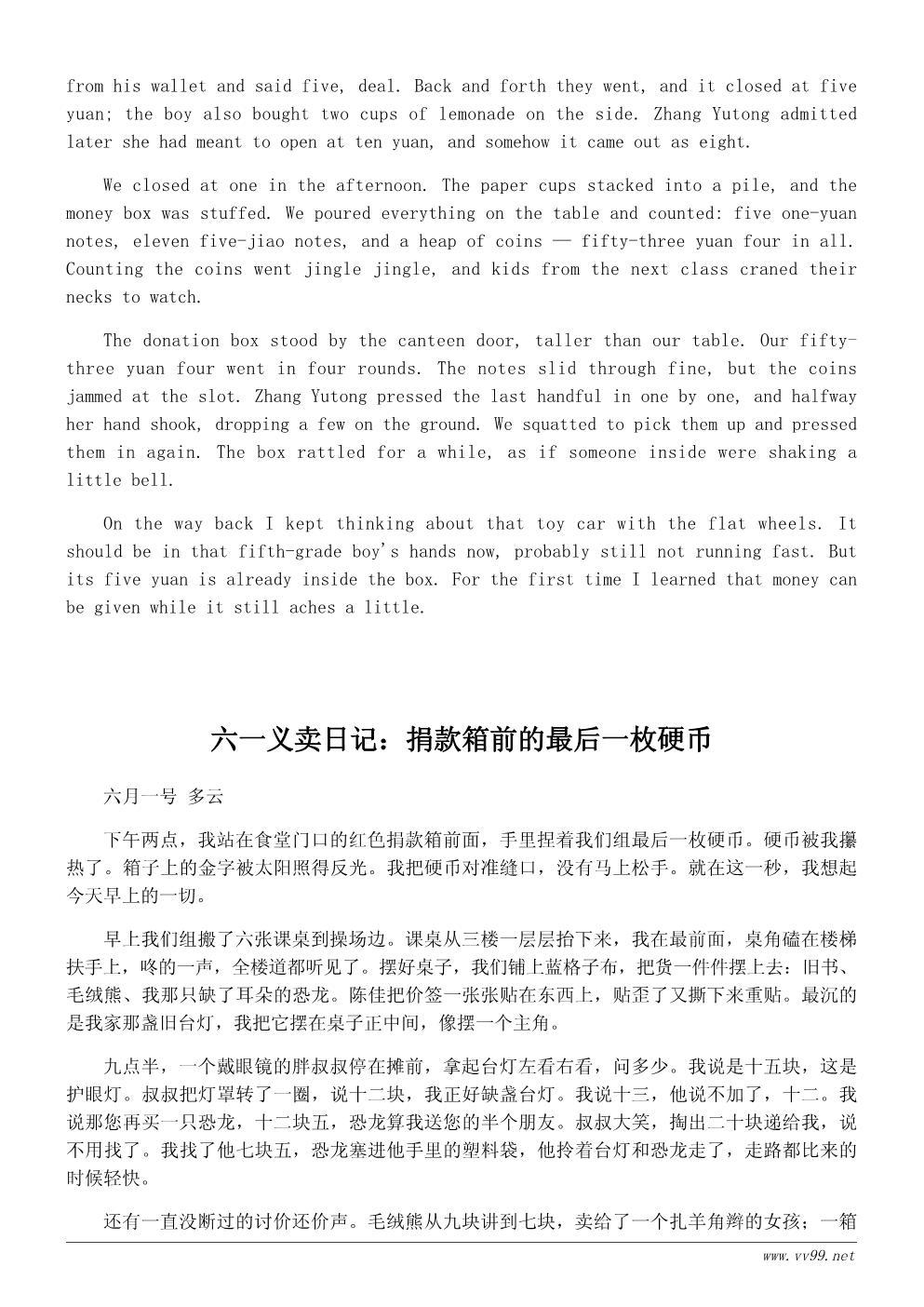
文章内容
六一义卖日记:三块二买走的童话
六月一号 晴
今天早上六点,我就被妈妈叫醒了。操场边的义卖摊位七点才开始摆,我们小组约好六点半到。我抱着攒了两年的旧书和一只洗干净的灰兔子玩偶,挤在爸爸电动车的后座上,书角把书包撑得鼓鼓的。
到了地方先布置摊位。我们借了教室里的旧窗帘铺在地上当摊布,四个角用砖头压住。李小满把硬纸板牌子立在中间,上面用马克笔写着爱心义卖,买什么都送一句祝福。我把书按高矮排成三排,灰兔子摆在最上面,又用胶带在地上贴了一条线,规定顾客不许踩进线里。忙到七点二十,摊子总算像个样子了。
八点多,生意来了。一个小个子一年级男生蹲在摊前,拿起那本《安徒生童话》,问多少钱。我说是五块。他翻开书看了看,又从口袋里摸出一把硬币,数了半天,抬起头说:三块二,我只有这些。我说五块不能少,这是我最喜欢的书。他妈妈走过来,看了看书,说孩子攒了很久的零花钱,你们自己商量个价吧。我想了想,说那就三块二,我再送你一句祝福。他问什么祝福。我说,祝你以后买得起所有想买的书。男生笑了,把硬币一枚一枚摆在摊布上。我数了两遍,一块的三枚,一角的二枚,正好三块二。
一上午我们卖了十七笔。中午收摊,我把钱摊在摊布上数:纸币加起来三十一块,硬币七块六,一共三十八块六。李小满拿本子记下来,那个数字写得特别大。
最难忘的是捐款箱。礼堂门口摆着一只红色的箱子,正面贴着一个金色的大字,捐。我把三十八块六分成两沓,纸币从窄缝里塞进去,硬币有点多,塞了两次。箱子吞钱的时候发出很轻的哗啦声,像下了一小阵雨。旁边有老师给我们拍照,我手里还捏着最后两枚硬币,忘了放下。
回教室的路上,李小满说他今天挣到了人生第一桶金。我兜里一分钱没有,可我觉得比谁都富。那本童话书空出来的位置,我打算下周再摆上新的书。原来把东西卖出去、再把钱交出去,是这么痛快的一件事。
Children's Day Bazaar Diary: The Fairy Tale Sold for Three Yuan Two
June 1st. Sunny.
Mom woke me up at six this morning. The bazaar booths by the sports field would not open until seven, but our group had agreed to meet at six thirty. I carried two years of old books and a washed gray rabbit doll, squeezed onto the back seat of Dad's electric bike, the corners of the books pushing my schoolbag out round.
First we set up the booth. We borrowed an old classroom curtain and spread it on the ground as our cloth, holding the four corners down with bricks. Li Xiaoman stood a cardboard sign in the middle, marker writing on it: charity bazaar, buy anything and get a blessing free. I lined the books up in three rows by height, put the gray rabbit on top, and taped a line on the ground so customers would not step inside. By seven twenty the booth finally looked like something.
A little past eight, business came. A small first-grade boy squatted in front of the booth, picked up the copy of Andersen's Fairy Tales, and asked the price. I said five yuan. He flipped through it, then fished a handful of coins from his pocket, counted them for a long time, and looked up: three yuan two, that's all I have. I said five is the lowest, this is my favorite book. His mother came over, looked at the book, and said the boy had saved his pocket money for a long time, so we should work out a price ourselves. I thought for a moment and said then three yuan two, and I will throw in a blessing. He asked what blessing. I said, may you afford every book you ever want to buy. The boy smiled and laid the coins on the cloth one by one. I counted twice: three one-yuan coins, two one-jiao coins, exactly three yuan two.
We made seventeen sales in the morning. At noon we closed up, and I spread the money on the cloth to count: thirty-one yuan in notes, seven yuan six in coins, thirty-eight yuan six in all. Li Xiaoman wrote it in his notebook, the number extra large.
What I will remember most is the donation box. A red box stood at the auditorium door with a big golden character on the front: donate. I split our thirty-eight yuan six into two stacks, pushed the notes through the narrow slot, and the coins took two tries. The box swallowed the money with a soft rustle, like a short rain. A teacher took our photo while I still held the last two coins, forgetting to put them down.
On the way back to the classroom, Li Xiaoman said he had earned his first bucket of gold in life. My pocket had not a cent left, yet I felt richer than anyone. The gap the fairy tale book left, I plan to fill with new books next week. So this is what it feels like to sell a thing and then give the money away — pure joy.
六一义卖日记:柠檬水摊上的讨价还价
六月一号 晴转多云
早上六点半,我们小组四个人在操场东角碰头。我们的摊位是一排旧课桌拼起来的,先擦桌子,再铺报纸,最后挂招牌。招牌是我昨晚画的,一张红纸,上面写着爱心义卖小铺,旁边画了一只歪歪的存钱罐。张雨桐把她家做的柠檬水搬来三桶,我用绳子把三个气球拴在桌腿上,风一吹,气球就撞桌子,砰砰响。
七点整开卖。我们的柠檬水五角一杯,纸杯是一毛钱一个的批发货。第一杯卖给了隔壁摊的王朵朵,她连喝两杯,第二杯非要给一块,说不用找。一上午光柠檬水就卖出去四十六杯。
讨价还价最凶的是那个五年级的男生。他拿起张雨桐的旧玩具车,问价。张雨桐说八块。他把车翻过来看了看轮子,说这个轮子都磨扁了,三块。张雨桐急了,说磨扁了也跑得动,六块,不能再少。男生从钱包里抽出一张五块的,说五块,成交。两个人你一句我一句,最后五块成交,男生还顺手买了两杯柠檬水。张雨桐事后说她本来想开价十块,开口的时候不知怎么就说成了八块。
下午一点收摊。纸杯叠起来有一摞,钱盒子里塞满了。我们把钱倒在桌上数:一块的五张,五毛的十一张,还有一堆硬币,一共五十三块四。数硬币的时候叮叮当当,隔壁班的同学都伸头看。
捐款箱在食堂门口,比我们的桌子还高。五十三块四,我们分四次塞进去。纸币顺,硬币卡在缝口,张雨桐把最后一把硬币一枚一枚按进去,按到一半手抖了,掉了几枚在地上。我们蹲下去捡,捡起来再按。箱子响了一阵,像有人在里面摇了一把小铃。
回来的路上我一直在想那辆轮子磨扁了的玩具车。它现在应该在那个五年级男生的手里,跑得也许还是不快。可那五块钱已经在箱子里了。这是我第一次知道,钱是可以一边心疼一边给的。
Children's Day Bazaar Diary: Haggling at the Lemonade Booth
June 1st. Sunny then cloudy.
At six thirty in the morning our group of four met at the east corner of the field. Our booth was a row of old school desks pushed together: first wipe the desks, then spread newspapers, then hang the sign. I painted the sign last night — a red sheet with Charity Bazaar Shop written on it, and a lopsided piggy bank drawn beside. Zhang Yutong carried over three buckets of her family's lemonade, and I tied three balloons to the table legs with string; whenever the wind blew, the balloons bumped the table, thump thump.
Sharp at seven we started selling. Our lemonade was five jiao a cup, the paper cups bought wholesale at one jiao each. The first cup went to Wang Duoduo at the next booth; she drank two in a row and insisted on paying a whole yuan for the second, telling me not to give change. By noon we had sold forty-six cups of lemonade alone.
The fiercest haggler was a fifth-grade boy. He picked up Zhang Yutong's old toy car and asked the price. She said eight yuan. He turned the car over, looked at the wheels, and said these wheels are worn flat, three yuan. Zhang Yutong panicked and said flat or not it still runs, six yuan, no lower. The boy pulled a five-yuan note from his wallet and said five, deal. Back and forth they went, and it closed at five yuan; the boy also bought two cups of lemonade on the side. Zhang Yutong admitted later she had meant to open at ten yuan, and somehow it came out as eight.
We closed at one in the afternoon. The paper cups stacked into a pile, and the money box was stuffed. We poured everything on the table and counted: five one-yuan notes, eleven five-jiao notes, and a heap of coins — fifty-three yuan four in all. Counting the coins went jingle jingle, and kids from the next class craned their necks to watch.
The donation box stood by the canteen door, taller than our table. Our fifty-three yuan four went in four rounds. The notes slid through fine, but the coins jammed at the slot. Zhang Yutong pressed the last handful in one by one, and halfway her hand shook, dropping a few on the ground. We squatted to pick them up and pressed them in again. The box rattled for a while, as if someone inside were shaking a little bell.
On the way back I kept thinking about that toy car with the flat wheels. It should be in that fifth-grade boy's hands now, probably still not running fast. But its five yuan is already inside the box. For the first time I learned that money can be given while it still aches a little.
小提示:上面此文档内容仅展示完整文档里的部分内容, 若需要下载完整文档请 点击免费下载完整文档 。