文章内容
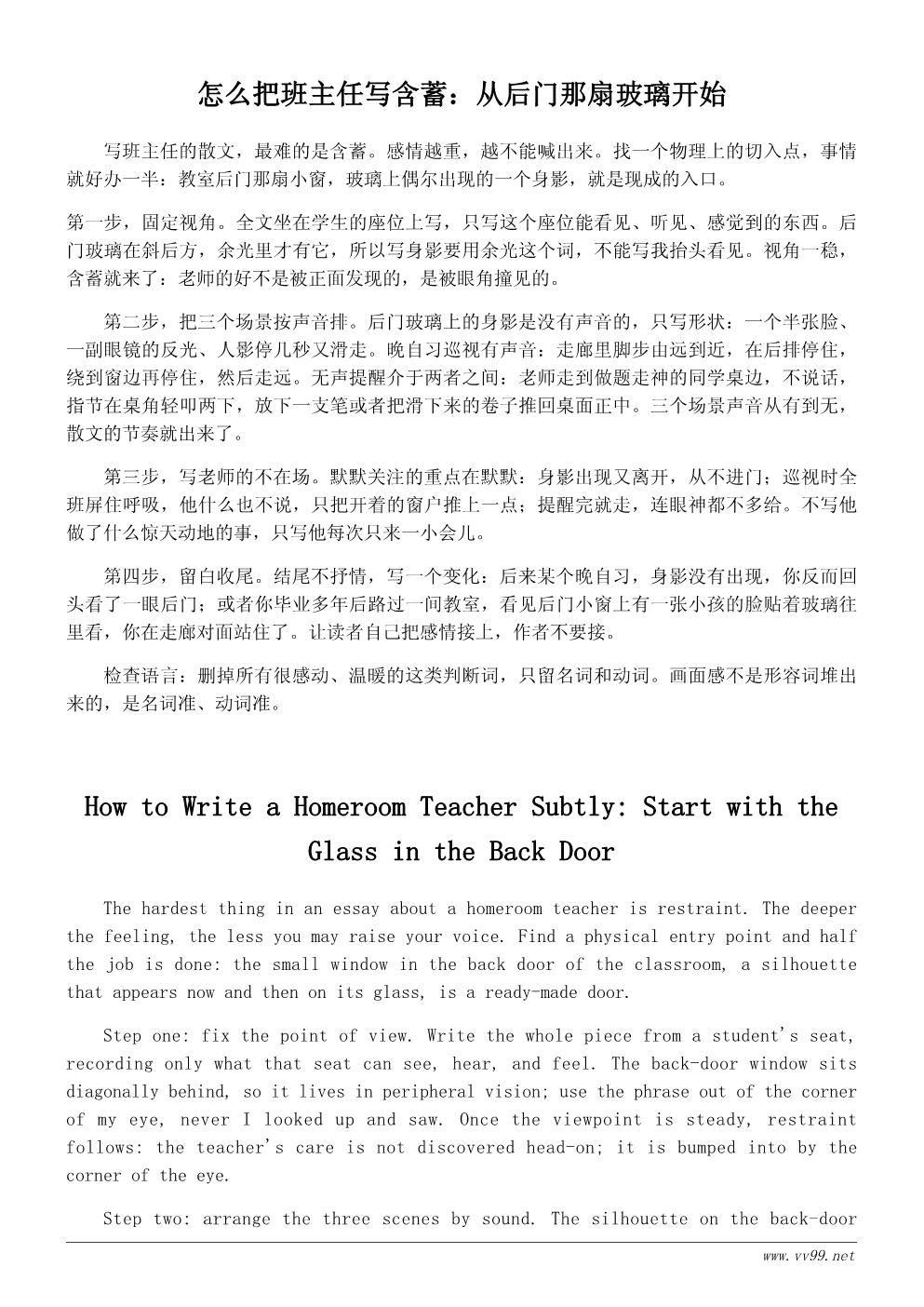
怎么把班主任写含蓄:从后门那扇玻璃开始
写班主任的散文,最难的是含蓄。感情越重,越不能喊出来。找一个物理上的切入点,事情就好办一半:教室后门那扇小窗,玻璃上偶尔出现的一个身影,就是现成的入口。
第一步,固定视角。全文坐在学生的座位上写,只写这个座位能看见、听见、感觉到的东西。后门玻璃在斜后方,余光里才有它,所以写身影要用余光这个词,不能写我抬头看见。视角一稳,含蓄就来了:老师的好不是被正面发现的,是被眼角撞见的。
第二步,把三个场景按声音排。后门玻璃上的身影是没有声音的,只写形状:一个半张脸、一副眼镜的反光、人影停几秒又滑走。晚自习巡视有声音:走廊里脚步由远到近,在后排停住,绕到窗边再停住,然后走远。无声提醒介于两者之间:老师走到做题走神的同学桌边,不说话,指节在桌角轻叩两下,放下一支笔或者把滑下来的卷子推回桌面正中。三个场景声音从有到无,散文的节奏就出来了。
第三步,写老师的不在场。默默关注的重点在默默:身影出现又离开,从不进门;巡视时全班屏住呼吸,他什么也不说,只把开着的窗户推上一点;提醒完就走,连眼神都不多给。不写他做了什么惊天动地的事,只写他每次只来一小会儿。
第四步,留白收尾。结尾不抒情,写一个变化:后来某个晚自习,身影没有出现,你反而回头看了一眼后门;或者你毕业多年后路过一间教室,看见后门小窗上有一张小孩的脸贴着玻璃往里看,你在走廊对面站住了。让读者自己把感情接上,作者不要接。
检查语言:删掉所有很感动、温暖的这类判断词,只留名词和动词。画面感不是形容词堆出来的,是名词准、动词准。
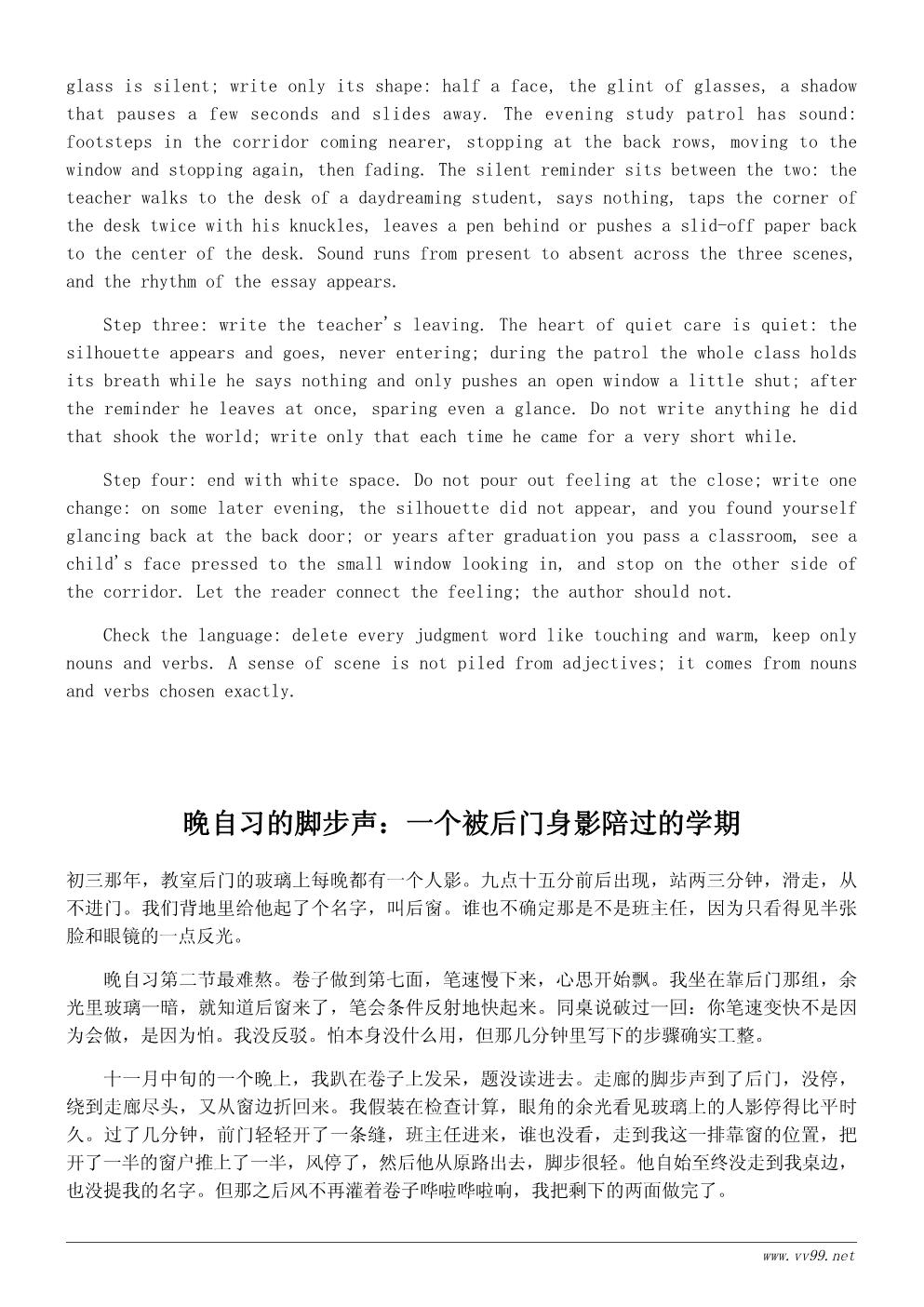
How to Write a Homeroom Teacher Subtly: Start with the Glass in the Back Door
The hardest thing in an essay about a homeroom teacher is restraint. The deeper the feeling, the less you may raise your voice. Find a physical entry point and half the job is done: the small window in the back door of the classroom, a silhouette that appears now and then on its glass, is a ready-made door.
Step one: fix the point of view. Write the whole piece from a student's seat, recording only what that seat can see, hear, and feel. The back-door window sits diagonally behind, so it lives in peripheral vision; use the phrase out of the corner of my eye, never I looked up and saw. Once the viewpoint is steady, restraint follows: the teacher's care is not discovered head-on; it is bumped into by the corner of the eye.
Step two: arrange the three scenes by sound. The silhouette on the back-door glass is silent; write only its shape: half a face, the glint of glasses, a shadow that pauses a few seconds and slides away. The evening study patrol has sound: footsteps in the corridor coming nearer, stopping at the back rows, moving to the window and stopping again, then fading. The silent reminder sits between the two: the teacher walks to the desk of a daydreaming student, says nothing, taps the corner of the desk twice with his knuckles, leaves a pen behind or pushes a slid-off paper back to the center of the desk. Sound runs from present to absent across the three scenes, and the rhythm of the essay appears.
Step three: write the teacher's leaving. The heart of quiet care is quiet: the silhouette appears and goes, never entering; during the patrol the whole class holds its breath while he says nothing and only pushes an open window a little shut; after the reminder he leaves at once, sparing even a glance. Do not write anything he did that shook the world; write only that each time he came for a very short while.
Step four: end with white space. Do not pour out feeling at the close; write one change: on some later evening, the silhouette did not appear, and you found yourself glancing back at the back door; or years after graduation you pass a classroom, see a child's face pressed to the small window looking in, and stop on the other side of the corridor. Let the reader connect the feeling; the author should not.
Check the language: delete every judgment word like touching and warm, keep only nouns and verbs. A sense of scene is not piled from adjectives; it comes from nouns and verbs chosen exactly.
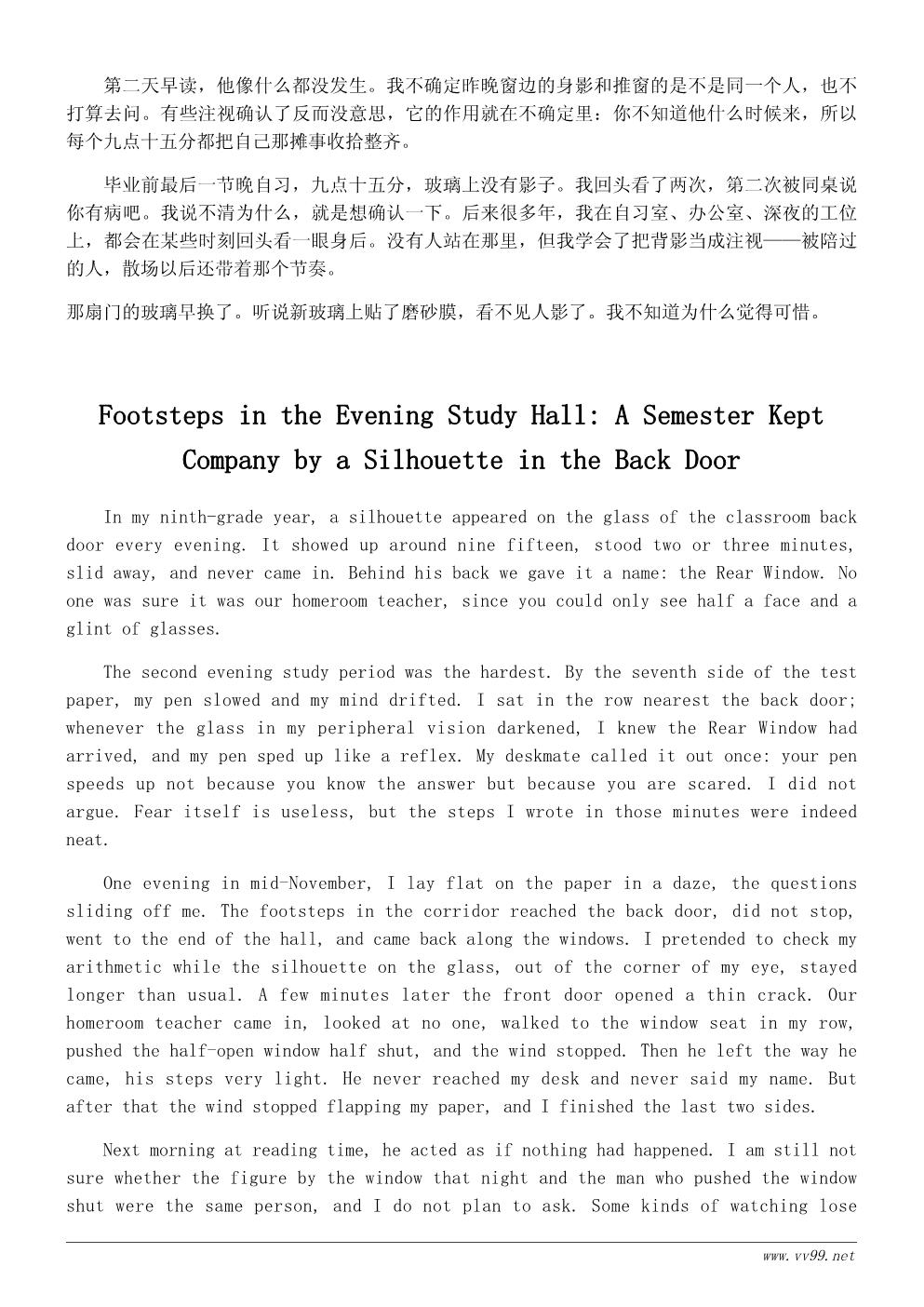
晚自习的脚步声:一个被后门身影陪过的学期
初三那年,教室后门的玻璃上每晚都有一个人影。九点十五分前后出现,站两三分钟,滑走,从不进门。我们背地里给他起了个名字,叫后窗。谁也不确定那是不是班主任,因为只看得见半张脸和眼镜的一点反光。
晚自习第二节最难熬。卷子做到第七面,笔速慢下来,心思开始飘。我坐在靠后门那组,余光里玻璃一暗,就知道后窗来了,笔会条件反射地快起来。同桌说破过一回:你笔速变快不是因为会做,是因为怕。我没反驳。怕本身没什么用,但那几分钟里写下的步骤确实工整。
十一月中旬的一个晚上,我趴在卷子上发呆,题没读进去。走廊的脚步声到了后门,没停,绕到走廊尽头,又从窗边折回来。我假装在检查计算,眼角的余光看见玻璃上的人影停得比平时久。过了几分钟,前门轻轻开了一条缝,班主任进来,谁也没看,走到我这一排靠窗的位置,把开了一半的窗户推上了一半,风停了,然后他从原路出去,脚步很轻。他自始至终没走到我桌边,也没提我的名字。但那之后风不再灌着卷子哗啦哗啦响,我把剩下的两面做完了。
第二天早读,他像什么都没发生。我不确定昨晚窗边的身影和推窗的是不是同一个人,也不打算去问。有些注视确认了反而没意思,它的作用就在不确定里:你不知道他什么时候来,所以每个九点十五分都把自己那摊事收拾整齐。
毕业前最后一节晚自习,九点十五分,玻璃上没有影子。我回头看了两次,第二次被同桌说你有病吧。我说不清为什么,就是想确认一下。后来很多年,我在自习室、办公室、深夜的工位上,都会在某些时刻回头看一眼身后。没有人站在那里,但我学会了把背影当成注视——被陪过的人,散场以后还带着那个节奏。
那扇门的玻璃早换了。听说新玻璃上贴了磨砂膜,看不见人影了。我不知道为什么觉得可惜。
Footsteps in the Evening Study Hall: A Semester Kept Company by a Silhouette in the Back Door
In my ninth-grade year, a silhouette appeared on the glass of the classroom back door every evening. It showed up around nine fifteen, stood two or three minutes, slid away, and never came in. Behind his back we gave it a name: the Rear Window. No one was sure it was our homeroom teacher, since you could only see half a face and a glint of glasses.
The second evening study period was the hardest. By the seventh side of the test paper, my pen slowed and my mind drifted. I sat in the row nearest the back door; whenever the glass in my peripheral vision darkened, I knew the Rear Window had arrived, and my pen sped up like a reflex. My deskmate called it out once: your pen speeds up not because you know the answer but because you are scared. I did not argue. Fear itself is useless, but the steps I wrote in those minutes were indeed neat.
One evening in mid-November, I lay flat on the paper in a daze, the questions sliding off me. The footsteps in the corridor reached the back door, did not stop, went to the end of the hall, and came back along the windows. I pretended to check my arithmetic while the silhouette on the glass, out of the corner of my eye, stayed longer than usual. A few minutes later the front door opened a thin crack. Our homeroom teacher came in, looked at no one, walked to the window seat in my row, pushed the half-open window half shut, and the wind stopped. Then he left the way he came, his steps very light. He never reached my desk and never said my name. But after that the wind stopped flapping my paper, and I finished the last two sides.
Next morning at reading time, he acted as if nothing had happened. I am still not sure whether the figure by the window that night and the man who pushed the window shut were the same person, and I do not plan to ask. Some kinds of watching lose their meaning once confirmed; their power lives in the uncertainty: you never know when he will come, so every nine fifteen you straighten up whatever you are doing.
In the last evening study before graduation, at nine fifteen, there was no shadow on the glass. I looked back twice; the second time my deskmate said, are you sick. I could not explain why; I just wanted to check. For years afterward, in study rooms, offices, and late-night desks, I still glance behind me at certain moments. No one stands there, but I learned to treat a silhouette as a gaze. Someone who was kept company carries that rhythm after the show ends.
The glass in that door has long been replaced. They say the new glass is frosted, and no silhouette can be seen through it. I do not know why I find that a pity.
小提示:上面此文档内容仅展示完整文档里的部分内容, 若需要下载完整文档请 点击免费下载完整文档 。