文章内容
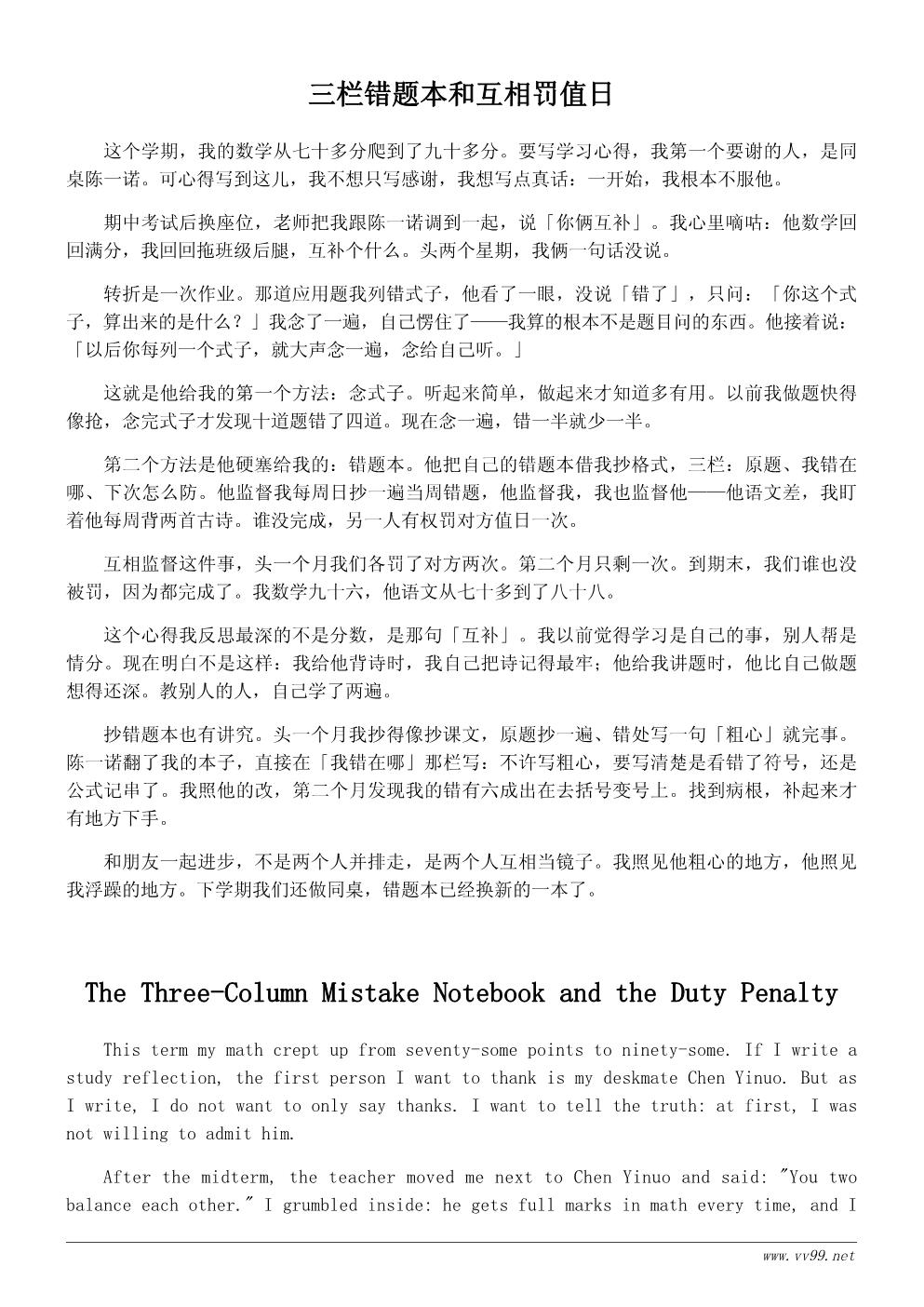
三栏错题本和互相罚值日
这个学期,我的数学从七十多分爬到了九十多分。要写学习心得,我第一个要谢的人,是同桌陈一诺。可心得写到这儿,我不想只写感谢,我想写点真话:一开始,我根本不服他。
期中考试后换座位,老师把我跟陈一诺调到一起,说「你俩互补」。我心里嘀咕:他数学回回满分,我回回拖班级后腿,互补个什么。头两个星期,我俩一句话没说。
转折是一次作业。那道应用题我列错式子,他看了一眼,没说「错了」,只问:「你这个式子,算出来的是什么?」我念了一遍,自己愣住了——我算的根本不是题目问的东西。他接着说:「以后你每列一个式子,就大声念一遍,念给自己听。」
这就是他给我的第一个方法:念式子。听起来简单,做起来才知道多有用。以前我做题快得像抢,念完式子才发现十道题错了四道。现在念一遍,错一半就少一半。
第二个方法是他硬塞给我的:错题本。他把自己的错题本借我抄格式,三栏:原题、我错在哪、下次怎么防。他监督我每周日抄一遍当周错题,他监督我,我也监督他——他语文差,我盯着他每周背两首古诗。谁没完成,另一人有权罚对方值日一次。
互相监督这件事,头一个月我们各罚了对方两次。第二个月只剩一次。到期末,我们谁也没被罚,因为都完成了。我数学九十六,他语文从七十多到了八十八。
这个心得我反思最深的不是分数,是那句「互补」。我以前觉得学习是自己的事,别人帮是情分。现在明白不是这样:我给他背诗时,我自己把诗记得最牢;他给我讲题时,他比自己做题想得还深。教别人的人,自己学了两遍。
抄错题本也有讲究。头一个月我抄得像抄课文,原题抄一遍、错处写一句「粗心」就完事。陈一诺翻了我的本子,直接在「我错在哪」那栏写:不许写粗心,要写清楚是看错了符号,还是公式记串了。我照他的改,第二个月发现我的错有六成出在去括号变号上。找到病根,补起来才有地方下手。
和朋友一起进步,不是两个人并排走,是两个人互相当镜子。我照见他粗心的地方,他照见我浮躁的地方。下学期我们还做同桌,错题本已经换新的一本了。
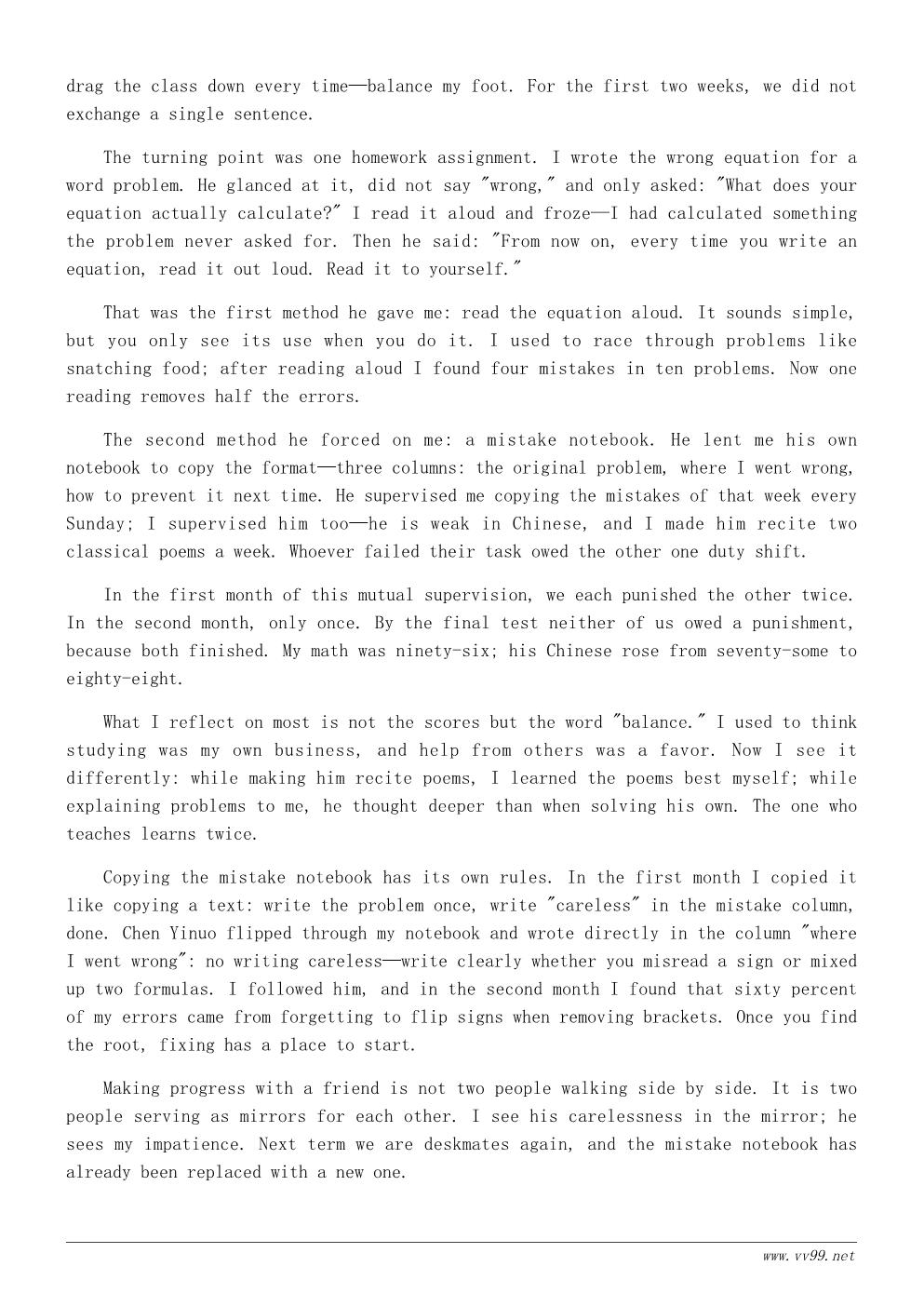
The Three-Column Mistake Notebook and the Duty Penalty
This term my math crept up from seventy-some points to ninety-some. If I write a study reflection, the first person I want to thank is my deskmate Chen Yinuo. But as I write, I do not want to only say thanks. I want to tell the truth: at first, I was not willing to admit him.
After the midterm, the teacher moved me next to Chen Yinuo and said: "You two balance each other." I grumbled inside: he gets full marks in math every time, and I drag the class down every time—balance my foot. For the first two weeks, we did not exchange a single sentence.
The turning point was one homework assignment. I wrote the wrong equation for a word problem. He glanced at it, did not say "wrong," and only asked: "What does your equation actually calculate?" I read it aloud and froze—I had calculated something the problem never asked for. Then he said: "From now on, every time you write an equation, read it out loud. Read it to yourself."
That was the first method he gave me: read the equation aloud. It sounds simple, but you only see its use when you do it. I used to race through problems like snatching food; after reading aloud I found four mistakes in ten problems. Now one reading removes half the errors.
The second method he forced on me: a mistake notebook. He lent me his own notebook to copy the format—three columns: the original problem, where I went wrong, how to prevent it next time. He supervised me copying the mistakes of that week every Sunday; I supervised him too—he is weak in Chinese, and I made him recite two classical poems a week. Whoever failed their task owed the other one duty shift.
In the first month of this mutual supervision, we each punished the other twice. In the second month, only once. By the final test neither of us owed a punishment, because both finished. My math was ninety-six; his Chinese rose from seventy-some to eighty-eight.
What I reflect on most is not the scores but the word "balance." I used to think studying was my own business, and help from others was a favor. Now I see it differently: while making him recite poems, I learned the poems best myself; while explaining problems to me, he thought deeper than when solving his own. The one who teaches learns twice.
Copying the mistake notebook has its own rules. In the first month I copied it like copying a text: write the problem once, write "careless" in the mistake column, done. Chen Yinuo flipped through my notebook and wrote directly in the column "where I went wrong": no writing careless—write clearly whether you misread a sign or mixed up two formulas. I followed him, and in the second month I found that sixty percent of my errors came from forgetting to flip signs when removing brackets. Once you find the root, fixing has a place to start.
Making progress with a friend is not two people walking side by side. It is two people serving as mirrors for each other. I see his carelessness in the mirror; he sees my impatience. Next term we are deskmates again, and the mistake notebook has already been replaced with a new one.
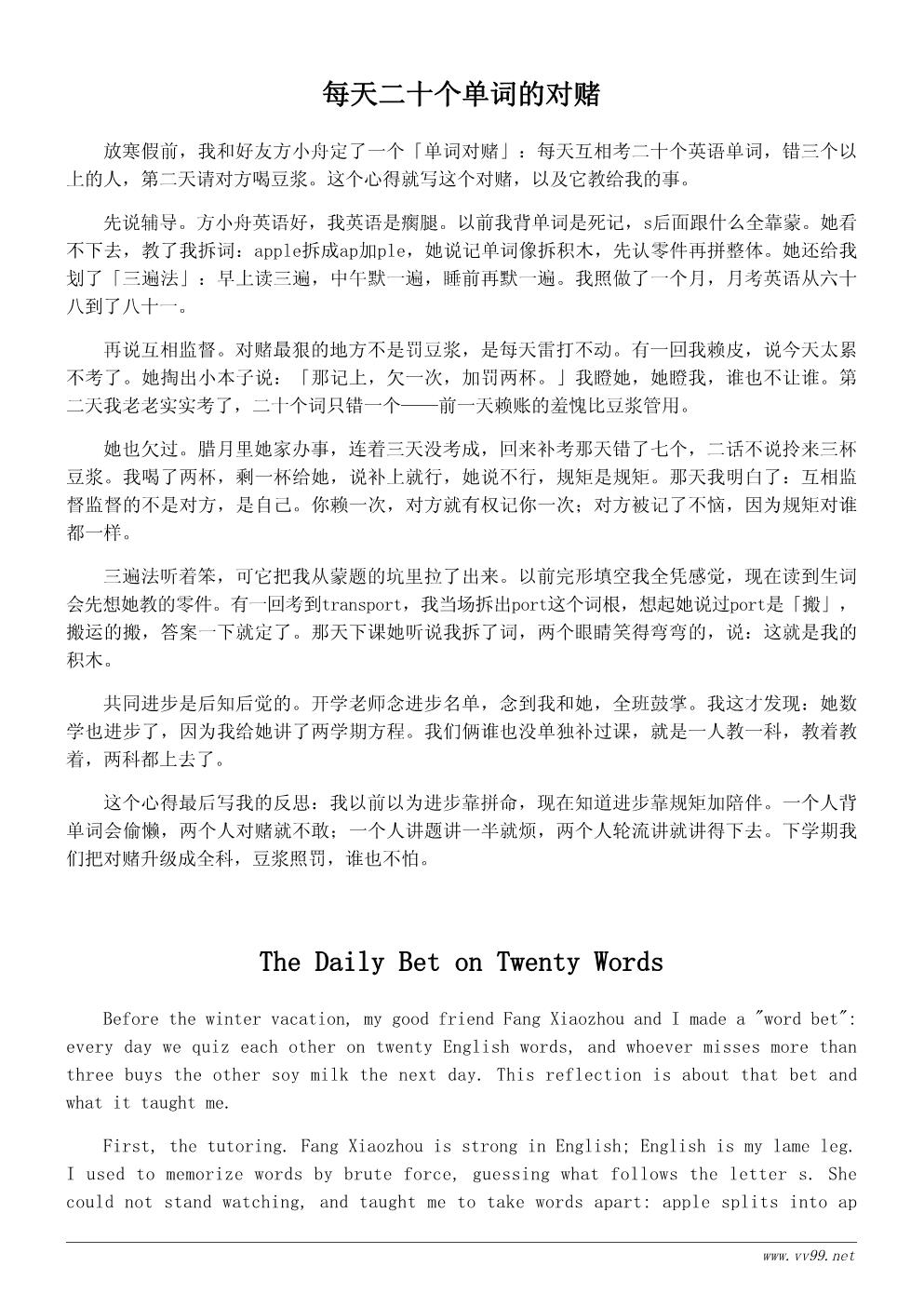
每天二十个单词的对赌
放寒假前,我和好友方小舟定了一个「单词对赌」:每天互相考二十个英语单词,错三个以上的人,第二天请对方喝豆浆。这个心得就写这个对赌,以及它教给我的事。
先说辅导。方小舟英语好,我英语是瘸腿。以前我背单词是死记,s后面跟什么全靠蒙。她看不下去,教了我拆词:apple拆成ap加ple,她说记单词像拆积木,先认零件再拼整体。她还给我划了「三遍法」:早上读三遍,中午默一遍,睡前再默一遍。我照做了一个月,月考英语从六十八到了八十一。
再说互相监督。对赌最狠的地方不是罚豆浆,是每天雷打不动。有一回我赖皮,说今天太累不考了。她掏出小本子说:「那记上,欠一次,加罚两杯。」我瞪她,她瞪我,谁也不让谁。第二天我老老实实考了,二十个词只错一个——前一天赖账的羞愧比豆浆管用。
她也欠过。腊月里她家办事,连着三天没考成,回来补考那天错了七个,二话不说拎来三杯豆浆。我喝了两杯,剩一杯给她,说补上就行,她说不行,规矩是规矩。那天我明白了:互相监督监督的不是对方,是自己。你赖一次,对方就有权记你一次;对方被记了不恼,因为规矩对谁都一样。
三遍法听着笨,可它把我从蒙题的坑里拉了出来。以前完形填空我全凭感觉,现在读到生词会先想她教的零件。有一回考到transport,我当场拆出port这个词根,想起她说过port是「搬」,搬运的搬,答案一下就定了。那天下课她听说我拆了词,两个眼睛笑得弯弯的,说:这就是我的积木。
共同进步是后知后觉的。开学老师念进步名单,念到我和她,全班鼓掌。我这才发现:她数学也进步了,因为我给她讲了两学期方程。我们俩谁也没单独补过课,就是一人教一科,教着教着,两科都上去了。
这个心得最后写我的反思:我以前以为进步靠拼命,现在知道进步靠规矩加陪伴。一个人背单词会偷懒,两个人对赌就不敢;一个人讲题讲一半就烦,两个人轮流讲就讲得下去。下学期我们把对赌升级成全科,豆浆照罚,谁也不怕。
The Daily Bet on Twenty Words
Before the winter vacation, my good friend Fang Xiaozhou and I made a "word bet": every day we quiz each other on twenty English words, and whoever misses more than three buys the other soy milk the next day. This reflection is about that bet and what it taught me.
First, the tutoring. Fang Xiaozhou is strong in English; English is my lame leg. I used to memorize words by brute force, guessing what follows the letter s. She could not stand watching, and taught me to take words apart: apple splits into ap plus ple. She said memorizing words is like taking building blocks apart—learn the pieces first, then assemble the whole. She also gave me her "three-pass method": read three times in the morning, write once from memory at noon, write once more before bed. I followed it for a month, and my monthly test English went from sixty-eight to eighty-one.
Second, the mutual supervision. The fiercest part of the bet is not the soy milk penalty but the daily routine that never breaks. Once I tried to weasel out, saying I was too tired to quiz that day. She took out a small notebook and said: "Then it is recorded—one debt, plus two extra cups." I glared at her, she glared at me, neither gave in. The next day I took the quiz honestly and missed only one of twenty words—the shame of the excuse of the previous day worked better than soy milk.
She also fell behind. In the twelfth lunar month her family had affairs to handle, and three days of quizzes were missed. On the day she made them up she missed seven words, and without a word she brought over three cups of soy milk. I drank two and left one for her, saying making it up is enough. She said no—the rules are the rules. That day I understood: mutual supervision supervises not the other person but yourself. If you slack once, the other has the right to record you; and when the other is recorded, there is no hard feeling, because the rule is the same for everyone.
The three-pass method sounds clumsy, but it pulled me out of the pit of guessing. Before, I did cloze passages entirely by feel; now when I meet a new word I first think of the pieces she taught. Once the test had the word transport, and on the spot I took out the root port, remembering she had said port means to carry—carrying things—and the answer settled at once. After class that day, when she heard I had taken the word apart, her eyes curved into crescents and she said: that is my building blocks.
The shared progress came home to me later. When the teacher read the list of improved students at the start of term and reached our two names, the whole class applauded. Only then did I notice that her math had improved too, because I had explained equations to her for two terms. Neither of us ever took extra classes. One taught one subject, the other taught another, and teaching went on until both subjects rose.
My final reflection: I used to think progress came from working desperately. Now I know it comes from rules plus company. Alone, memorizing words invites laziness; with a bet between two people, nobody dares. Alone, explaining problems gets tiresome halfway; taking turns, two people keep explaining. Next term we upgrade the bet to all subjects. The soy milk penalty stays, and neither of us is afraid.
小提示:上面此文档内容仅展示完整文档里的部分内容, 若需要下载完整文档请 点击免费下载完整文档 。