文章内容
文章内容
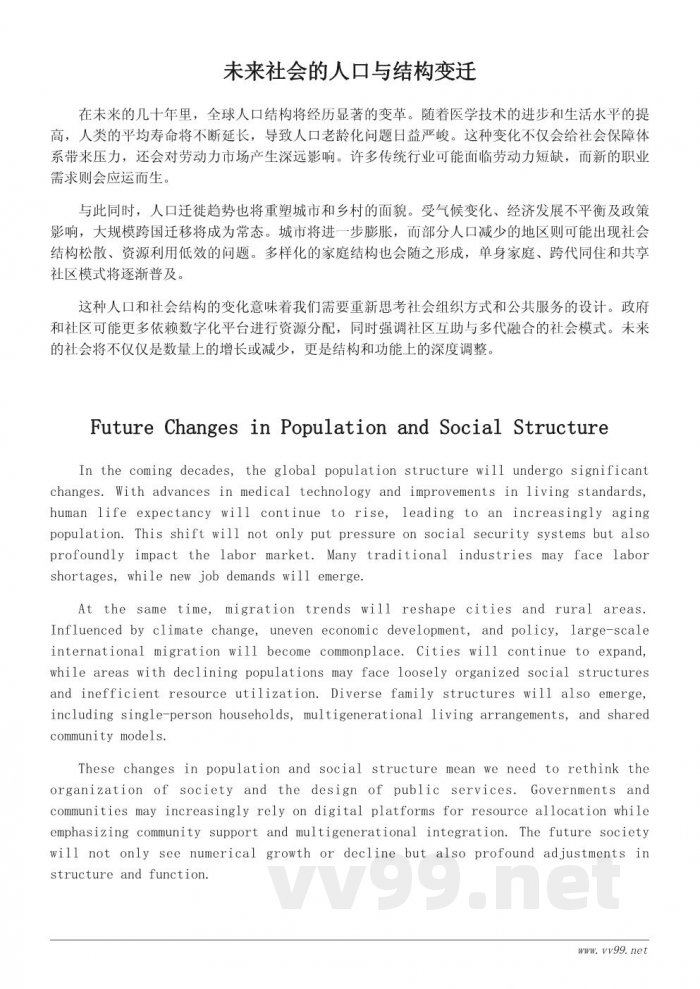
未来社会的人口与结构变迁
在未来的几十年里,全球人口结构将经历显著的变革。随着医学技术的进步和生活水平的提高,人类的平均寿命将不断延长,导致人口老龄化问题日益严峻。这种变化不仅会给社会保障体系带来压力,还会对劳动力市场产生深远影响。许多传统行业可能面临劳动力短缺,而新的职业需求则会应运而生。
与此同时,人口迁徙趋势也将重塑城市和乡村的面貌。受气候变化、经济发展不平衡及政策影响,大规模跨国迁移将成为常态。城市将进一步膨胀,而部分人口减少的地区则可能出现社会结构松散、资源利用低效的问题。多样化的家庭结构也会随之形成,单身家庭、跨代同住和共享社区模式将逐渐普及。
这种人口和社会结构的变化意味着我们需要重新思考社会组织方式和公共服务的设计。政府和社区可能更多依赖数字化平台进行资源分配,同时强调社区互助与多代融合的社会模式。未来的社会将不仅仅是数量上的增长或减少,更是结构和功能上的深度调整。
Future Changes in Population and Social Structure
In the coming decades, the global population structure will undergo significant changes. With advances in medical technology and improvements in living standards, human life expectancy will continue to rise, leading to an increasingly aging population. This shift will not only put pressure on social security systems but also profoundly impact the labor market. Many traditional industries may face labor shortages, while new job demands will emerge.
At the same time, migration trends will reshape cities and rural areas. Influenced by climate change, uneven economic development, and policy, large-scale international migration will become commonplace. Cities will continue to expand, while areas with declining populations may face loosely organized social structures and inefficient resource utilization. Diverse family structures will also emerge, including single-person households, multigenerational living arrangements, and shared community models.
These changes in population and social structure mean we need to rethink the organization of society and the design of public services. Governments and communities may increasingly rely on digital platforms for resource allocation while emphasizing community support and multigenerational integration. The future society will not only see numerical growth or decline but also profound adjustments in structure and function.
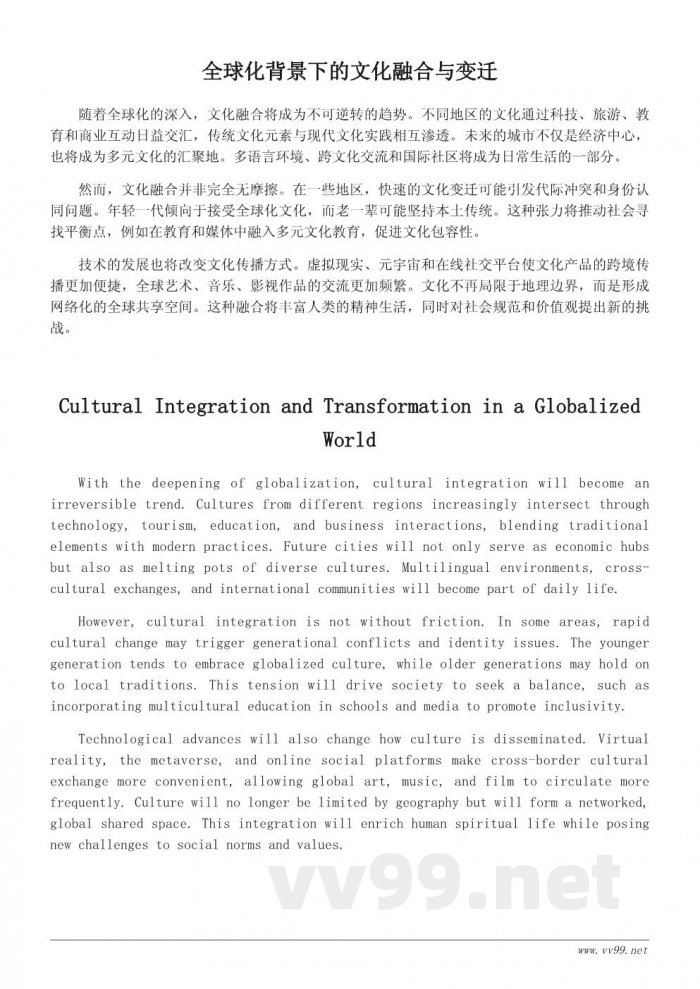
全球化背景下的文化融合与变迁
随着全球化的深入,文化融合将成为不可逆转的趋势。不同地区的文化通过科技、旅游、教育和商业互动日益交汇,传统文化元素与现代文化实践相互渗透。未来的城市不仅是经济中心,也将成为多元文化的汇聚地。多语言环境、跨文化交流和国际社区将成为日常生活的一部分。
然而,文化融合并非完全无摩擦。在一些地区,快速的文化变迁可能引发代际冲突和身份认同问题。年轻一代倾向于接受全球化文化,而老一辈可能坚持本土传统。这种张力将推动社会寻找平衡点,例如在教育和媒体中融入多元文化教育,促进文化包容性。
技术的发展也将改变文化传播方式。虚拟现实、元宇宙和在线社交平台使文化产品的跨境传播更加便捷,全球艺术、音乐、影视作品的交流更加频繁。文化不再局限于地理边界,而是形成网络化的全球共享空间。这种融合将丰富人类的精神生活,同时对社会规范和价值观提出新的挑战。
Cultural Integration and Transformation in a Globalized World
With the deepening of globalization, cultural integration will become an irreversible trend. Cultures from different regions increasingly intersect through technology, tourism, education, and business interactions, blending traditional elements with modern practices. Future cities will not only serve as economic hubs but also as melting pots of diverse cultures. Multilingual environments, cross-cultural exchanges, and international communities will become part of daily life.
However, cultural integration is not without friction. In some areas, rapid cultural change may trigger generational conflicts and identity issues. The younger generation tends to embrace globalized culture, while older generations may hold on to local traditions. This tension will drive society to seek a balance, such as incorporating multicultural education in schools and media to promote inclusivity.
Technological advances will also change how culture is disseminated. Virtual reality, the metaverse, and online social platforms make cross-border cultural exchange more convenient, allowing global art, music, and film to circulate more frequently. Culture will no longer be limited by geography but will form a networked, global shared space. This integration will enrich human spiritual life while posing new challenges to social norms and values.
小提示:上面此文档内容仅展示完整文档里的部分内容, 若需要下载完整文档请 点击免费下载完整文档 。