文章内容
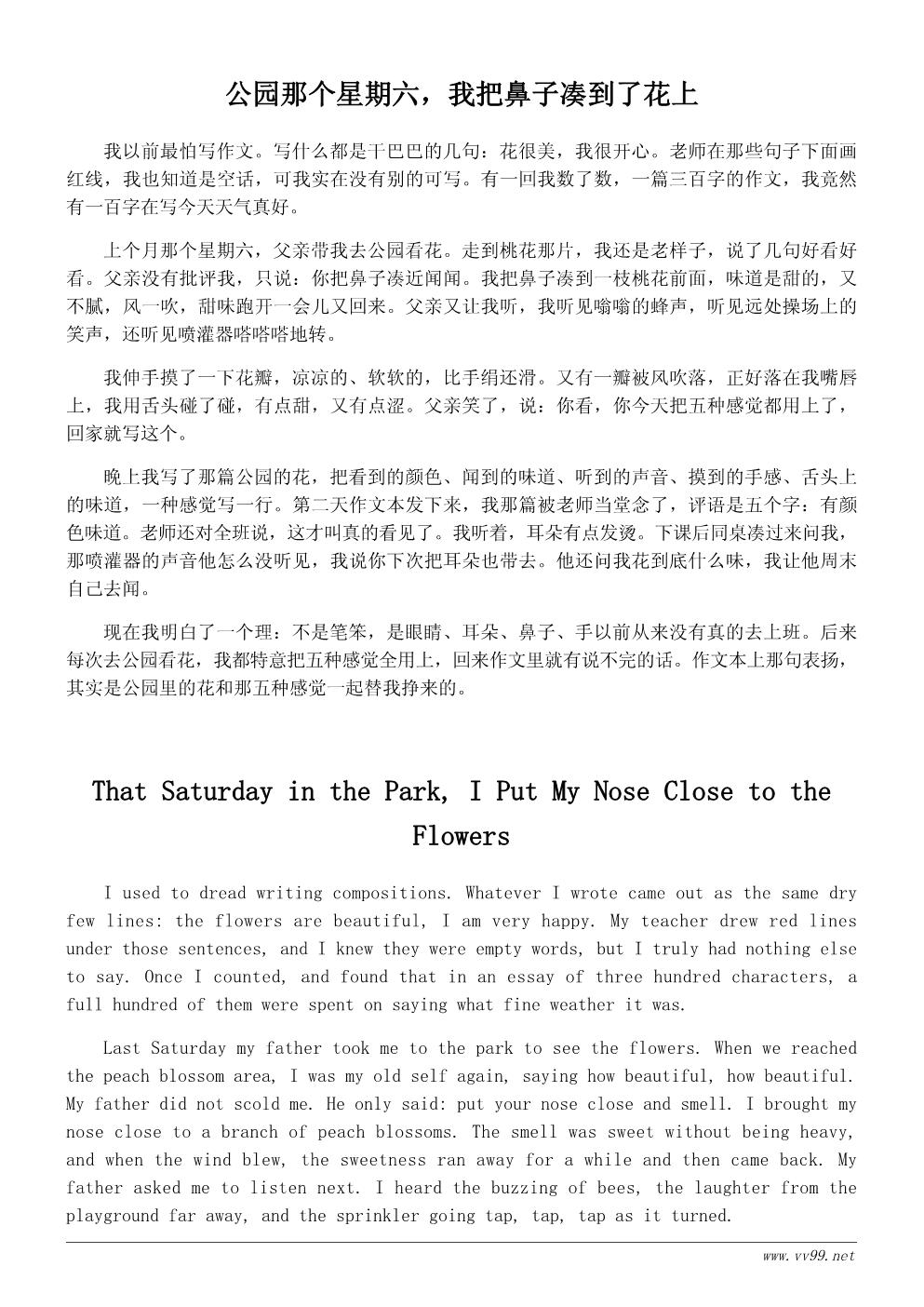
公园那个星期六,我把鼻子凑到了花上
我以前最怕写作文。写什么都是干巴巴的几句:花很美,我很开心。老师在那些句子下面画红线,我也知道是空话,可我实在没有别的可写。有一回我数了数,一篇三百字的作文,我竟然有一百字在写今天天气真好。
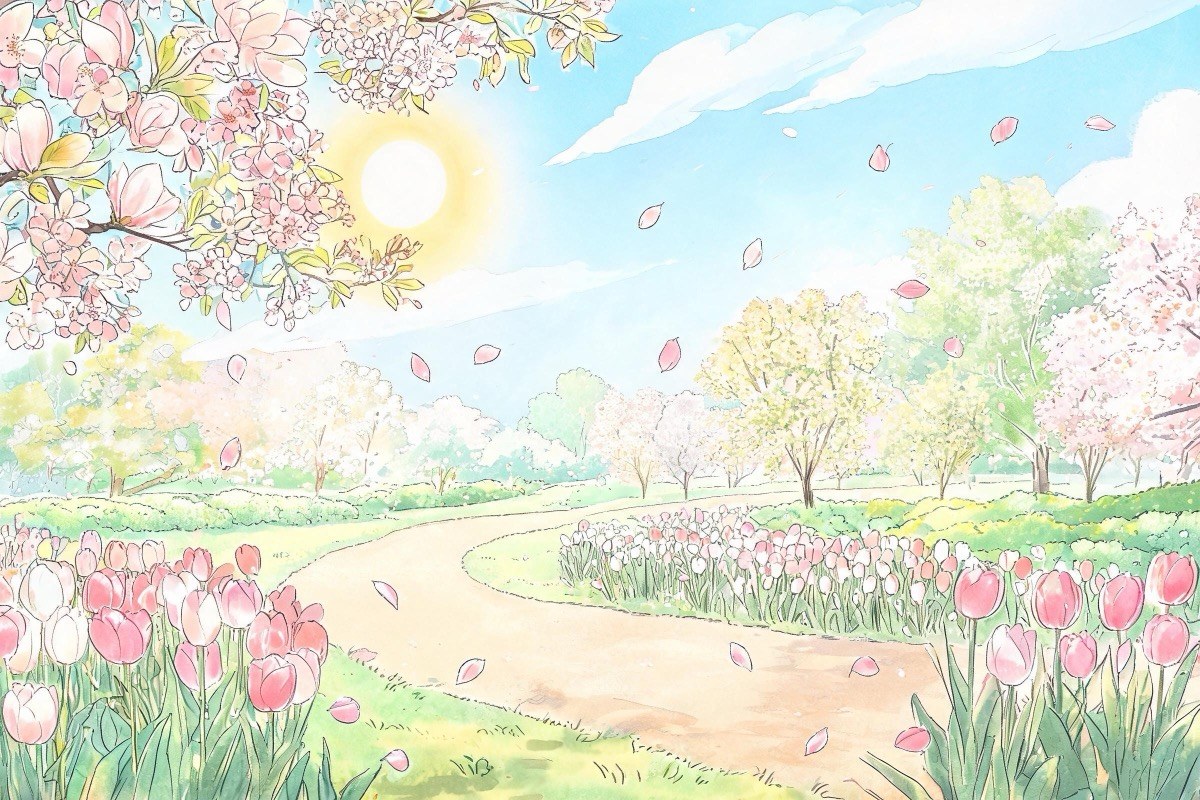
上个月那个星期六,父亲带我去公园看花。走到桃花那片,我还是老样子,说了几句好看好看。父亲没有批评我,只说:你把鼻子凑近闻闻。我把鼻子凑到一枝桃花前面,味道是甜的,又不腻,风一吹,甜味跑开一会儿又回来。父亲又让我听,我听见嗡嗡的蜂声,听见远处操场上的笑声,还听见喷灌器嗒嗒嗒地转。
我伸手摸了一下花瓣,凉凉的、软软的,比手绢还滑。又有一瓣被风吹落,正好落在我嘴唇上,我用舌头碰了碰,有点甜,又有点涩。父亲笑了,说:你看,你今天把五种感觉都用上了,回家就写这个。
晚上我写了那篇公园的花,把看到的颜色、闻到的味道、听到的声音、摸到的手感、舌头上的味道,一种感觉写一行。第二天作文本发下来,我那篇被老师当堂念了,评语是五个字:有颜色味道。老师还对全班说,这才叫真的看见了。我听着,耳朵有点发烫。下课后同桌凑过来问我,那喷灌器的声音他怎么没听见,我说你下次把耳朵也带去。他还问我花到底什么味,我让他周末自己去闻。
现在我明白了一个理:不是笔笨,是眼睛、耳朵、鼻子、手以前从来没有真的去上班。后来每次去公园看花,我都特意把五种感觉全用上,回来作文里就有说不完的话。作文本上那句表扬,其实是公园里的花和那五种感觉一起替我挣来的。
That Saturday in the Park, I Put My Nose Close to the Flowers
I used to dread writing compositions. Whatever I wrote came out as the same dry few lines: the flowers are beautiful, I am very happy. My teacher drew red lines under those sentences, and I knew they were empty words, but I truly had nothing else to say. Once I counted, and found that in an essay of three hundred characters, a full hundred of them were spent on saying what fine weather it was.
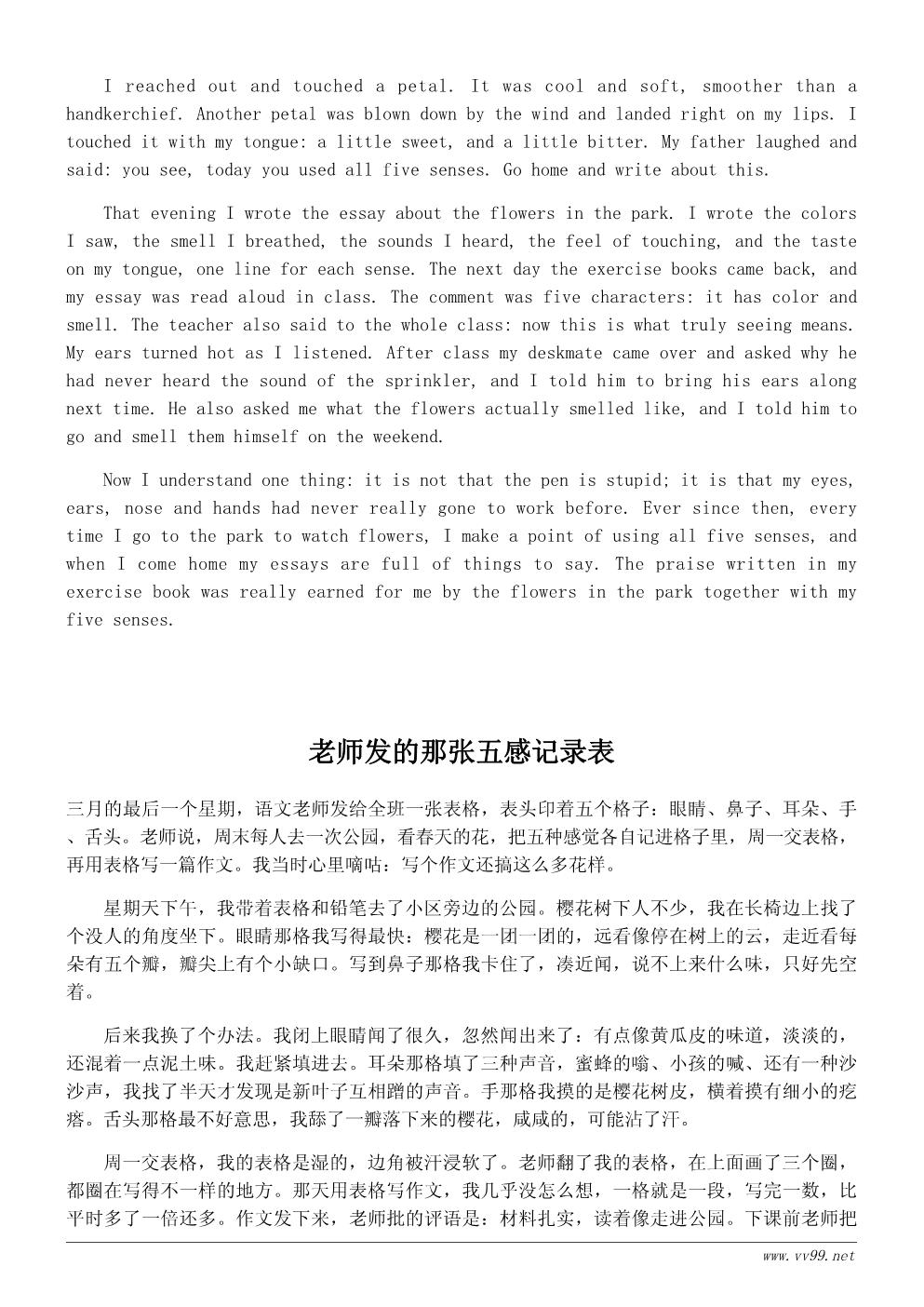
Last Saturday my father took me to the park to see the flowers. When we reached the peach blossom area, I was my old self again, saying how beautiful, how beautiful. My father did not scold me. He only said: put your nose close and smell. I brought my nose close to a branch of peach blossoms. The smell was sweet without being heavy, and when the wind blew, the sweetness ran away for a while and then came back. My father asked me to listen next. I heard the buzzing of bees, the laughter from the playground far away, and the sprinkler going tap, tap, tap as it turned.
I reached out and touched a petal. It was cool and soft, smoother than a handkerchief. Another petal was blown down by the wind and landed right on my lips. I touched it with my tongue: a little sweet, and a little bitter. My father laughed and said: you see, today you used all five senses. Go home and write about this.
That evening I wrote the essay about the flowers in the park. I wrote the colors I saw, the smell I breathed, the sounds I heard, the feel of touching, and the taste on my tongue, one line for each sense. The next day the exercise books came back, and my essay was read aloud in class. The comment was five characters: it has color and smell. The teacher also said to the whole class: now this is what truly seeing means. My ears turned hot as I listened. After class my deskmate came over and asked why he had never heard the sound of the sprinkler, and I told him to bring his ears along next time. He also asked me what the flowers actually smelled like, and I told him to go and smell them himself on the weekend.
Now I understand one thing: it is not that the pen is stupid; it is that my eyes, ears, nose and hands had never really gone to work before. Ever since then, every time I go to the park to watch flowers, I make a point of using all five senses, and when I come home my essays are full of things to say. The praise written in my exercise book was really earned for me by the flowers in the park together with my five senses.
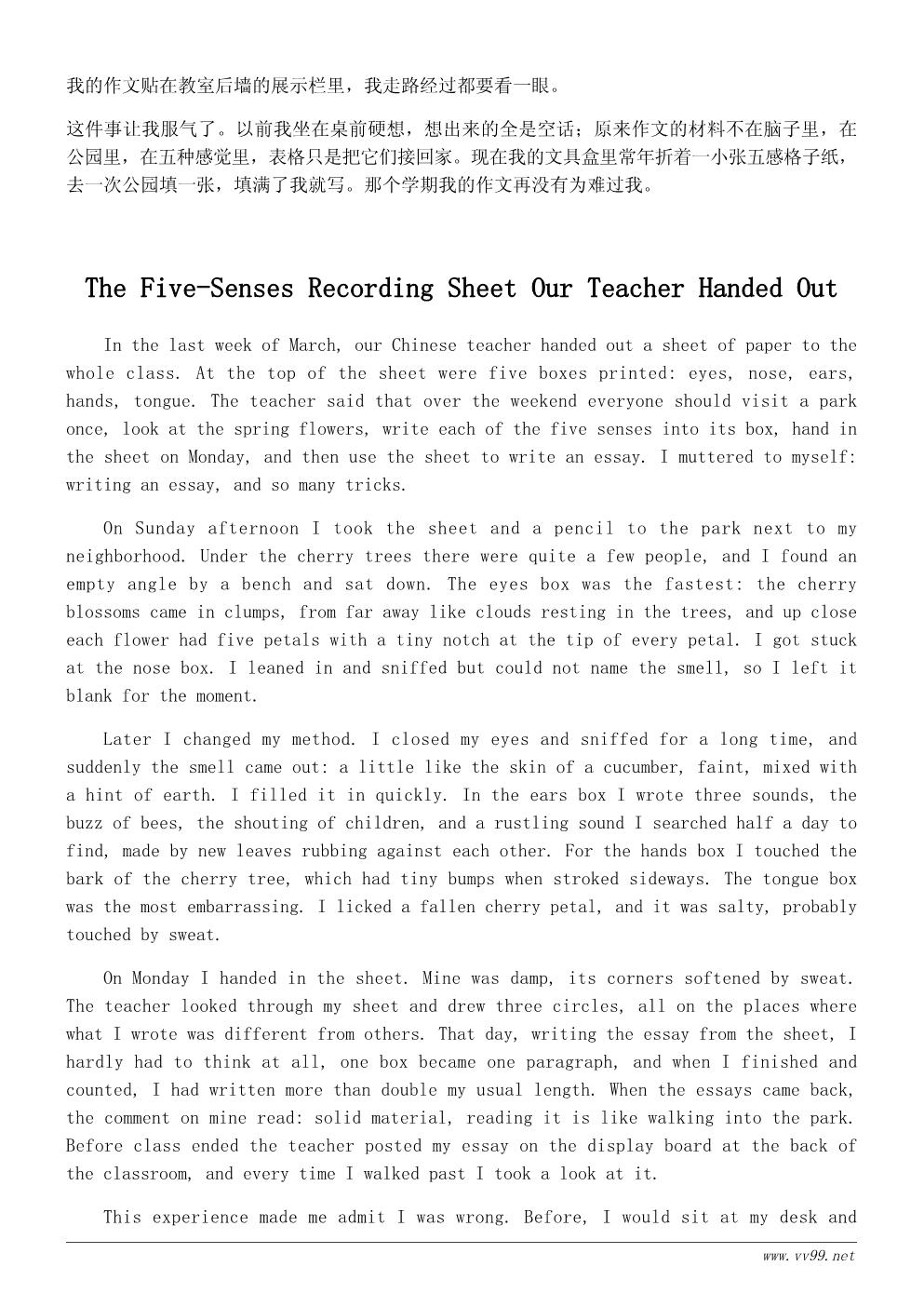
老师发的那张五感记录表
三月的最后一个星期,语文老师发给全班一张表格,表头印着五个格子:眼睛、鼻子、耳朵、手、舌头。老师说,周末每人去一次公园,看春天的花,把五种感觉各自记进格子里,周一交表格,再用表格写一篇作文。我当时心里嘀咕:写个作文还搞这么多花样。
星期天下午,我带着表格和铅笔去了小区旁边的公园。樱花树下人不少,我在长椅边上找了个没人的角度坐下。眼睛那格我写得最快:樱花是一团一团的,远看像停在树上的云,走近看每朵有五个瓣,瓣尖上有个小缺口。写到鼻子那格我卡住了,凑近闻,说不上来什么味,只好先空着。
后来我换了个办法。我闭上眼睛闻了很久,忽然闻出来了:有点像黄瓜皮的味道,淡淡的,还混着一点泥土味。我赶紧填进去。耳朵那格填了三种声音,蜜蜂的嗡、小孩的喊、还有一种沙沙声,我找了半天才发现是新叶子互相蹭的声音。手那格我摸的是樱花树皮,横着摸有细小的疙瘩。舌头那格最不好意思,我舔了一瓣落下来的樱花,咸咸的,可能沾了汗。
周一交表格,我的表格是湿的,边角被汗浸软了。老师翻了我的表格,在上面画了三个圈,都圈在写得不一样的地方。那天用表格写作文,我几乎没怎么想,一格就是一段,写完一数,比平时多了一倍还多。作文发下来,老师批的评语是:材料扎实,读着像走进公园。下课前老师把我的作文贴在教室后墙的展示栏里,我走路经过都要看一眼。
这件事让我服气了。以前我坐在桌前硬想,想出来的全是空话;原来作文的材料不在脑子里,在公园里,在五种感觉里,表格只是把它们接回家。现在我的文具盒里常年折着一小张五感格子纸,去一次公园填一张,填满了我就写。那个学期我的作文再没有为难过我。
The Five-Senses Recording Sheet Our Teacher Handed Out
In the last week of March, our Chinese teacher handed out a sheet of paper to the whole class. At the top of the sheet were five boxes printed: eyes, nose, ears, hands, tongue. The teacher said that over the weekend everyone should visit a park once, look at the spring flowers, write each of the five senses into its box, hand in the sheet on Monday, and then use the sheet to write an essay. I muttered to myself: writing an essay, and so many tricks.
On Sunday afternoon I took the sheet and a pencil to the park next to my neighborhood. Under the cherry trees there were quite a few people, and I found an empty angle by a bench and sat down. The eyes box was the fastest: the cherry blossoms came in clumps, from far away like clouds resting in the trees, and up close each flower had five petals with a tiny notch at the tip of every petal. I got stuck at the nose box. I leaned in and sniffed but could not name the smell, so I left it blank for the moment.
Later I changed my method. I closed my eyes and sniffed for a long time, and suddenly the smell came out: a little like the skin of a cucumber, faint, mixed with a hint of earth. I filled it in quickly. In the ears box I wrote three sounds, the buzz of bees, the shouting of children, and a rustling sound I searched half a day to find, made by new leaves rubbing against each other. For the hands box I touched the bark of the cherry tree, which had tiny bumps when stroked sideways. The tongue box was the most embarrassing. I licked a fallen cherry petal, and it was salty, probably touched by sweat.
On Monday I handed in the sheet. Mine was damp, its corners softened by sweat. The teacher looked through my sheet and drew three circles, all on the places where what I wrote was different from others. That day, writing the essay from the sheet, I hardly had to think at all, one box became one paragraph, and when I finished and counted, I had written more than double my usual length. When the essays came back, the comment on mine read: solid material, reading it is like walking into the park. Before class ended the teacher posted my essay on the display board at the back of the classroom, and every time I walked past I took a look at it.
This experience made me admit I was wrong. Before, I would sit at my desk and force myself to think, and all that came out was empty talk. The material for essays was not inside my head; it was in the park, in the five senses, and the sheet only carried it home for me. Now there is always a small folded sheet of five-senses boxes in my pencil case. Every trip to the park fills one sheet, and when a sheet is full I write. For the rest of that term, essays never troubled me again.
小提示:上面此文档内容仅展示完整文档里的部分内容, 若需要下载完整文档请 点击免费下载完整文档 。