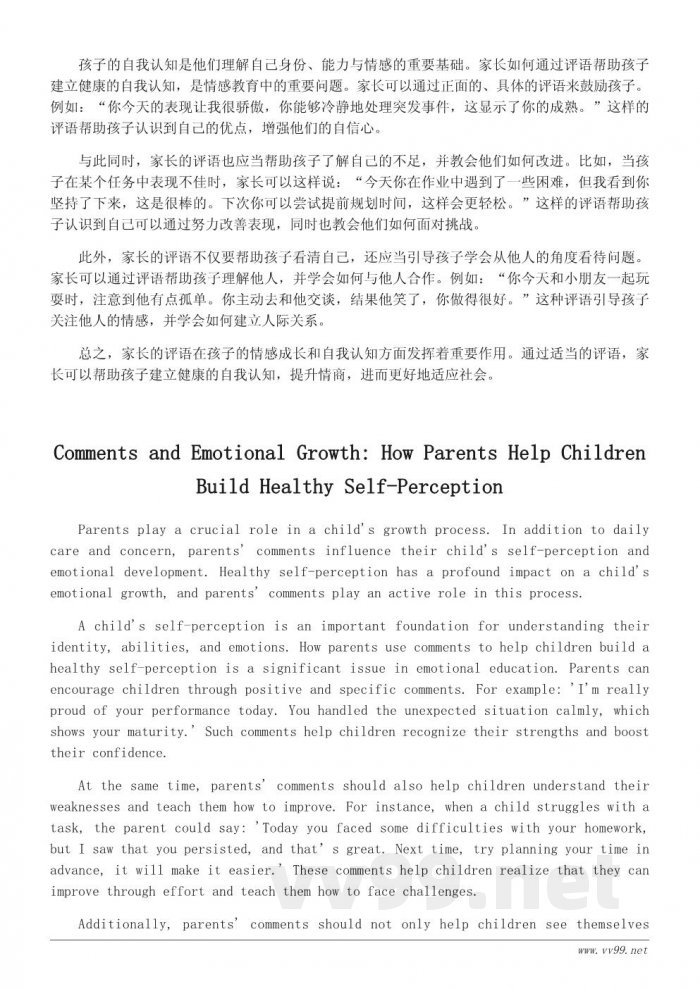
文章内容
文章内容
家长评语:帮助孩子正确看待自我与他人的关键
在日常生活中,家长对孩子的评语不仅仅是对孩子行为的评价,它们还承载着情感和认知的引导。家长如何通过评语帮助孩子认识自我,理解他人,是孩子情感与认知成长的重要一环。
首先,家长的评语应当真实、客观,避免过度赞美或过度批评。真实的评语能够帮助孩子认清自己的优点与不足,从而促使孩子进行自我反思。比如,家长可以说:“今天你在课堂上积极回答问题,表现得很自信,这是你进步的表现。但你在和同学讨论时,有时候太急于表达自己的观点,应该多听听别人的意见。”这样的评语,不仅肯定了孩子的进步,也指出了需要改进的地方。
其次,家长的评语应当帮助孩子理解他人。许多孩子在成长过程中,往往容易集中在自己的表现上,而忽略了他人的感受与表现。家长可以通过评语引导孩子学会体察他人的情感和优缺点。例如:“你今天和小明合作得很好,能看到他做事认真,尽职尽责。你们的合作不仅是你们各自的优点结合,也是相互补充。”这样的评语让孩子学会欣赏他人,也提高了他们的情商。
通过这些评语,家长不仅是为孩子提供了关于自我反思的引导,还通过教会孩子看待他人的优缺点,促进了他们情商的提升。尤其是在孩子情感波动较大时,家长通过适当的评语,可以帮助孩子保持冷静,理性看待自己和他人。
总之,家长的评语具有深远的影响力。在日常教育中,家长可以通过巧妙的评语,不断引导孩子认识自我与他人,帮助孩子在情感和认知上不断成长。
Parenting Comments: The Key to Helping Children Properly Understand Themselves and Others
In daily life, parents' comments on their children are not just evaluations of behavior but also carry emotional and cognitive guidance. How parents help their children recognize themselves and understand others through comments is an essential part of their emotional and cognitive development.
Firstly, parents' comments should be honest and objective, avoiding excessive praise or criticism. Honest comments help children recognize their strengths and weaknesses, encouraging self-reflection. For example, a parent could say: 'Today you answered questions confidently in class, which is a sign of progress. But when discussing with your classmates, you sometimes rush to express your opinion without listening to others.' Such comments acknowledge the child's progress and point out areas for improvement.
Secondly, parents' comments should help children understand others. Many children, during their growth, tend to focus on their own performance and overlook the feelings and actions of others. Parents can guide children to recognize others' emotions and strengths through comments. For example: 'You worked well with Xiao Ming today, and I could see that he was diligent and responsible. Your collaboration combined both of your strengths and complemented each other.' This kind of comment teaches children to appreciate others and enhances their emotional intelligence.
Through these comments, parents not only guide their children in self-reflection but also help them learn to recognize the strengths and weaknesses of others, promoting the development of emotional intelligence. Especially during emotional fluctuations, appropriate comments from parents can help children remain calm and rational in understanding themselves and others.
In conclusion, parents' comments have a far-reaching impact. Through thoughtful feedback, parents can continually guide their children to recognize themselves and others, supporting their emotional and cognitive growth.
通过家长评语引导孩子情商发展
家长的评语,是孩子在成长过程中重要的情感反馈。评语不仅仅是对孩子日常行为的简单评价,它承载着家长对于孩子情感和认知成长的期许。如何通过家长的评语,引导孩子的情商发展,是每一位家长都需要深思的问题。
情商是指个体识别、理解和管理自己与他人情感的能力。在日常生活中,家长通过评语帮助孩子识别自己和他人的情感,是情商教育的一部分。比如,当孩子遇到挫折时,家长可以通过评语鼓励孩子表达情感,并学会正确地应对挑战:“今天你在比赛中失利了,虽然感到难过,但你没有放弃,继续努力。这是你情商的一部分,你学会了接受自己的情绪,并以积极的心态面对挑战。”这样的评语可以帮助孩子接受失败,并从失败中汲取经验,提升自我调节能力。
此外,家长的评语还应当帮助孩子理解他人,特别是在与他人互动的过程中。孩子的情商发展,离不开他人情感的关注与理解。家长可以通过评语让孩子意识到他人的情感,学会从他人的角度看问题。例如:“今天你和小华一起做任务时,他表现得很专注。你有没有注意到他忙碌时的神情?那是他在为任务负责。你们的合作很好,你学会了互相支持。”这类评语引导孩子看到他人的情感需求,理解他人的付出。
总的来说,家长通过评语不仅能帮助孩子进行自我反思,还能引导孩子理解他人的情感需求。这种情感教育,不仅是情商培养的重要部分,更是孩子成长的基石。
Guiding Children's Emotional Intelligence Through Parenting Comments
Parents' comments are an essential form of emotional feedback in a child's growth process. These comments are not just simple evaluations of daily behavior; they carry the parents' expectations for the child's emotional and cognitive development. How parents use comments to guide their children's emotional intelligence development is a question every parent needs to consider.
Emotional intelligence refers to the ability to recognize, understand, and manage both one's own and others' emotions. In daily life, parents help children identify their own and others' emotions through comments, which is a part of emotional education. For example, when a child faces a setback, a parent can encourage the child to express their feelings and learn to cope with challenges properly: 'You lost the competition today, and though you felt sad, you didn't give up and kept trying. This is a part of your emotional intelligence—you've learned to accept your emotions and face challenges with a positive mindset.' Such comments help the child accept failure and learn from it, enhancing their self-regulation ability.
Moreover, parents' comments should also help children understand others, especially in interpersonal interactions. A child's emotional intelligence development cannot happen without attention to and understanding of others' emotions. Parents can use comments to make children aware of others' feelings and teach them to see things from others' perspectives. For example: 'Today, when you worked with Xiao Hua, he seemed very focused. Did you notice his expression when he was busy? That shows he was taking responsibility for the task. Your collaboration was great, and you learned to support each other.' This type of comment guides children to recognize others' emotional needs and appreciate their contributions.
Overall, through comments, parents can not only help children reflect on themselves but also guide them to understand others' emotional needs. This emotional education is not only a crucial part of developing emotional intelligence but also the foundation of a child's growth.
小提示:上面此文档内容仅展示完整文档里的部分内容, 若需要下载完整文档请 点击免费下载完整文档 。