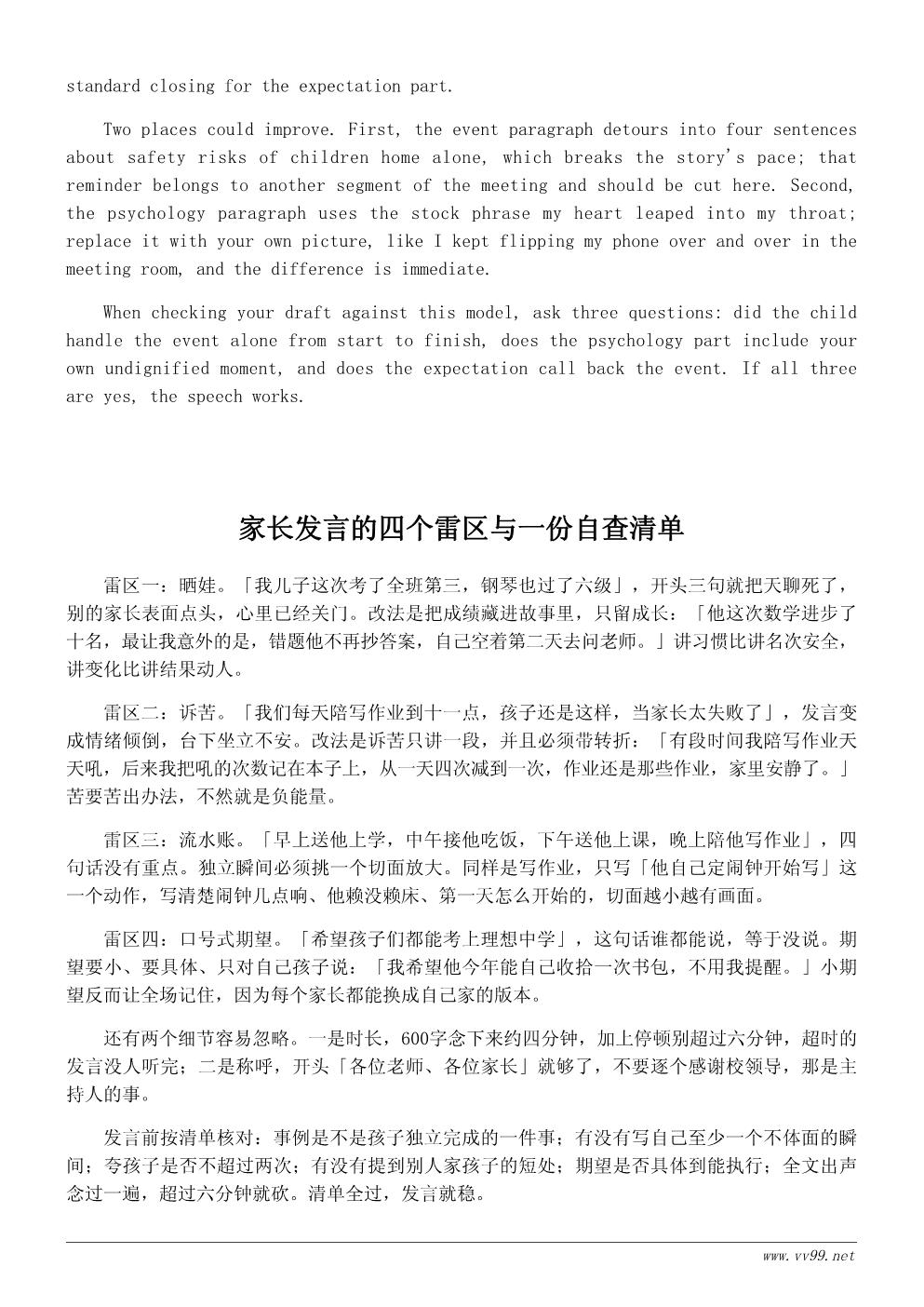
文章内容
家长发言稿怎么搭:独立瞬间、心理变化、期望三段法
先分字数:称呼开场约50字,孩子独立的瞬间约250字,自己的心理变化约200字,期望约80字,致谢约40字。这个分配的关键是瞬间部分最重,因为家长会的发言靠故事撑场,道理只是收尾。
选「第一次独立完成任务」的事例,标准有三条:任务要完整,从开始到结束孩子一个人做完;过程要出过岔子,顺利的故事没听头;结果不必完美,做砸了反而真实。假设你选「孩子第一次独自坐公交去上课」:他坐过站两站,下车后打电话来声音发颤,自己查站牌坐回来。三条件全占,这就是好素材。
写瞬间部分用「监控视角」:你不在现场,怎么讲得具体?靠事后还原。孩子自己的描述、他回来后的动作、你检查留下的痕迹,都是材料。「他回来说坐过站了,然后把公交卡从书包侧袋换到前袋,说下次不会再忘。」一个换口袋的动作,比十句「他长大了」都管用。
心理变化部分按时间写三层:事前(送不送纠结)、事中(等待的煎熬)、事后(发现孩子比自己想象的行)。假设写事前:「我在门口把鞋递给他,嘴上说去吧去吧,手已经把公交卡塞进他兜里。」嘴上放手、手上不放手,这种矛盾心理每个家长都有,说出来台下会点头。
期望部分最容易翻车,两个坑:一是攀比,「希望他下次考进前十」会让别的家长反感;二是太空,「希望他健康快乐」像贺卡。改法是期望只对着自己孩子,并且落在具体品质上:「我不指望他事事出色,只希望他坐过站之后,还愿意自己查站牌坐回来。」期望呼应前面的故事,整篇就闭环了。
语气上记住三句话:夸孩子不超过两次,讲自己的糗事可以多一点,不点评别人家的孩子。家长会发言的得体,不是措辞多讲究,而是让每位家长都觉得你说的是自己家的事。
How to Structure a Parents Meeting Speech: Independence, Feelings, Expectation
Divide the words first: about 50 for the greeting, about 250 for the moment of independence, about 200 for your own change of heart, about 80 for the expectation, and about 40 for thanks. The moment part carries the most weight, because a parents meeting speech stands on a story; the lesson only closes it.
For the first time completing a task alone, use three selection standards: the task must be complete, done by the child from start to finish; something must go wrong along the way, since smooth stories bore people; the result need not be perfect, and a mess is actually more real. Suppose you choose the child riding the bus alone to a class for the first time: he passed his stop by two, called with a shaking voice, then checked the sign and rode back. All three conditions met, that is good material.
Write the moment from a camera view: you were not there, so how is it specific? Reconstruct afterward. The child's own account, what he did when he got home, the traces you found, all count as material. He said he missed the stop, then moved the bus card from the side pocket of his bag to the front pocket, saying he would not forget next time. One pocket-switch beats ten lines about him growing up.
For the change of heart, write three layers in time order: before the event, the tug of war over letting go; during it, the long wait of worry; after it, finding the child more capable than you imagined. For the before layer, suppose you write: I handed him his shoes at the door, saying go ahead go ahead, while my hand already stuffed the bus card into his pocket. Mouth letting go, hand not letting go, every parent recognizes that contradiction, and the room will nod.
The expectation part fails most often, in two ways. One is comparing: hoping he cracks the top ten next time annoys other parents. Two is emptiness: hoping he is healthy and happy reads like a greeting card. Fix it by aiming the expectation only at your own child, pinned to a concrete quality: I do not expect him to excel at everything; I only hope that after missing a stop, he still wants to check the sign and ride back. The expectation echoes the story, and the whole speech closes the loop.
On tone, remember three rules: praise the child no more than twice, share more of your own blunders, and never comment on other people's children. Decorum at a parents meeting is not fancy wording; it is making every parent feel you are talking about their own family.
范文点评:《他把自己锁在门外的那二十分钟》
假设范文开头:「各位老师、各位家长:晚上好。我讲一件上个月的事,我儿子把自己锁在了家门外,整整二十分钟。」开头没有「时光飞逝」的客套,直接抛出事故,「二十分钟」这个具体时长让在座家长立刻开始代入自己孩子。家长会发言的开头要的就是这个效果。
事件还原段是这篇范文最扎实的地方。孩子放学回家发现忘带钥匙,小区门禁需要刷卡进不来,他做了三件事:先按门铃,家里没人;再给我打电话,我在开会没听见;最后他蹲在楼道里等,等到邻居回家才借电话打通。范文没有美化孩子,「蹲在楼道里等」这个有点笨的办法恰恰是真实的,家长会上讲孩子笨拙的可爱,比讲聪明更打动人。
心理段写的是家长自己:「我开完会看到五个未接来电,往回跑的路上想的不是孩子冷不冷,而是他会不会怪我。见到他第一句话是对不起,他倒说没事,我在楼下等得还挺好玩。」这段的高明处是写错了顺序的关心:先想到孩子的责备,再想到冷暖,这是真实父母的心理,不是标准答案。结尾孩子那句「还挺好玩」把紧张卸掉,台下会笑,笑完才有共鸣。
期望段只有一句:「我不求他从不遇到麻烦,只求他被锁在门外的时候,肯自己想办法,也肯等。」一句话回扣全部事件,不喊口号,不跟别人比,这就是期望部分的标准收法。
两处可以改进。一是事件段里家长补了一段「现在孩子独自在家的安全隐患」,足足四句,把故事节奏打断了,这类安全提醒放家长会其他环节更合适,发言里应删掉。二是心理段用了「我的心提到了嗓子眼」这种现成套话,换成自己的话,比如「我在会议室里把手机翻过来又翻过去」,画面感立刻不同。
拿这篇范文对照自己的稿子,问三个问题:事件是不是孩子一个人从头做到尾,心理段有没有写自己不体面的瞬间,期望有没有回扣事件。三个都是,这篇发言就成立。
A Model Speech Annotated: The Twenty Minutes He Locked Himself Out
Suppose the model opens: Teachers and parents, good evening. Let me tell you something from last month. My son locked himself out of our apartment, for a full twenty minutes. No small talk about time flying, straight into the accident, and the specific twenty minutes makes every parent in the room start picturing their own child. That is exactly what an opening at a parents meeting should do.
The reconstruction paragraph is the sturdiest part. The child came home from school, found he forgot the key, and the building gate needed a card he did not have. He did three things: rang the doorbell, nobody home; called me, I was in a meeting and missed it; then squatted in the corridor and waited until a neighbor came home and he could borrow a phone. The speech does not polish the child. Squatting and waiting is a slightly clumsy move, and that is what makes it real. At a parents meeting, the charm of a child's clumsiness moves people more than cleverness does.
The psychology paragraph is about the parent: After the meeting I saw five missed calls. Running back, what I thought of was not whether he was cold, but whether he would blame me. My first words when I saw him were sorry, and he said it is fine, waiting downstairs was kind of fun. The brilliance is the out-of-order care: blame first, warmth second, which is how real parents think, not the model answer. The child's line about it being fun releases the tension; the room laughs, and the laughter is what creates resonance.
The expectation is one sentence: I do not ask that he never meets trouble; I only ask that when he is locked out, he is willing to think of a way, and willing to wait. One line that calls back the whole event, no slogans, no comparisons. That is the standard closing for the expectation part.
Two places could improve. First, the event paragraph detours into four sentences about safety risks of children home alone, which breaks the story's pace; that reminder belongs to another segment of the meeting and should be cut here. Second, the psychology paragraph uses the stock phrase my heart leaped into my throat; replace it with your own picture, like I kept flipping my phone over and over in the meeting room, and the difference is immediate.
When checking your draft against this model, ask three questions: did the child handle the event alone from start to finish, does the psychology part include your own undignified moment, and does the expectation call back the event. If all three are yes, the speech works.
小提示:上面此文档内容仅展示完整文档里的部分内容, 若需要下载完整文档请 点击免费下载完整文档 。