文章内容
班会演讲稿三段式:失败、坚持、感悟这样搭
拿到这个题目先别急着写,先把600字分好:称呼和开头约60字,失败经历约200字,坚持到底约200字,感悟约100字,结尾致谢约40字。分配清楚后每段都有话可说,不会写到一半就没词。
开头两句话完成两件事:称呼加悬念。假设你写「敬爱的老师、亲爱的同学们:大家好!我想讲一件我到现在都记得的事,那天我考砸了,但我一点也不后悔。」听众马上想知道为什么考砸还不后悔,注意力就抓住了。别用「光阴似箭,日月如梭」这类开头,班会上一半人会走神。
失败经历部分只选一件事。选的标准:时间、地点、结果都能写具体。「我数学考了68分,卷子发下来时,最后一道大题整个空着,卷面上全是红色的叉」,比「我经历过一次失败」强十倍。写情绪别用「我很伤心」,写动作:把卷子塞进书包最底层,晚上躺在床上盯着天花板。动作让听众自己得出伤心的结论,这比直接说更有感染力。
坚持到底部分回答三个问题:做了什么、坚持了多久、中间有没有想放弃。假设你写「每天重做三道错题,坚持了六个星期,第三周的时候我烦了,把错题本推到一边,第二天又把它拉回来」。小行动加转折才可信,只写「我努力奋斗」,听众不会买账。
感悟部分只留一个道理,别贪多。假设你的故事讲的是坚持,感悟就写「结果不会马上变好,但坚持会让结果慢慢变好」,再用两三句话展开。感悟必须回扣前面的失败和坚持,前面讲坚持、结尾却感谢老师,就接不上了。
结尾一句致谢收住:「我的演讲完了,谢谢大家。」不重复感悟,不喊口号。上台前把长句改短,加上「同学们」「大家」这类称呼,在需要停顿和加重的地方做小记号,讲出来才不像念稿。
The Three-Part Class Meeting Speech: Failure, Persistence, Insight
When you get this title, do not start writing right away. First divide the 600 words: about 60 for the greeting and opening, about 200 for the failure, about 200 for the persistence, about 100 for the insight, and about 40 for the closing thanks. With the plan clear, every part has something to say, and you will not run out of words halfway.
The opening should do two things in two sentences: a greeting plus a hook. Suppose you write: Dear teachers and classmates, hello! I want to tell you something I still remember today. That day I failed a test badly, but I do not regret it at all. The audience immediately wonders why a failure brings no regret, and you have their attention. Do not open with stock phrases about time flying; half the class will drift off.
For the failure part, choose only one event. The standard: you can state the time, the place, and the result concretely. I got 68 in math; when the paper came back, the last big question was completely blank, and the page was full of red crosses works ten times better than I once experienced a failure. To show feelings, do not write I was sad. Write actions: stuffing the paper into the bottom of the schoolbag, lying in bed staring at the ceiling. Actions let the audience reach the conclusion themselves, which is more moving than stating it.
The persistence part answers three questions: what did you do, how long did it last, and did you want to give up. Suppose you write: I redid three wrong problems every day for six weeks; in the third week I got fed up and pushed the notebook aside, then pulled it back the next day. Small actions plus a turn make it believable. If you only write I worked hard, the audience will not buy it.
Keep only one lesson in the insight part. If your story is about persistence, write something like results do not improve right away, but persistence slowly improves them, then expand in two or three sentences. The insight must connect back to the failure and the persistence. If the story is about persistence but the ending thanks the teacher, the parts do not fit.
Close with one line of thanks: That is the end of my speech. Thank you. Do not repeat the lesson or shout a slogan. Before going on stage, cut long sentences into short ones, add words like classmates and everyone, and mark where to pause or stress. Then it sounds like speaking, not reading.
范文点评:《那次演讲比赛,我忘词了》
假设范文开头是:「老师们、同学们:大家好!三个月前我站在讲台上,脑子一片空白,站了整整四十秒。」这个开头直接进事故现场,四十秒这个数字让尴尬变得可感,比「那次失败让我刻骨铭心」有效得多。班会演讲的第一分钟决定听众是否抬头,范文用具体秒数换来了这个抬头。
失败段里有一句值得抄进笔记:「下台的时候,我听见后排有人笑,我确定那是在笑我,虽然可能不是。」先写听到的,再写自己脑补的,最后自己拆穿自己,一句话把难堪和自尊都写出来了。失败经历要写得真实,靠的就是这种「写事实,也写事实引发的胡思乱想」。
坚持段写的是练稿过程:「我把稿子录成音频,上学路上听,睡觉前听,听了两个星期,后来闭着眼都能背。但我知道背熟不等于不紧张,所以我对着家里的镜子练,第一遍笑场了,第五遍才像样。」这段的聪明处在于承认背熟之后还会紧张,然后给出对策。很多同学写坚持只写到「我反复练习」就停了,范文多走了两步:练到什么程度、还剩什么问题、怎么解决,坚持才有说服力。
感悟段只有一句核心:「那天的四十秒教会我,准备不能只准备到刚好够,要多准备一截,那一截就是留给紧张的。」这个感悟从练稿经历里长出来,不是硬贴上去的大道理。演讲稿的感悟最好能变成一句听众带得走的话,范文这句做到了。
范文也有两处可以改。一是中段罗列练习方式时连用了三个「听」,读起来齐得假,改成「听、背、默写」三种不同动作更自然。二是结尾致谢前加了一段「同学们,让我们一起勇敢面对失败吧」,这种号召在班会演讲里容易空,删掉,直接停在感悟那句再加致谢,反而有力。
对照这篇范文改自己的稿子时,检查三件事:失败有没有具体数字或画面,坚持有没有写到「还剩什么问题」,感悟能不能脱离全文单独成立。三件事都过关,600字的稿子就立住了。
A Model Speech Annotated: I Forgot My Words at That Speech Contest
Suppose the model speech opens like this: Teachers and classmates, hello! Three months ago I stood on stage with my mind completely blank and stood there for a full forty seconds. This opening walks straight into the scene, and the number forty seconds makes the embarrassment tangible, far better than that failure is etched in my heart. The first minute of a class meeting speech decides whether the audience looks up, and the model earns that look with a concrete number.
One sentence in the failure paragraph is worth copying into your notebook: On my way off stage I heard someone laughing in the back row, and I was sure it was at me, though maybe it was not. First the sound, then the story the mind adds, then the self-correction, all in one line, capturing both humiliation and pride. Failure feels real when you write the fact and the racing thoughts the fact causes.
The persistence paragraph is about drilling the script: I recorded it as audio, listened on the way to school and before bed for two weeks, until I could recite it with my eyes closed. But memorizing does not stop nervousness, so I practiced in front of the mirror; the first try made me laugh, the fifth looked decent. The clever part is admitting nervousness survives memorization, then offering a fix. Many students stop at I practiced again and again. The model takes two more steps: how far the practice went, what problem remained, and how it was solved. That is what makes persistence convincing.
The insight paragraph has one core line: Those forty seconds taught me that preparation should never stop at just enough; keep an extra length, and that extra is reserved for nervousness. The lesson grows out of the practice story instead of being pasted on. A speech insight should be a sentence the audience can carry home, and this one qualifies.
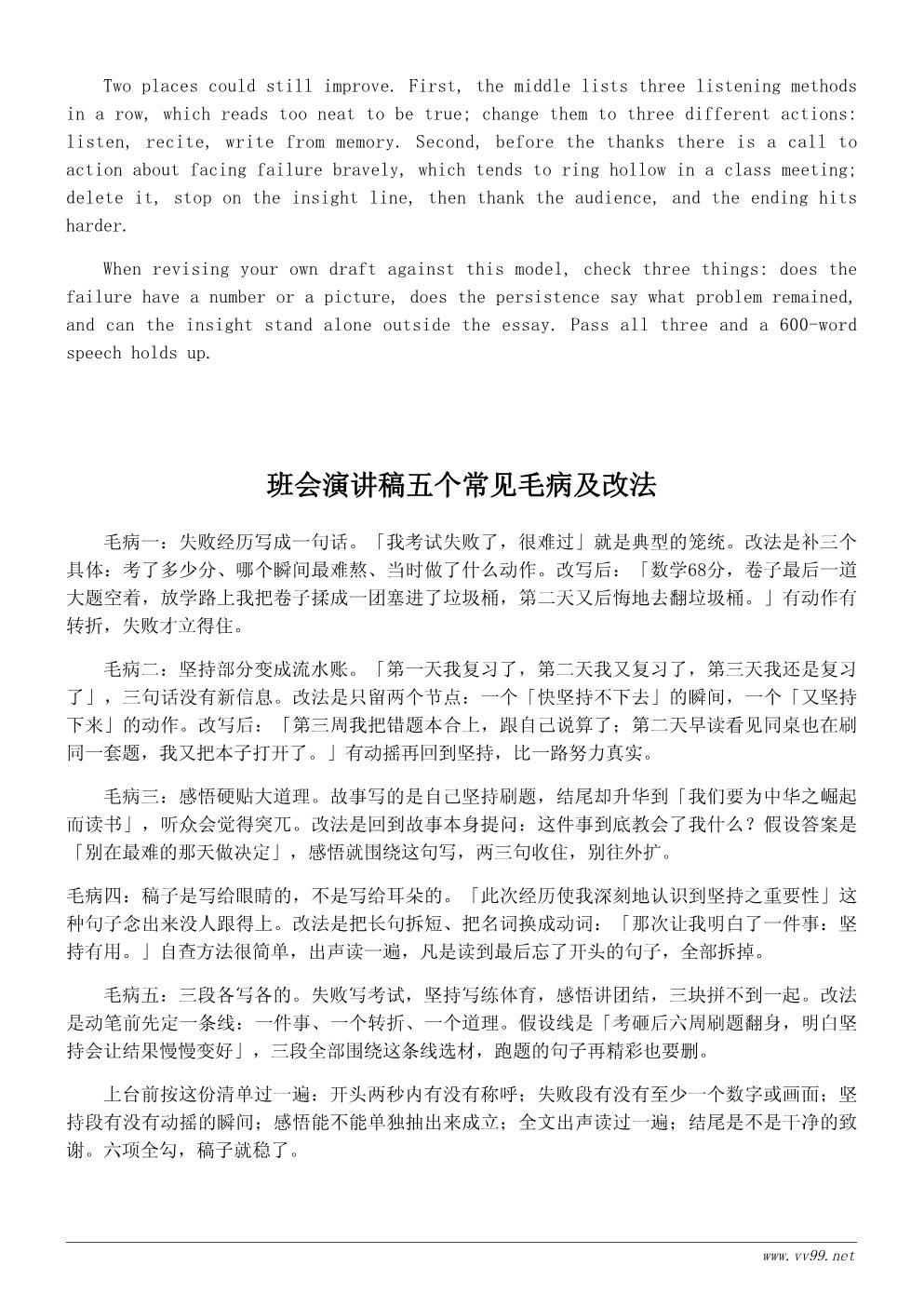
Two places could still improve. First, the middle lists three listening methods in a row, which reads too neat to be true; change them to three different actions: listen, recite, write from memory. Second, before the thanks there is a call to action about facing failure bravely, which tends to ring hollow in a class meeting; delete it, stop on the insight line, then thank the audience, and the ending hits harder.
When revising your own draft against this model, check three things: does the failure have a number or a picture, does the persistence say what problem remained, and can the insight stand alone outside the essay. Pass all three and a 600-word speech holds up.
小提示:上面此文档内容仅展示完整文档里的部分内容, 若需要下载完整文档请 点击免费下载完整文档 。