文章内容
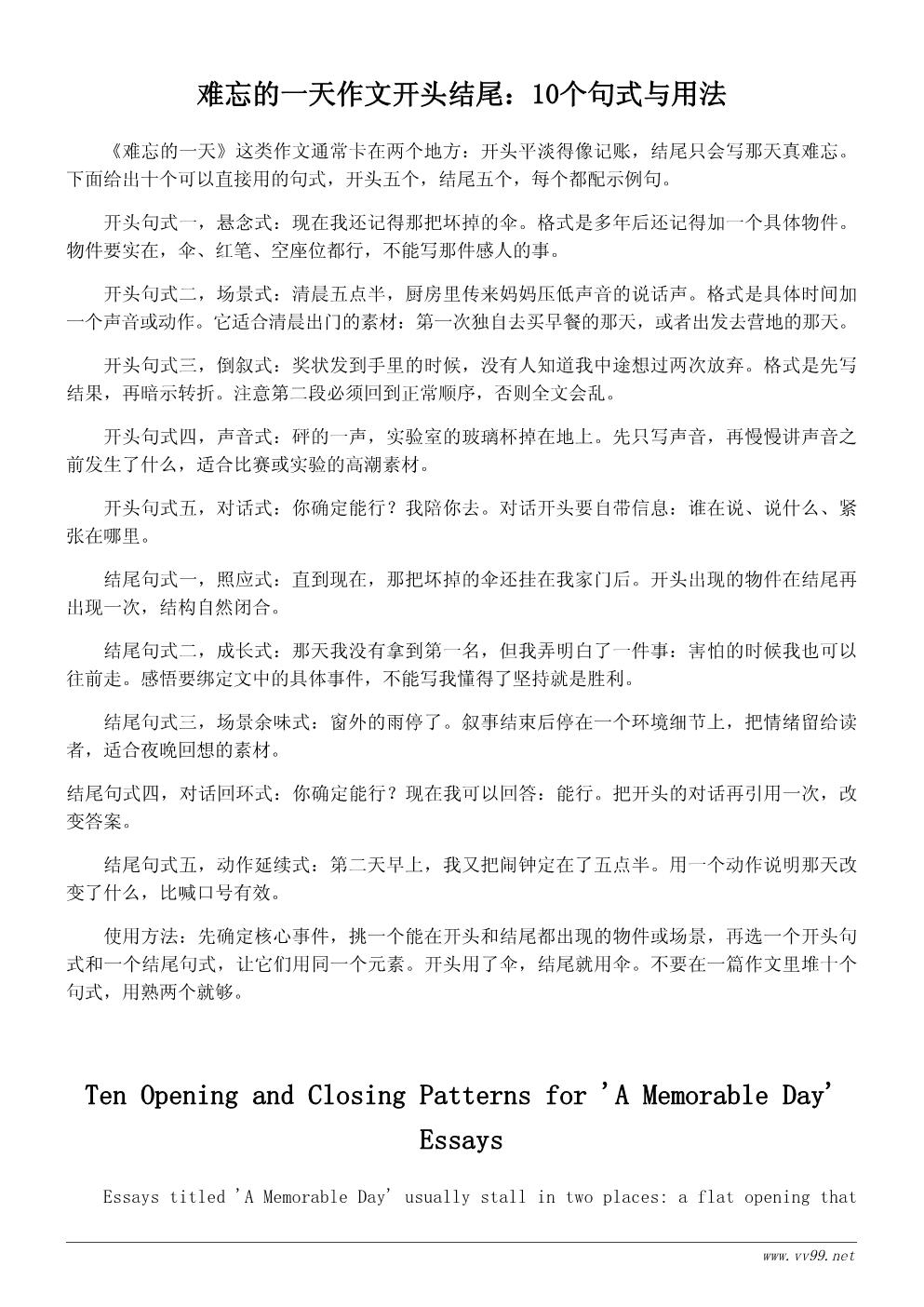
难忘的一天作文开头结尾:10个句式与用法
《难忘的一天》这类作文通常卡在两个地方:开头平淡得像记账,结尾只会写那天真难忘。下面给出十个可以直接用的句式,开头五个,结尾五个,每个都配示例句。
开头句式一,悬念式:现在我还记得那把坏掉的伞。格式是多年后还记得加一个具体物件。物件要实在,伞、红笔、空座位都行,不能写那件感人的事。
开头句式二,场景式:清晨五点半,厨房里传来妈妈压低声音的说话声。格式是具体时间加一个声音或动作。它适合清晨出门的素材:第一次独自去买早餐的那天,或者出发去营地的那天。
开头句式三,倒叙式:奖状发到手里的时候,没有人知道我中途想过两次放弃。格式是先写结果,再暗示转折。注意第二段必须回到正常顺序,否则全文会乱。
开头句式四,声音式:砰的一声,实验室的玻璃杯掉在地上。先只写声音,再慢慢讲声音之前发生了什么,适合比赛或实验的高潮素材。
开头句式五,对话式:你确定能行?我陪你去。对话开头要自带信息:谁在说、说什么、紧张在哪里。
结尾句式一,照应式:直到现在,那把坏掉的伞还挂在我家门后。开头出现的物件在结尾再出现一次,结构自然闭合。
结尾句式二,成长式:那天我没有拿到第一名,但我弄明白了一件事:害怕的时候我也可以往前走。感悟要绑定文中的具体事件,不能写我懂得了坚持就是胜利。
结尾句式三,场景余味式:窗外的雨停了。叙事结束后停在一个环境细节上,把情绪留给读者,适合夜晚回想的素材。
结尾句式四,对话回环式:你确定能行?现在我可以回答:能行。把开头的对话再引用一次,改变答案。
结尾句式五,动作延续式:第二天早上,我又把闹钟定在了五点半。用一个动作说明那天改变了什么,比喊口号有效。
使用方法:先确定核心事件,挑一个能在开头和结尾都出现的物件或场景,再选一个开头句式和一个结尾句式,让它们用同一个元素。开头用了伞,结尾就用伞。不要在一篇作文里堆十个句式,用熟两个就够。
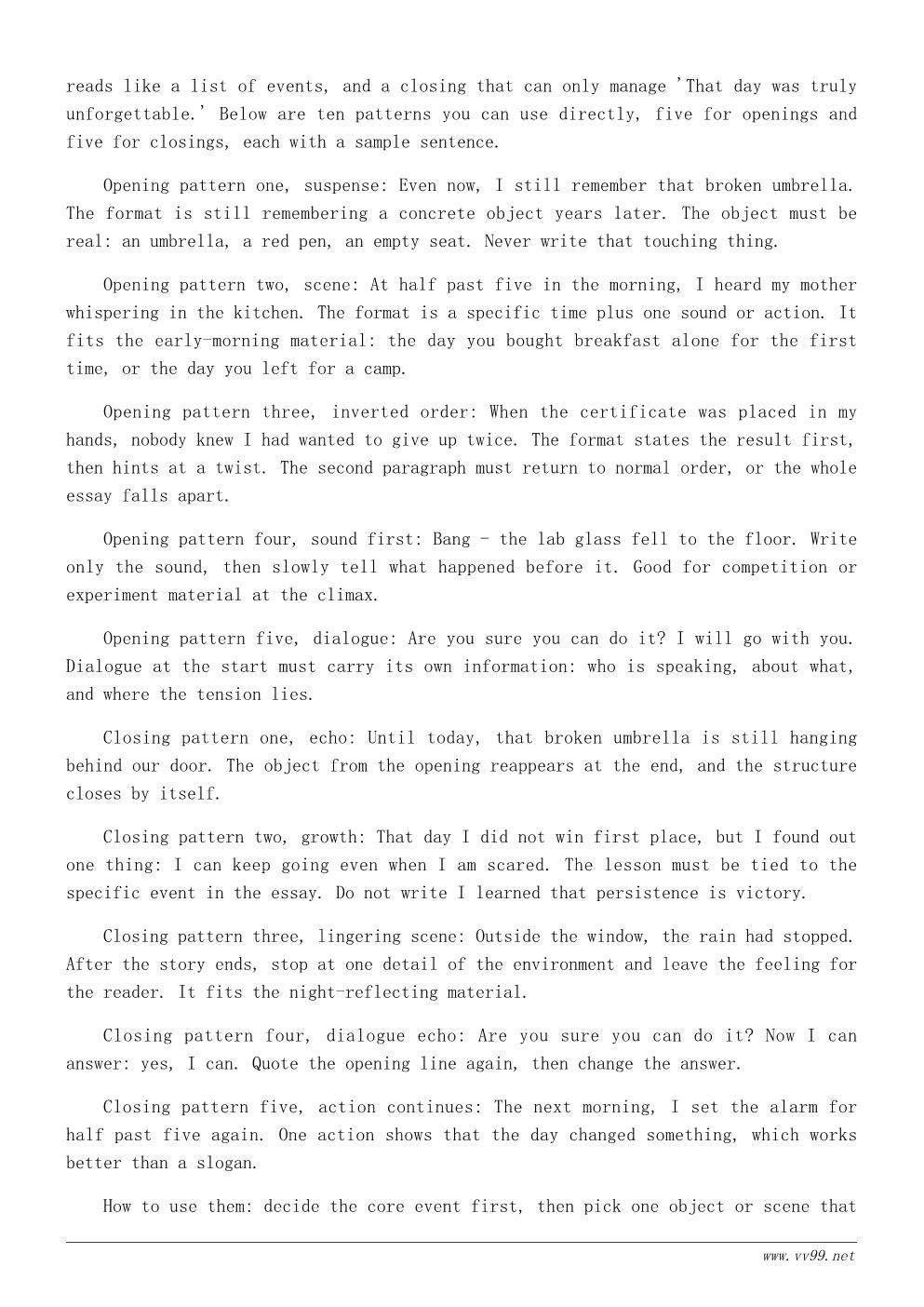
Ten Opening and Closing Patterns for 'A Memorable Day' Essays
Essays titled 'A Memorable Day' usually stall in two places: a flat opening that reads like a list of events, and a closing that can only manage 'That day was truly unforgettable.' Below are ten patterns you can use directly, five for openings and five for closings, each with a sample sentence.
Opening pattern one, suspense: Even now, I still remember that broken umbrella. The format is still remembering a concrete object years later. The object must be real: an umbrella, a red pen, an empty seat. Never write that touching thing.
Opening pattern two, scene: At half past five in the morning, I heard my mother whispering in the kitchen. The format is a specific time plus one sound or action. It fits the early-morning material: the day you bought breakfast alone for the first time, or the day you left for a camp.
Opening pattern three, inverted order: When the certificate was placed in my hands, nobody knew I had wanted to give up twice. The format states the result first, then hints at a twist. The second paragraph must return to normal order, or the whole essay falls apart.
Opening pattern four, sound first: Bang - the lab glass fell to the floor. Write only the sound, then slowly tell what happened before it. Good for competition or experiment material at the climax.
Opening pattern five, dialogue: Are you sure you can do it? I will go with you. Dialogue at the start must carry its own information: who is speaking, about what, and where the tension lies.
Closing pattern one, echo: Until today, that broken umbrella is still hanging behind our door. The object from the opening reappears at the end, and the structure closes by itself.
Closing pattern two, growth: That day I did not win first place, but I found out one thing: I can keep going even when I am scared. The lesson must be tied to the specific event in the essay. Do not write I learned that persistence is victory.
Closing pattern three, lingering scene: Outside the window, the rain had stopped. After the story ends, stop at one detail of the environment and leave the feeling for the reader. It fits the night-reflecting material.
Closing pattern four, dialogue echo: Are you sure you can do it? Now I can answer: yes, I can. Quote the opening line again, then change the answer.
Closing pattern five, action continues: The next morning, I set the alarm for half past five again. One action shows that the day changed something, which works better than a slogan.
How to use them: decide the core event first, then pick one object or scene that can appear at both the start and the end, and choose one opening pattern and one closing pattern built on the same element. If the opening uses the umbrella, let the closing use the umbrella too. Do not stack all ten patterns in one essay; two well-used patterns are enough.
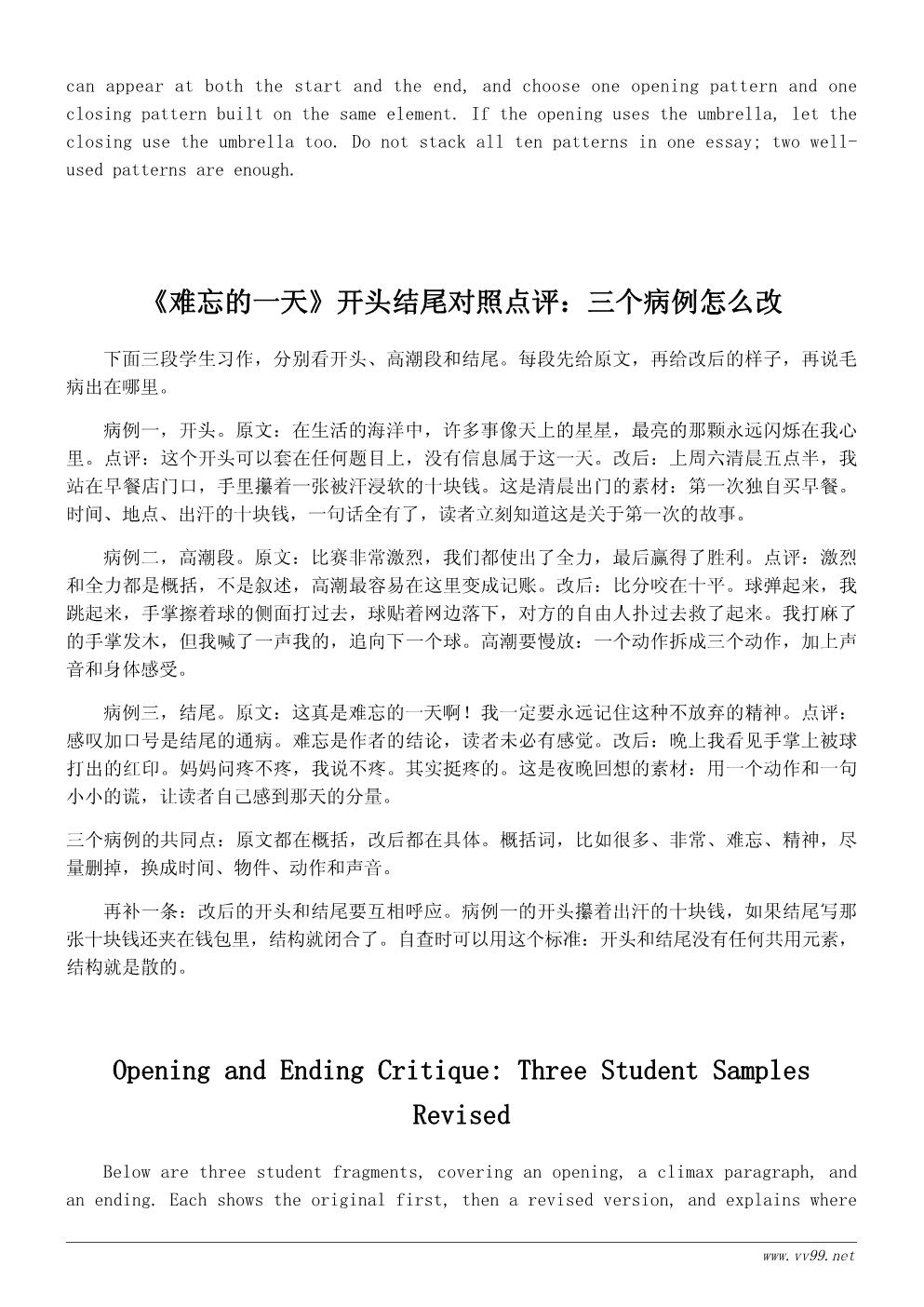
《难忘的一天》开头结尾对照点评:三个病例怎么改
下面三段学生习作,分别看开头、高潮段和结尾。每段先给原文,再给改后的样子,再说毛病出在哪里。
病例一,开头。原文:在生活的海洋中,许多事像天上的星星,最亮的那颗永远闪烁在我心里。点评:这个开头可以套在任何题目上,没有信息属于这一天。改后:上周六清晨五点半,我站在早餐店门口,手里攥着一张被汗浸软的十块钱。这是清晨出门的素材:第一次独自买早餐。时间、地点、出汗的十块钱,一句话全有了,读者立刻知道这是关于第一次的故事。
病例二,高潮段。原文:比赛非常激烈,我们都使出了全力,最后赢得了胜利。点评:激烈和全力都是概括,不是叙述,高潮最容易在这里变成记账。改后:比分咬在十平。球弹起来,我跳起来,手掌擦着球的侧面打过去,球贴着网边落下,对方的自由人扑过去救了起来。我打麻了的手掌发木,但我喊了一声我的,追向下一个球。高潮要慢放:一个动作拆成三个动作,加上声音和身体感受。
病例三,结尾。原文:这真是难忘的一天啊!我一定要永远记住这种不放弃的精神。点评:感叹加口号是结尾的通病。难忘是作者的结论,读者未必有感觉。改后:晚上我看见手掌上被球打出的红印。妈妈问疼不疼,我说不疼。其实挺疼的。这是夜晚回想的素材:用一个动作和一句小小的谎,让读者自己感到那天的分量。
三个病例的共同点:原文都在概括,改后都在具体。概括词,比如很多、非常、难忘、精神,尽量删掉,换成时间、物件、动作和声音。
再补一条:改后的开头和结尾要互相呼应。病例一的开头攥着出汗的十块钱,如果结尾写那张十块钱还夹在钱包里,结构就闭合了。自查时可以用这个标准:开头和结尾没有任何共用元素,结构就是散的。
Opening and Ending Critique: Three Student Samples Revised
Below are three student fragments, covering an opening, a climax paragraph, and an ending. Each shows the original first, then a revised version, and explains where the problem is.
Case one, the opening. Original: In the sea of life, many events are like stars in the sky, and the brightest one shines in my heart forever. Critique: this opening can be attached to any topic; it carries no information about this particular day. Revised: Last Saturday at half past five in the morning, I stood at the entrance of the breakfast shop, holding a ten-yuan note gone soft with sweat. That is the early-morning material: buying breakfast alone for the first time. Time, place, and the sweaty note all appear in one sentence, and the reader knows at once this is a story about a first time.
Case two, the climax. Original: The match was fierce, we all gave our all, and we finally won. Critique: fierce and gave our all are summaries, not narration; this is where a climax turns into bookkeeping. Revised: The score was tied at ten. The ball bounced up, I jumped, my palm brushed the side of it, the ball skimmed the net and fell, and the other side's libero dived to save it. My stung palm went numb, but I shouted Mine and chased the next ball. A climax needs slow motion: turn one action into three, and add sound and body feeling.
Case three, the ending. Original: What an unforgettable day! I will always remember this spirit of never giving up. Critique: exclamation plus slogan is the standard ending illness. Unforgettable is the writer's conclusion; the reader may not feel it. Revised: At night I saw the red mark on my palm where the ball had hit. Mom asked if it hurt. I said no. It actually hurt a lot. That is the night-reflecting material: one action and one small lie let the reader feel the weight of that day on their own.
The common thread in all three cases: the originals stay general, the revisions get specific. General words such as many, very, unforgettable, and spirit should be cut and replaced with time, objects, actions, and sounds.
One more rule: the revised opening and ending must echo each other. If the opening holds a sweaty ten-yuan note, the ending can say that note is still in the wallet, and the structure closes. A simple test: if the opening and the ending share no element at all, the structure is loose.
小提示:上面此文档内容仅展示完整文档里的部分内容, 若需要下载完整文档请 点击免费下载完整文档 。