文章内容
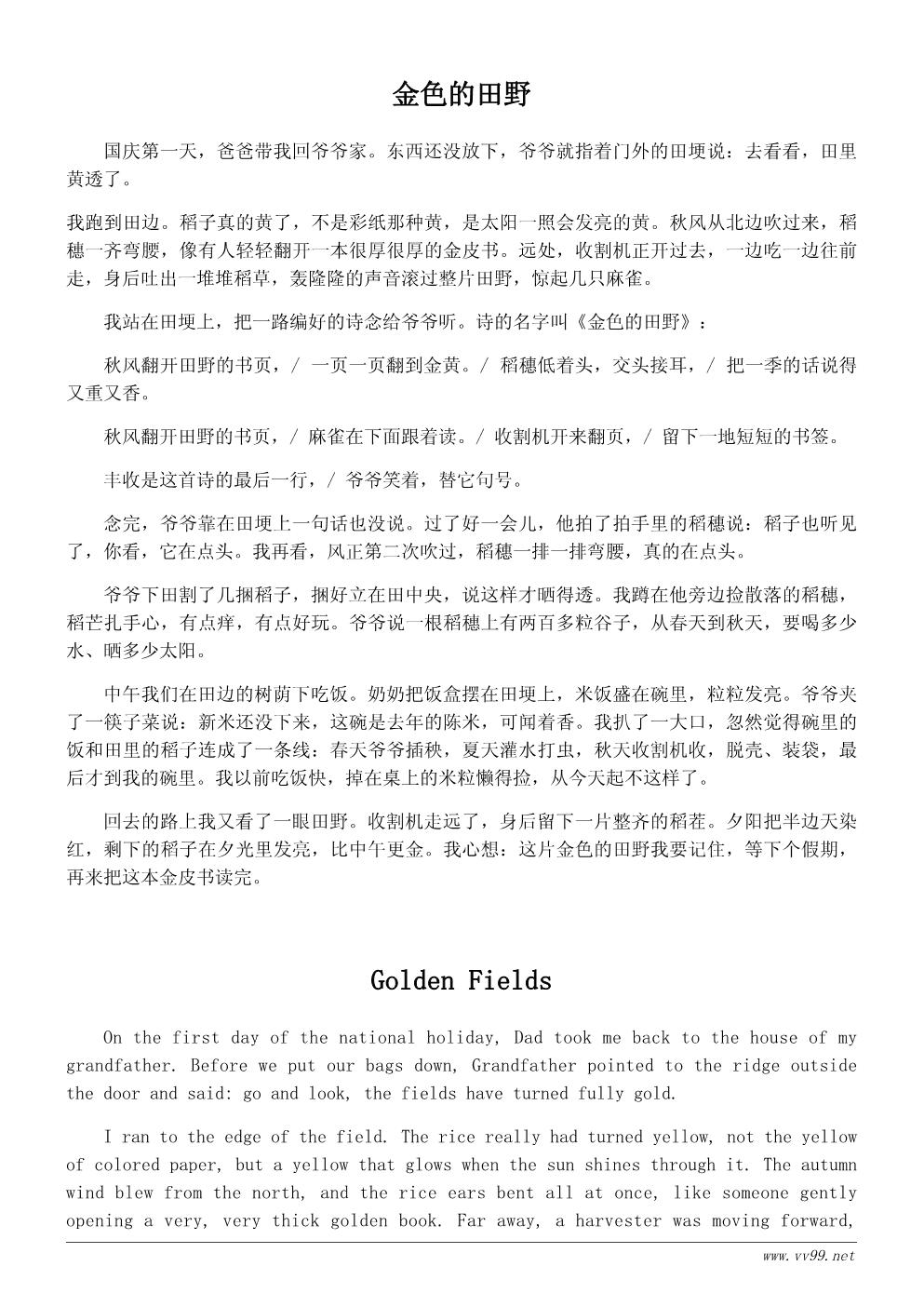
金色的田野
国庆第一天,爸爸带我回爷爷家。东西还没放下,爷爷就指着门外的田埂说:去看看,田里黄透了。
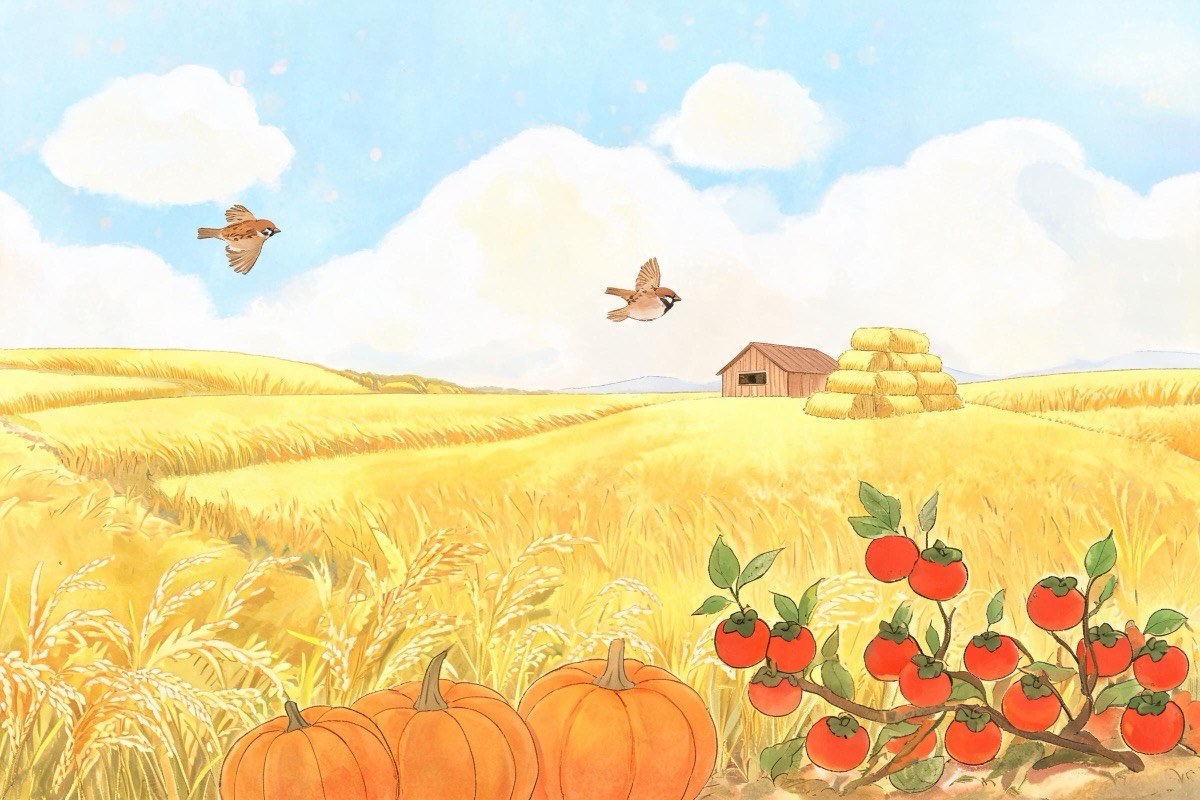
我跑到田边。稻子真的黄了,不是彩纸那种黄,是太阳一照会发亮的黄。秋风从北边吹过来,稻穗一齐弯腰,像有人轻轻翻开一本很厚很厚的金皮书。远处,收割机正开过去,一边吃一边往前走,身后吐出一堆堆稻草,轰隆隆的声音滚过整片田野,惊起几只麻雀。
我站在田埂上,把一路编好的诗念给爷爷听。诗的名字叫《金色的田野》:
秋风翻开田野的书页,/ 一页一页翻到金黄。/ 稻穗低着头,交头接耳,/ 把一季的话说得又重又香。
秋风翻开田野的书页,/ 麻雀在下面跟着读。/ 收割机开来翻页,/ 留下一地短短的书签。
丰收是这首诗的最后一行,/ 爷爷笑着,替它句号。
念完,爷爷靠在田埂上一句话也没说。过了好一会儿,他拍了拍手里的稻穗说:稻子也听见了,你看,它在点头。我再看,风正第二次吹过,稻穗一排一排弯腰,真的在点头。
爷爷下田割了几捆稻子,捆好立在田中央,说这样才晒得透。我蹲在他旁边捡散落的稻穗,稻芒扎手心,有点痒,有点好玩。爷爷说一根稻穗上有两百多粒谷子,从春天到秋天,要喝多少水、晒多少太阳。
中午我们在田边的树荫下吃饭。奶奶把饭盒摆在田埂上,米饭盛在碗里,粒粒发亮。爷爷夹了一筷子菜说:新米还没下来,这碗是去年的陈米,可闻着香。我扒了一大口,忽然觉得碗里的饭和田里的稻子连成了一条线:春天爷爷插秧,夏天灌水打虫,秋天收割机收,脱壳、装袋,最后才到我的碗里。我以前吃饭快,掉在桌上的米粒懒得捡,从今天起不这样了。
回去的路上我又看了一眼田野。收割机走远了,身后留下一片整齐的稻茬。夕阳把半边天染红,剩下的稻子在夕光里发亮,比中午更金。我心想:这片金色的田野我要记住,等下个假期,再来把这本金皮书读完。
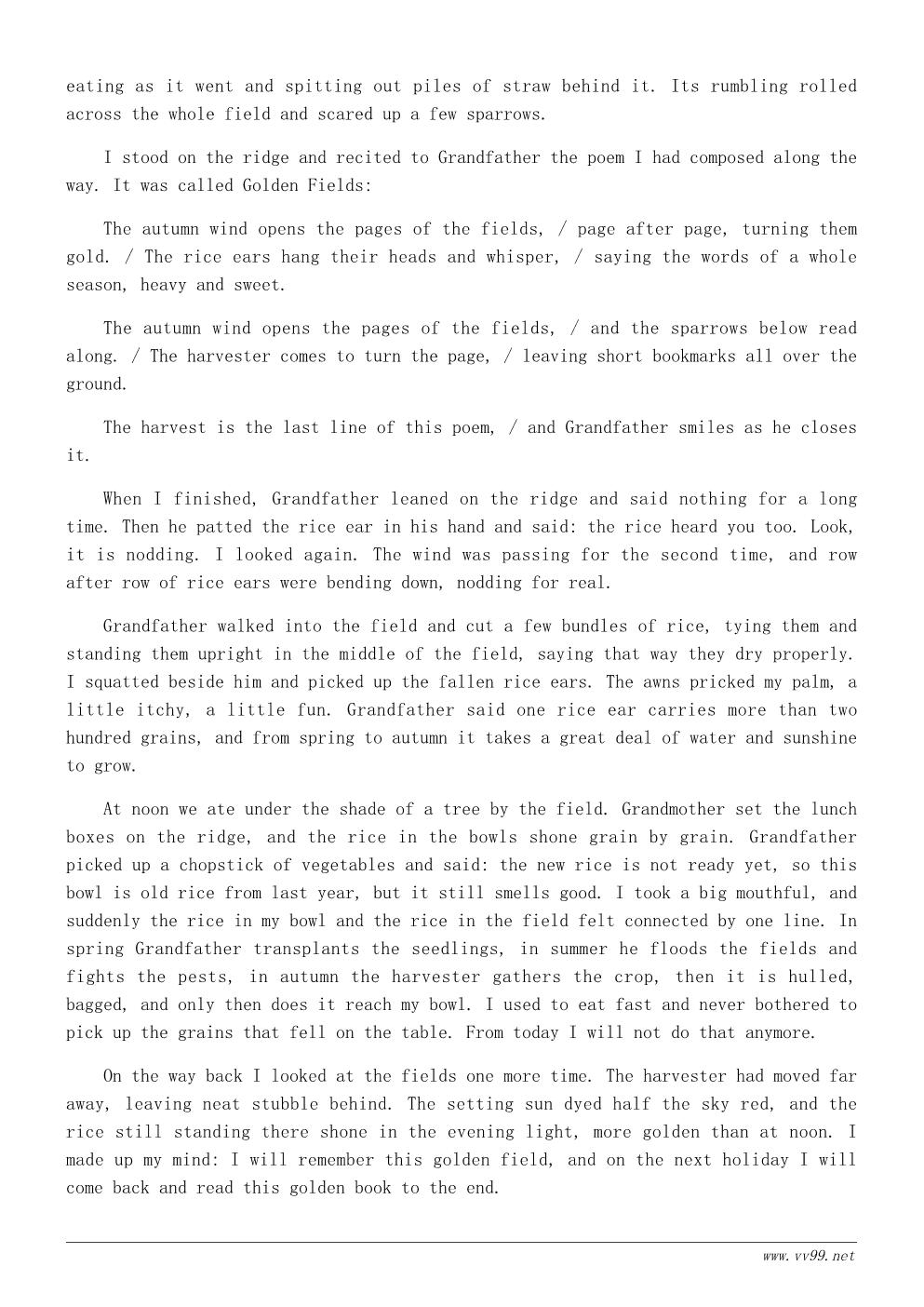
Golden Fields
On the first day of the national holiday, Dad took me back to the house of my grandfather. Before we put our bags down, Grandfather pointed to the ridge outside the door and said: go and look, the fields have turned fully gold.
I ran to the edge of the field. The rice really had turned yellow, not the yellow of colored paper, but a yellow that glows when the sun shines through it. The autumn wind blew from the north, and the rice ears bent all at once, like someone gently opening a very, very thick golden book. Far away, a harvester was moving forward, eating as it went and spitting out piles of straw behind it. Its rumbling rolled across the whole field and scared up a few sparrows.
I stood on the ridge and recited to Grandfather the poem I had composed along the way. It was called Golden Fields:
The autumn wind opens the pages of the fields, / page after page, turning them gold. / The rice ears hang their heads and whisper, / saying the words of a whole season, heavy and sweet.
The autumn wind opens the pages of the fields, / and the sparrows below read along. / The harvester comes to turn the page, / leaving short bookmarks all over the ground.
The harvest is the last line of this poem, / and Grandfather smiles as he closes it.
When I finished, Grandfather leaned on the ridge and said nothing for a long time. Then he patted the rice ear in his hand and said: the rice heard you too. Look, it is nodding. I looked again. The wind was passing for the second time, and row after row of rice ears were bending down, nodding for real.
Grandfather walked into the field and cut a few bundles of rice, tying them and standing them upright in the middle of the field, saying that way they dry properly. I squatted beside him and picked up the fallen rice ears. The awns pricked my palm, a little itchy, a little fun. Grandfather said one rice ear carries more than two hundred grains, and from spring to autumn it takes a great deal of water and sunshine to grow.
At noon we ate under the shade of a tree by the field. Grandmother set the lunch boxes on the ridge, and the rice in the bowls shone grain by grain. Grandfather picked up a chopstick of vegetables and said: the new rice is not ready yet, so this bowl is old rice from last year, but it still smells good. I took a big mouthful, and suddenly the rice in my bowl and the rice in the field felt connected by one line. In spring Grandfather transplants the seedlings, in summer he floods the fields and fights the pests, in autumn the harvester gathers the crop, then it is hulled, bagged, and only then does it reach my bowl. I used to eat fast and never bothered to pick up the grains that fell on the table. From today I will not do that anymore.
On the way back I looked at the fields one more time. The harvester had moved far away, leaving neat stubble behind. The setting sun dyed half the sky red, and the rice still standing there shone in the evening light, more golden than at noon. I made up my mind: I will remember this golden field, and on the next holiday I will come back and read this golden book to the end.
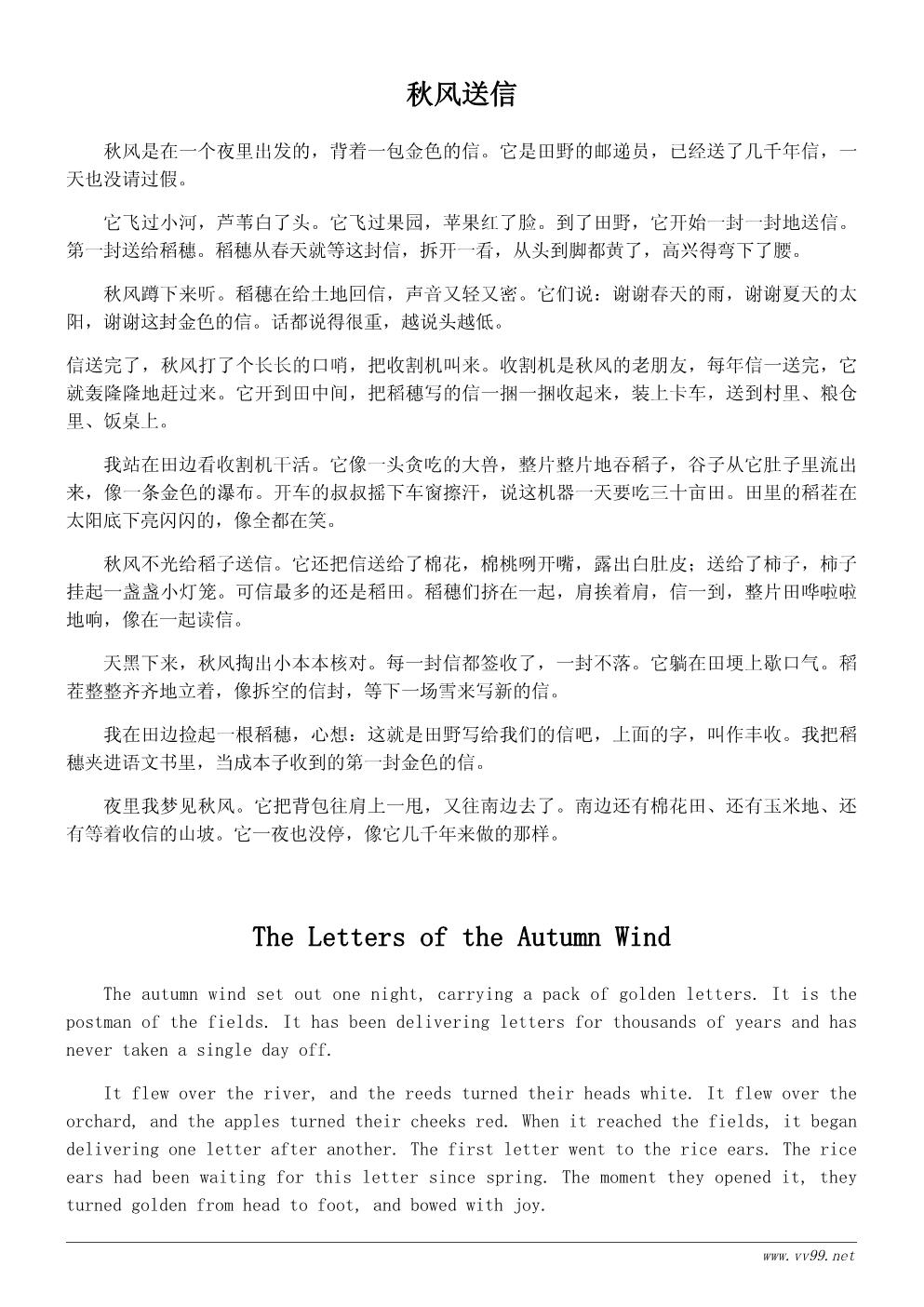
秋风送信
秋风是在一个夜里出发的,背着一包金色的信。它是田野的邮递员,已经送了几千年信,一天也没请过假。
它飞过小河,芦苇白了头。它飞过果园,苹果红了脸。到了田野,它开始一封一封地送信。第一封送给稻穗。稻穗从春天就等这封信,拆开一看,从头到脚都黄了,高兴得弯下了腰。
秋风蹲下来听。稻穗在给土地回信,声音又轻又密。它们说:谢谢春天的雨,谢谢夏天的太阳,谢谢这封金色的信。话都说得很重,越说头越低。
信送完了,秋风打了个长长的口哨,把收割机叫来。收割机是秋风的老朋友,每年信一送完,它就轰隆隆地赶过来。它开到田中间,把稻穗写的信一捆一捆收起来,装上卡车,送到村里、粮仓里、饭桌上。
我站在田边看收割机干活。它像一头贪吃的大兽,整片整片地吞稻子,谷子从它肚子里流出来,像一条金色的瀑布。开车的叔叔摇下车窗擦汗,说这机器一天要吃三十亩田。田里的稻茬在太阳底下亮闪闪的,像全都在笑。
秋风不光给稻子送信。它还把信送给了棉花,棉桃咧开嘴,露出白肚皮;送给了柿子,柿子挂起一盏盏小灯笼。可信最多的还是稻田。稻穗们挤在一起,肩挨着肩,信一到,整片田哗啦啦地响,像在一起读信。
天黑下来,秋风掏出小本本核对。每一封信都签收了,一封不落。它躺在田埂上歇口气。稻茬整整齐齐地立着,像拆空的信封,等下一场雪来写新的信。
我在田边捡起一根稻穗,心想:这就是田野写给我们的信吧,上面的字,叫作丰收。我把稻穗夹进语文书里,当成本子收到的第一封金色的信。
夜里我梦见秋风。它把背包往肩上一甩,又往南边去了。南边还有棉花田、还有玉米地、还有等着收信的山坡。它一夜也没停,像它几千年来做的那样。
The Letters of the Autumn Wind
The autumn wind set out one night, carrying a pack of golden letters. It is the postman of the fields. It has been delivering letters for thousands of years and has never taken a single day off.
It flew over the river, and the reeds turned their heads white. It flew over the orchard, and the apples turned their cheeks red. When it reached the fields, it began delivering one letter after another. The first letter went to the rice ears. The rice ears had been waiting for this letter since spring. The moment they opened it, they turned golden from head to foot, and bowed with joy.
The autumn wind squatted down to listen. The rice ears were writing letters back to the soil, their voices light and thick. They said: thank you for the rain of spring, thank you for the sun of summer, thank you for this golden letter. Every word was heavy, and the more they spoke, the lower they bowed.
When the letters were done, the autumn wind gave a long whistle and called the harvester. The harvester is an old friend of the autumn wind. Every year, as soon as the letters are delivered, it comes rolling over. It drives into the middle of the field, gathers the letters of the rice ears bundle by bundle, loads them onto the truck, and sends them to the village, to the granary, to the dinner table.
I stood by the field and watched the harvester work. It was like a big greedy animal, swallowing the rice swath by swath, and the grain poured out of its belly like a golden waterfall. The driver rolled down his window and wiped his sweat. He said the machine eats thirty mu of field in a day. The stubble glittered in the sun, as if the whole field were laughing.
The autumn wind does not deliver only to the rice. It also carried letters to the cotton, and the cotton bolls opened their mouths and showed their white bellies. It carried letters to the persimmons, and the persimmons hung up lantern after lantern. Still, the fields with the most letters are the rice fields. The rice ears stand shoulder to shoulder, and when the letters arrive, the whole field rustles, as if it were reading them together.
When dark fell, the autumn wind took out its little book and checked. Every letter had been signed for, not one missing. It lay down on the ridge to rest. The stubble stood in neat rows, like emptied envelopes, waiting for the next snow to write new letters.
I picked up a rice ear by the field and thought: this must be the letter the fields wrote to us. The word written on it is harvest. I pressed the rice ear into my Chinese textbook, as the first golden letter my notebook ever received.
At night I dreamed of the autumn wind. It slung its pack over one shoulder and headed south again. To the south there are still cotton fields, still cornfields, still hillsides waiting for their letters. It did not stop all night, just as it has done for thousands of years.
小提示:上面此文档内容仅展示完整文档里的部分内容, 若需要下载完整文档请 点击免费下载完整文档 。