文章内容
数蚂蚁的表格,我在上课前就做过
初二下学期,物理老师讲实验,头一个强调的词叫控制变量。我听到这四个字,脑子里冒出来的不是课本,而是前年十月我自己做的一张表。
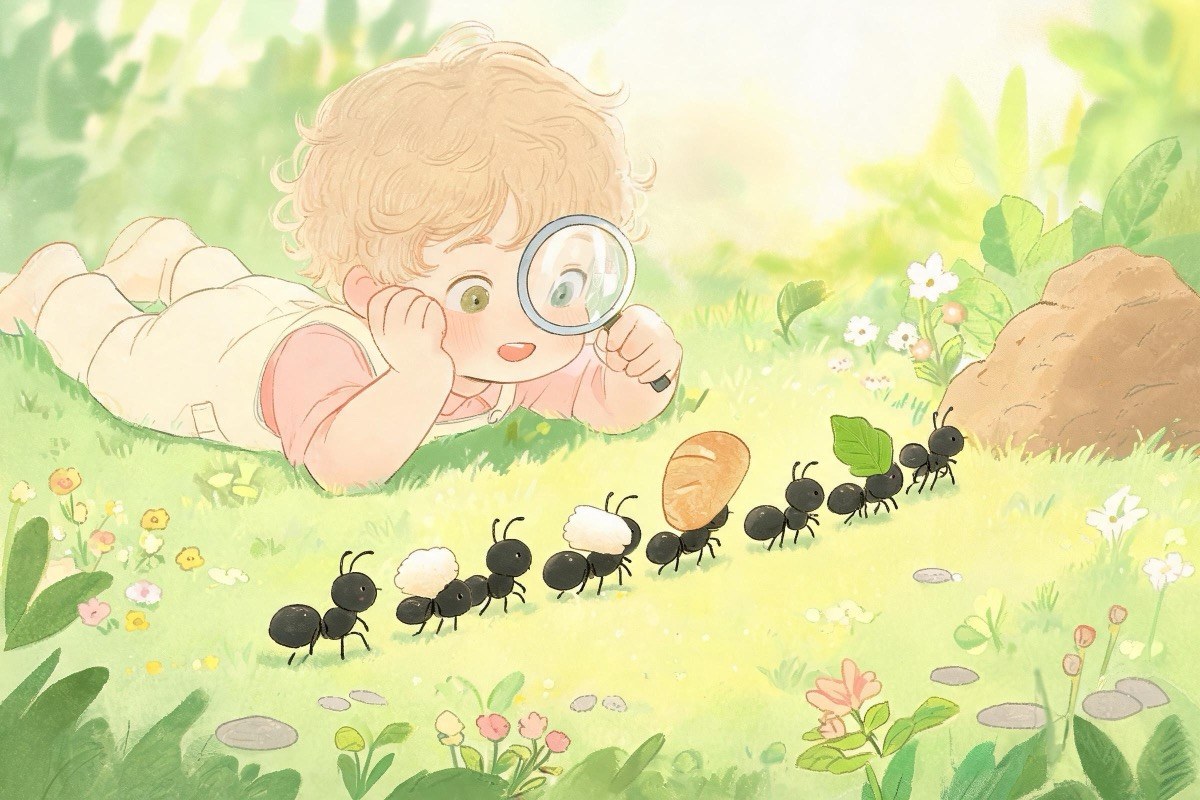
前年十月,我在花坛边看蚂蚁搬吃的。我盯的是它们搬东西有多快。我把一粒米放在蚁洞边上,第一只蚂蚁找到之后,我就数一分钟里有多少只蚂蚁经过花坛沿上的一个点。第一次数出来是14只。我觉得光一个数说明不了什么,就把米挪远两步,再数,这回是9只。再挪远两步,是6只。
回家我在作业纸反面画了张表:三行,记下距离和每分钟经过的只数。盯着这张表,我发现一件事:三次我都用的同一种米,都是同一个钟点,都在同一段花坛沿,变的只有距离那一个东西。那时候我不知道这种做法叫什么名字,只觉得不这样弄,数出来的数就对不上,就不可信。
物理课上,老师讲:研究两个量之间的关系,别的条件都要保持一样,只改变一个条件。我举手说我做过这个,我把米和只数的事讲了一遍。老师让我把那张表投出来给全班看,讲完他说:这就是控制变量,你们比课本早用了一年。
我的物理成绩那天以后并没有一下子变好,但我开始喜欢物理课了。因为那些规律不再是黑板上的字,是我手上已经干过的事。后来做斜面小车的实验,我们组是最快想明白哪些条件不能动的。
我的学习心得是:课本教的方法,是借来的;自己手上摸出来的方法,才是自己的。数蚂蚁的表很小,可做表的那一下,控制变量这四个字就不抽象了。我懂得观察不只是看,看了记下来,改一个条件再数一遍,这已经是学习的开头。
那张画着表的作业纸还夹在物理课本里。每次翻到实验那一页,都能看见14、9、6这三个数。它们提醒我:一个方法可以先用后学,用过了,才真的学会。
The Ant Counting Table I Made Before the Lesson
In the second term of my second year of middle school, the physics teacher began teaching experiments, and the first term he stressed was keeping other conditions the same. When I heard that phrase, what came to mind was not the textbook but a table I had made in October of the year before.
In October of that year, I watched the ants by the flower bed. What I watched was how fast they carried food. I placed a grain of rice near the hole, and after the first ant found it, I counted how many ants passed a point on the curb within one minute. The first count gave 14. I thought one number proved nothing, so I moved the rice two steps farther and counted again. This time it was 9. I moved it two more steps, and it was 6.
At home I drew a table on the back of a test paper: three rows, with the distance and the number passing per minute. Staring at the table, I noticed something. All three times I had used the same kind of rice, at the same hour, by the same curb. Only one thing had changed, the distance. I did not know the name of this method then. I only felt that if I did not do it this way, the numbers would not be trustworthy.
In physics class the teacher explained the method: when studying the relation between two quantities, keep every other condition unchanged and change only one. I raised my hand and said I had done this. I told him about the rice and the counts. He asked me to show my table to the class. When I finished, he said: this is exactly the method, and you had used it a year before the textbook.
My physics grades did not jump after that day, but I began to like physics class. The rules were no longer words on the blackboard; they were things my hands had already done. Later, in the experiment about a cart on a sloped board, my group was the first to work out which conditions must stay the same.
Here is my reflection as a learner: a method borrowed from the textbook belongs to the textbook, and a method your hands have found belongs to you. The ant table was small, but the moment I made it, the phrase about keeping conditions the same stopped being abstract. Observation is not just looking. To look, to write it down, to change one condition, to count again, that is where real learning begins.
The test paper with my table is still inside my physics textbook. Every time I reach the experiment pages, I see the three numbers: 14, 9, 6. They remind me that you can use a method before you learn its name, and using it is how you come to truly know it.
蚂蚁给我当了一学期的同桌
我有个习惯,从初一起就有:随身带个小本子,蹲在花坛边记蚂蚁。记了一学期,本子写满了两本。期末复习那阵子,我妈让我把闲书闲事都收起来,我把两个本子也收进了抽屉。结果复习到一半,我鬼使神差又把本子翻了出来。这一翻,翻出了我整个初中最好的一次成绩。
那天我背历史年代,背了忘、忘了背,烦得很。翻蚂蚁本子解闷,看到十月我记过:蚂蚁走的路不是直的,是先乱走,走熟了才成一条线。我盯着这句话愣了半天。历史年代不也是这样吗?一个年代孤零零地背,就是乱走;把它跟前后的事连起来,路就成线了。我拿铅笔在年代旁边画箭头,把洋务运动、甲午、戊戌串成一条线,再背,居然一遍就记住了。
我顺着这个想法把别的科也改了。数学错题以前是一道一道抄的,像散米粒。我改成先写这一类题的共同线,再把错题挂在线上当分支。英语单词以前按字母表背,我改成按话题串,一串带一串。那半个月,我复习的顺序全变了:先找线,再补点。
期末考完,我自己估的分比平时高。发完成绩单那天,我把两个蚂蚁本子从抽屉里拿出来,擦干净,放回书包。我妈看见了没说话,后来她跟别人讲:那两个黑本子倒成了功臣。
我的学习心得讲出来很简单:知识不是米粒,是蚁路。单看一粒米,搬起来费劲;看清了路,米自己会往家走。观察蚂蚁教会我的不是蚂蚁,是找线。错题本、年代线、单词串,全是蚁路这个想法生出来的。
现在我的本子还在记蚂蚁,不过记的东西多了:记完蚂蚁,我会顺手想一想,今天学的哪一课也有条线。观察的习惯留下来了,它就不只在花坛边起作用,它在每张课桌上都跟着我。
The Ants Were My Deskmates for a Whole Term
I have had a habit since the first year of middle school: a small notebook in my pocket, and notes about ants taken while crouching by the flower bed. After one term the notebook was filled to the end of two volumes. During the final review my mother told me to put away all idle reading and idle doings, so I put the notebooks in a drawer. Halfway through reviewing, I found myself pulling them out again. That single act led to the best grades of my middle school years.
That day I was memorizing historical dates. I forgot what I had just learned, over and over, and got frustrated. I opened the ant notebook to rest my mind, and found a line from October: the paths of ants are not straight at first; they wander wildly, and only after the wandering does one line remain. I stared at that sentence for a long while. Are historical dates not the same thing? A date memorized alone is wandering; connect it to the events before and after, and the road becomes a line. I took a pencil and drew arrows beside the dates, stringing the Self-Strengthening Movement, the Sino-Japanese War, and the Reform Movement into one line, and one round of memorizing held.
I carried the idea into other subjects. My math mistakes used to be copied one by one, like scattered grains of rice. I changed it: first write the common line of a type of problem, then hang the mistakes on the line as branches. I used to memorize English words in alphabetical order; I changed it to topic chains, one chain pulling the next. For half a month my whole review order changed: find the line first, then fill in the points.
After the final exams my own estimate came out higher than usual. On the day the report card was handed out, I took the two ant notebooks out of the drawer, wiped them clean, and put them back in my schoolbag. My mother said nothing at the time. Later she told others: those two black notebooks turned out to be heroes.
My reflection is simple: knowledge is not grains of rice, it is ant roads. A single grain is heavy to carry; once you see the road, the grain travels home by itself. What the ants taught me was not ants, it was how to find the line. The mistake notebook, the date line, the word chains, all of them grew from the idea of the ant road.
I still record ants in my notebook, but now I record more: after writing about ants, I like to think about which lesson I learned that day also has a line in it. Once the habit of observing stays with you, it works not only by the flower bed but at every desk, following you everywhere.
小提示:上面此文档内容仅展示完整文档里的部分内容, 若需要下载完整文档请 点击免费下载完整文档 。