文章内容
屋后的菜园
乡下的房子后头有一片菜园,一道竹篱笆围着,篱笆门上挂着一截旧麻绳,绳圈里常年插着一根拔菜的铁钩。从这门进去,左手边是一排豆角架,竹竿搭成人字,豆角藤绕着竿往上缠,架子底下阴凉,蹲着人乘过凉,地上还留着半个画歪的粉笔圈。右手边是六畦菜,畦与畦之间踩出窄窄的土路,路两边的土被脚底板磨得发亮。再往里走,靠墙立着一口黑釉水缸,缸口盖着木板,板上一只豁了口的瓢。菜园不大,从篱笆门到水缸,我数过,二十一步。
我在那儿待了一个暑假,眼睛最后全落在辣椒上。辣椒种在靠墙的畦里,一共七棵。六月底它们开花,花小,白的,五个瓣,落一朵花,枝丫里就顶出一枚朝天的小辣椒,青绿色,指头肚那么粗。七月的雨一场接一场,辣椒一天一个样,有的弯得像月牙,有的直得像钉子。最热闹的是八月的枝头,同一棵上,青的、半黄透红的、红透的挤在一处,红的那种颜色沉,像上过漆,太阳一照,油亮。我踮着脚摘过一根红的,咬一口,辣气从舌根冲上来,眼泪差点下来。外婆在边上笑,说辣椒要摘就摘红透的,半青的留着,明天它就红了。从那以后我每天早上去看那七棵,看它们一天红几根,像数日子。
菜园里最忙的人是外婆。傍晚她提着水瓢从水缸里舀水,从最外边的畦浇起,一瓢一瓢,水落在土上,土色深一块浅一块。她浇到辣椒畦会慢下来,把水浇在根边的土上,不冲叶子,说晌午冲叶子,太阳一晒,叶子要烂。浇完她顺手掐掉两根歪长的豇豆,扔进腰间的布袋。她在畦路上走,脚落在哪块土上不用看,哪块土松、哪块土滑,她比谁都清楚。有天夜里打雷,她披了雨衣去菜园,把豆角架上的竹竿又绑了一道。第二天架子好好的,她的鞋糊满了泥。我后来在城里吃过很多菜,舌头老想起那七棵辣椒。菜园还是那个菜园,篱笆门、豆角架、六畦菜、水缸,一样一样都在原地,只是提瓢的人,一年比一年矮了。
The Garden Behind the House
Behind the house in the village lies a vegetable garden, fenced round with bamboo. On the gate hangs a piece of old hemp rope, and in its loop stands an iron hook for pulling vegetables, there all year round. Entering through this gate, on the left is a row of bean trellises, bamboo poles leaned into A-frames, bean vines winding up the poles. Under the trellises is shade where people have squatted to escape the heat, and on the ground remains half of a chalk circle, drawn crooked. On the right lie six vegetable beds, with narrow dirt paths trodden between them, the soil on both sides of the paths polished smooth by shoe soles. Farther in, against the wall stands a black-glazed water jar, its mouth covered with a board, a notched ladle resting on the board. The garden is not big. From the gate to the water jar, I counted twenty-one steps.
I stayed there one summer vacation, and my eyes ended up resting entirely on the chili peppers. They grow in the bed by the wall, seven plants in all. At the end of June they flower, small white blossoms with five petals; when one flower falls, a small upward-pointing chili pushes out from the fork of the branches, blue-green, as thick as a fingertip. The rains of July come one after another, and the chilies change from day to day, some curved like a crescent moon, some straight like a nail. The liveliest sight is the branches in August: on one and the same plant, green ones, half-yellow turning red, and fully ripe red ones crowd together; the red ones carry a deep color, like lacquer, and shine oily in the sun. I once stood on tiptoe, picked a red one, took a bite, and the heat rose from the root of my tongue until tears nearly came. Grandmother laughed beside me, saying that if you pick chilies, pick the fully ripe red ones, and leave the half-green, for tomorrow they will turn red. After that I went to look at those seven plants every morning, counting how many turned red each day, like counting the days of the month.
The busiest person in the garden is Grandmother. In the evening she carries the ladle, scoops water from the jar, and starts watering from the outermost bed, one ladle after another, the water falling on the soil, which darkens patch by patch. When she reaches the chili bed she slows down, pouring the water on the soil around the roots rather than over the leaves, saying that water on the leaves at noon, baked by the sun, will rot them. When she finishes she pinches off two straggly long beans and drops them into the cloth bag at her waist. Walking along the bed paths, she never looks at where her feet land; she knows better than anyone which soil is loose and which is slippery. One night with thunder, she put on her raincoat and went out to the garden to lash the bamboo poles of the bean trellis one more time. The next day the trellis stood firm, and her shoes were caked with mud. Later, eating many vegetables in the city, my tongue still often recalls those seven chili plants. The garden is still that garden; the gate, the bean trellises, the six beds, the water jar, each still in its place. Only the person carrying the ladle grows a little shorter each year.
爷爷的西红柿架
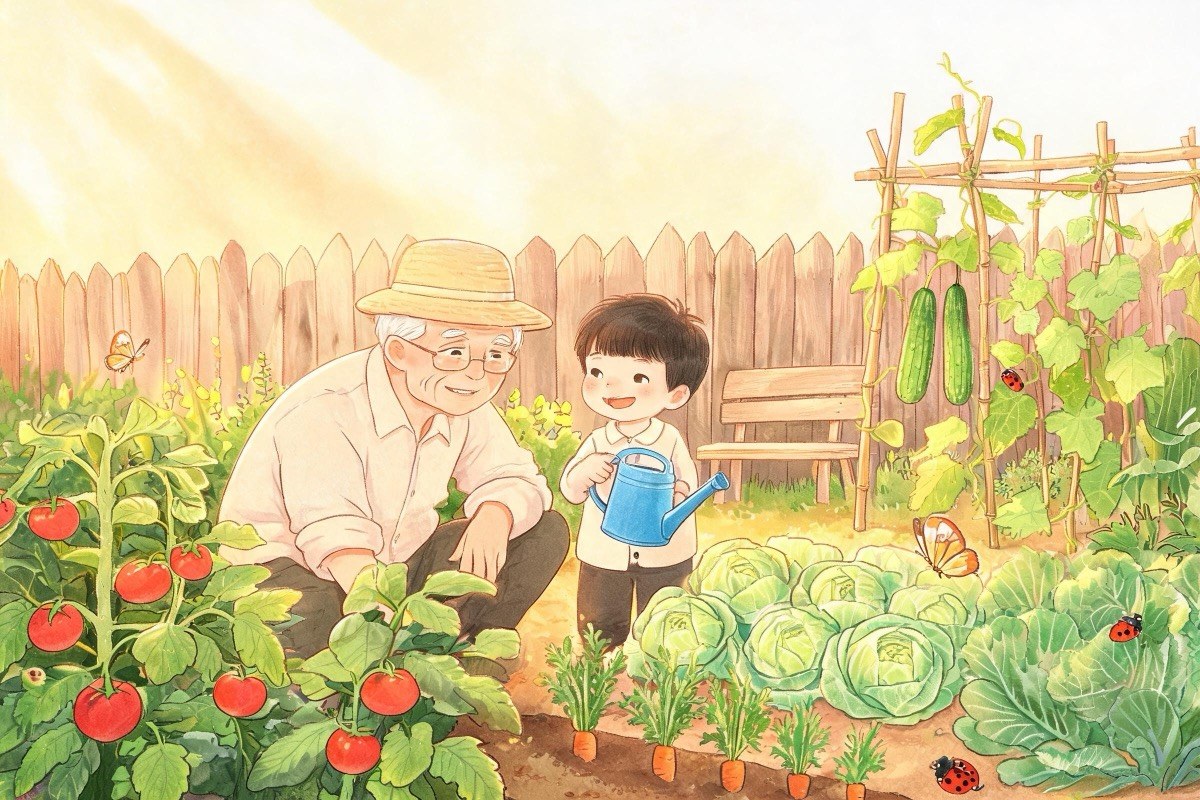
爷爷在菜园靠墙的地方立了一排西红柿架,八根竹竿,绑着八棵苗,像给它们一人发了一根拐杖。他跟我说,西红柿是站着结果的作物,得扶。我那时刚上初一,暑假回去,天天往菜园跑,看来看去,看入了西红柿。
六月中旬,苗上开黄花,一穗一穗,花心是深的橙。花谢了,底下结出青果,硬邦邦的,顶上带个五角形的蒂。爷爷蹲在架前打杈,指头一掰,叶腋里冒出来的小杈就掉了,他说杈不打,养分全喂了叶子,果子就光长个不甜。他打杈极快,一棵十几下,打完拍拍手上的土。绑蔓用的是玉米皮撕成的条,绕一圈,打个活扣,他说死扣勒手,藤长粗了会疼。我问他藤会疼吗,他说种了一辈子,看什么都像会疼。
七月底西红柿开始转色,从果肩上一圈淡红起头,一天红过一圈。爷爷想了个办法,在每穗果旁边插一小截香烟盒纸,写上日子,说这样就知道哪穗该摘了。我替他念纸上的字,念到第三穗,他摘下一个还带点青的,说这个挂到屋里,一周自己就红。挂在窗钩上的那个真的一天天红了,红得比地里的慢,但匀。八月中旬的一天早上,架子上的熟果一齐到了时候,红得发软,太阳照过来,果皮上一层亮。爷爷摘了一捧,在褂子上蹭两下,挑最红的一个直接递到我手里,说甜,咬。我站在架边咬开,汁水顺着手肘往下淌,沙瓤,甜里带一点酸。爷爷看着我笑,自己也拿了一个,不蹭,直接咬,说地里的果子干净。
后来那排架子拆了,竹竿收进柴房。我在城里写作业的夜里,偶尔想起那截插在果穗边的烟盒纸,一小条白纸上写着铅笔字,像给果子记的账。爷爷一辈子没给家里记过账,倒给西红柿记过。妈妈说他现在种得少了,八根竿换成四根,还是靠墙立着,每年六月开花。我打电话回去,他说今年的头一穗红了,给我留着。我说留着干什么,他又说了一遍,留着,你回来摘。电话那头有风,吹得架子上的绳响。我知道他递菜的手还是那样,蹭两下,直接塞过来,什么也不多说。
Grandpa's Tomato Trellis
Grandpa put up a row of tomato trellises against the wall of the garden, eight bamboo poles tied to eight seedlings, like handing each one a walking stick. He told me tomatoes bear fruit standing up, so they need support. I had just entered seventh grade that summer, and every day I ran out to the garden, and whatever I looked at, I ended up lost in the tomatoes.
In mid-June the seedlings opened yellow flowers, spike after spike, the centers a deep orange. When the flowers faded, hard green fruits formed beneath, each topped with a five-pointed calyx. Grandpa squatted before the trellis to remove suckers, flicking his finger and snapping off the little shoots from the leaf axils. He said if the suckers are left, the nourishment all feeds the leaves, and the fruit grows big but not sweet. He worked fast, a dozen flicks per plant, then dusted the soil off his hands. For tying the vines he used strips torn from corn husks, winding once and finishing with a slip knot, saying a hard knot cuts into the hand and the swelling vine would ache. I asked him whether a vine could ache. He said after farming a lifetime, everything looks like it could ache.
At the end of July the tomatoes began to change color, starting with a pale ring at the shoulder of the fruit, reddening one ring deeper each day. Grandpa hit on a trick: beside each fruit cluster he stuck in a small slip of cigarette-box paper with the date written on it, saying that way you know which cluster is ready. I read the pencil marks for him, and at the third cluster he picked one still slightly green, saying hang it indoors and in a week it will redden by itself. The one on the window hook really did redden day by day, slower than those in the ground, but evenly. One morning in mid-August, the ripe fruit on the trellis all reached their hour at once, red and soft, a sheen on the skin in the sunlight. Grandpa picked a handful, wiped one twice on his jacket, chose the reddest, and handed it straight to me, saying it is sweet, bite into it. Standing by the trellis I bit open, juice running down to my elbow, sandy pulp, sweet with a thread of sour. Grandpa watched me and smiled, took one himself, did not wipe it, bit right in, saying fruit from the ground is clean.
Later that row of trellises came down, and the poles went into the woodshed. On nights doing homework in the city, I sometimes think of that slip of cigarette-box paper beside the fruit cluster, a narrow white strip with pencil writing, like an account kept for the tomatoes. Grandpa never kept accounts for the family, yet he kept them for his tomatoes. Mother says he grows less now, four poles instead of eight, still against the wall, still flowering every June. When I phone home he says the first cluster this year has turned red, saved for me. I ask what for. He says it again: saved, come back and pick it. There is wind on the line, rattling the ties on the trellis. I know his hands passing over vegetables are still the same, wipe twice, press it into you, and say nothing more.
小提示:上面此文档内容仅展示完整文档里的部分内容, 若需要下载完整文档请 点击免费下载完整文档 。