文章内容
文章内容
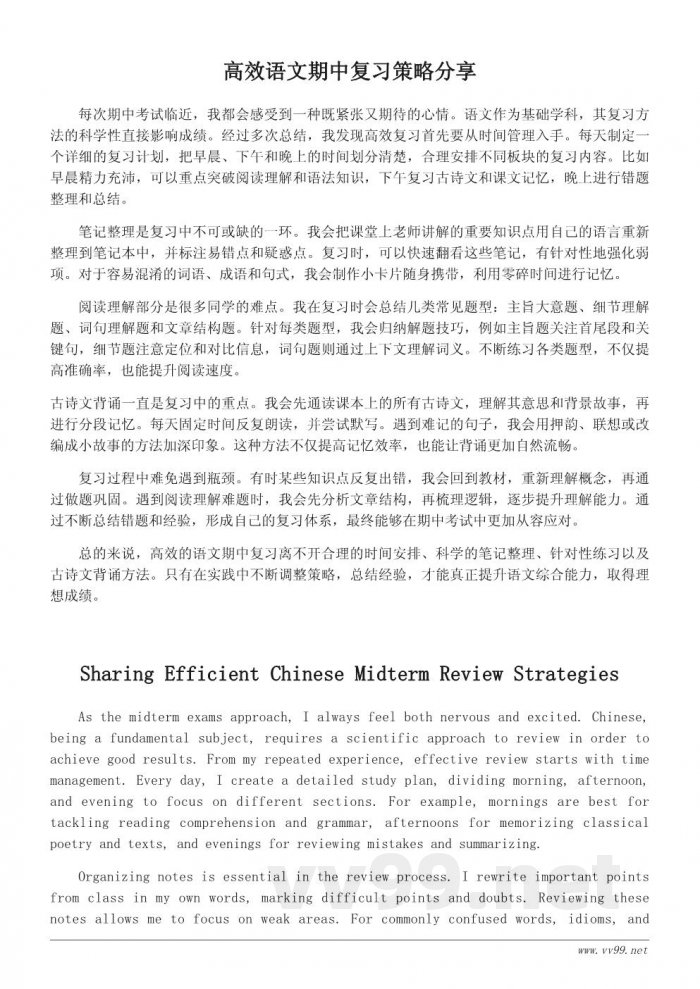
高效语文期中复习策略分享
每次期中考试临近,我都会感受到一种既紧张又期待的心情。语文作为基础学科,其复习方法的科学性直接影响成绩。经过多次总结,我发现高效复习首先要从时间管理入手。每天制定一个详细的复习计划,把早晨、下午和晚上的时间划分清楚,合理安排不同板块的复习内容。比如早晨精力充沛,可以重点突破阅读理解和语法知识,下午复习古诗文和课文记忆,晚上进行错题整理和总结。
笔记整理是复习中不可或缺的一环。我会把课堂上老师讲解的重要知识点用自己的语言重新整理到笔记本中,并标注易错点和疑惑点。复习时,可以快速翻看这些笔记,有针对性地强化弱项。对于容易混淆的词语、成语和句式,我会制作小卡片随身携带,利用零碎时间进行记忆。
阅读理解部分是很多同学的难点。我在复习时会总结几类常见题型:主旨大意题、细节理解题、词句理解题和文章结构题。针对每类题型,我会归纳解题技巧,例如主旨题关注首尾段和关键句,细节题注意定位和对比信息,词句题则通过上下文理解词义。不断练习各类题型,不仅提高准确率,也能提升阅读速度。
古诗文背诵一直是复习中的重点。我会先通读课本上的所有古诗文,理解其意思和背景故事,再进行分段记忆。每天固定时间反复朗读,并尝试默写。遇到难记的句子,我会用押韵、联想或改编成小故事的方法加深印象。这种方法不仅提高记忆效率,也能让背诵更加自然流畅。
复习过程中难免遇到瓶颈。有时某些知识点反复出错,我会回到教材,重新理解概念,再通过做题巩固。遇到阅读理解难题时,我会先分析文章结构,再梳理逻辑,逐步提升理解能力。通过不断总结错题和经验,形成自己的复习体系,最终能够在期中考试中更加从容应对。
总的来说,高效的语文期中复习离不开合理的时间安排、科学的笔记整理、针对性练习以及古诗文背诵方法。只有在实践中不断调整策略,总结经验,才能真正提升语文综合能力,取得理想成绩。
Sharing Efficient Chinese Midterm Review Strategies
As the midterm exams approach, I always feel both nervous and excited. Chinese, being a fundamental subject, requires a scientific approach to review in order to achieve good results. From my repeated experience, effective review starts with time management. Every day, I create a detailed study plan, dividing morning, afternoon, and evening to focus on different sections. For example, mornings are best for tackling reading comprehension and grammar, afternoons for memorizing classical poetry and texts, and evenings for reviewing mistakes and summarizing.
Organizing notes is essential in the review process. I rewrite important points from class in my own words, marking difficult points and doubts. Reviewing these notes allows me to focus on weak areas. For commonly confused words, idioms, and sentence patterns, I make flashcards to use during spare moments for memorization.
Reading comprehension is a common challenge for many students. I categorize typical question types: main idea, detail, vocabulary, and structure questions. For each type, I summarize strategies, such as focusing on opening and closing paragraphs for main ideas, locating information for detail questions, and using context to understand vocabulary. Practicing each type repeatedly improves both accuracy and speed.
Memorizing classical poetry is a key part of the review. I first read through all poems in the textbook, understanding their meanings and background stories, then memorize them in segments. I set fixed times to recite daily and attempt to write them from memory. For difficult lines, I use rhymes, associations, or turn them into small stories to enhance retention, making memorization more natural and fluent.
During review, bottlenecks are inevitable. If I repeatedly make mistakes on certain points, I revisit the textbook, understand the concepts again, and consolidate through practice. When facing difficult reading comprehension questions, I analyze the article's structure and logic step by step to improve understanding. By consistently summarizing mistakes and experiences, I build my own review system, allowing me to approach midterms more confidently.
In summary, effective Chinese midterm review relies on proper time management, organized notes, targeted exercises, and efficient poetry memorization techniques. Only by continuously adjusting strategies and summarizing experiences in practice can one truly enhance overall Chinese skills and achieve ideal results.
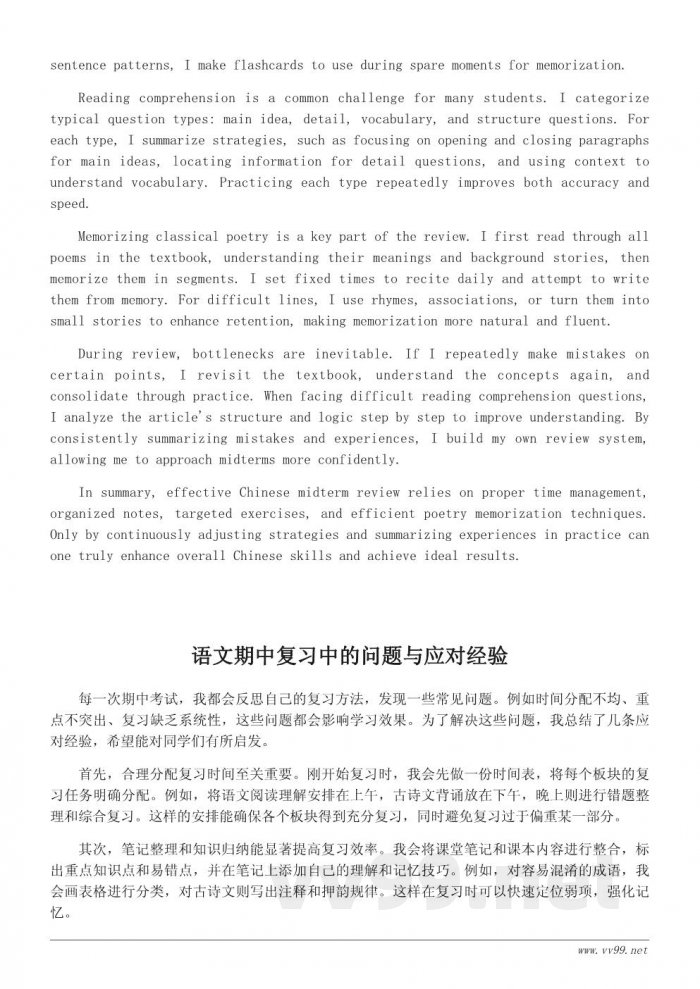
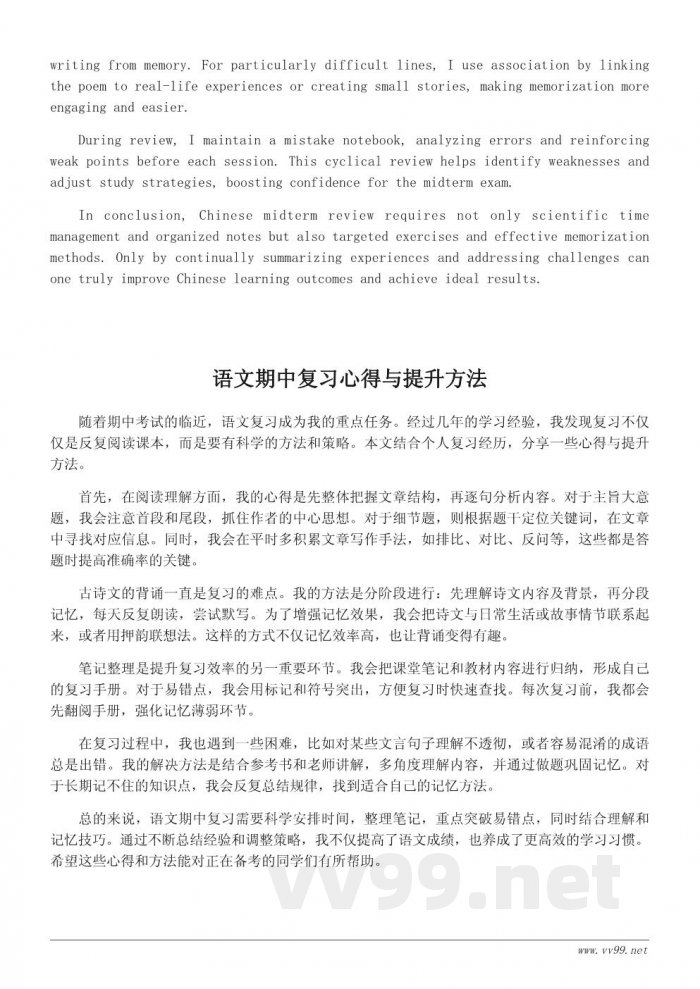
语文期中复习中的问题与应对经验
每一次期中考试,我都会反思自己的复习方法,发现一些常见问题。例如时间分配不均、重点不突出、复习缺乏系统性,这些问题都会影响学习效果。为了解决这些问题,我总结了几条应对经验,希望能对同学们有所启发。
首先,合理分配复习时间至关重要。刚开始复习时,我会先做一份时间表,将每个板块的复习任务明确分配。例如,将语文阅读理解安排在上午,古诗文背诵放在下午,晚上则进行错题整理和综合复习。这样的安排能确保各个板块得到充分复习,同时避免复习过于偏重某一部分。
其次,笔记整理和知识归纳能显著提高复习效率。我会将课堂笔记和课本内容进行整合,标出重点知识点和易错点,并在笔记上添加自己的理解和记忆技巧。例如,对容易混淆的成语,我会画表格进行分类,对古诗文则写出注释和押韵规律。这样在复习时可以快速定位弱项,强化记忆。
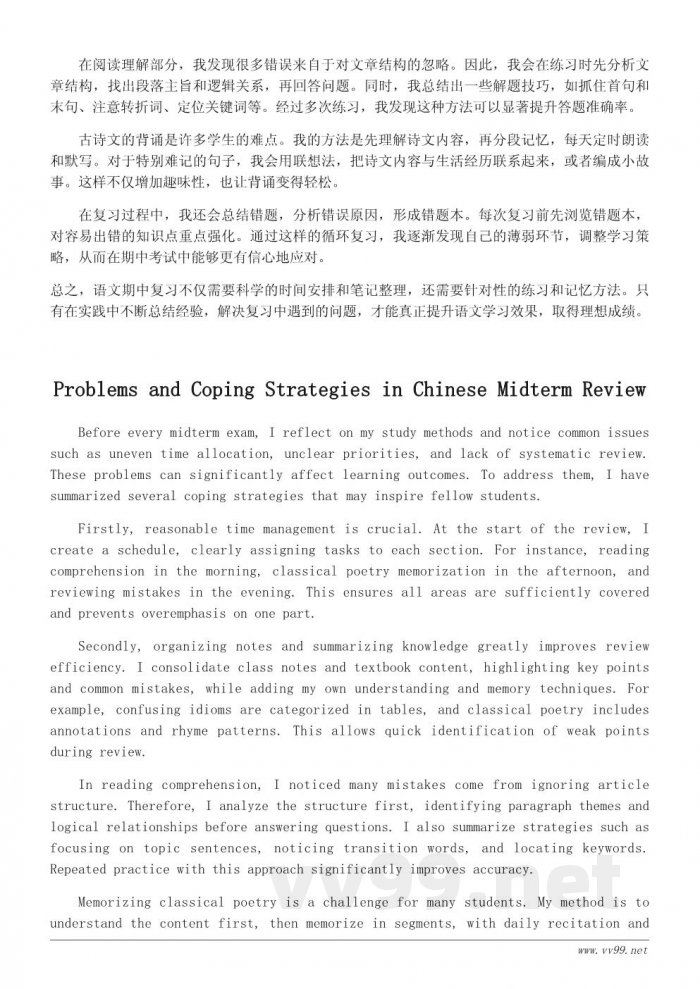
在阅读理解部分,我发现很多错误来自于对文章结构的忽略。因此,我会在练习时先分析文章结构,找出段落主旨和逻辑关系,再回答问题。同时,我总结出一些解题技巧,如抓住首句和末句、注意转折词、定位关键词等。经过多次练习,我发现这种方法可以显著提升答题准确率。
古诗文的背诵是许多学生的难点。我的方法是先理解诗文内容,再分段记忆,每天定时朗读和默写。对于特别难记的句子,我会用联想法,把诗文内容与生活经历联系起来,或者编成小故事。这样不仅增加趣味性,也让背诵变得轻松。
在复习过程中,我还会总结错题,分析错误原因,形成错题本。每次复习前先浏览错题本,对容易出错的知识点重点强化。通过这样的循环复习,我逐渐发现自己的薄弱环节,调整学习策略,从而在期中考试中能够更有信心地应对。
总之,语文期中复习不仅需要科学的时间安排和笔记整理,还需要针对性的练习和记忆方法。只有在实践中不断总结经验,解决复习中遇到的问题,才能真正提升语文学习效果,取得理想成绩。
Problems and Coping Strategies in Chinese Midterm Review
Before every midterm exam, I reflect on my study methods and notice common issues such as uneven time allocation, unclear priorities, and lack of systematic review. These problems can significantly affect learning outcomes. To address them, I have summarized several coping strategies that may inspire fellow students.
Firstly, reasonable time management is crucial. At the start of the review, I create a schedule, clearly assigning tasks to each section. For instance, reading comprehension in the morning, classical poetry memorization in the afternoon, and reviewing mistakes in the evening. This ensures all areas are sufficiently covered and prevents overemphasis on one part.
Secondly, organizing notes and summarizing knowledge greatly improves review efficiency. I consolidate class notes and textbook content, highlighting key points and common mistakes, while adding my own understanding and memory techniques. For example, confusing idioms are categorized in tables, and classical poetry includes annotations and rhyme patterns. This allows quick identification of weak points during review.
In reading comprehension, I noticed many mistakes come from ignoring article structure. Therefore, I analyze the structure first, identifying paragraph themes and logical relationships before answering questions. I also summarize strategies such as focusing on topic sentences, noticing transition words, and locating keywords. Repeated practice with this approach significantly improves accuracy.
Memorizing classical poetry is a challenge for many students. My method is to understand the content first, then memorize in segments, with daily recitation and writing from memory. For particularly difficult lines, I use association by linking the poem to real-life experiences or creating small stories, making memorization more engaging and easier.
During review, I maintain a mistake notebook, analyzing errors and reinforcing weak points before each session. This cyclical review helps identify weaknesses and adjust study strategies, boosting confidence for the midterm exam.
In conclusion, Chinese midterm review requires not only scientific time management and organized notes but also targeted exercises and effective memorization methods. Only by continually summarizing experiences and addressing challenges can one truly improve Chinese learning outcomes and achieve ideal results.
小提示:上面此文档内容仅展示完整文档里的部分内容, 若需要下载完整文档请 点击免费下载完整文档 。