文章内容
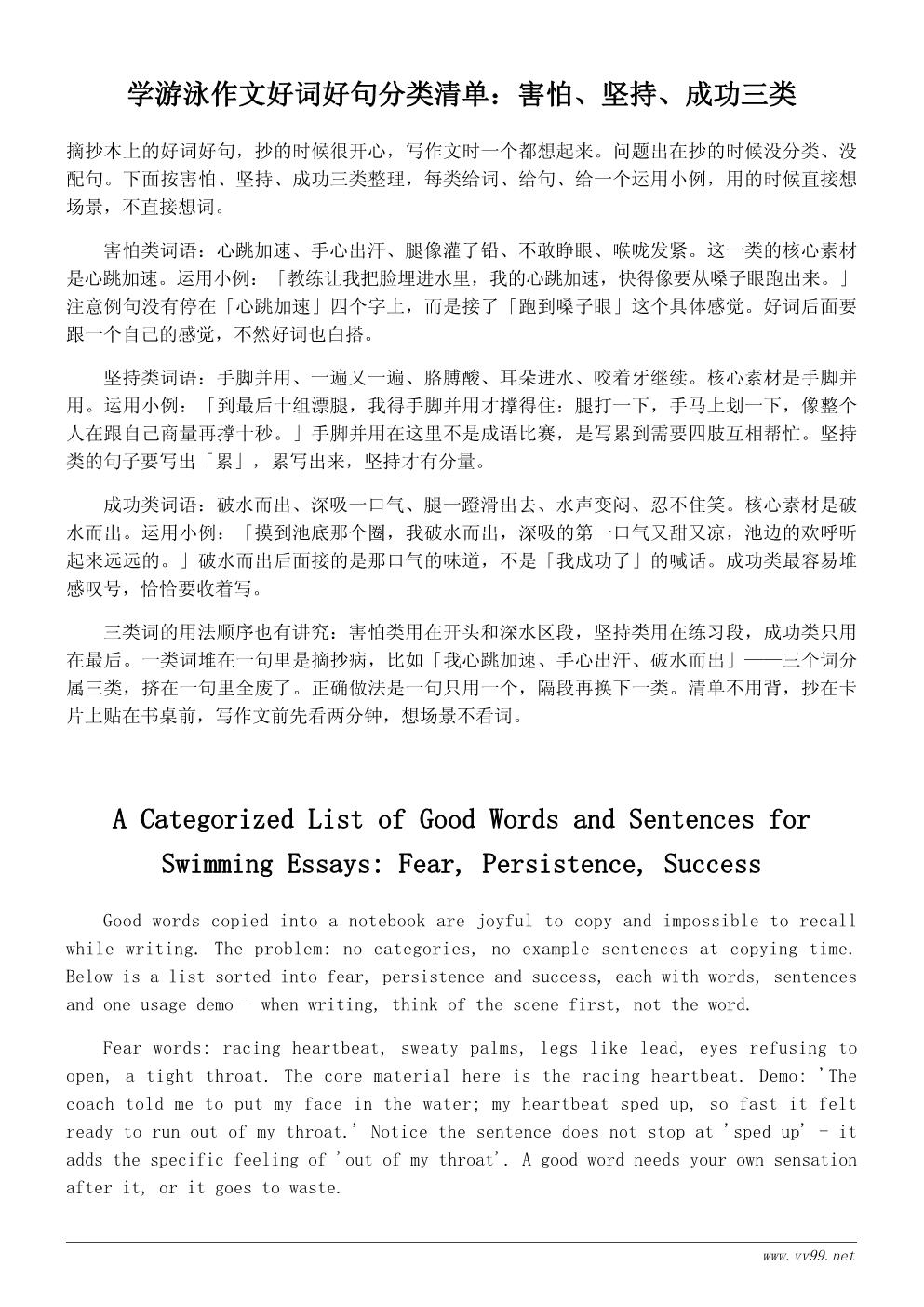
学游泳作文好词好句分类清单:害怕、坚持、成功三类
摘抄本上的好词好句,抄的时候很开心,写作文时一个都想起来。问题出在抄的时候没分类、没配句。下面按害怕、坚持、成功三类整理,每类给词、给句、给一个运用小例,用的时候直接想场景,不直接想词。
害怕类词语:心跳加速、手心出汗、腿像灌了铅、不敢睁眼、喉咙发紧。这一类的核心素材是心跳加速。运用小例:「教练让我把脸埋进水里,我的心跳加速,快得像要从嗓子眼跑出来。」注意例句没有停在「心跳加速」四个字上,而是接了「跑到嗓子眼」这个具体感觉。好词后面要跟一个自己的感觉,不然好词也白搭。
坚持类词语:手脚并用、一遍又一遍、胳膊酸、耳朵进水、咬着牙继续。核心素材是手脚并用。运用小例:「到最后十组漂腿,我得手脚并用才撑得住:腿打一下,手马上划一下,像整个人在跟自己商量再撑十秒。」手脚并用在这里不是成语比赛,是写累到需要四肢互相帮忙。坚持类的句子要写出「累」,累写出来,坚持才有分量。
成功类词语:破水而出、深吸一口气、腿一蹬滑出去、水声变闷、忍不住笑。核心素材是破水而出。运用小例:「摸到池底那个圈,我破水而出,深吸的第一口气又甜又凉,池边的欢呼听起来远远的。」破水而出后面接的是那口气的味道,不是「我成功了」的喊话。成功类最容易堆感叹号,恰恰要收着写。
三类词的用法顺序也有讲究:害怕类用在开头和深水区段,坚持类用在练习段,成功类只用在最后。一类词堆在一句里是摘抄病,比如「我心跳加速、手心出汗、破水而出」——三个词分属三类,挤在一句里全废了。正确做法是一句只用一个,隔段再换下一类。清单不用背,抄在卡片上贴在书桌前,写作文前先看两分钟,想场景不看词。
A Categorized List of Good Words and Sentences for Swimming Essays: Fear, Persistence, Success
Good words copied into a notebook are joyful to copy and impossible to recall while writing. The problem: no categories, no example sentences at copying time. Below is a list sorted into fear, persistence and success, each with words, sentences and one usage demo - when writing, think of the scene first, not the word.
Fear words: racing heartbeat, sweaty palms, legs like lead, eyes refusing to open, a tight throat. The core material here is the racing heartbeat. Demo: 'The coach told me to put my face in the water; my heartbeat sped up, so fast it felt ready to run out of my throat.' Notice the sentence does not stop at 'sped up' - it adds the specific feeling of 'out of my throat'. A good word needs your own sensation after it, or it goes to waste.
Persistence words: hands and feet working together, again and again, sore arms, water in the ears, gritting teeth to continue. The core material is hands and feet working together. Demo: 'By the last ten sets of kick drills I needed hands and feet cooperating just to hold on: one kick, one pull, as if my whole body were bargaining with itself for ten more seconds.' Here 'hands and feet together' is not an idiom contest - it shows tiredness so deep the limbs must help each other. Persistence sentences must show the fatigue; only then does persistence have weight.
Success words: breaking the surface, one deep breath, pushing off and gliding, muffled water sound, an uncontrollable smile. The core material is breaking the surface. Demo: 'My hand found the ring on the bottom and I broke the surface; the first breath in was sweet and cold, and the cheering on the bank sounded far away.' After 'broke the surface' comes the taste of that breath, not a shout of 'I made it'. Success sentences pile up exclamation marks most easily - hold them back.
The three groups also have a placement order: fear words go in the opening and the deep-end paragraph, persistence words in the practice paragraphs, success words only at the end. Stuffing one word from each group into a single sentence is notebook disease - 'my heart raced, palms sweated, and I broke the surface' puts three words from three groups in one line and ruins all three. Use one per sentence and switch groups across paragraphs. No need to memorize the list: copy it onto a card by the desk, glance at it for two minutes before writing, and think in scenes rather than words.
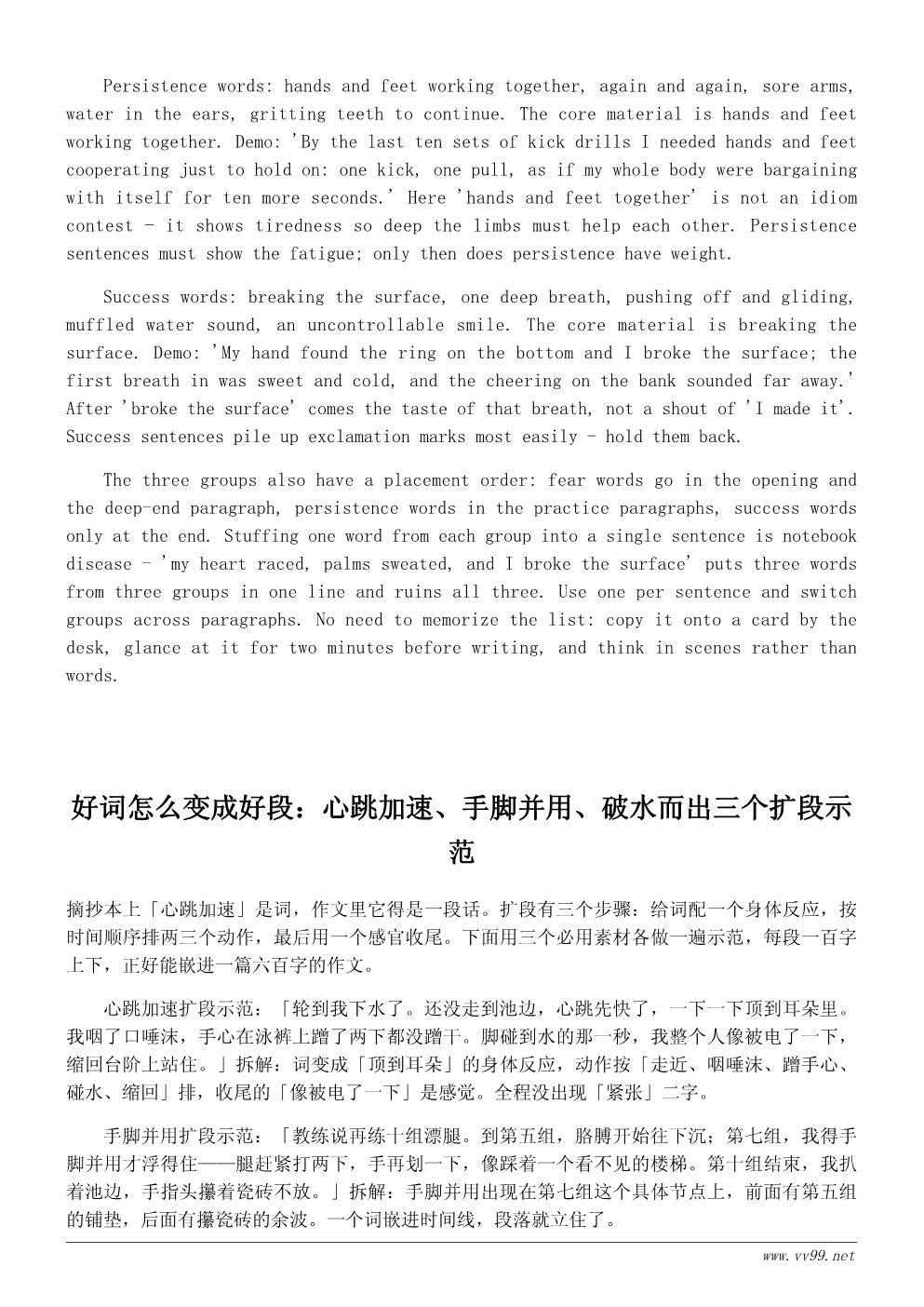
好词怎么变成好段:心跳加速、手脚并用、破水而出三个扩段示范
摘抄本上「心跳加速」是词,作文里它得是一段话。扩段有三个步骤:给词配一个身体反应,按时间顺序排两三个动作,最后用一个感官收尾。下面用三个必用素材各做一遍示范,每段一百字上下,正好能嵌进一篇六百字的作文。
心跳加速扩段示范:「轮到我下水了。还没走到池边,心跳先快了,一下一下顶到耳朵里。我咽了口唾沫,手心在泳裤上蹭了两下都没蹭干。脚碰到水的那一秒,我整个人像被电了一下,缩回台阶上站住。」拆解:词变成「顶到耳朵」的身体反应,动作按「走近、咽唾沫、蹭手心、碰水、缩回」排,收尾的「像被电了一下」是感觉。全程没出现「紧张」二字。
手脚并用扩段示范:「教练说再练十组漂腿。到第五组,胳膊开始往下沉;第七组,我得手脚并用才浮得住——腿赶紧打两下,手再划一下,像踩着一个看不见的楼梯。第十组结束,我扒着池边,手指头攥着瓷砖不放。」拆解:手脚并用出现在第七组这个具体节点上,前面有第五组的铺垫,后面有攥瓷砖的余波。一个词嵌进时间线,段落就立住了。
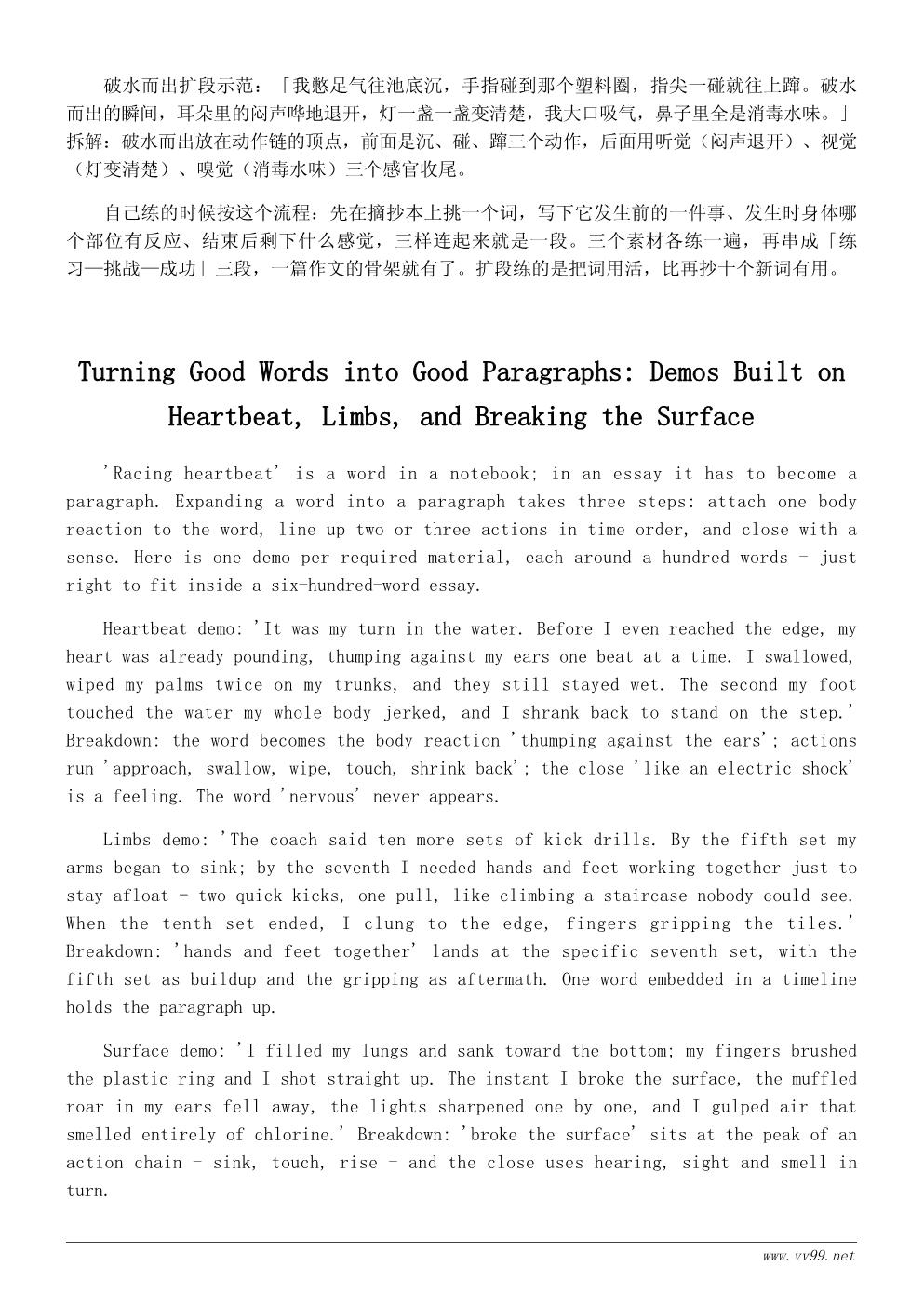
破水而出扩段示范:「我憋足气往池底沉,手指碰到那个塑料圈,指尖一碰就往上蹿。破水而出的瞬间,耳朵里的闷声哗地退开,灯一盏一盏变清楚,我大口吸气,鼻子里全是消毒水味。」拆解:破水而出放在动作链的顶点,前面是沉、碰、蹿三个动作,后面用听觉(闷声退开)、视觉(灯变清楚)、嗅觉(消毒水味)三个感官收尾。
自己练的时候按这个流程:先在摘抄本上挑一个词,写下它发生前的一件事、发生时身体哪个部位有反应、结束后剩下什么感觉,三样连起来就是一段。三个素材各练一遍,再串成「练习—挑战—成功」三段,一篇作文的骨架就有了。扩段练的是把词用活,比再抄十个新词有用。
Turning Good Words into Good Paragraphs: Demos Built on Heartbeat, Limbs, and Breaking the Surface
'Racing heartbeat' is a word in a notebook; in an essay it has to become a paragraph. Expanding a word into a paragraph takes three steps: attach one body reaction to the word, line up two or three actions in time order, and close with a sense. Here is one demo per required material, each around a hundred words - just right to fit inside a six-hundred-word essay.
Heartbeat demo: 'It was my turn in the water. Before I even reached the edge, my heart was already pounding, thumping against my ears one beat at a time. I swallowed, wiped my palms twice on my trunks, and they still stayed wet. The second my foot touched the water my whole body jerked, and I shrank back to stand on the step.' Breakdown: the word becomes the body reaction 'thumping against the ears'; actions run 'approach, swallow, wipe, touch, shrink back'; the close 'like an electric shock' is a feeling. The word 'nervous' never appears.
Limbs demo: 'The coach said ten more sets of kick drills. By the fifth set my arms began to sink; by the seventh I needed hands and feet working together just to stay afloat - two quick kicks, one pull, like climbing a staircase nobody could see. When the tenth set ended, I clung to the edge, fingers gripping the tiles.' Breakdown: 'hands and feet together' lands at the specific seventh set, with the fifth set as buildup and the gripping as aftermath. One word embedded in a timeline holds the paragraph up.
Surface demo: 'I filled my lungs and sank toward the bottom; my fingers brushed the plastic ring and I shot straight up. The instant I broke the surface, the muffled roar in my ears fell away, the lights sharpened one by one, and I gulped air that smelled entirely of chlorine.' Breakdown: 'broke the surface' sits at the peak of an action chain - sink, touch, rise - and the close uses hearing, sight and smell in turn.
To practice: pick one word from your notebook, write down what happened just before it, which part of the body reacted during it, and what sensation remained after. String the three together and you have a paragraph. Drill all three materials, then link them into practice - challenge - success, and the skeleton of an essay exists. Drilling word-to-paragraph beats copying ten more new words.
小提示:上面此文档内容仅展示完整文档里的部分内容, 若需要下载完整文档请 点击免费下载完整文档 。