文章内容
500字记叙文怎么安排三个场景:呛水、犹豫、重新下水
拿到「呛水之后我没放弃」这个题,先别急着写,把五百字拆给三个场景:第一次呛水约一百二十字,岸边犹豫约一百三十字,重新下水学会换气约两百字,开头结尾各占一小截。字数分好了,文章就不会头重脚轻。
第一个场景写呛水,要写过程而不是喊疼。假设你第一次进深水区,脚一蹬离了池底,鼻子进水,喉咙一紧,咳出来的水带着池水的味道,耳朵里嗡嗡响,教练把你托到池边。身体反应写具体了,读者才有代入感,光写「我呛了水,很难受」八个字就断了。
第二个场景是岸边犹豫,这是最容易写薄的一段。别直接写「我想放弃」,写动作:坐在池边把浮板推远,盯着水面不说话,听同伴在群里喊下次再去,手指抠着毛巾边。心理活动用短句插进去,「去还是不去」「丢人就丢人吧」,一两句就够,多了像自言自语。
第三个场景重新下水,把换气拆成步骤:扶着池边练吐泡泡,脸入水数两拍,抬头张嘴吸气,肩膀越抬越高。写两三次失败,再写某一次突然顺了,脚踩水手划动,游出了五米。有失败才有成功,一步到位的换气没人信。
三个场景之间要有一根线连着,方法是让同一个物件出现三次:呛水时抓着的是浮板,犹豫时把浮板推远,重新下水时又抱住它练吐泡泡。浮板一出现,三段就串起来了,读者不会觉得是三个片段硬拼的。连词「然后」「接着」少用,场景切换直接换段就行。
开头一句话进场景,比如「那口水是周三下午呛的」,不要从「夏天到了我报名游泳班」写起。结尾收在朴素感受上,「原来放弃和坚持只差一次下水」,不要升华到人生哲理。自查一遍:三个场景字数加起来在四百五到五百五之间,心理描写不超过五处短句,就合格了。
How to Plan Three Scenes in a 500-Word Story: Choking, Hesitating, Getting Back In
When you get a title like 'I Didn't Give Up After Choking on Water', don't start writing right away. Split the five hundred words among three scenes: the first choking, about one hundred and twenty words; hesitating at the pool edge, about one hundred and thirty; getting back in and learning to breathe, about two hundred. Leave a small slice for the opening and the closing. Once the word budget is set, the story won't be lopsided.
For the choking scene, write the process, not the pain. Suppose you enter the deep end for the first time, push off the bottom, water rushes into your nose, your throat tightens, you cough up water that tastes of the pool, and your ears buzz until the coach lifts you to the edge. Describe the body reactions concretely and the reader feels it too; just writing 'I choked and felt terrible' dies in eight words.
The second scene, hesitating at the edge, is the easiest one to write thin. Don't write 'I wanted to give up'. Write actions: sitting at the edge pushing the kickboard away, staring at the water without a word, hearing classmates plan their next trip online, fingers picking at the towel's edge. Drop short thoughts in like 'go or not go' or 'so what if it's embarrassing'. One or two lines are enough; more starts to sound like muttering.
For the third scene, break breathing into steps: hold the wall and practice blowing bubbles, put your face in and count two beats, lift your head and inhale through the open mouth, shoulders rising higher with each try. Write two or three failures, then one attempt that suddenly works: feet kicking, arms pulling, five meters done. Success needs failure behind it; nobody believes a swimmer who got breathing right on the first try.
The three scenes need a thread connecting them, and the trick is to bring one object back three times: you grab the kickboard when choking, push it away while hesitating, and hug it again at the wall practicing bubbles. Once the kickboard keeps appearing, the three paragraphs string together and the reader won't feel three clips glued side by side. Use linking words like 'then' and 'next' sparingly; just start a new paragraph to switch scenes.
Open with one sentence inside the scene, like 'The water I choked on was from Wednesday afternoon', not 'Summer came and I signed up for a class'. End on a plain feeling, like 'Giving up and keeping at it turned out to be one dip apart', not a life lesson. Check once: if the three scenes add up between four hundred fifty and five hundred fifty words and the short thoughts stay under five, you pass.
范文点评:《呛水之后我没放弃》好在哪里、哪里要改
假设范文第一段这样开头:「教练让我松开浮板的那一刻,我的脚离开了池底。」点评:好。一句话把读者放进场景,没有交代报名、天气、泳衣这些背景。紧接着范文写「水从鼻子灌进去,像被人捏住了喉咙,我胡乱抓了一把,抓到的是教练的手臂」,比喻是身体感受,不华丽但准确,这是呛水段值得学的地方。
第二段范文写犹豫:「我坐在岸边,把浮板立起来挡住自己,好像挡住就没人看见我刚才的狼狈。妈妈在岸上没喊我,她只是把毛巾抖开铺好。」点评:「立浮板挡自己」这个动作选得好,把「怕丢人」写出来了,不用解释。铺毛巾的妈妈是侧面写法,家长的安静比喊「加油」更有力量。这一段可以挑剔的地方是只有一句心理活动,稍薄,可以在「抖开毛巾」后补一句自己的打算,比如「我数到三十,如果还怕就真的不下了」,给犹豫加一个具体的倒计时。
第三段换气:「我扶着池边吐了二十个泡泡,脸进水时默数一二,抬头吸气的声音像拉风箱。第五次的时候,身子忽然轻了,我游出了三米,然后是五米。」点评:数字用得好,二十个泡泡、第五次、三米五米,进步有了刻度。要改的地方是失败只一笔带过,建议在「第五次」前补一次具体的失败,比如「第四次抬头太急,又呛了一口,池边的水洼里多了我的鼻涕」,狼狈写足,后面的轻才真实。
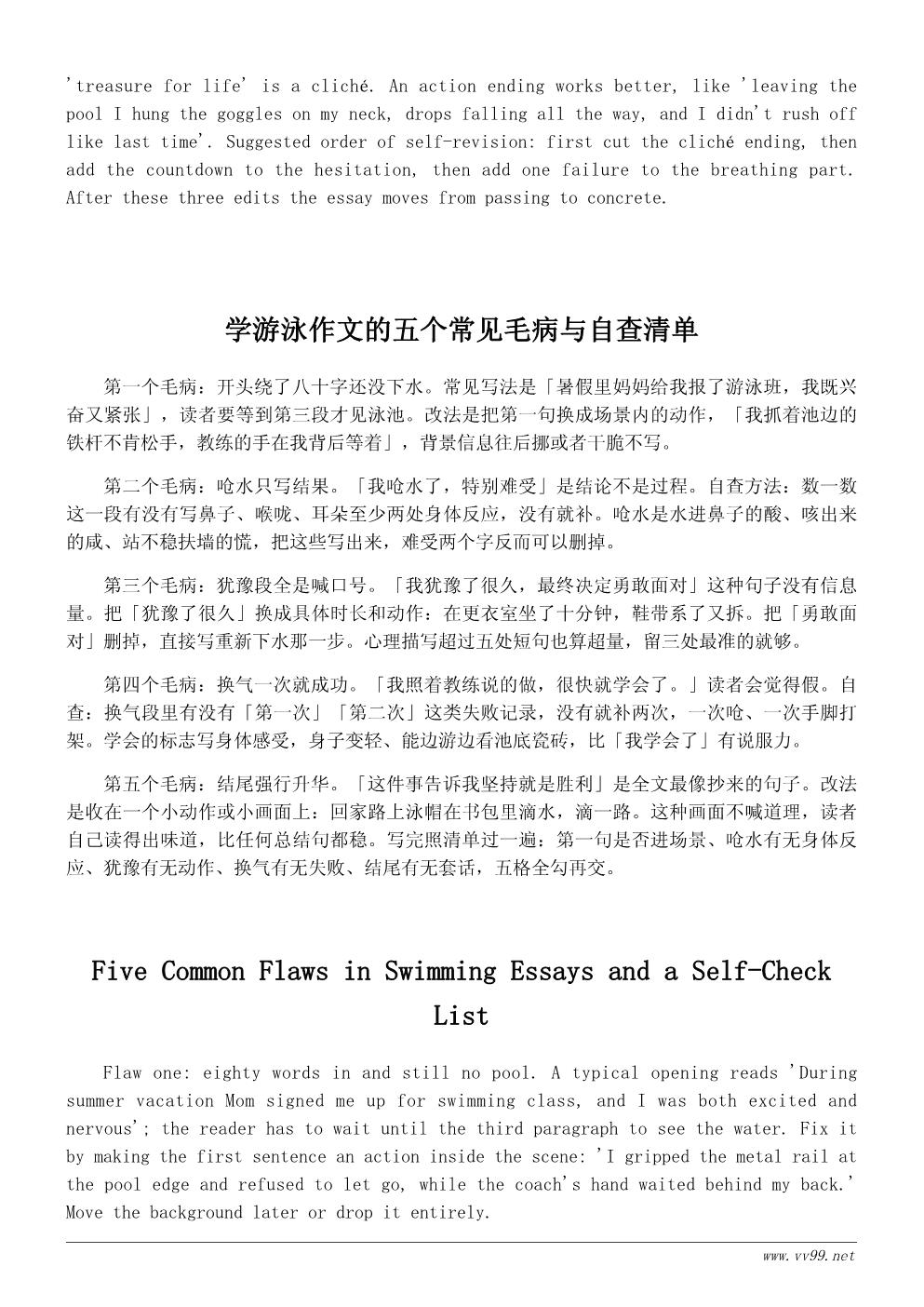
范文结尾:「我学会了游泳,也学会了不放弃,这将是我一生的财富。」点评:这是全文最弱的一句,「一生的财富」是套话。换成动作收尾更好,比如「出泳池的时候我把泳镜挂在脖子上,水珠一路滴下去,我没有像上次那样急着跑」。自我修改的顺序建议先砍结尾套话,再给犹豫段补倒计时,最后给换气段补一次失败,三处改完,文章就从合格变成具体。
Model Essay Review: What Works in 'I Didn't Give Up After Choking' and What Needs Fixing
Suppose the model essay opens like this: 'The moment the coach told me to let go of the kickboard, my feet left the pool bottom.' Review: good. One sentence drops the reader into the scene with no background about signing up, the weather, or the swimsuit. The next line reads 'water poured in through my nose as if a hand squeezed my throat; I grabbed wildly and caught the coach's arm.' The simile is physical, not fancy but accurate. This is what the choking paragraph is worth learning from.
In the second paragraph the model writes the hesitation: 'I sat at the edge propping the kickboard up to hide myself, as if hiding meant nobody saw my mess. Mom didn't call me from the bank; she just shook the towel open and laid it out.' Review: propping the board to hide is a well-chosen action that shows fear of embarrassment without explaining it, and the quiet mother spreading the towel is a side view - parental calm beats shouting 'you can do it'. One thing to nitpick: there is only a single thought here, a bit thin. After the towel line, add one plan of the character's own, like 'I would count to thirty, and if I was still scared I would truly quit', giving the hesitation a concrete countdown.
The breathing paragraph reads: 'I held the wall and blew twenty bubbles, counted one-two with my face under, and the inhale sounded like pumping a bellows. On the fifth try my body suddenly felt light. I swam three meters, then five.' Review: the numbers work well - twenty bubbles, the fifth try, three meters then five - progress gets a scale. The weak spot is that failure passes in one stroke. Before 'the fifth try', add one concrete failure, like 'on the fourth attempt I lifted my head too fast and choked again, adding my snot to the puddle at the pool edge'. Only when the mess is written fully does the lightness later feel real.
The model ends with: 'I learned to swim and learned not to give up, which will be a treasure for my whole life.' Review: this is the weakest sentence in the essay; 'treasure for life' is a cliché. An action ending works better, like 'leaving the pool I hung the goggles on my neck, drops falling all the way, and I didn't rush off like last time'. Suggested order of self-revision: first cut the cliché ending, then add the countdown to the hesitation, then add one failure to the breathing part. After these three edits the essay moves from passing to concrete.
小提示:上面此文档内容仅展示完整文档里的部分内容, 若需要下载完整文档请 点击免费下载完整文档 。