文章内容
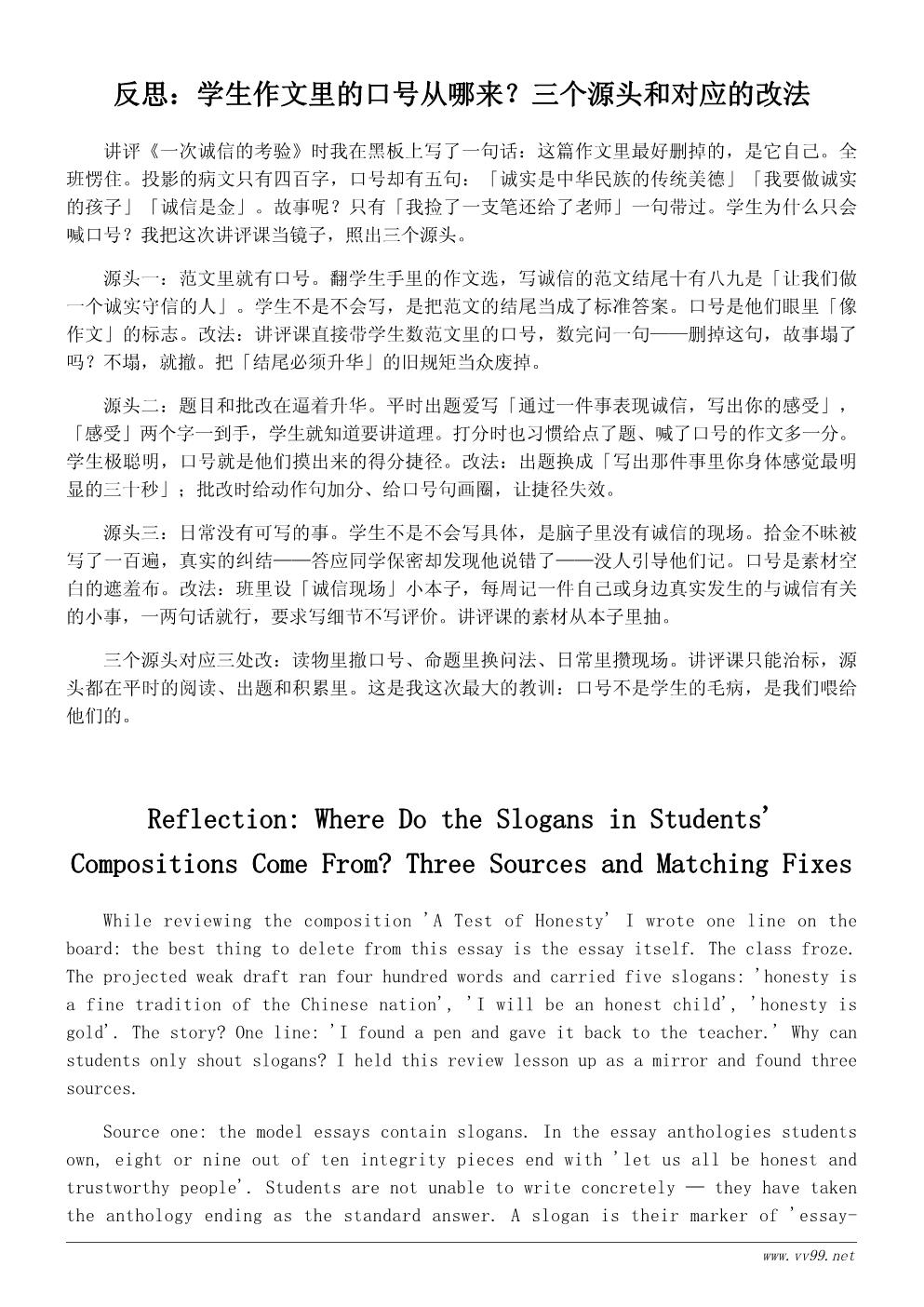
反思:学生作文里的口号从哪来?三个源头和对应的改法
讲评《一次诚信的考验》时我在黑板上写了一句话:这篇作文里最好删掉的,是它自己。全班愣住。投影的病文只有四百字,口号却有五句:「诚实是中华民族的传统美德」「我要做诚实的孩子」「诚信是金」。故事呢?只有「我捡了一支笔还给了老师」一句带过。学生为什么只会喊口号?我把这次讲评课当镜子,照出三个源头。
源头一:范文里就有口号。翻学生手里的作文选,写诚信的范文结尾十有八九是「让我们做一个诚实守信的人」。学生不是不会写,是把范文的结尾当成了标准答案。口号是他们眼里「像作文」的标志。改法:讲评课直接带学生数范文里的口号,数完问一句——删掉这句,故事塌了吗?不塌,就撤。把「结尾必须升华」的旧规矩当众废掉。
源头二:题目和批改在逼着升华。平时出题爱写「通过一件事表现诚信,写出你的感受」,「感受」两个字一到手,学生就知道要讲道理。打分时也习惯给点了题、喊了口号的作文多一分。学生极聪明,口号就是他们摸出来的得分捷径。改法:出题换成「写出那件事里你身体感觉最明显的三十秒」;批改时给动作句加分、给口号句画圈,让捷径失效。
源头三:日常没有可写的事。学生不是不会写具体,是脑子里没有诚信的现场。拾金不昧被写了一百遍,真实的纠结——答应同学保密却发现他说错了——没人引导他们记。口号是素材空白的遮羞布。改法:班里设「诚信现场」小本子,每周记一件自己或身边真实发生的与诚信有关的小事,一两句话就行,要求写细节不写评价。讲评课的素材从本子里抽。
三个源头对应三处改:读物里撤口号、命题里换问法、日常里攒现场。讲评课只能治标,源头都在平时的阅读、出题和积累里。这是我这次最大的教训:口号不是学生的毛病,是我们喂给他们的。
Reflection: Where Do the Slogans in Students' Compositions Come From? Three Sources and Matching Fixes
While reviewing the composition 'A Test of Honesty' I wrote one line on the board: the best thing to delete from this essay is the essay itself. The class froze. The projected weak draft ran four hundred words and carried five slogans: 'honesty is a fine tradition of the Chinese nation', 'I will be an honest child', 'honesty is gold'. The story? One line: 'I found a pen and gave it back to the teacher.' Why can students only shout slogans? I held this review lesson up as a mirror and found three sources.
Source one: the model essays contain slogans. In the essay anthologies students own, eight or nine out of ten integrity pieces end with 'let us all be honest and trustworthy people'. Students are not unable to write concretely — they have taken the anthology ending as the standard answer. A slogan is their marker of 'essay-ness'. Fix: in the review lesson, count the slogans in model essays aloud, then ask one question — if this line is deleted, does the story collapse? If not, remove it. Publicly abolish the old rule that 'the ending must sublimate'.
Source two: prompts and grading push sublimation. Prompts often read 'show honesty through one event and write your feelings'. The word 'feelings' tells students to preach. Grading also tends to give an extra point to essays that state the theme and shout a slogan. Students are sharp; the slogan is the scoring shortcut they discovered. Fix: replace prompts with 'write the thirty seconds in that event when your body felt it most'; in grading, award action sentences and circle slogan sentences, so the shortcut stops paying.
Source three: daily life offers nothing to write. Students lack a live scene of integrity, not the skill. Picking up lost money has been written a hundred times, while real dilemmas — promising a classmate secrecy then learning he got it wrong — go unrecorded because nobody guides the recording. Slogans are the fig leaf over an empty well. Fix: keep an 'integrity scenes' notebook in the class; each week every student logs one true small event about integrity, one or two sentences, details required, judgments forbidden. Review-lesson material comes from this notebook.
Three sources, three fixes: remove slogans from reading material, change the question in prompts, collect scenes in daily life. A review lesson only treats symptoms; the sources live in regular reading, prompt design, and accumulation. That is the biggest lesson: the slogan is not the students' flaw — it is what we fed them.
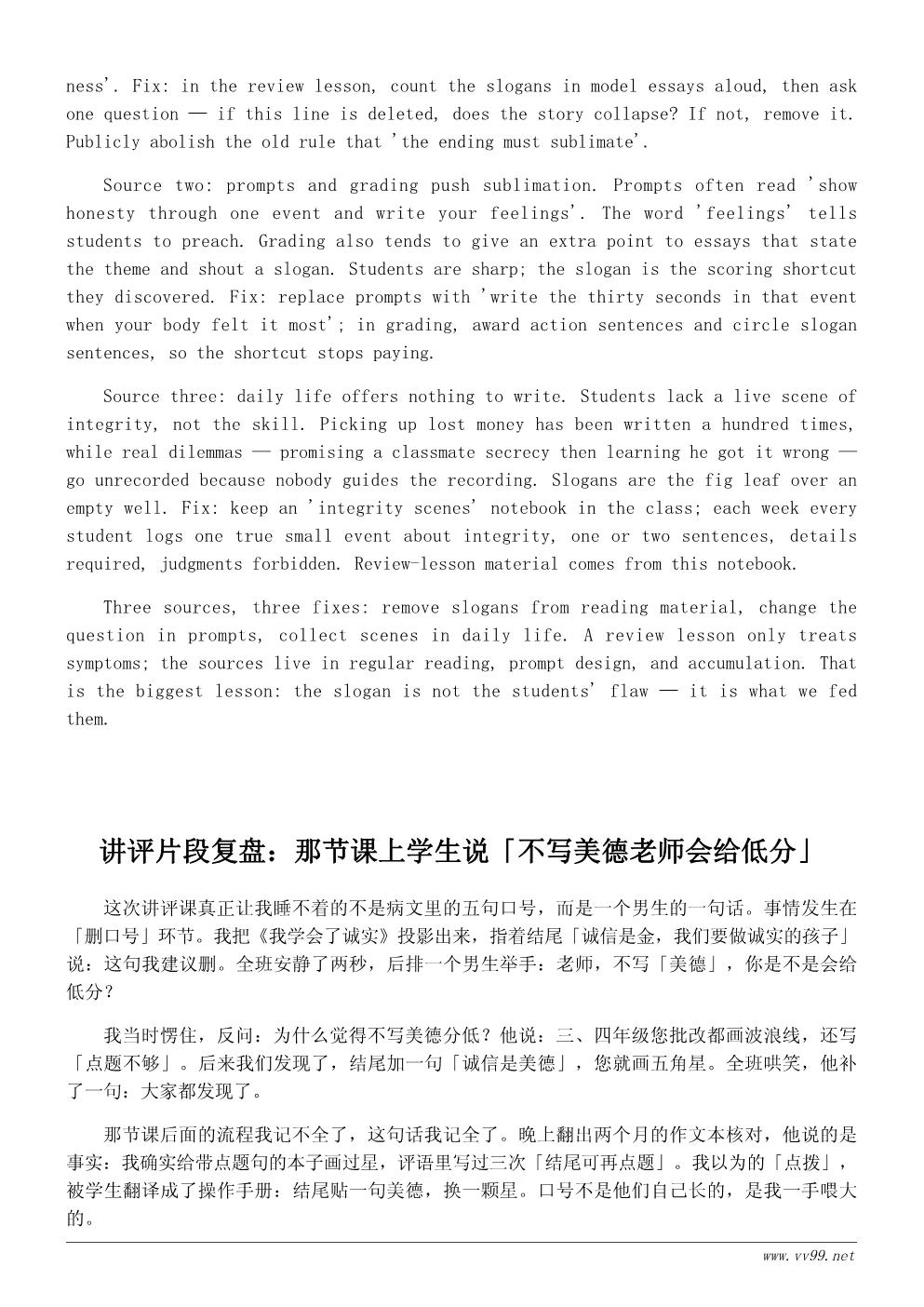
讲评片段复盘:那节课上学生说「不写美德老师会给低分」
这次讲评课真正让我睡不着的不是病文里的五句口号,而是一个男生的一句话。事情发生在「删口号」环节。我把《我学会了诚实》投影出来,指着结尾「诚信是金,我们要做诚实的孩子」说:这句我建议删。全班安静了两秒,后排一个男生举手:老师,不写「美德」,你是不是会给低分?
我当时愣住,反问:为什么觉得不写美德分低?他说:三、四年级您批改都画波浪线,还写「点题不够」。后来我们发现了,结尾加一句「诚信是美德」,您就画五角星。全班哄笑,他补了一句:大家都发现了。
那节课后面的流程我记不全了,这句话我记全了。晚上翻出两个月的作文本核对,他说的是事实:我确实给带点题句的本子画过星,评语里写过三次「结尾可再点题」。我以为的「点拨」,被学生翻译成了操作手册:结尾贴一句美德,换一颗星。口号不是他们自己长的,是我一手喂大的。
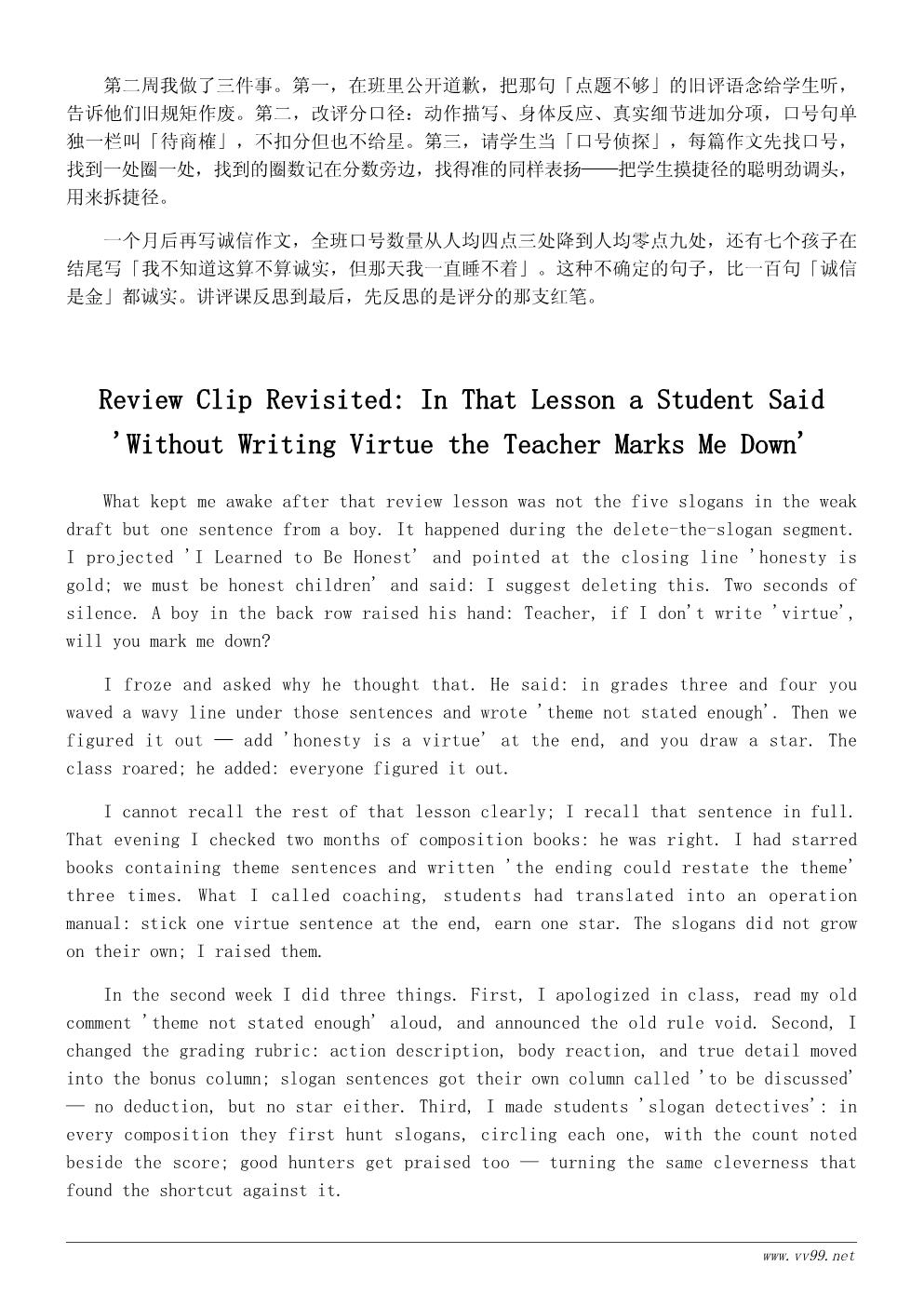
第二周我做了三件事。第一,在班里公开道歉,把那句「点题不够」的旧评语念给学生听,告诉他们旧规矩作废。第二,改评分口径:动作描写、身体反应、真实细节进加分项,口号句单独一栏叫「待商榷」,不扣分但也不给星。第三,请学生当「口号侦探」,每篇作文先找口号,找到一处圈一处,找到的圈数记在分数旁边,找得准的同样表扬——把学生摸捷径的聪明劲调头,用来拆捷径。
一个月后再写诚信作文,全班口号数量从人均四点三处降到人均零点九处,还有七个孩子在结尾写「我不知道这算不算诚实,但那天我一直睡不着」。这种不确定的句子,比一百句「诚信是金」都诚实。讲评课反思到最后,先反思的是评分的那支红笔。
Review Clip Revisited: In That Lesson a Student Said 'Without Writing Virtue the Teacher Marks Me Down'
What kept me awake after that review lesson was not the five slogans in the weak draft but one sentence from a boy. It happened during the delete-the-slogan segment. I projected 'I Learned to Be Honest' and pointed at the closing line 'honesty is gold; we must be honest children' and said: I suggest deleting this. Two seconds of silence. A boy in the back row raised his hand: Teacher, if I don't write 'virtue', will you mark me down?
I froze and asked why he thought that. He said: in grades three and four you waved a wavy line under those sentences and wrote 'theme not stated enough'. Then we figured it out — add 'honesty is a virtue' at the end, and you draw a star. The class roared; he added: everyone figured it out.
I cannot recall the rest of that lesson clearly; I recall that sentence in full. That evening I checked two months of composition books: he was right. I had starred books containing theme sentences and written 'the ending could restate the theme' three times. What I called coaching, students had translated into an operation manual: stick one virtue sentence at the end, earn one star. The slogans did not grow on their own; I raised them.
In the second week I did three things. First, I apologized in class, read my old comment 'theme not stated enough' aloud, and announced the old rule void. Second, I changed the grading rubric: action description, body reaction, and true detail moved into the bonus column; slogan sentences got their own column called 'to be discussed' — no deduction, but no star either. Third, I made students 'slogan detectives': in every composition they first hunt slogans, circling each one, with the count noted beside the score; good hunters get praised too — turning the same cleverness that found the shortcut against it.
A month later, on a new integrity composition, class slogan counts fell from an average of 4.3 to 0.9, and seven children ended with lines like 'I don't know if that counts as honesty, but I kept awake that night'. Such uncertain sentences are more honest than a hundred 'honesty is gold's. Reflecting on the review lesson leads, in the end, to reflecting on the red pen that did the grading.
小提示:上面此文档内容仅展示完整文档里的部分内容, 若需要下载完整文档请 点击免费下载完整文档 。