文章内容
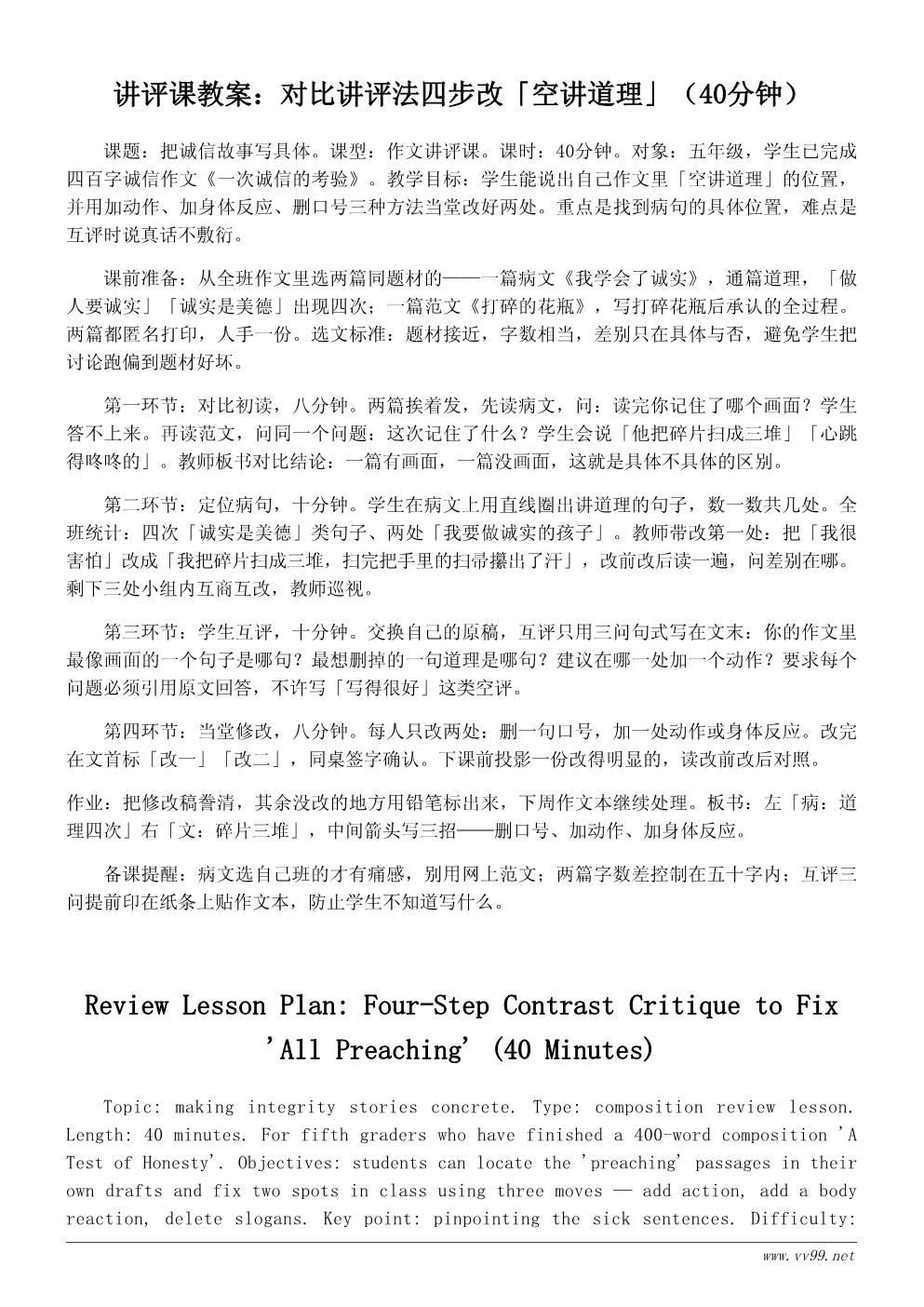
讲评课教案:对比讲评法四步改「空讲道理」(40分钟)
课题:把诚信故事写具体。课型:作文讲评课。课时:40分钟。对象:五年级,学生已完成四百字诚信作文《一次诚信的考验》。教学目标:学生能说出自己作文里「空讲道理」的位置,并用加动作、加身体反应、删口号三种方法当堂改好两处。重点是找到病句的具体位置,难点是互评时说真话不敷衍。
课前准备:从全班作文里选两篇同题材的——一篇病文《我学会了诚实》,通篇道理,「做人要诚实」「诚实是美德」出现四次;一篇范文《打碎的花瓶》,写打碎花瓶后承认的全过程。两篇都匿名打印,人手一份。选文标准:题材接近,字数相当,差别只在具体与否,避免学生把讨论跑偏到题材好坏。
第一环节:对比初读,八分钟。两篇挨着发,先读病文,问:读完你记住了哪个画面?学生答不上来。再读范文,问同一个问题:这次记住了什么?学生会说「他把碎片扫成三堆」「心跳得咚咚的」。教师板书对比结论:一篇有画面,一篇没画面,这就是具体不具体的区别。
第二环节:定位病句,十分钟。学生在病文上用直线圈出讲道理的句子,数一数共几处。全班统计:四次「诚实是美德」类句子、两处「我要做诚实的孩子」。教师带改第一处:把「我很害怕」改成「我把碎片扫成三堆,扫完把手里的扫帚攥出了汗」,改前改后读一遍,问差别在哪。剩下三处小组内互商互改,教师巡视。
第三环节:学生互评,十分钟。交换自己的原稿,互评只用三问句式写在文末:你的作文里最像画面的一个句子是哪句?最想删掉的一句道理是哪句?建议在哪一处加一个动作?要求每个问题必须引用原文回答,不许写「写得很好」这类空评。
第四环节:当堂修改,八分钟。每人只改两处:删一句口号,加一处动作或身体反应。改完在文首标「改一」「改二」,同桌签字确认。下课前投影一份改得明显的,读改前改后对照。
作业:把修改稿誊清,其余没改的地方用铅笔标出来,下周作文本继续处理。板书:左「病:道理四次」右「文:碎片三堆」,中间箭头写三招——删口号、加动作、加身体反应。
备课提醒:病文选自己班的才有痛感,别用网上范文;两篇字数差控制在五十字内;互评三问提前印在纸条上贴作文本,防止学生不知道写什么。
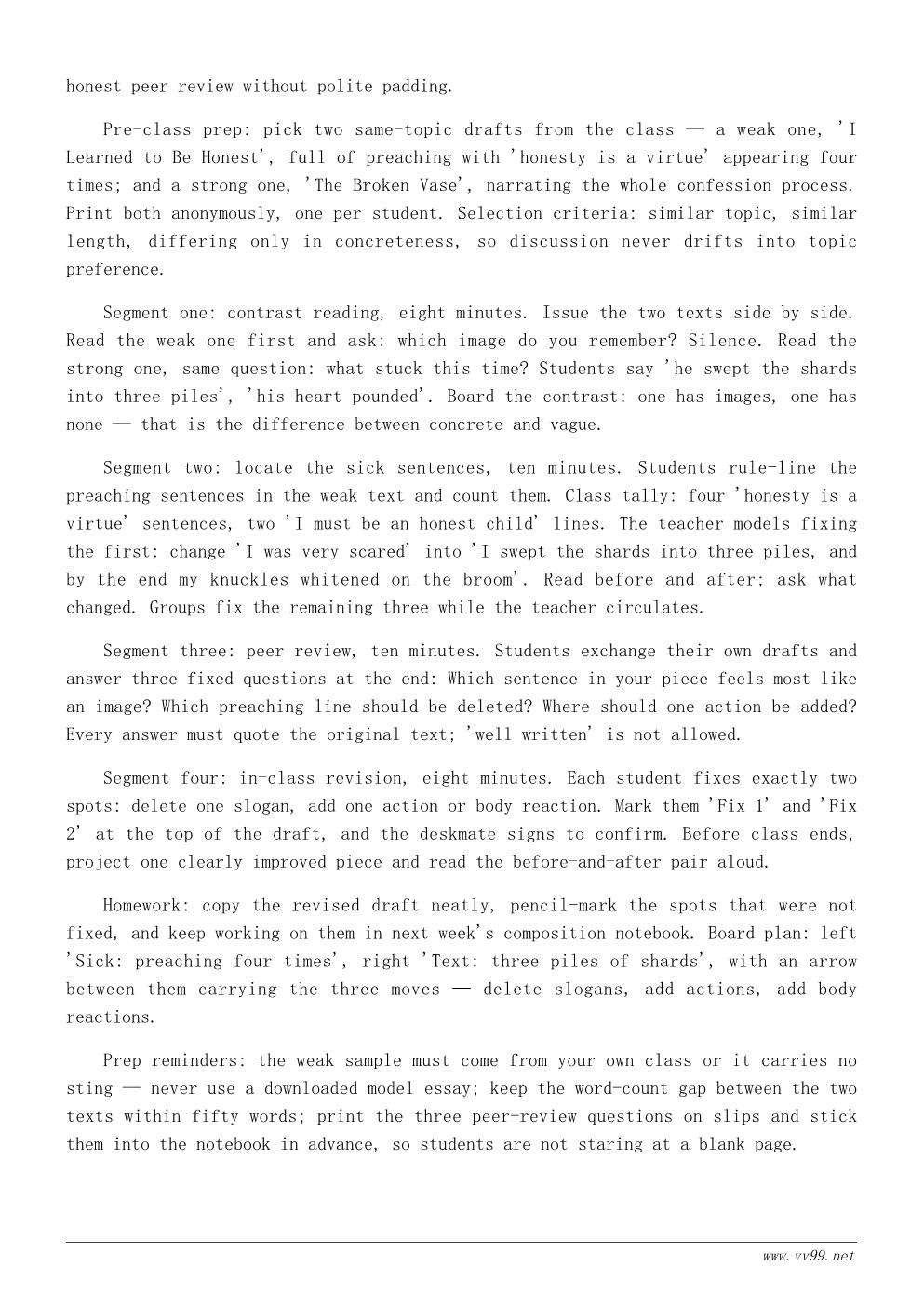
Review Lesson Plan: Four-Step Contrast Critique to Fix 'All Preaching' (40 Minutes)
Topic: making integrity stories concrete. Type: composition review lesson. Length: 40 minutes. For fifth graders who have finished a 400-word composition 'A Test of Honesty'. Objectives: students can locate the 'preaching' passages in their own drafts and fix two spots in class using three moves — add action, add a body reaction, delete slogans. Key point: pinpointing the sick sentences. Difficulty: honest peer review without polite padding.
Pre-class prep: pick two same-topic drafts from the class — a weak one, 'I Learned to Be Honest', full of preaching with 'honesty is a virtue' appearing four times; and a strong one, 'The Broken Vase', narrating the whole confession process. Print both anonymously, one per student. Selection criteria: similar topic, similar length, differing only in concreteness, so discussion never drifts into topic preference.
Segment one: contrast reading, eight minutes. Issue the two texts side by side. Read the weak one first and ask: which image do you remember? Silence. Read the strong one, same question: what stuck this time? Students say 'he swept the shards into three piles', 'his heart pounded'. Board the contrast: one has images, one has none — that is the difference between concrete and vague.
Segment two: locate the sick sentences, ten minutes. Students rule-line the preaching sentences in the weak text and count them. Class tally: four 'honesty is a virtue' sentences, two 'I must be an honest child' lines. The teacher models fixing the first: change 'I was very scared' into 'I swept the shards into three piles, and by the end my knuckles whitened on the broom'. Read before and after; ask what changed. Groups fix the remaining three while the teacher circulates.
Segment three: peer review, ten minutes. Students exchange their own drafts and answer three fixed questions at the end: Which sentence in your piece feels most like an image? Which preaching line should be deleted? Where should one action be added? Every answer must quote the original text; 'well written' is not allowed.
Segment four: in-class revision, eight minutes. Each student fixes exactly two spots: delete one slogan, add one action or body reaction. Mark them 'Fix 1' and 'Fix 2' at the top of the draft, and the deskmate signs to confirm. Before class ends, project one clearly improved piece and read the before-and-after pair aloud.
Homework: copy the revised draft neatly, pencil-mark the spots that were not fixed, and keep working on them in next week's composition notebook. Board plan: left 'Sick: preaching four times', right 'Text: three piles of shards', with an arrow between them carrying the three moves — delete slogans, add actions, add body reactions.
Prep reminders: the weak sample must come from your own class or it carries no sting — never use a downloaded model essay; keep the word-count gap between the two texts within fifty words; print the three peer-review questions on slips and stick them into the notebook in advance, so students are not staring at a blank page.
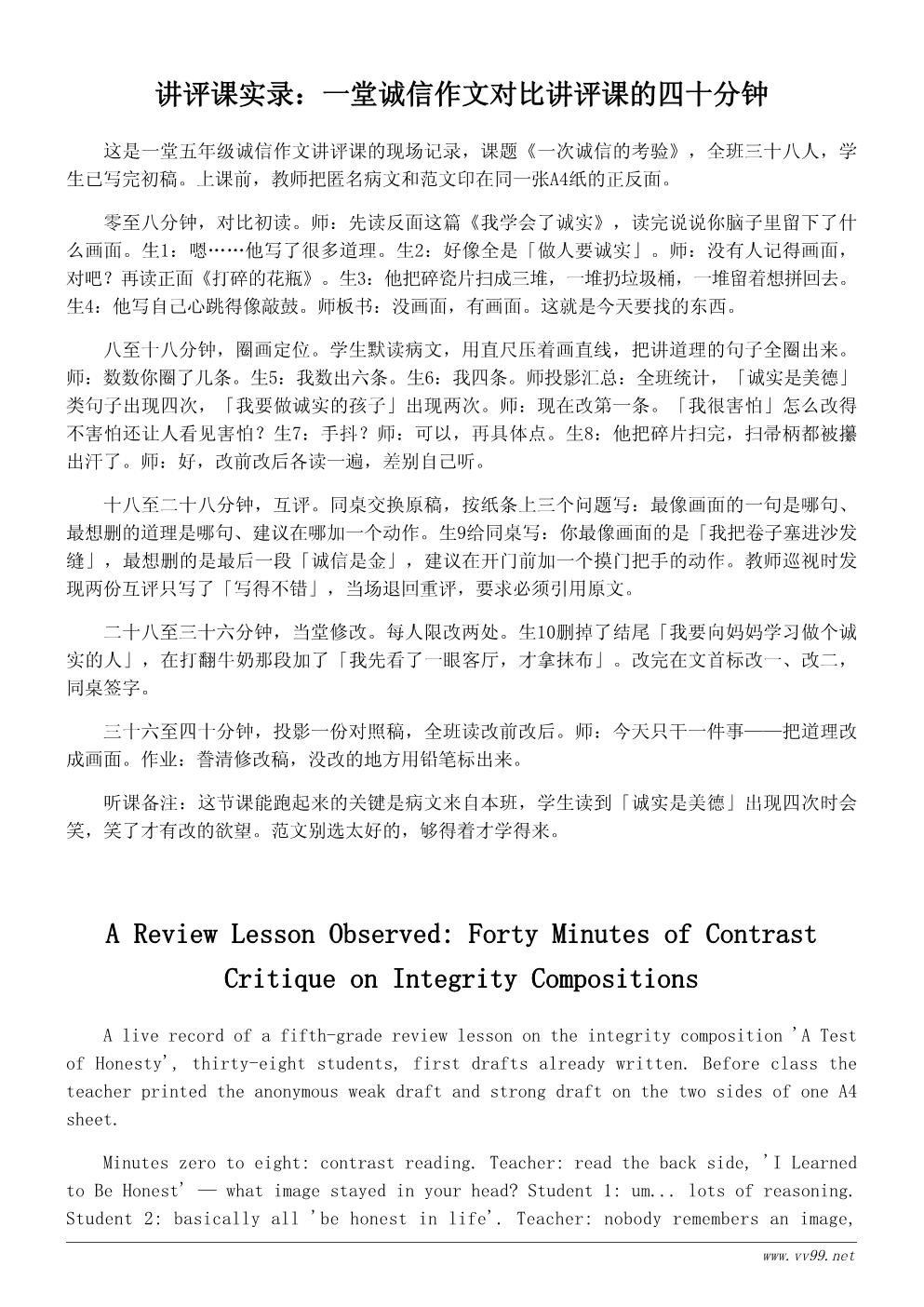
讲评课实录:一堂诚信作文对比讲评课的四十分钟
这是一堂五年级诚信作文讲评课的现场记录,课题《一次诚信的考验》,全班三十八人,学生已写完初稿。上课前,教师把匿名病文和范文印在同一张A4纸的正反面。
零至八分钟,对比初读。师:先读反面这篇《我学会了诚实》,读完说说你脑子里留下了什么画面。生1:嗯……他写了很多道理。生2:好像全是「做人要诚实」。师:没有人记得画面,对吧?再读正面《打碎的花瓶》。生3:他把碎瓷片扫成三堆,一堆扔垃圾桶,一堆留着想拼回去。生4:他写自己心跳得像敲鼓。师板书:没画面,有画面。这就是今天要找的东西。
八至十八分钟,圈画定位。学生默读病文,用直尺压着画直线,把讲道理的句子全圈出来。师:数数你圈了几条。生5:我数出六条。生6:我四条。师投影汇总:全班统计,「诚实是美德」类句子出现四次,「我要做诚实的孩子」出现两次。师:现在改第一条。「我很害怕」怎么改得不害怕还让人看见害怕?生7:手抖?师:可以,再具体点。生8:他把碎片扫完,扫帚柄都被攥出汗了。师:好,改前改后各读一遍,差别自己听。
十八至二十八分钟,互评。同桌交换原稿,按纸条上三个问题写:最像画面的一句是哪句、最想删的道理是哪句、建议在哪加一个动作。生9给同桌写:你最像画面的是「我把卷子塞进沙发缝」,最想删的是最后一段「诚信是金」,建议在开门前加一个摸门把手的动作。教师巡视时发现两份互评只写了「写得不错」,当场退回重评,要求必须引用原文。
二十八至三十六分钟,当堂修改。每人限改两处。生10删掉了结尾「我要向妈妈学习做个诚实的人」,在打翻牛奶那段加了「我先看了一眼客厅,才拿抹布」。改完在文首标改一、改二,同桌签字。
三十六至四十分钟,投影一份对照稿,全班读改前改后。师:今天只干一件事——把道理改成画面。作业:誊清修改稿,没改的地方用铅笔标出来。
听课备注:这节课能跑起来的关键是病文来自本班,学生读到「诚实是美德」出现四次时会笑,笑了才有改的欲望。范文别选太好的,够得着才学得来。
A Review Lesson Observed: Forty Minutes of Contrast Critique on Integrity Compositions
A live record of a fifth-grade review lesson on the integrity composition 'A Test of Honesty', thirty-eight students, first drafts already written. Before class the teacher printed the anonymous weak draft and strong draft on the two sides of one A4 sheet.
Minutes zero to eight: contrast reading. Teacher: read the back side, 'I Learned to Be Honest' — what image stayed in your head? Student 1: um... lots of reasoning. Student 2: basically all 'be honest in life'. Teacher: nobody remembers an image, right? Now read the front, 'The Broken Vase'. Student 3: he swept the porcelain shards into three piles — one to the bin, one kept to glue back. Student 4: he wrote that his heart pounded like a drum. Board: no image, has image. That is what we hunt today.
Minutes eight to eighteen: locate and mark. Students read the weak draft silently and rule-line every preaching sentence. Teacher: how many did you circle? Student 5: six. Student 6: four. Projected tally: four 'honesty is a virtue' sentences, two 'I must be an honest child' lines. Teacher: fix the first one. How do we rewrite 'I was very scared' so the fear shows without naming it? Student 7: shaking hands? Teacher: good, more concrete. Student 8: by the time he finished sweeping, the broom handle was wet with his palm sweat. Read before and after; hear the difference yourselves.
Minutes eighteen to twenty-eight: peer review. Deskmates exchange drafts and answer three printed questions: which sentence feels most like an image, which preaching line deserves deletion, where to add one action. Student 9 writes: your best image line is 'I stuffed the test paper into the sofa crack'; delete the closing 'honesty is gold'; add a touching-the-doorknob action before opening the door. The teacher catches two reviews that only say 'well done' and sends them back on the spot — every answer must quote the original.
Minutes twenty-eight to thirty-six: in-class revision, two spots each. Student 10 deletes 'I will learn from Mom to be honest' and adds 'I first glanced at the living room, then grabbed the cloth' to the spilled-milk paragraph. Mark Fix 1, Fix 2; deskmate signs.
Minutes thirty-six to forty: one before-and-after draft is projected and read aloud. Teacher: today we did one thing only — turn preaching into pictures. Homework: copy the revised draft; pencil-mark what was not fixed.
Observer note: the lesson works because the weak sample came from this class — students laugh when they see 'honesty is a virtue' four times, and the laugh is what starts the urge to fix. Do not pick an untouchably perfect model; reachability is what makes it learnable.
小提示:上面此文档内容仅展示完整文档里的部分内容, 若需要下载完整文档请 点击免费下载完整文档 。