文章内容
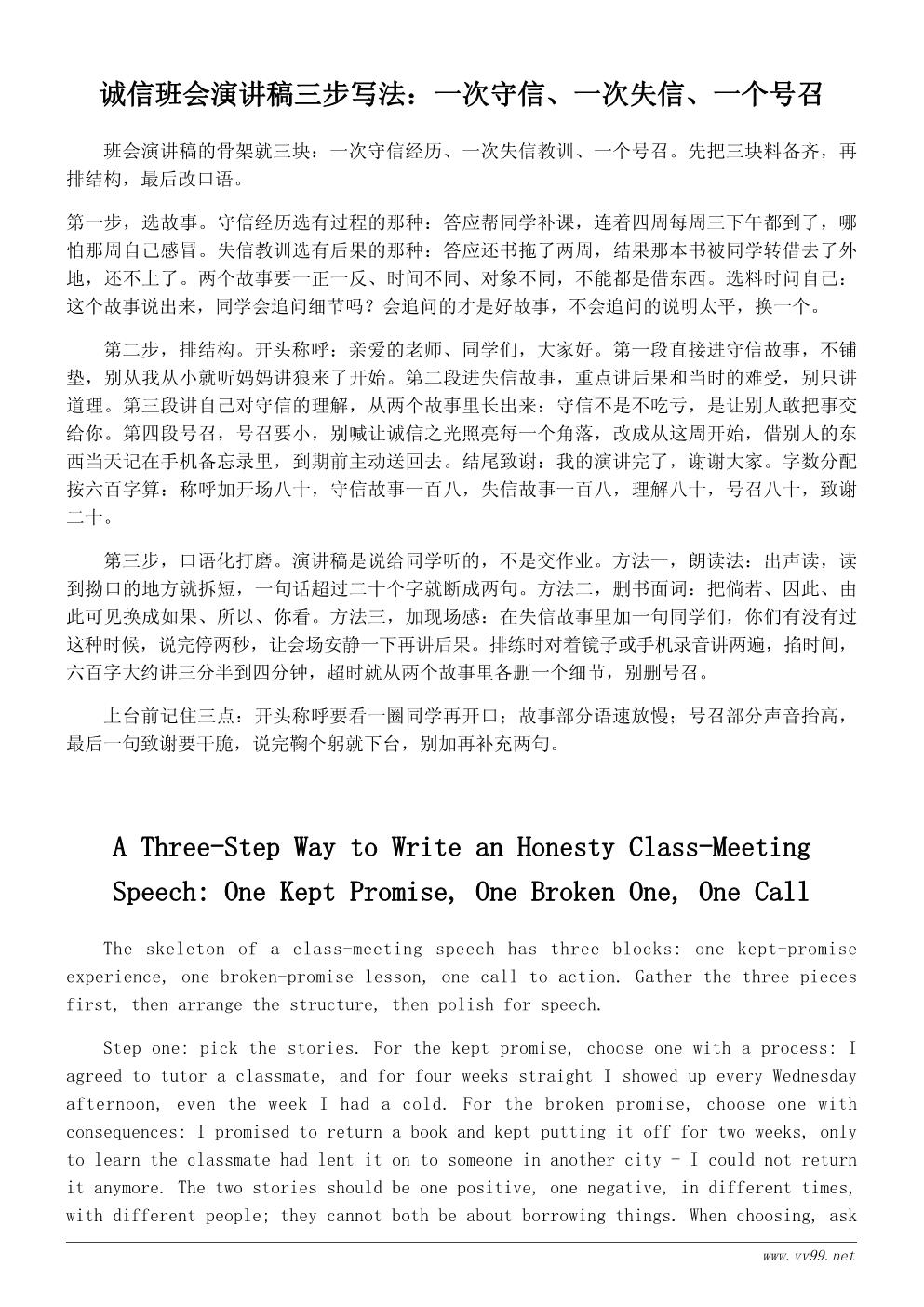
诚信班会演讲稿三步写法:一次守信、一次失信、一个号召
班会演讲稿的骨架就三块:一次守信经历、一次失信教训、一个号召。先把三块料备齐,再排结构,最后改口语。
第一步,选故事。守信经历选有过程的那种:答应帮同学补课,连着四周每周三下午都到了,哪怕那周自己感冒。失信教训选有后果的那种:答应还书拖了两周,结果那本书被同学转借去了外地,还不上了。两个故事要一正一反、时间不同、对象不同,不能都是借东西。选料时问自己:这个故事说出来,同学会追问细节吗?会追问的才是好故事,不会追问的说明太平,换一个。
第二步,排结构。开头称呼:亲爱的老师、同学们,大家好。第一段直接进守信故事,不铺垫,别从我从小就听妈妈讲狼来了开始。第二段进失信故事,重点讲后果和当时的难受,别只讲道理。第三段讲自己对守信的理解,从两个故事里长出来:守信不是不吃亏,是让别人敢把事交给你。第四段号召,号召要小,别喊让诚信之光照亮每一个角落,改成从这周开始,借别人的东西当天记在手机备忘录里,到期前主动送回去。结尾致谢:我的演讲完了,谢谢大家。字数分配按六百字算:称呼加开场八十,守信故事一百八,失信故事一百八,理解八十,号召八十,致谢二十。
第三步,口语化打磨。演讲稿是说给同学听的,不是交作业。方法一,朗读法:出声读,读到拗口的地方就拆短,一句话超过二十个字就断成两句。方法二,删书面词:把倘若、因此、由此可见换成如果、所以、你看。方法三,加现场感:在失信故事里加一句同学们,你们有没有过这种时候,说完停两秒,让会场安静一下再讲后果。排练时对着镜子或手机录音讲两遍,掐时间,六百字大约讲三分半到四分钟,超时就从两个故事里各删一个细节,别删号召。
上台前记住三点:开头称呼要看一圈同学再开口;故事部分语速放慢;号召部分声音抬高,最后一句致谢要干脆,说完鞠个躬就下台,别加再补充两句。
A Three-Step Way to Write an Honesty Class-Meeting Speech: One Kept Promise, One Broken One, One Call
The skeleton of a class-meeting speech has three blocks: one kept-promise experience, one broken-promise lesson, one call to action. Gather the three pieces first, then arrange the structure, then polish for speech.
Step one: pick the stories. For the kept promise, choose one with a process: I agreed to tutor a classmate, and for four weeks straight I showed up every Wednesday afternoon, even the week I had a cold. For the broken promise, choose one with consequences: I promised to return a book and kept putting it off for two weeks, only to learn the classmate had lent it on to someone in another city - I could not return it anymore. The two stories should be one positive, one negative, in different times, with different people; they cannot both be about borrowing things. When choosing, ask yourself: if I tell this story, will classmates press me for details? If they will, it is a good story; if not, it is too flat - swap it out.
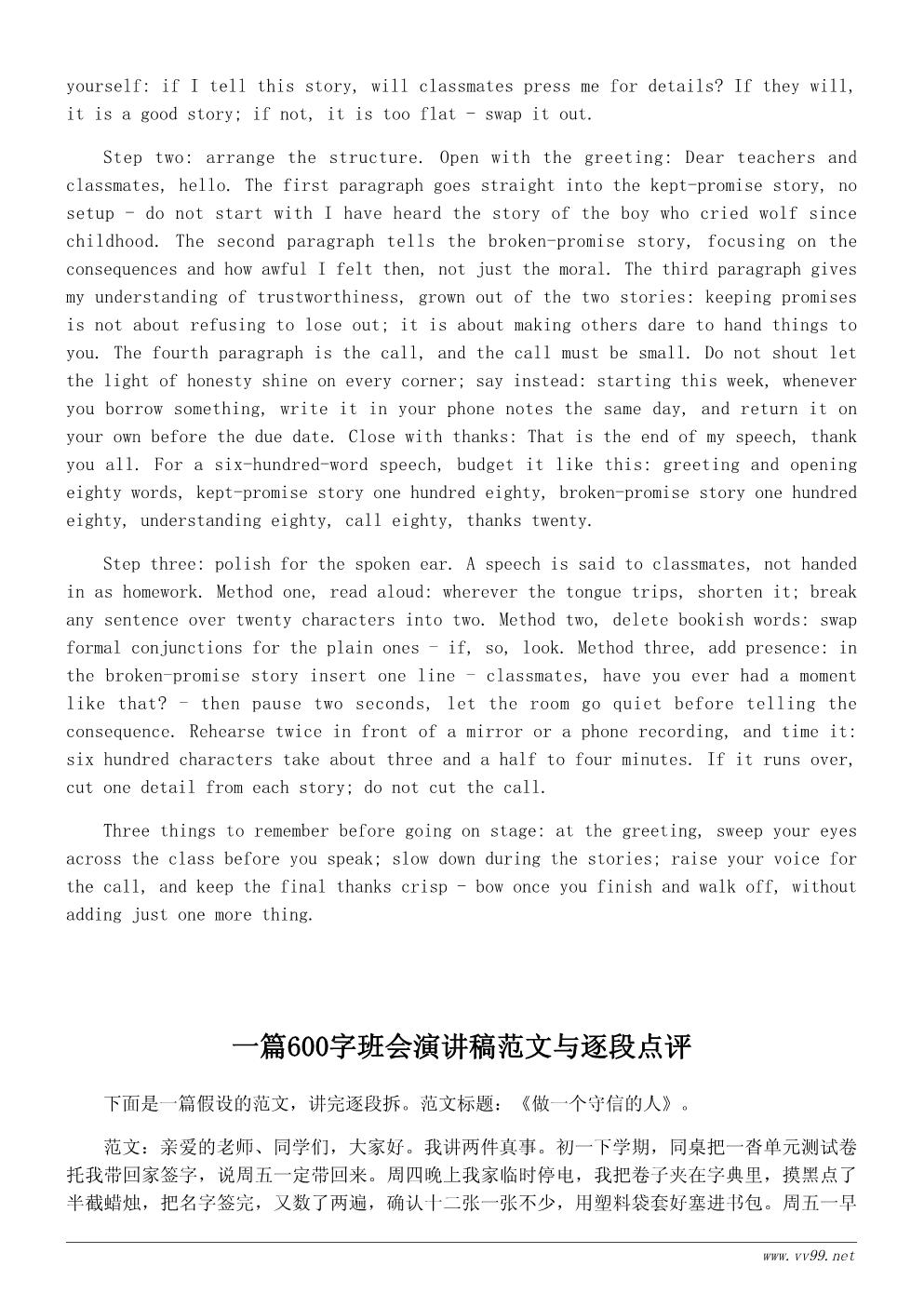
Step two: arrange the structure. Open with the greeting: Dear teachers and classmates, hello. The first paragraph goes straight into the kept-promise story, no setup - do not start with I have heard the story of the boy who cried wolf since childhood. The second paragraph tells the broken-promise story, focusing on the consequences and how awful I felt then, not just the moral. The third paragraph gives my understanding of trustworthiness, grown out of the two stories: keeping promises is not about refusing to lose out; it is about making others dare to hand things to you. The fourth paragraph is the call, and the call must be small. Do not shout let the light of honesty shine on every corner; say instead: starting this week, whenever you borrow something, write it in your phone notes the same day, and return it on your own before the due date. Close with thanks: That is the end of my speech, thank you all. For a six-hundred-word speech, budget it like this: greeting and opening eighty words, kept-promise story one hundred eighty, broken-promise story one hundred eighty, understanding eighty, call eighty, thanks twenty.
Step three: polish for the spoken ear. A speech is said to classmates, not handed in as homework. Method one, read aloud: wherever the tongue trips, shorten it; break any sentence over twenty characters into two. Method two, delete bookish words: swap formal conjunctions for the plain ones - if, so, look. Method three, add presence: in the broken-promise story insert one line - classmates, have you ever had a moment like that? - then pause two seconds, let the room go quiet before telling the consequence. Rehearse twice in front of a mirror or a phone recording, and time it: six hundred characters take about three and a half to four minutes. If it runs over, cut one detail from each story; do not cut the call.
Three things to remember before going on stage: at the greeting, sweep your eyes across the class before you speak; slow down during the stories; raise your voice for the call, and keep the final thanks crisp - bow once you finish and walk off, without adding just one more thing.
一篇600字班会演讲稿范文与逐段点评
下面是一篇假设的范文,讲完逐段拆。范文标题:《做一个守信的人》。
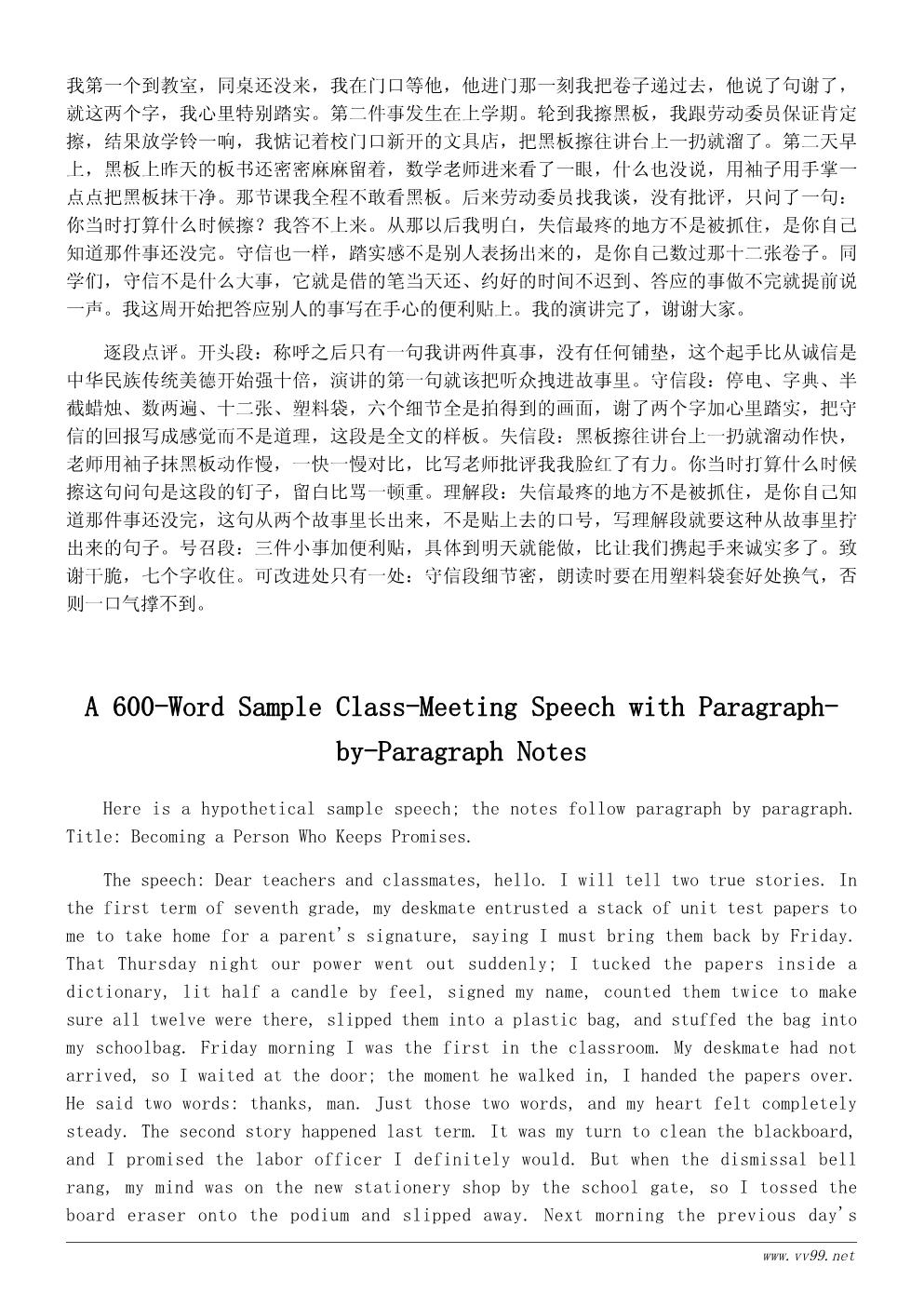
范文:亲爱的老师、同学们,大家好。我讲两件真事。初一下学期,同桌把一沓单元测试卷托我带回家签字,说周五一定带回来。周四晚上我家临时停电,我把卷子夹在字典里,摸黑点了半截蜡烛,把名字签完,又数了两遍,确认十二张一张不少,用塑料袋套好塞进书包。周五一早我第一个到教室,同桌还没来,我在门口等他,他进门那一刻我把卷子递过去,他说了句谢了,就这两个字,我心里特别踏实。第二件事发生在上学期。轮到我擦黑板,我跟劳动委员保证肯定擦,结果放学铃一响,我惦记着校门口新开的文具店,把黑板擦往讲台上一扔就溜了。第二天早上,黑板上昨天的板书还密密麻麻留着,数学老师进来看了一眼,什么也没说,用袖子用手掌一点点把黑板抹干净。那节课我全程不敢看黑板。后来劳动委员找我谈,没有批评,只问了一句:你当时打算什么时候擦?我答不上来。从那以后我明白,失信最疼的地方不是被抓住,是你自己知道那件事还没完。守信也一样,踏实感不是别人表扬出来的,是你自己数过那十二张卷子。同学们,守信不是什么大事,它就是借的笔当天还、约好的时间不迟到、答应的事做不完就提前说一声。我这周开始把答应别人的事写在手心的便利贴上。我的演讲完了,谢谢大家。
逐段点评。开头段:称呼之后只有一句我讲两件真事,没有任何铺垫,这个起手比从诚信是中华民族传统美德开始强十倍,演讲的第一句就该把听众拽进故事里。守信段:停电、字典、半截蜡烛、数两遍、十二张、塑料袋,六个细节全是拍得到的画面,谢了两个字加心里踏实,把守信的回报写成感觉而不是道理,这段是全文的样板。失信段:黑板擦往讲台上一扔就溜动作快,老师用袖子抹黑板动作慢,一快一慢对比,比写老师批评我我脸红了有力。你当时打算什么时候擦这句问句是这段的钉子,留白比骂一顿重。理解段:失信最疼的地方不是被抓住,是你自己知道那件事还没完,这句从两个故事里长出来,不是贴上去的口号,写理解段就要这种从故事里拧出来的句子。号召段:三件小事加便利贴,具体到明天就能做,比让我们携起手来诚实多了。致谢干脆,七个字收住。可改进处只有一处:守信段细节密,朗读时要在用塑料袋套好处换气,否则一口气撑不到。
A 600-Word Sample Class-Meeting Speech with Paragraph-by-Paragraph Notes
Here is a hypothetical sample speech; the notes follow paragraph by paragraph. Title: Becoming a Person Who Keeps Promises.
The speech: Dear teachers and classmates, hello. I will tell two true stories. In the first term of seventh grade, my deskmate entrusted a stack of unit test papers to me to take home for a parent's signature, saying I must bring them back by Friday. That Thursday night our power went out suddenly; I tucked the papers inside a dictionary, lit half a candle by feel, signed my name, counted them twice to make sure all twelve were there, slipped them into a plastic bag, and stuffed the bag into my schoolbag. Friday morning I was the first in the classroom. My deskmate had not arrived, so I waited at the door; the moment he walked in, I handed the papers over. He said two words: thanks, man. Just those two words, and my heart felt completely steady. The second story happened last term. It was my turn to clean the blackboard, and I promised the labor officer I definitely would. But when the dismissal bell rang, my mind was on the new stationery shop by the school gate, so I tossed the board eraser onto the podium and slipped away. Next morning the previous day's writing still covered the board densely. The math teacher walked in, glanced at it, said nothing, and wiped the board clean little by little with his sleeve and palm. All through that lesson I could not look at the blackboard. Later the labor officer talked to me. No scolding - he just asked one question: when did you plan to wipe it? I had no answer. From then on I understood: the most painful part of breaking a promise is not getting caught; it is knowing the thing is still unfinished inside you. And keeping a promise works the same way - the steadiness is not praise from others; it is you having counted those twelve papers yourself. Classmates, keeping faith is no grand matter: return borrowed pens the same day, do not show up late to agreed times, and if a promised task cannot be finished, say so in advance. Starting this week, I will write what I promise others on sticky notes in my palm. That is the end of my speech. Thank you all.
Paragraph notes. The opening: after the greeting, one sentence only - I will tell two true stories - with zero setup. This start is ten times better than opening with honesty is a traditional virtue, because a speech's first line should drag the audience into a story. The kept-promise paragraph: power outage, dictionary, half a candle, counted twice, twelve papers, plastic bag - six details, every one filmable. The two words thanks, man plus the steady feeling turn the reward of trustworthiness into a sensation, not a moral; this paragraph is the model for the whole speech. The broken-promise paragraph: tossing the eraser and slipping away is fast; the teacher wiping the board with his sleeve is slow; fast against slow hits harder than writing the teacher scolded me and I blushed. The question when did you plan to wipe it is the nail that holds this paragraph - the silence weighs more than a lecture. The understanding paragraph: the most painful part of breaking a promise is not getting caught but knowing the thing is still unfinished - this line grows out of the two stories instead of being pasted on as a slogan; that is the kind of sentence an understanding paragraph needs. The call: three small deeds plus the sticky note - specific enough to do tomorrow - far better than let us join hands in honesty. The thanks are crisp, closed in seven characters. One thing to improve: the kept-promise paragraph is detail-dense, so when reading aloud, take a breath at slipped them into a plastic bag, or one breath will not carry you to the end.
小提示:上面此文档内容仅展示完整文档里的部分内容, 若需要下载完整文档请 点击免费下载完整文档 。