文章内容
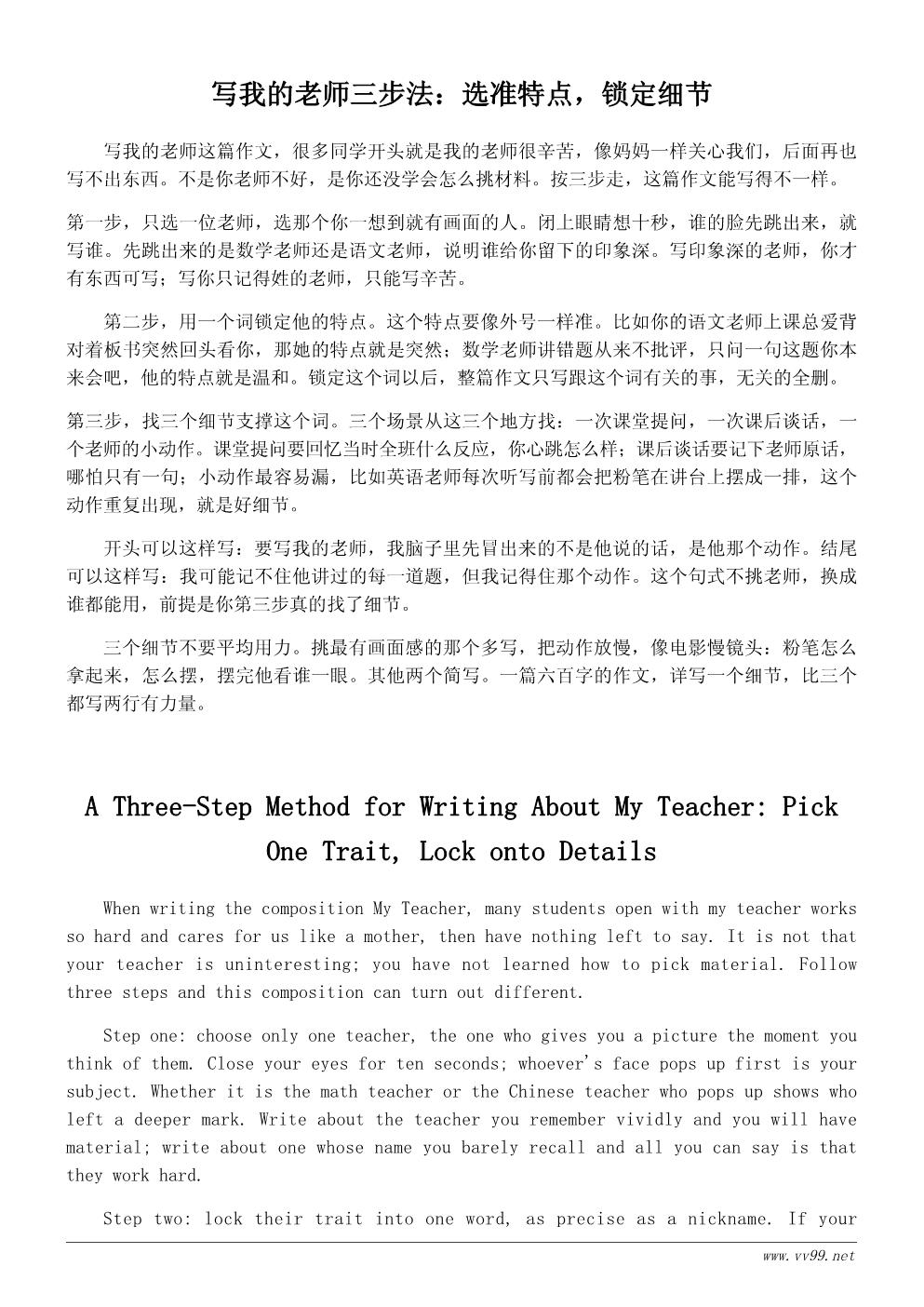
写我的老师三步法:选准特点,锁定细节
写我的老师这篇作文,很多同学开头就是我的老师很辛苦,像妈妈一样关心我们,后面再也写不出东西。不是你老师不好,是你还没学会怎么挑材料。按三步走,这篇作文能写得不一样。
第一步,只选一位老师,选那个你一想到就有画面的人。闭上眼睛想十秒,谁的脸先跳出来,就写谁。先跳出来的是数学老师还是语文老师,说明谁给你留下的印象深。写印象深的老师,你才有东西可写;写你只记得姓的老师,只能写辛苦。
第二步,用一个词锁定他的特点。这个特点要像外号一样准。比如你的语文老师上课总爱背对着板书突然回头看你,那她的特点就是突然;数学老师讲错题从来不批评,只问一句这题你本来会吧,他的特点就是温和。锁定这个词以后,整篇作文只写跟这个词有关的事,无关的全删。
第三步,找三个细节支撑这个词。三个场景从这三个地方找:一次课堂提问,一次课后谈话,一个老师的小动作。课堂提问要回忆当时全班什么反应,你心跳怎么样;课后谈话要记下老师原话,哪怕只有一句;小动作最容易漏,比如英语老师每次听写前都会把粉笔在讲台上摆成一排,这个动作重复出现,就是好细节。
开头可以这样写:要写我的老师,我脑子里先冒出来的不是他说的话,是他那个动作。结尾可以这样写:我可能记不住他讲过的每一道题,但我记得住那个动作。这个句式不挑老师,换成谁都能用,前提是你第三步真的找了细节。
三个细节不要平均用力。挑最有画面感的那个多写,把动作放慢,像电影慢镜头:粉笔怎么拿起来,怎么摆,摆完他看谁一眼。其他两个简写。一篇六百字的作文,详写一个细节,比三个都写两行有力量。
A Three-Step Method for Writing About My Teacher: Pick One Trait, Lock onto Details
When writing the composition My Teacher, many students open with my teacher works so hard and cares for us like a mother, then have nothing left to say. It is not that your teacher is uninteresting; you have not learned how to pick material. Follow three steps and this composition can turn out different.
Step one: choose only one teacher, the one who gives you a picture the moment you think of them. Close your eyes for ten seconds; whoever's face pops up first is your subject. Whether it is the math teacher or the Chinese teacher who pops up shows who left a deeper mark. Write about the teacher you remember vividly and you will have material; write about one whose name you barely recall and all you can say is that they work hard.
Step two: lock their trait into one word, as precise as a nickname. If your Chinese teacher always turns around suddenly while writing on the blackboard to check the class, her trait is suddenly. If your math teacher never scolds you for a wrong answer and only asks you could do this one before, his trait is gentleness. Once the word is locked, write only what relates to it and delete everything else.
Step three: find three details to support that word. Look in three places: one classroom question, one after-class talk, one small habit of the teacher. For the classroom question, recall how the whole class reacted and how your heart pounded. For the talk, write down the teacher's exact words, even if it is only one sentence. Small habits are easiest to miss: for example, the English teacher lines up pieces of chalk on the podium before every dictation. A habit that repeats is a good detail.
You can open like this: when I write about my teacher, the first thing in my mind is not his words but that habit of his. You can close like this: I may forget every problem he taught, but I will remember that habit. This frame fits any teacher, as long as step three actually produced details.
Do not spend equal effort on the three details. Pick the most visual one and slow it down like a movie in slow motion: how he picks up the chalk, how he lays it out, whom he glances at afterward. Keep the other two brief. In a six-hundred-character composition, one detail written in full is stronger than three details written in two lines each.
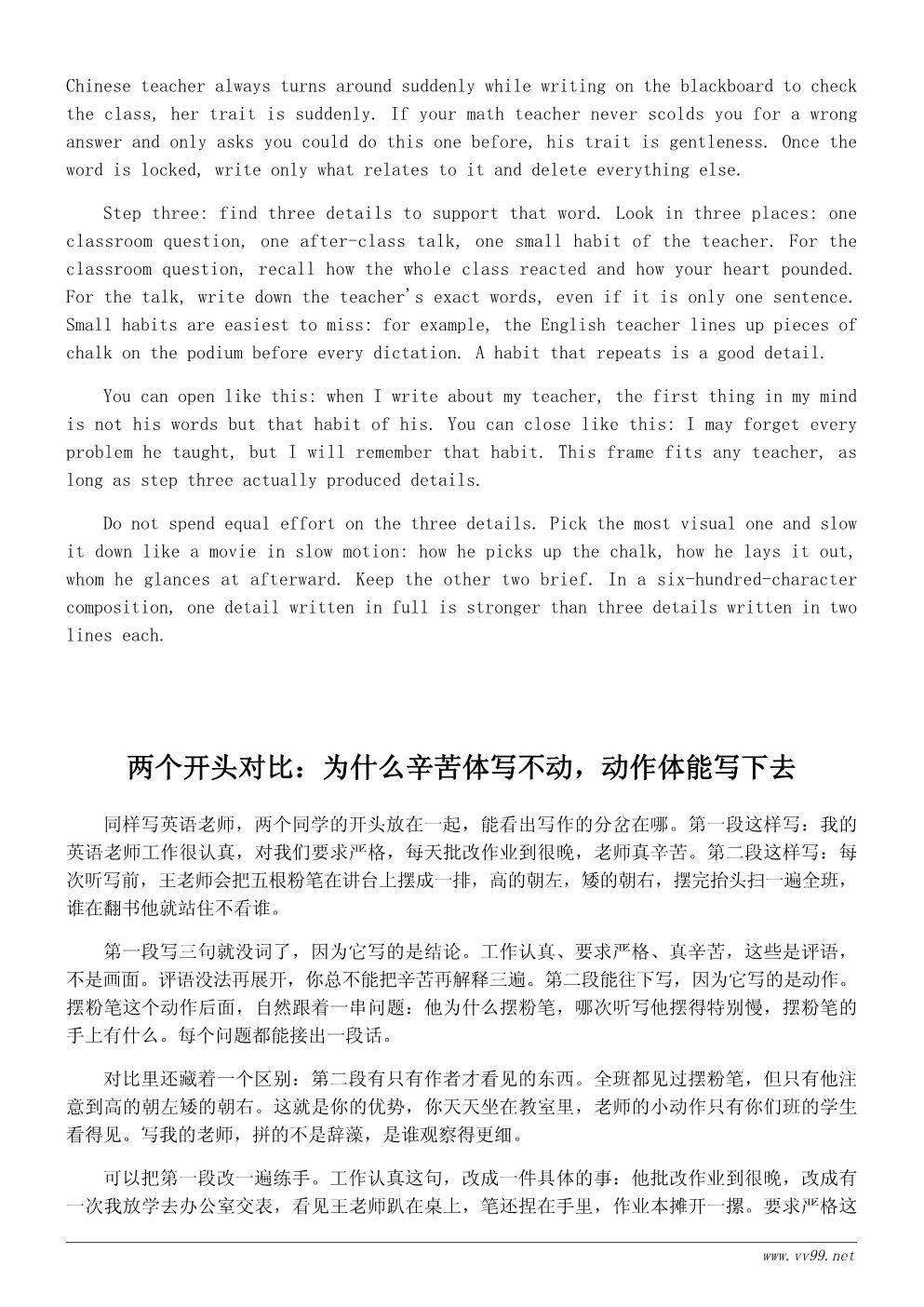
两个开头对比:为什么辛苦体写不动,动作体能写下去
同样写英语老师,两个同学的开头放在一起,能看出写作的分岔在哪。第一段这样写:我的英语老师工作很认真,对我们要求严格,每天批改作业到很晚,老师真辛苦。第二段这样写:每次听写前,王老师会把五根粉笔在讲台上摆成一排,高的朝左,矮的朝右,摆完抬头扫一遍全班,谁在翻书他就站住不看谁。
第一段写三句就没词了,因为它写的是结论。工作认真、要求严格、真辛苦,这些是评语,不是画面。评语没法再展开,你总不能把辛苦再解释三遍。第二段能往下写,因为它写的是动作。摆粉笔这个动作后面,自然跟着一串问题:他为什么摆粉笔,哪次听写他摆得特别慢,摆粉笔的手上有什么。每个问题都能接出一段话。
对比里还藏着一个区别:第二段有只有作者才看见的东西。全班都见过摆粉笔,但只有他注意到高的朝左矮的朝右。这就是你的优势,你天天坐在教室里,老师的小动作只有你们班的学生看得见。写我的老师,拼的不是辞藻,是谁观察得更细。
可以把第一段改一遍练手。工作认真这句,改成一件具体的事:他批改作业到很晚,改成有一次我放学去办公室交表,看见王老师趴在桌上,笔还捏在手里,作业本摊开一摞。要求严格这句,改成一句原话:有一次我把he写成he's,他用红笔在本子上画了个大大的问号,什么也没说,第二天又在我本子同一个地方画了个问号。改完你会发现,字数多了,辛苦两个字反而不用出现了,读者自己读出来。
这个练习叫把评语翻译成画面。平时读作文书,看到别人写好朋友的句子写得好,也可以做这个翻译:这句是评语还是画面,画面那句能不能拆成动作。练上两周,你自己写的时候会自动先想画面。
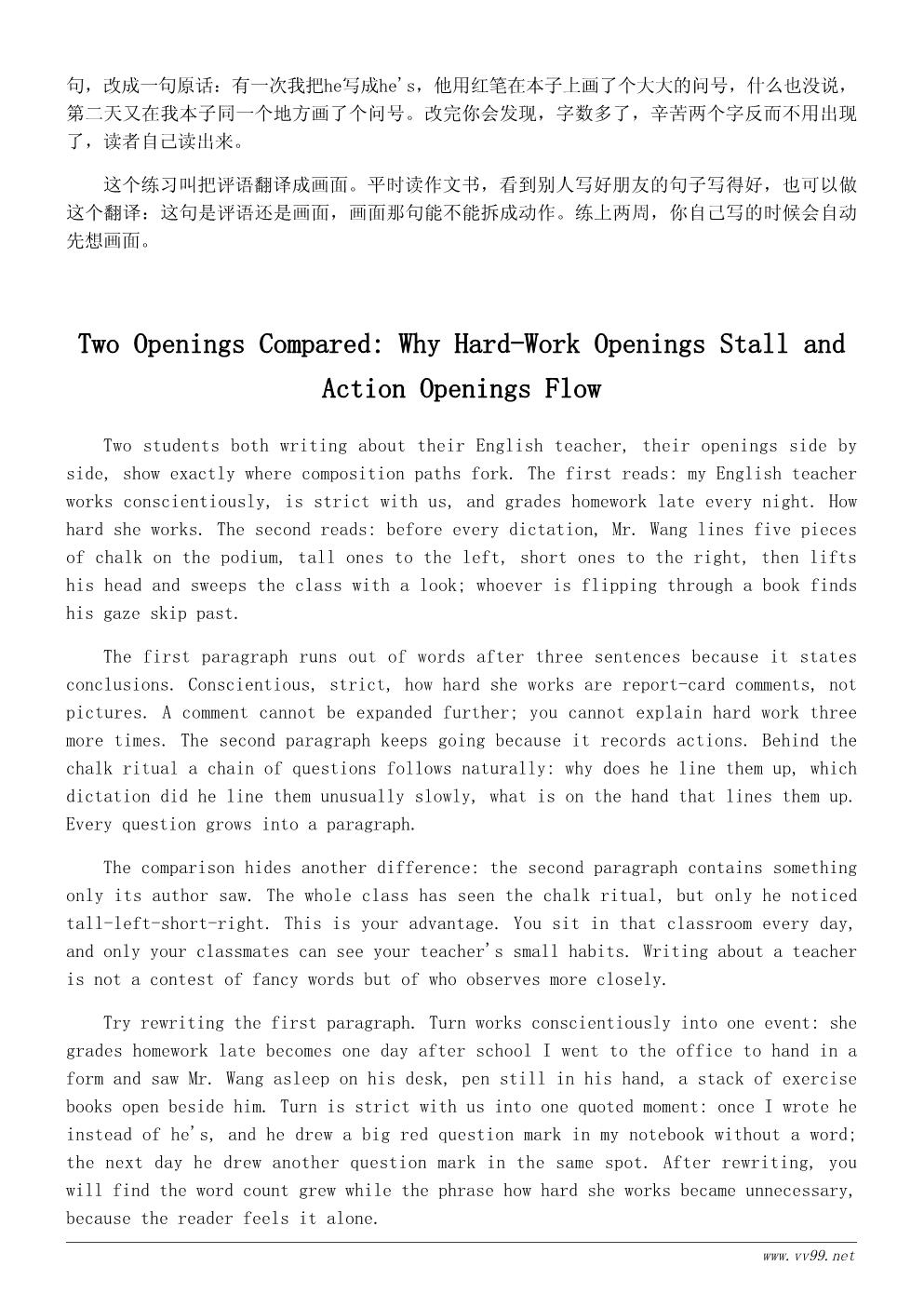
Two Openings Compared: Why Hard-Work Openings Stall and Action Openings Flow
Two students both writing about their English teacher, their openings side by side, show exactly where composition paths fork. The first reads: my English teacher works conscientiously, is strict with us, and grades homework late every night. How hard she works. The second reads: before every dictation, Mr. Wang lines five pieces of chalk on the podium, tall ones to the left, short ones to the right, then lifts his head and sweeps the class with a look; whoever is flipping through a book finds his gaze skip past.
The first paragraph runs out of words after three sentences because it states conclusions. Conscientious, strict, how hard she works are report-card comments, not pictures. A comment cannot be expanded further; you cannot explain hard work three more times. The second paragraph keeps going because it records actions. Behind the chalk ritual a chain of questions follows naturally: why does he line them up, which dictation did he line them unusually slowly, what is on the hand that lines them up. Every question grows into a paragraph.
The comparison hides another difference: the second paragraph contains something only its author saw. The whole class has seen the chalk ritual, but only he noticed tall-left-short-right. This is your advantage. You sit in that classroom every day, and only your classmates can see your teacher's small habits. Writing about a teacher is not a contest of fancy words but of who observes more closely.
Try rewriting the first paragraph. Turn works conscientiously into one event: she grades homework late becomes one day after school I went to the office to hand in a form and saw Mr. Wang asleep on his desk, pen still in his hand, a stack of exercise books open beside him. Turn is strict with us into one quoted moment: once I wrote he instead of he's, and he drew a big red question mark in my notebook without a word; the next day he drew another question mark in the same spot. After rewriting, you will find the word count grew while the phrase how hard she works became unnecessary, because the reader feels it alone.
This exercise is translating comments into pictures. When you read composition guides and admire how someone describes a friend, do the same translation: is this sentence a comment or a picture, and can the picture be broken into actions. Two weeks of this, and your own writing will reach for pictures first.
小提示:上面此文档内容仅展示完整文档里的部分内容, 若需要下载完整文档请 点击免费下载完整文档 。