文章内容
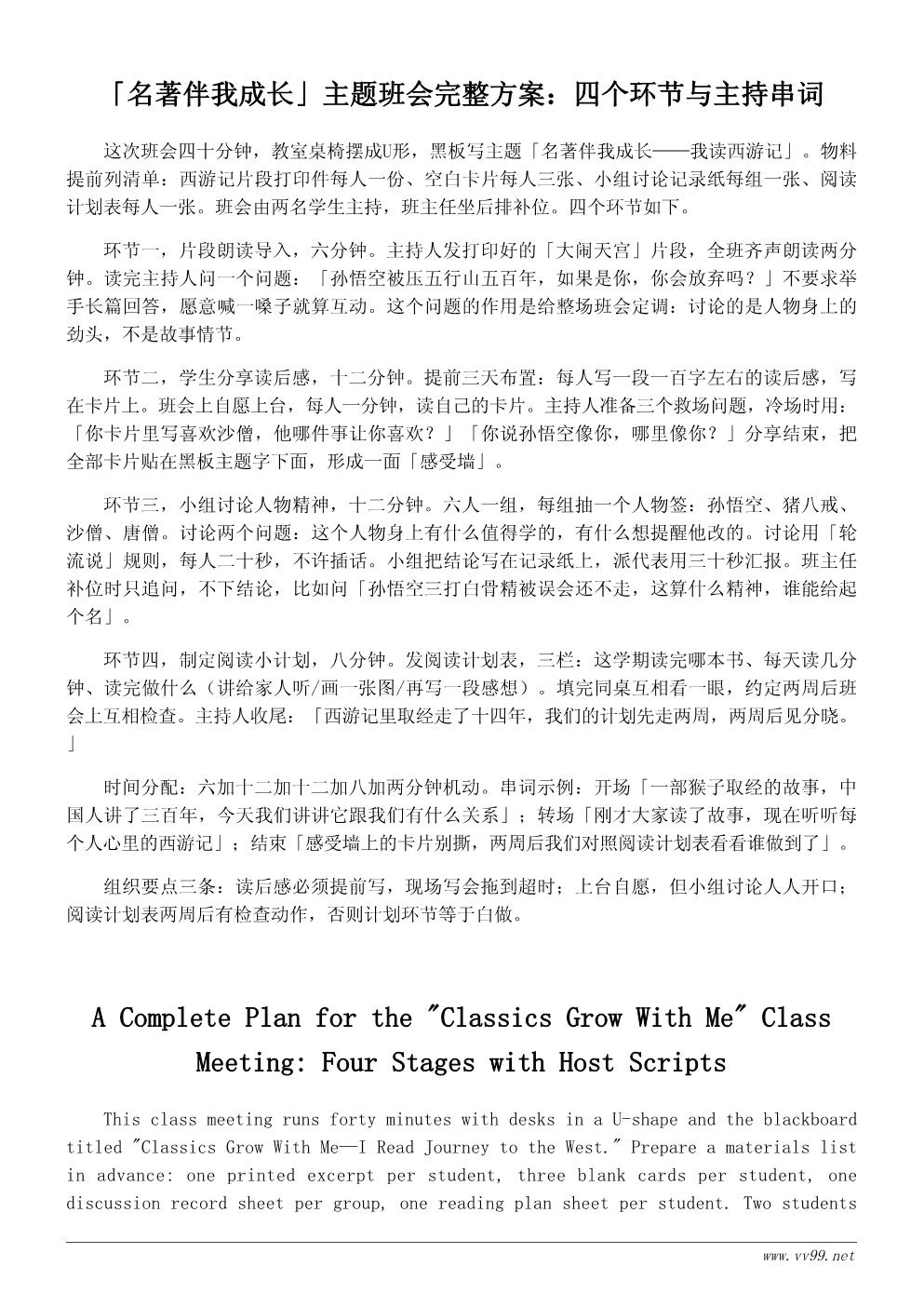
「名著伴我成长」主题班会完整方案:四个环节与主持串词
这次班会四十分钟,教室桌椅摆成U形,黑板写主题「名著伴我成长——我读西游记」。物料提前列清单:西游记片段打印件每人一份、空白卡片每人三张、小组讨论记录纸每组一张、阅读计划表每人一张。班会由两名学生主持,班主任坐后排补位。四个环节如下。
环节一,片段朗读导入,六分钟。主持人发打印好的「大闹天宫」片段,全班齐声朗读两分钟。读完主持人问一个问题:「孙悟空被压五行山五百年,如果是你,你会放弃吗?」不要求举手长篇回答,愿意喊一嗓子就算互动。这个问题的作用是给整场班会定调:讨论的是人物身上的劲头,不是故事情节。
环节二,学生分享读后感,十二分钟。提前三天布置:每人写一段一百字左右的读后感,写在卡片上。班会上自愿上台,每人一分钟,读自己的卡片。主持人准备三个救场问题,冷场时用:「你卡片里写喜欢沙僧,他哪件事让你喜欢?」「你说孙悟空像你,哪里像你?」分享结束,把全部卡片贴在黑板主题字下面,形成一面「感受墙」。
环节三,小组讨论人物精神,十二分钟。六人一组,每组抽一个人物签:孙悟空、猪八戒、沙僧、唐僧。讨论两个问题:这个人物身上有什么值得学的,有什么想提醒他改的。讨论用「轮流说」规则,每人二十秒,不许插话。小组把结论写在记录纸上,派代表用三十秒汇报。班主任补位时只追问,不下结论,比如问「孙悟空三打白骨精被误会还不走,这算什么精神,谁能给起个名」。
环节四,制定阅读小计划,八分钟。发阅读计划表,三栏:这学期读完哪本书、每天读几分钟、读完做什么(讲给家人听/画一张图/再写一段感想)。填完同桌互相看一眼,约定两周后班会上互相检查。主持人收尾:「西游记里取经走了十四年,我们的计划先走两周,两周后见分晓。」
时间分配:六加十二加十二加八加两分钟机动。串词示例:开场「一部猴子取经的故事,中国人讲了三百年,今天我们讲讲它跟我们有什么关系」;转场「刚才大家读了故事,现在听听每个人心里的西游记」;结束「感受墙上的卡片别撕,两周后我们对照阅读计划表看看谁做到了」。
组织要点三条:读后感必须提前写,现场写会拖到超时;上台自愿,但小组讨论人人开口;阅读计划表两周后有检查动作,否则计划环节等于白做。
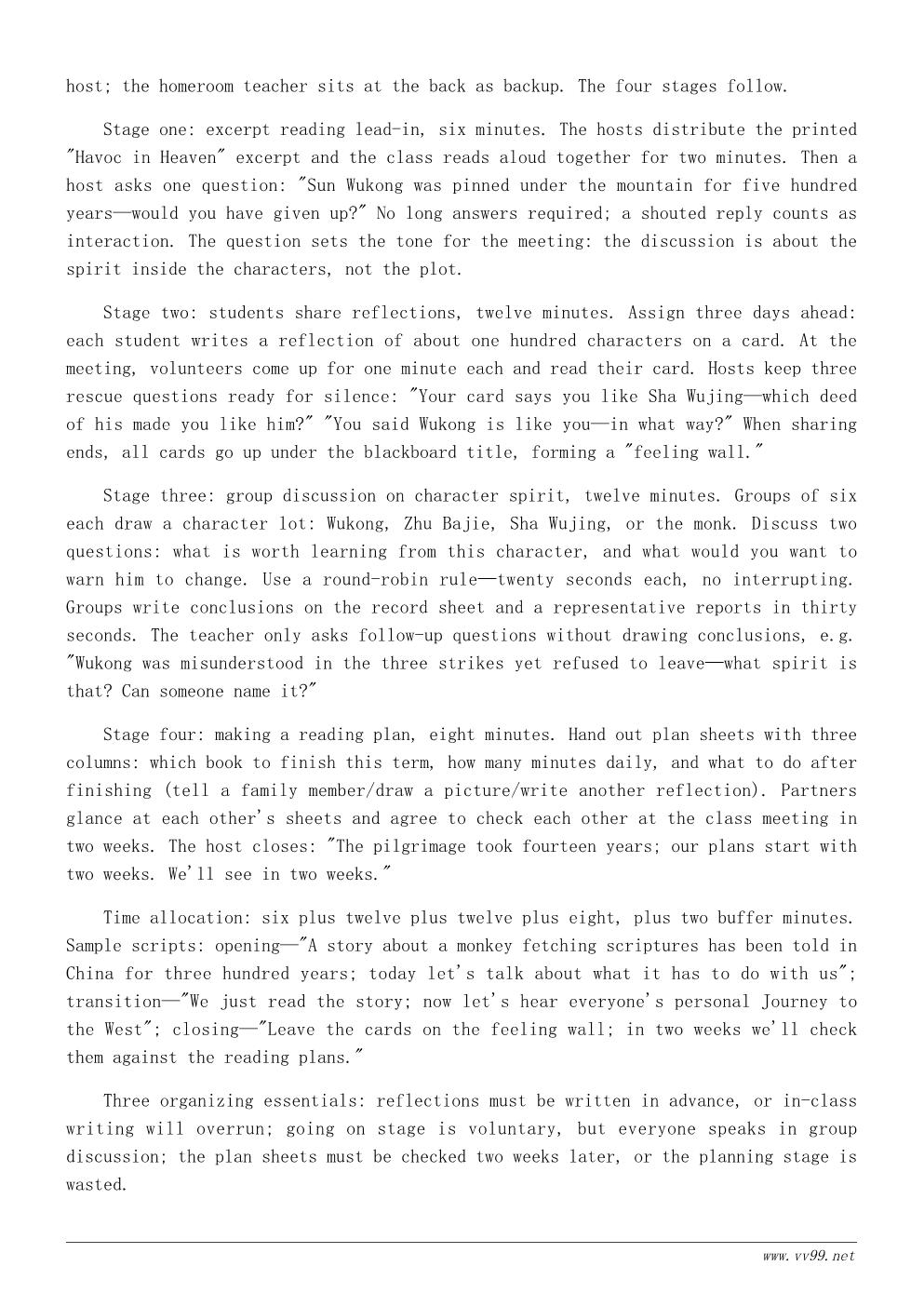
A Complete Plan for the "Classics Grow With Me" Class Meeting: Four Stages with Host Scripts
This class meeting runs forty minutes with desks in a U-shape and the blackboard titled "Classics Grow With Me—I Read Journey to the West." Prepare a materials list in advance: one printed excerpt per student, three blank cards per student, one discussion record sheet per group, one reading plan sheet per student. Two students host; the homeroom teacher sits at the back as backup. The four stages follow.
Stage one: excerpt reading lead-in, six minutes. The hosts distribute the printed "Havoc in Heaven" excerpt and the class reads aloud together for two minutes. Then a host asks one question: "Sun Wukong was pinned under the mountain for five hundred years—would you have given up?" No long answers required; a shouted reply counts as interaction. The question sets the tone for the meeting: the discussion is about the spirit inside the characters, not the plot.
Stage two: students share reflections, twelve minutes. Assign three days ahead: each student writes a reflection of about one hundred characters on a card. At the meeting, volunteers come up for one minute each and read their card. Hosts keep three rescue questions ready for silence: "Your card says you like Sha Wujing—which deed of his made you like him?" "You said Wukong is like you—in what way?" When sharing ends, all cards go up under the blackboard title, forming a "feeling wall."
Stage three: group discussion on character spirit, twelve minutes. Groups of six each draw a character lot: Wukong, Zhu Bajie, Sha Wujing, or the monk. Discuss two questions: what is worth learning from this character, and what would you want to warn him to change. Use a round-robin rule—twenty seconds each, no interrupting. Groups write conclusions on the record sheet and a representative reports in thirty seconds. The teacher only asks follow-up questions without drawing conclusions, e.g. "Wukong was misunderstood in the three strikes yet refused to leave—what spirit is that? Can someone name it?"
Stage four: making a reading plan, eight minutes. Hand out plan sheets with three columns: which book to finish this term, how many minutes daily, and what to do after finishing (tell a family member/draw a picture/write another reflection). Partners glance at each other's sheets and agree to check each other at the class meeting in two weeks. The host closes: "The pilgrimage took fourteen years; our plans start with two weeks. We'll see in two weeks."
Time allocation: six plus twelve plus twelve plus eight, plus two buffer minutes. Sample scripts: opening—"A story about a monkey fetching scriptures has been told in China for three hundred years; today let's talk about what it has to do with us"; transition—"We just read the story; now let's hear everyone's personal Journey to the West"; closing—"Leave the cards on the feeling wall; in two weeks we'll check them against the reading plans."
Three organizing essentials: reflections must be written in advance, or in-class writing will overrun; going on stage is voluntary, but everyone speaks in group discussion; the plan sheets must be checked two weeks later, or the planning stage is wasted.
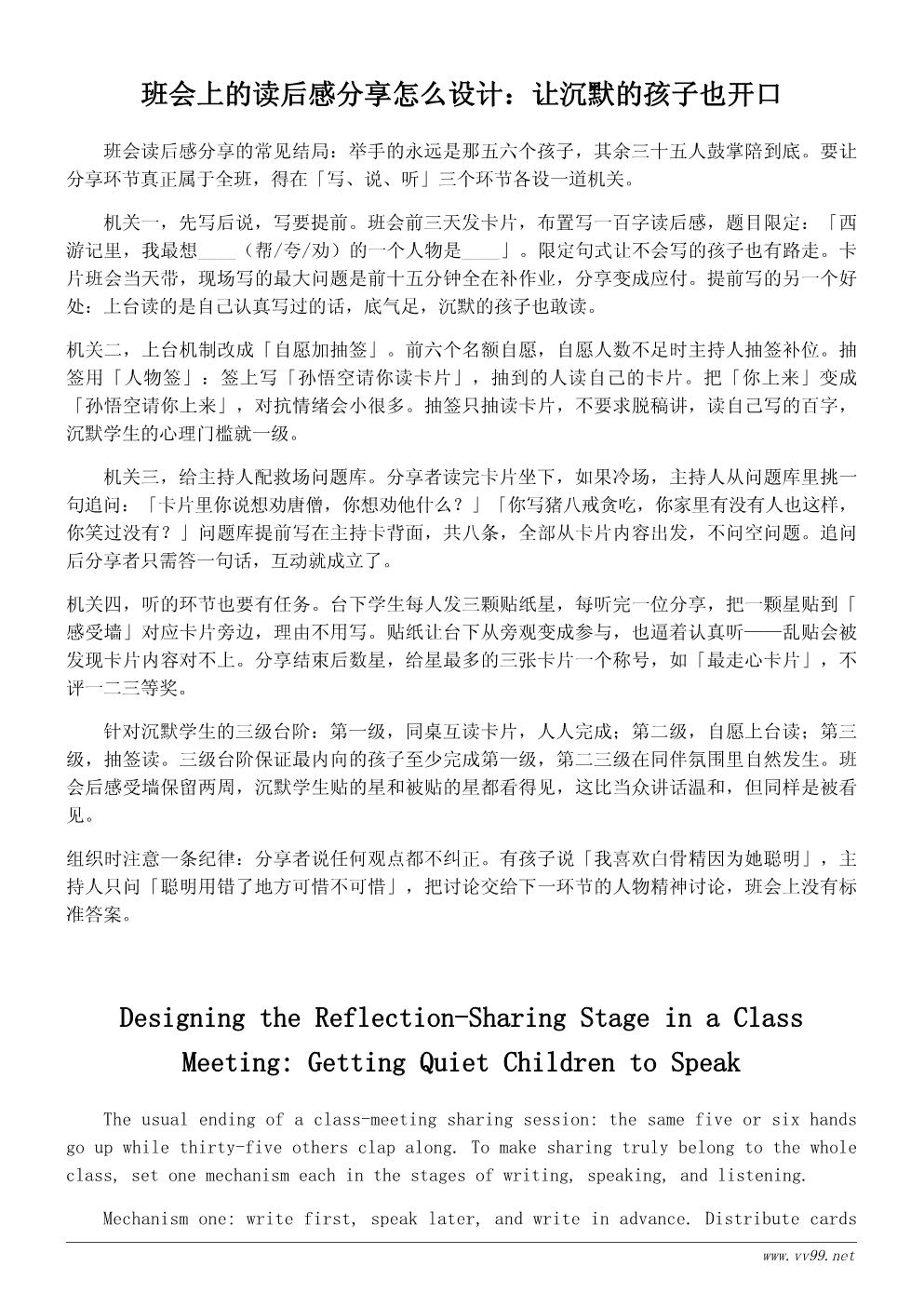
班会上的读后感分享怎么设计:让沉默的孩子也开口
班会读后感分享的常见结局:举手的永远是那五六个孩子,其余三十五人鼓掌陪到底。要让分享环节真正属于全班,得在「写、说、听」三个环节各设一道机关。
机关一,先写后说,写要提前。班会前三天发卡片,布置写一百字读后感,题目限定:「西游记里,我最想____(帮/夸/劝)的一个人物是____」。限定句式让不会写的孩子也有路走。卡片班会当天带,现场写的最大问题是前十五分钟全在补作业,分享变成应付。提前写的另一个好处:上台读的是自己认真写过的话,底气足,沉默的孩子也敢读。
机关二,上台机制改成「自愿加抽签」。前六个名额自愿,自愿人数不足时主持人抽签补位。抽签用「人物签」:签上写「孙悟空请你读卡片」,抽到的人读自己的卡片。把「你上来」变成「孙悟空请你上来」,对抗情绪会小很多。抽签只抽读卡片,不要求脱稿讲,读自己写的百字,沉默学生的心理门槛就一级。
机关三,给主持人配救场问题库。分享者读完卡片坐下,如果冷场,主持人从问题库里挑一句追问:「卡片里你说想劝唐僧,你想劝他什么?」「你写猪八戒贪吃,你家里有没有人也这样,你笑过没有?」问题库提前写在主持卡背面,共八条,全部从卡片内容出发,不问空问题。追问后分享者只需答一句话,互动就成立了。
机关四,听的环节也要有任务。台下学生每人发三颗贴纸星,每听完一位分享,把一颗星贴到「感受墙」对应卡片旁边,理由不用写。贴纸让台下从旁观变成参与,也逼着认真听——乱贴会被发现卡片内容对不上。分享结束后数星,给星最多的三张卡片一个称号,如「最走心卡片」,不评一二三等奖。
针对沉默学生的三级台阶:第一级,同桌互读卡片,人人完成;第二级,自愿上台读;第三级,抽签读。三级台阶保证最内向的孩子至少完成第一级,第二三级在同伴氛围里自然发生。班会后感受墙保留两周,沉默学生贴的星和被贴的星都看得见,这比当众讲话温和,但同样是被看见。
组织时注意一条纪律:分享者说任何观点都不纠正。有孩子说「我喜欢白骨精因为她聪明」,主持人只问「聪明用错了地方可惜不可惜」,把讨论交给下一环节的人物精神讨论,班会上没有标准答案。
Designing the Reflection-Sharing Stage in a Class Meeting: Getting Quiet Children to Speak
The usual ending of a class-meeting sharing session: the same five or six hands go up while thirty-five others clap along. To make sharing truly belong to the whole class, set one mechanism each in the stages of writing, speaking, and listening.
Mechanism one: write first, speak later, and write in advance. Distribute cards three days before the meeting with a one-hundred-character assignment using a fixed frame: "In Journey to the West, the person I most want to ____ (help/praise/warn) is ____". The fixed frame gives even weak writers a path. Cards are brought on meeting day; writing on the spot means the first fifteen minutes become homework-catching-up and sharing becomes perfunctory. Another benefit of writing ahead: students read their own careful words on stage, which gives even quiet children the confidence to read aloud.
Mechanism two: change the stage mechanism to "volunteers plus lottery." The first six slots are voluntary; if volunteers fall short, hosts draw lots to fill them. Use "character lots": the lot reads "Sun Wukong invites you to read your card," and the drawn student reads their card. Turning "you come up" into "Sun Wukong invites you up" softens resistance a great deal. The lottery only requires reading the card, not speaking from memory—reading one's own hundred characters is a single step over the threshold for a silent student.
Mechanism three: equip hosts with a rescue-question bank. If silence follows a reading, the host picks one question from the bank: "Your card says you want to warn the monk—warn him about what?" "You wrote that Zhu Bajie loves food—does anyone at home do the same? Have you laughed about it?" The bank, eight questions in total, is printed on the back of the host card; every question starts from the card's content, never from abstractions. One sentence of answer from the speaker completes the interaction.
Mechanism four: the audience gets tasks too. Each seated student receives three star stickers and, after each sharing, sticks one beside the matching card on the feeling wall—no written reason needed. Stickers turn bystanders into participants and enforce listening, because careless sticking mismatches the card's content. After sharing, count the stars; the three most-starred cards get titles like "Most Heartfelt Card"—no first or second prizes.
For silent students, build three steps: step one, read cards with a deskmate—everyone completes it; step two, volunteer to read on stage; step three, read by lottery. The steps guarantee even the most introverted child completes step one, while steps two and three happen naturally in the group atmosphere. Keep the feeling wall up for two weeks afterward: the stars a quiet student gave and received are all visible—gentler than public speaking, but still a form of being seen.
One discipline to enforce: never correct a speaker's view. If a child says "I like the White Bone Demon because she is clever," the host only asks, "Is it a pity that cleverness was used in the wrong place?"—and hands the debate to the next stage on character spirit. A class meeting has no standard answers.
小提示:上面此文档内容仅展示完整文档里的部分内容, 若需要下载完整文档请 点击免费下载完整文档 。