文章内容
文章内容
高三期中复盘:找到优势与短板的关键
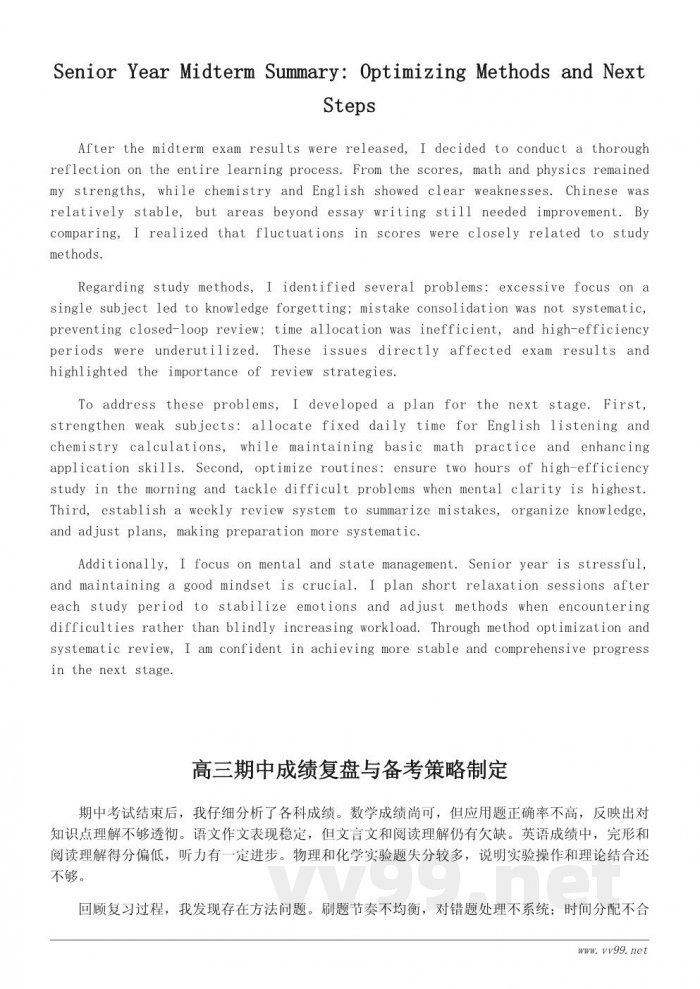
高三的期中考试已经结束,面对成绩单,我试着进行一次全面的复盘。首先,我对各科成绩进行了对比。数学成绩保持稳定,尤其是几何和函数部分表现突出,但代数运算和应用题还有明显提升空间。语文方面,阅读理解和作文的得分较高,但古文默写和文言文理解仍存在疏漏。英语成绩中,听力表现一般,语法和完形填空的正确率还需提高。理科中物理实验题和化学计算题是我的短板,历史和政治则表现中等。
在复习方法上,我发现自己刷题节奏不够均衡,常常集中在一两科目上,导致其他科目遗忘较多。时间分配上,早晨的高效时间没有充分利用,错题处理也不够系统化,有些错题只是简单记录,没有深入分析。
基于这些发现,我为下一阶段制定了几个可执行策略。第一,强化薄弱科目,数学代数和英语听力将每天安排专项练习;第二,优化作息,保证每天至少7小时睡眠,并在上午安排高难度题训练;第三,建立周复盘机制,每周末总结错题和学习进度,调整下一周计划。
此外,我意识到高三的学习不仅是知识的积累,更是心理状态的管理。期中复盘让我明确了目标,也减轻了焦虑感。通过科学安排时间和方法,我相信自己在后续备考中可以更有方向感,逐步提升整体水平。
Midterm Review for Senior Year: Identifying Strengths and Weaknesses
The midterm exams of senior year have concluded, and I decided to conduct a comprehensive review of my performance. First, I compared scores across subjects. My math performance remained stable, particularly in geometry and functions, but algebra and applied problems still need improvement. In Chinese, I scored well in reading comprehension and essays, but classical Chinese and literature understanding had gaps. In English, listening was average, and grammar and cloze exercises need more accuracy. In sciences, physics experiments and chemistry calculations were my weaknesses, while history and politics were moderate.
Regarding study methods, I realized my practice schedule was uneven, often focusing on one or two subjects, which caused forgetfulness in others. My time allocation was also suboptimal, as I did not fully utilize the morning high-efficiency period, and my handling of mistakes lacked depth; some errors were merely recorded without thorough analysis.
Based on these observations, I developed several actionable strategies for the next stage. First, strengthen weak subjects: daily targeted practice for algebra in math and listening in English. Second, optimize daily routines, ensuring at least seven hours of sleep and scheduling difficult tasks in the morning. Third, establish a weekly review system, summarizing mistakes and progress every weekend to adjust the following week's plan.
Moreover, I realized that senior year is not only about knowledge accumulation but also about managing mental state. This midterm review clarified my goals and reduced anxiety. With scientific time management and methods, I believe I can advance more directionally in my preparation and gradually improve overall performance.
查漏补缺:高三期中后的科学复盘
期中考试结束后,我的第一反应是总结自己的优势与不足。各科成绩的差异非常明显:数学高分体现了刷题基础扎实,但偶尔粗心导致失分;语文作文分数稳定,但阅读理解和古文翻译还有进步空间;英语在词汇和语法上表现尚可,但听力和写作仍需加强。理科中,物理计算题容易丢分,化学实验题操作不够熟练。
在复习过程中,我意识到自己存在方法上的问题。例如刷题节奏过快,只关注数量而忽略了质量,错题没有系统归档,时间分配不均。尤其是在高强度复习阶段,容易陷入题海而忽视知识点梳理。
针对这些问题,我制定了下一阶段的策略。首先,强化薄弱环节,数学错题每日复盘,英语听力每晚坚持训练;其次,优化作息,把上午的黄金时间用在思维集中、难度较高的学科;再次,建立每周复盘机制,总结错题、整理知识漏洞,确保漏洞不被遗忘。
心理调节也至关重要,高三学习压力大,保持良好的作息、适度运动和自我激励是提高学习效率的前提。通过这次复盘,我不仅找到了成绩的瓶颈,也明确了下一阶段的努力方向。系统复盘让我的备考更有条理,也让自己在高压下保持清晰的学习目标。
Filling Gaps: A Scientific Midterm Review for Senior Year
After the midterm exams, my first reaction was to summarize my strengths and weaknesses. The differences across subjects were very evident: high math scores showed a solid practice foundation, but occasional carelessness caused points lost; Chinese essay scores were stable, but reading comprehension and classical Chinese translation needed improvement; English performance was acceptable in vocabulary and grammar, but listening and writing required more work. In science, physics calculation questions caused frequent mistakes, and chemistry experiments were not practiced enough.
During the review, I realized problems in my study methods. For example, I practiced problems too quickly, focusing on quantity over quality, mistakes were not systematically archived, and time allocation was uneven. Especially during intensive study periods, I tended to get lost in problem sets without consolidating key knowledge points.
To address these issues, I formulated strategies for the next stage. First, strengthen weak areas: daily review of math mistakes, nightly listening practice for English. Second, optimize routines by dedicating morning high-efficiency periods to cognitively demanding subjects. Third, establish a weekly review system to summarize mistakes and knowledge gaps, ensuring they are not forgotten.
Mental adjustment is also crucial. Senior year is stressful, and maintaining good sleep, moderate exercise, and self-motivation is key to efficiency. Through this review, I not only identified bottlenecks in my performance but also clarified the focus for the next stage. Systematic review makes my preparation more organized and helps maintain clear study goals under pressure.
小提示:上面此文档内容仅展示完整文档里的部分内容, 若需要下载完整文档请 点击免费下载完整文档 。