文章内容
文章内容
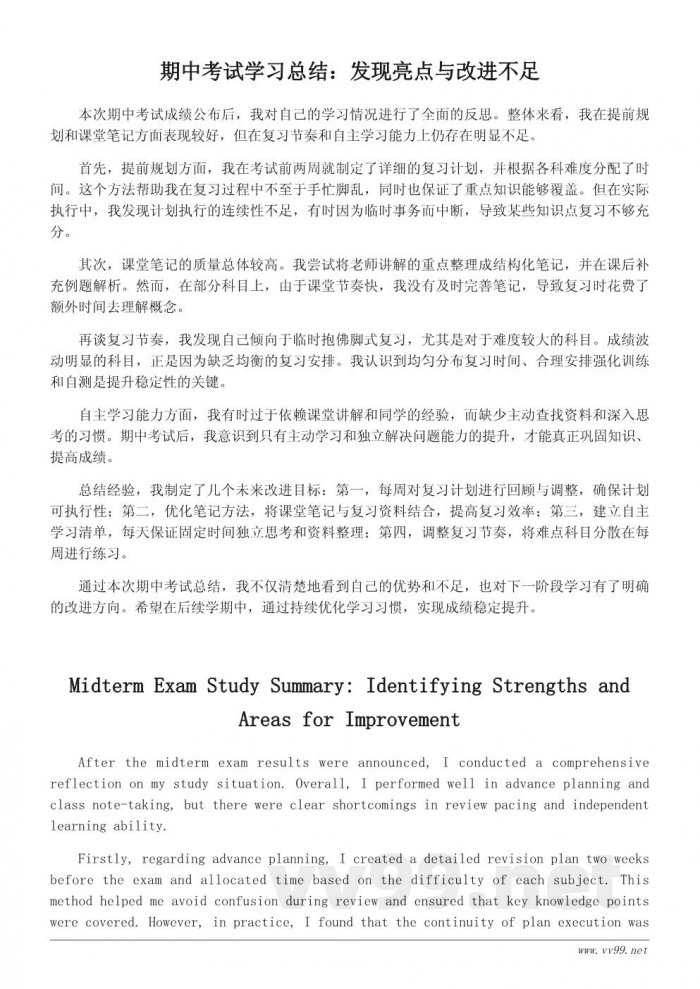
期中考试学习总结:发现亮点与改进不足
本次期中考试成绩公布后,我对自己的学习情况进行了全面的反思。整体来看,我在提前规划和课堂笔记方面表现较好,但在复习节奏和自主学习能力上仍存在明显不足。
首先,提前规划方面,我在考试前两周就制定了详细的复习计划,并根据各科难度分配了时间。这个方法帮助我在复习过程中不至于手忙脚乱,同时也保证了重点知识能够覆盖。但在实际执行中,我发现计划执行的连续性不足,有时因为临时事务而中断,导致某些知识点复习不够充分。
其次,课堂笔记的质量总体较高。我尝试将老师讲解的重点整理成结构化笔记,并在课后补充例题解析。然而,在部分科目上,由于课堂节奏快,我没有及时完善笔记,导致复习时花费了额外时间去理解概念。
再谈复习节奏,我发现自己倾向于临时抱佛脚式复习,尤其是对于难度较大的科目。成绩波动明显的科目,正是因为缺乏均衡的复习安排。我认识到均匀分布复习时间、合理安排强化训练和自测是提升稳定性的关键。
自主学习能力方面,我有时过于依赖课堂讲解和同学的经验,而缺少主动查找资料和深入思考的习惯。期中考试后,我意识到只有主动学习和独立解决问题能力的提升,才能真正巩固知识、提高成绩。
总结经验,我制定了几个未来改进目标:第一,每周对复习计划进行回顾与调整,确保计划可执行性;第二,优化笔记方法,将课堂笔记与复习资料结合,提高复习效率;第三,建立自主学习清单,每天保证固定时间独立思考和资料整理;第四,调整复习节奏,将难点科目分散在每周进行练习。
通过本次期中考试总结,我不仅清楚地看到自己的优势和不足,也对下一阶段学习有了明确的改进方向。希望在后续学期中,通过持续优化学习习惯,实现成绩稳定提升。
Midterm Exam Study Summary: Identifying Strengths and Areas for Improvement
After the midterm exam results were announced, I conducted a comprehensive reflection on my study situation. Overall, I performed well in advance planning and class note-taking, but there were clear shortcomings in review pacing and independent learning ability.
Firstly, regarding advance planning, I created a detailed revision plan two weeks before the exam and allocated time based on the difficulty of each subject. This method helped me avoid confusion during review and ensured that key knowledge points were covered. However, in practice, I found that the continuity of plan execution was insufficient; sometimes, temporary matters interrupted the schedule, leaving some knowledge points inadequately reviewed.
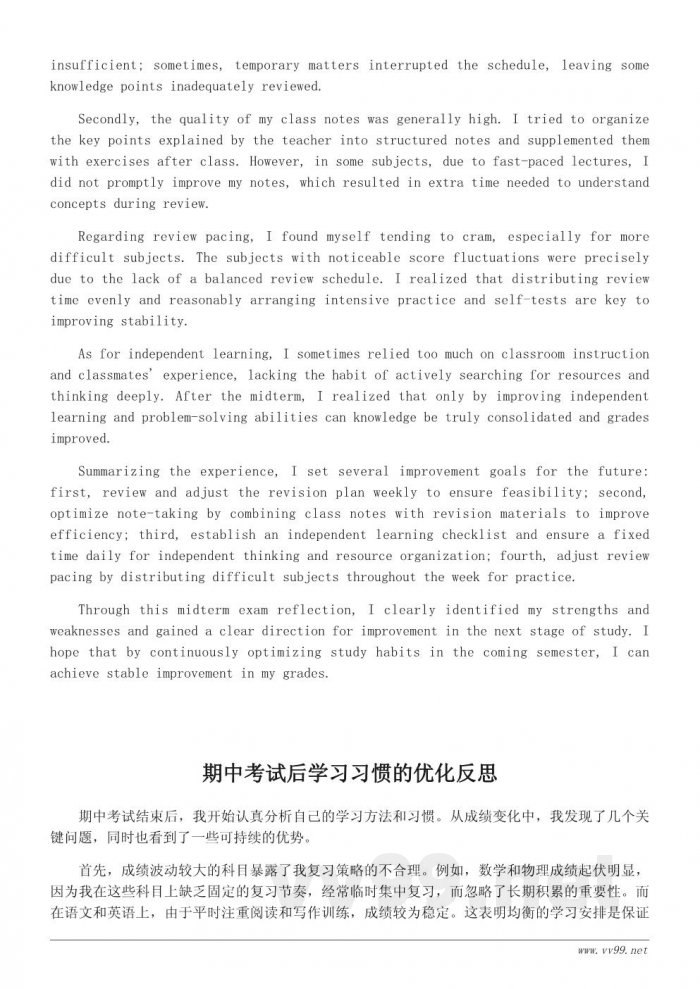
Secondly, the quality of my class notes was generally high. I tried to organize the key points explained by the teacher into structured notes and supplemented them with exercises after class. However, in some subjects, due to fast-paced lectures, I did not promptly improve my notes, which resulted in extra time needed to understand concepts during review.
Regarding review pacing, I found myself tending to cram, especially for more difficult subjects. The subjects with noticeable score fluctuations were precisely due to the lack of a balanced review schedule. I realized that distributing review time evenly and reasonably arranging intensive practice and self-tests are key to improving stability.
As for independent learning, I sometimes relied too much on classroom instruction and classmates' experience, lacking the habit of actively searching for resources and thinking deeply. After the midterm, I realized that only by improving independent learning and problem-solving abilities can knowledge be truly consolidated and grades improved.
Summarizing the experience, I set several improvement goals for the future: first, review and adjust the revision plan weekly to ensure feasibility; second, optimize note-taking by combining class notes with revision materials to improve efficiency; third, establish an independent learning checklist and ensure a fixed time daily for independent thinking and resource organization; fourth, adjust review pacing by distributing difficult subjects throughout the week for practice.
Through this midterm exam reflection, I clearly identified my strengths and weaknesses and gained a clear direction for improvement in the next stage of study. I hope that by continuously optimizing study habits in the coming semester, I can achieve stable improvement in my grades.
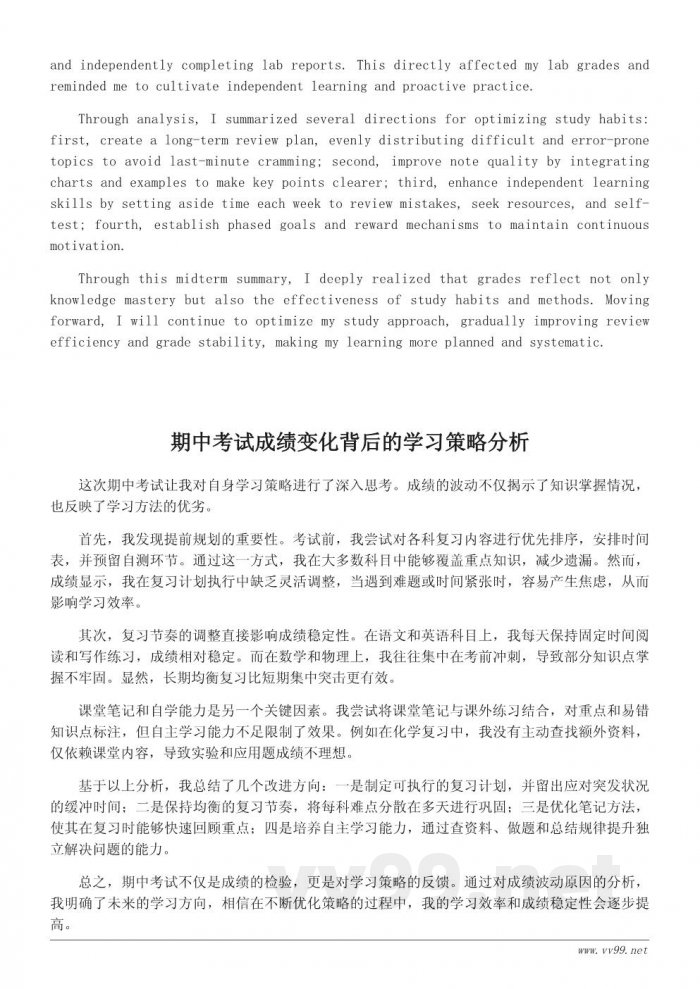
期中考试后学习习惯的优化反思
期中考试结束后,我开始认真分析自己的学习方法和习惯。从成绩变化中,我发现了几个关键问题,同时也看到了一些可持续的优势。
首先,成绩波动较大的科目暴露了我复习策略的不合理。例如,数学和物理成绩起伏明显,因为我在这些科目上缺乏固定的复习节奏,经常临时集中复习,而忽略了长期积累的重要性。而在语文和英语上,由于平时注重阅读和写作训练,成绩较为稳定。这表明均衡的学习安排是保证稳定性的重要因素。
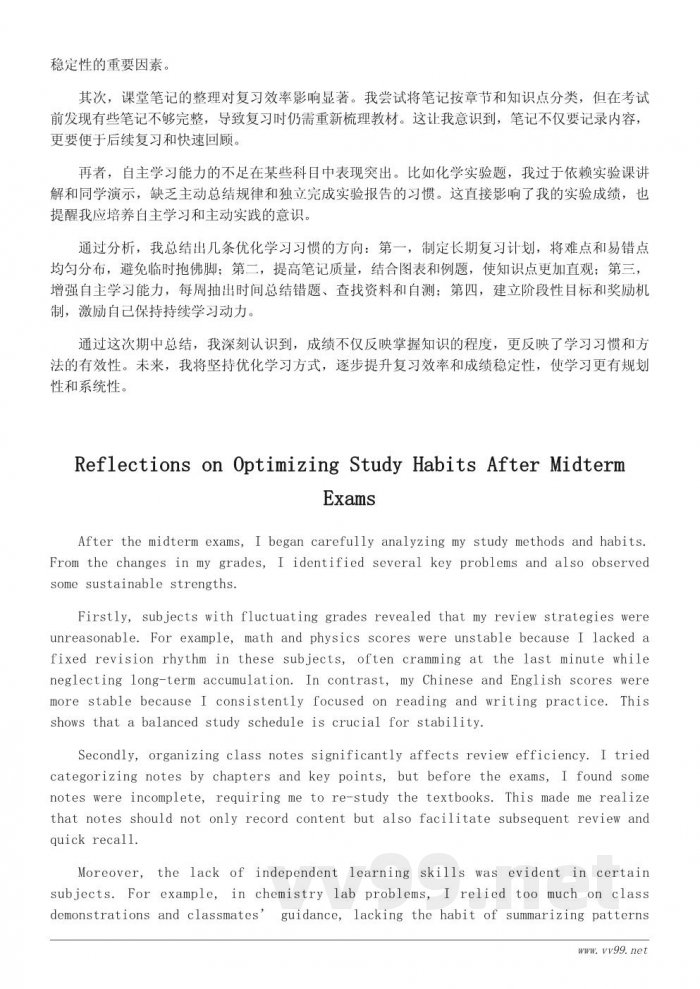
其次,课堂笔记的整理对复习效率影响显著。我尝试将笔记按章节和知识点分类,但在考试前发现有些笔记不够完整,导致复习时仍需重新梳理教材。这让我意识到,笔记不仅要记录内容,更要便于后续复习和快速回顾。
再者,自主学习能力的不足在某些科目中表现突出。比如化学实验题,我过于依赖实验课讲解和同学演示,缺乏主动总结规律和独立完成实验报告的习惯。这直接影响了我的实验成绩,也提醒我应培养自主学习和主动实践的意识。
通过分析,我总结出几条优化学习习惯的方向:第一,制定长期复习计划,将难点和易错点均匀分布,避免临时抱佛脚;第二,提高笔记质量,结合图表和例题,使知识点更加直观;第三,增强自主学习能力,每周抽出时间总结错题、查找资料和自测;第四,建立阶段性目标和奖励机制,激励自己保持持续学习动力。
通过这次期中总结,我深刻认识到,成绩不仅反映掌握知识的程度,更反映了学习习惯和方法的有效性。未来,我将坚持优化学习方式,逐步提升复习效率和成绩稳定性,使学习更有规划性和系统性。
Reflections on Optimizing Study Habits After Midterm Exams
After the midterm exams, I began carefully analyzing my study methods and habits. From the changes in my grades, I identified several key problems and also observed some sustainable strengths.
Firstly, subjects with fluctuating grades revealed that my review strategies were unreasonable. For example, math and physics scores were unstable because I lacked a fixed revision rhythm in these subjects, often cramming at the last minute while neglecting long-term accumulation. In contrast, my Chinese and English scores were more stable because I consistently focused on reading and writing practice. This shows that a balanced study schedule is crucial for stability.
Secondly, organizing class notes significantly affects review efficiency. I tried categorizing notes by chapters and key points, but before the exams, I found some notes were incomplete, requiring me to re-study the textbooks. This made me realize that notes should not only record content but also facilitate subsequent review and quick recall.
Moreover, the lack of independent learning skills was evident in certain subjects. For example, in chemistry lab problems, I relied too much on class demonstrations and classmates’ guidance, lacking the habit of summarizing patterns and independently completing lab reports. This directly affected my lab grades and reminded me to cultivate independent learning and proactive practice.
Through analysis, I summarized several directions for optimizing study habits: first, create a long-term review plan, evenly distributing difficult and error-prone topics to avoid last-minute cramming; second, improve note quality by integrating charts and examples to make key points clearer; third, enhance independent learning skills by setting aside time each week to review mistakes, seek resources, and self-test; fourth, establish phased goals and reward mechanisms to maintain continuous motivation.
Through this midterm summary, I deeply realized that grades reflect not only knowledge mastery but also the effectiveness of study habits and methods. Moving forward, I will continue to optimize my study approach, gradually improving review efficiency and grade stability, making my learning more planned and systematic.
小提示:上面此文档内容仅展示完整文档里的部分内容, 若需要下载完整文档请 点击免费下载完整文档 。