文章内容
文章内容
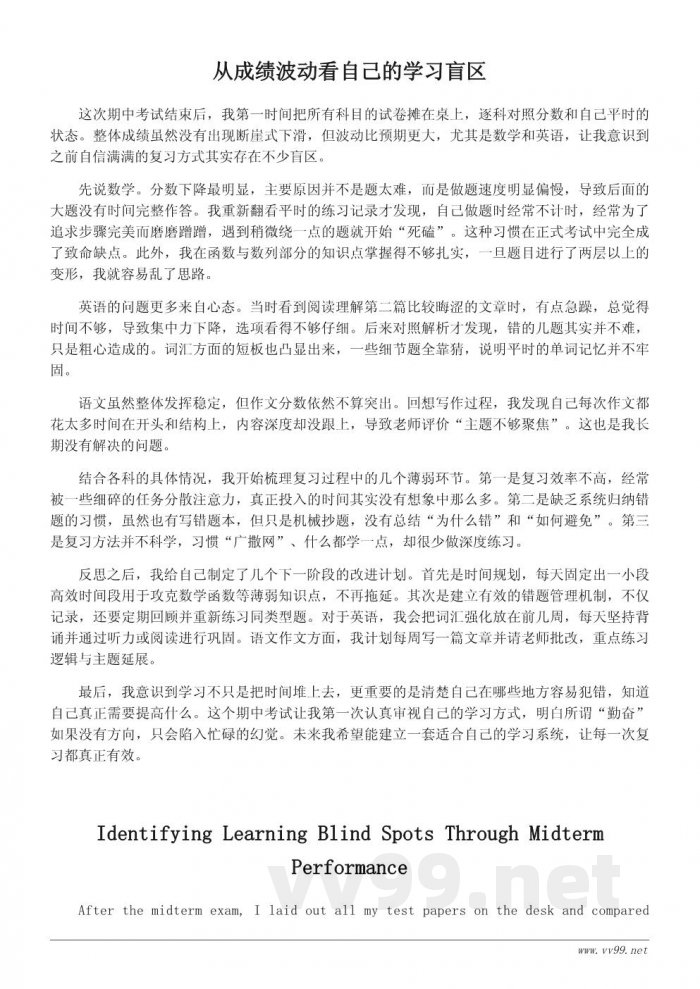
从成绩波动看自己的学习盲区
这次期中考试结束后,我第一时间把所有科目的试卷摊在桌上,逐科对照分数和自己平时的状态。整体成绩虽然没有出现断崖式下滑,但波动比预期更大,尤其是数学和英语,让我意识到之前自信满满的复习方式其实存在不少盲区。
先说数学。分数下降最明显,主要原因并不是题太难,而是做题速度明显偏慢,导致后面的大题没有时间完整作答。我重新翻看平时的练习记录才发现,自己做题时经常不计时,经常为了追求步骤完美而磨磨蹭蹭,遇到稍微绕一点的题就开始“死磕”。这种习惯在正式考试中完全成了致命缺点。此外,我在函数与数列部分的知识点掌握得不够扎实,一旦题目进行了两层以上的变形,我就容易乱了思路。
英语的问题更多来自心态。当时看到阅读理解第二篇比较晦涩的文章时,有点急躁,总觉得时间不够,导致集中力下降,选项看得不够仔细。后来对照解析才发现,错的几题其实并不难,只是粗心造成的。词汇方面的短板也凸显出来,一些细节题全靠猜,说明平时的单词记忆并不牢固。
语文虽然整体发挥稳定,但作文分数依然不算突出。回想写作过程,我发现自己每次作文都花太多时间在开头和结构上,内容深度却没跟上,导致老师评价“主题不够聚焦”。这也是我长期没有解决的问题。
结合各科的具体情况,我开始梳理复习过程中的几个薄弱环节。第一是复习效率不高,经常被一些细碎的任务分散注意力,真正投入的时间其实没有想象中那么多。第二是缺乏系统归纳错题的习惯,虽然也有写错题本,但只是机械抄题,没有总结“为什么错”和“如何避免”。第三是复习方法并不科学,习惯“广撒网”、什么都学一点,却很少做深度练习。
反思之后,我给自己制定了几个下一阶段的改进计划。首先是时间规划,每天固定出一小段高效时间段用于攻克数学函数等薄弱知识点,不再拖延。其次是建立有效的错题管理机制,不仅记录,还要定期回顾并重新练习同类型题。对于英语,我会把词汇强化放在前几周,每天坚持背诵并通过听力或阅读进行巩固。语文作文方面,我计划每周写一篇文章并请老师批改,重点练习逻辑与主题延展。
最后,我意识到学习不只是把时间堆上去,更重要的是清楚自己在哪些地方容易犯错,知道自己真正需要提高什么。这个期中考试让我第一次认真审视自己的学习方式,明白所谓“勤奋”如果没有方向,只会陷入忙碌的幻觉。未来我希望能建立一套适合自己的学习系统,让每一次复习都真正有效。
Identifying Learning Blind Spots Through Midterm Performance
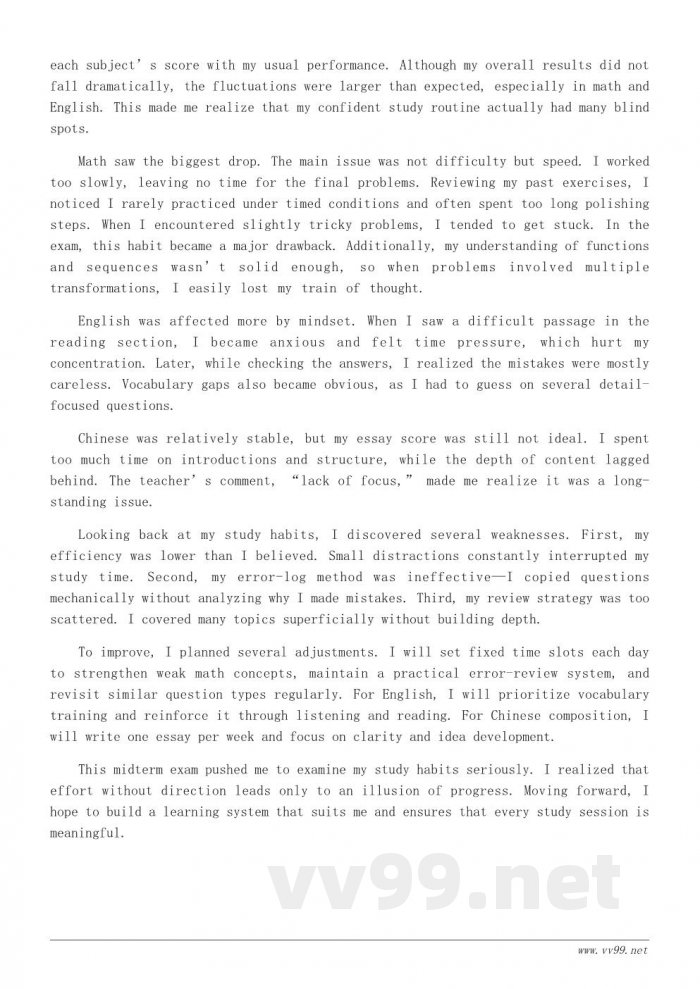
After the midterm exam, I laid out all my test papers on the desk and compared each subject’s score with my usual performance. Although my overall results did not fall dramatically, the fluctuations were larger than expected, especially in math and English. This made me realize that my confident study routine actually had many blind spots.
Math saw the biggest drop. The main issue was not difficulty but speed. I worked too slowly, leaving no time for the final problems. Reviewing my past exercises, I noticed I rarely practiced under timed conditions and often spent too long polishing steps. When I encountered slightly tricky problems, I tended to get stuck. In the exam, this habit became a major drawback. Additionally, my understanding of functions and sequences wasn’t solid enough, so when problems involved multiple transformations, I easily lost my train of thought.
English was affected more by mindset. When I saw a difficult passage in the reading section, I became anxious and felt time pressure, which hurt my concentration. Later, while checking the answers, I realized the mistakes were mostly careless. Vocabulary gaps also became obvious, as I had to guess on several detail-focused questions.
Chinese was relatively stable, but my essay score was still not ideal. I spent too much time on introductions and structure, while the depth of content lagged behind. The teacher’s comment, “lack of focus,” made me realize it was a long-standing issue.
Looking back at my study habits, I discovered several weaknesses. First, my efficiency was lower than I believed. Small distractions constantly interrupted my study time. Second, my error-log method was ineffective—I copied questions mechanically without analyzing why I made mistakes. Third, my review strategy was too scattered. I covered many topics superficially without building depth.
To improve, I planned several adjustments. I will set fixed time slots each day to strengthen weak math concepts, maintain a practical error-review system, and revisit similar question types regularly. For English, I will prioritize vocabulary training and reinforce it through listening and reading. For Chinese composition, I will write one essay per week and focus on clarity and idea development.
This midterm exam pushed me to examine my study habits seriously. I realized that effort without direction leads only to an illusion of progress. Moving forward, I hope to build a learning system that suits me and ensures that every study session is meaningful.
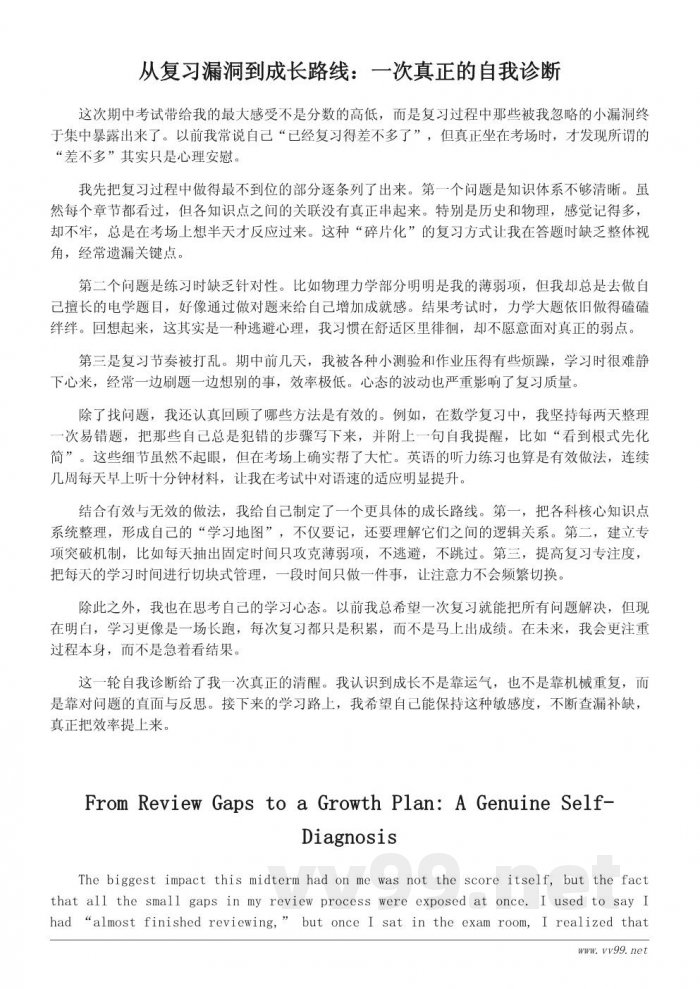
从复习漏洞到成长路线:一次真正的自我诊断
这次期中考试带给我的最大感受不是分数的高低,而是复习过程中那些被我忽略的小漏洞终于集中暴露出来了。以前我常说自己“已经复习得差不多了”,但真正坐在考场时,才发现所谓的“差不多”其实只是心理安慰。
我先把复习过程中做得最不到位的部分逐条列了出来。第一个问题是知识体系不够清晰。虽然每个章节都看过,但各知识点之间的关联没有真正串起来。特别是历史和物理,感觉记得多,却不牢,总是在考场上想半天才反应过来。这种“碎片化”的复习方式让我在答题时缺乏整体视角,经常遗漏关键点。
第二个问题是练习时缺乏针对性。比如物理力学部分明明是我的薄弱项,但我却总是去做自己擅长的电学题目,好像通过做对题来给自己增加成就感。结果考试时,力学大题依旧做得磕磕绊绊。回想起来,这其实是一种逃避心理,我习惯在舒适区里徘徊,却不愿意面对真正的弱点。
第三是复习节奏被打乱。期中前几天,我被各种小测验和作业压得有些烦躁,学习时很难静下心来,经常一边刷题一边想别的事,效率极低。心态的波动也严重影响了复习质量。
除了找问题,我还认真回顾了哪些方法是有效的。例如,在数学复习中,我坚持每两天整理一次易错题,把那些自己总是犯错的步骤写下来,并附上一句自我提醒,比如“看到根式先化简”。这些细节虽然不起眼,但在考场上确实帮了大忙。英语的听力练习也算是有效做法,连续几周每天早上听十分钟材料,让我在考试中对语速的适应明显提升。
结合有效与无效的做法,我给自己制定了一个更具体的成长路线。第一,把各科核心知识点系统整理,形成自己的“学习地图”,不仅要记,还要理解它们之间的逻辑关系。第二,建立专项突破机制,比如每天抽出固定时间只攻克薄弱项,不逃避,不跳过。第三,提高复习专注度,把每天的学习时间进行切块式管理,一段时间只做一件事,让注意力不会频繁切换。
除此之外,我也在思考自己的学习心态。以前我总希望一次复习就能把所有问题解决,但现在明白,学习更像是一场长跑,每次复习都只是积累,而不是马上出成绩。在未来,我会更注重过程本身,而不是急着看结果。
这一轮自我诊断给了我一次真正的清醒。我认识到成长不是靠运气,也不是靠机械重复,而是靠对问题的直面与反思。接下来的学习路上,我希望自己能保持这种敏感度,不断查漏补缺,真正把效率提上来。
From Review Gaps to a Growth Plan: A Genuine Self-Diagnosis
The biggest impact this midterm had on me was not the score itself, but the fact that all the small gaps in my review process were exposed at once. I used to say I had “almost finished reviewing,” but once I sat in the exam room, I realized that “almost” was nothing more than psychological comfort.
I began listing the flaws in my review routine. The first issue was that my knowledge structure wasn’t clear. Although I had gone through every chapter, I never connected the key points. Subjects like history and physics felt familiar but fragile. This fragmented learning method made it hard to answer questions with a complete perspective.
The second issue was a lack of targeted practice. Mechanics in physics is my weak area, yet I kept doing electrical circuits simply because I could get them right. It gave me a false sense of accomplishment but did not improve my real weakness. During the exam, the mechanics problems still troubled me. Looking back, this was avoidance disguised as practice.
The third issue was an unstable study rhythm. During the days before the exam, quizzes and homework piled up, making me restless. My mind wandered while studying, and efficiency dropped significantly.
On the positive side, some methods did work. For math, I reviewed my common mistakes every two days and wrote reminders like “simplify radicals first.” It seemed trivial, but it helped a lot in the actual exam. My English listening training also paid off after several weeks of daily practice.
Combining what was useful and what wasn’t, I developed a clearer growth plan. First, I will organize all key concepts in each subject into a personal “learning map.” Second, I will set fixed sessions to tackle weaknesses instead of avoiding them. Third, I will use block-time management to focus on one task at a time and reduce distractions.
I also reflected on my mindset. I used to hope that one round of review could solve everything, but now I realize learning is a long-distance run. Progress comes from accumulated effort, not from rushing for results.
This self-diagnosis gave me much-needed clarity. I now understand that improvement comes not from luck or repetition but from facing problems honestly. I hope I can maintain this awareness and keep refining my study habits moving forward.
小提示:上面此文档内容仅展示完整文档里的部分内容, 若需要下载完整文档请 点击免费下载完整文档 。