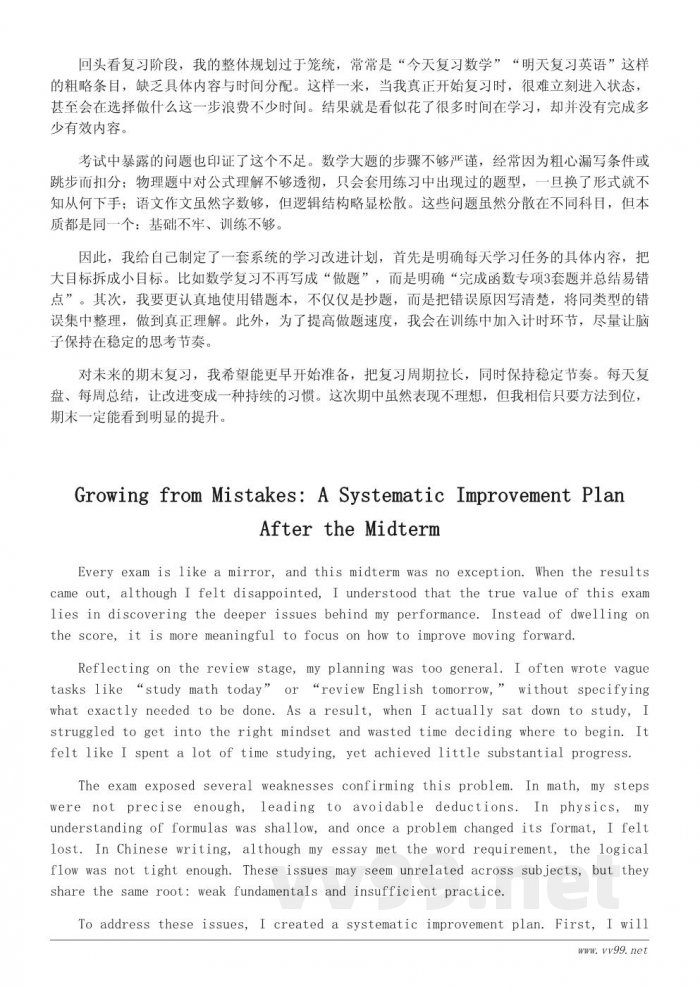
文章内容
文章内容
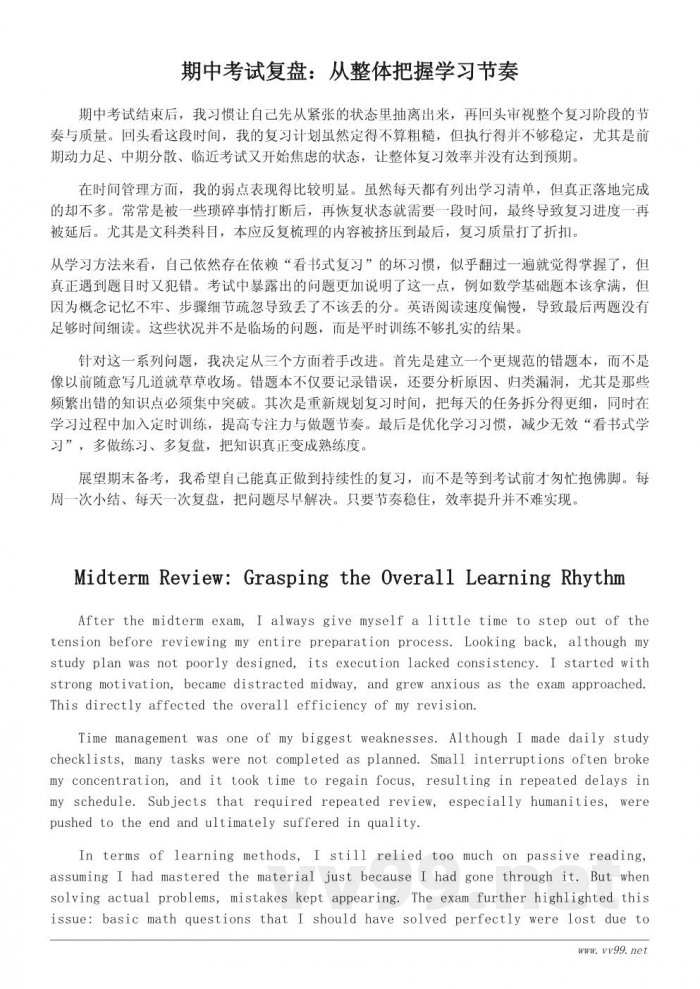
期中考试复盘:从整体把握学习节奏
期中考试结束后,我习惯让自己先从紧张的状态里抽离出来,再回头审视整个复习阶段的节奏与质量。回头看这段时间,我的复习计划虽然定得不算粗糙,但执行得并不够稳定,尤其是前期动力足、中期分散、临近考试又开始焦虑的状态,让整体复习效率并没有达到预期。
在时间管理方面,我的弱点表现得比较明显。虽然每天都有列出学习清单,但真正落地完成的却不多。常常是被一些琐碎事情打断后,再恢复状态就需要一段时间,最终导致复习进度一再被延后。尤其是文科类科目,本应反复梳理的内容被挤压到最后,复习质量打了折扣。
从学习方法来看,自己依然存在依赖“看书式复习”的坏习惯,似乎翻过一遍就觉得掌握了,但真正遇到题目时又犯错。考试中暴露出的问题更加说明了这一点,例如数学基础题本该拿满,但因为概念记忆不牢、步骤细节疏忽导致丢了不该丢的分。英语阅读速度偏慢,导致最后两题没有足够时间细读。这些状况并不是临场的问题,而是平时训练不够扎实的结果。
针对这一系列问题,我决定从三个方面着手改进。首先是建立一个更规范的错题本,而不是像以前随意写几道就草草收场。错题本不仅要记录错误,还要分析原因、归类漏洞,尤其是那些频繁出错的知识点必须集中突破。其次是重新规划复习时间,把每天的任务拆分得更细,同时在学习过程中加入定时训练,提高专注力与做题节奏。最后是优化学习习惯,减少无效“看书式学习”,多做练习、多复盘,把知识真正变成熟练度。
展望期末备考,我希望自己能真正做到持续性的复习,而不是等到考试前才匆忙抱佛脚。每周一次小结、每天一次复盘,把问题尽早解决。只要节奏稳住,效率提升并不难实现。
Midterm Review: Grasping the Overall Learning Rhythm
After the midterm exam, I always give myself a little time to step out of the tension before reviewing my entire preparation process. Looking back, although my study plan was not poorly designed, its execution lacked consistency. I started with strong motivation, became distracted midway, and grew anxious as the exam approached. This directly affected the overall efficiency of my revision.
Time management was one of my biggest weaknesses. Although I made daily study checklists, many tasks were not completed as planned. Small interruptions often broke my concentration, and it took time to regain focus, resulting in repeated delays in my schedule. Subjects that required repeated review, especially humanities, were pushed to the end and ultimately suffered in quality.
In terms of learning methods, I still relied too much on passive reading, assuming I had mastered the material just because I had gone through it. But when solving actual problems, mistakes kept appearing. The exam further highlighted this issue: basic math questions that I should have solved perfectly were lost due to unstable fundamentals and careless steps. In English, my reading speed was too slow, leaving insufficient time for the last two questions. These issues were not caused by the exam itself but by weak daily practice.
To address these problems, I plan to improve in three areas. First, I will build a more systematic error notebook, not just casually jotting down mistakes. Each error will be analyzed and categorized so recurring weaknesses can be targeted. Second, I will redesign my study schedule, breaking tasks into smaller units and adding timed practice sessions to improve focus and pace. Lastly, I will adjust my study habits by reducing passive reading and increasing active practice and reflection.
Looking toward the final exam, I hope to maintain consistent study habits instead of cramming at the last minute. Weekly reviews and daily reflections will allow me to fix issues early. As long as I stabilize my rhythm, improving efficiency will become much easier.
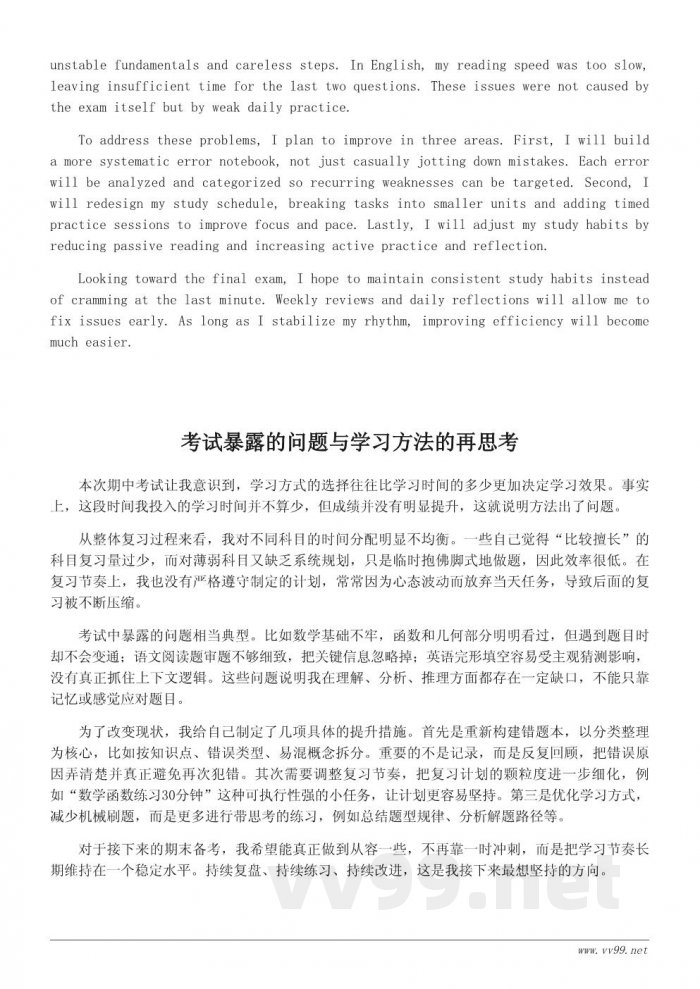
考试暴露的问题与学习方法的再思考
本次期中考试让我意识到,学习方式的选择往往比学习时间的多少更加决定学习效果。事实上,这段时间我投入的学习时间并不算少,但成绩并没有明显提升,这就说明方法出了问题。
从整体复习过程来看,我对不同科目的时间分配明显不均衡。一些自己觉得“比较擅长”的科目复习量过少,而对薄弱科目又缺乏系统规划,只是临时抱佛脚式地做题,因此效率很低。在复习节奏上,我也没有严格遵守制定的计划,常常因为心态波动而放弃当天任务,导致后面的复习被不断压缩。
考试中暴露的问题相当典型。比如数学基础不牢,函数和几何部分明明看过,但遇到题目时却不会变通;语文阅读题审题不够细致,把关键信息忽略掉;英语完形填空容易受主观猜测影响,没有真正抓住上下文逻辑。这些问题说明我在理解、分析、推理方面都存在一定缺口,不能只靠记忆或感觉应对题目。
为了改变现状,我给自己制定了几项具体的提升措施。首先是重新构建错题本,以分类整理为核心,比如按知识点、错误类型、易混概念拆分。重要的不是记录,而是反复回顾,把错误原因弄清楚并真正避免再次犯错。其次需要调整复习节奏,把复习计划的颗粒度进一步细化,例如“数学函数练习30分钟”这种可执行性强的小任务,让计划更容易坚持。第三是优化学习方式,减少机械刷题,而是更多进行带思考的练习,例如总结题型规律、分析解题路径等。
对于接下来的期末备考,我希望能真正做到从容一些,不再靠一时冲刺,而是把学习节奏长期维持在一个稳定水平。持续复盘、持续练习、持续改进,这是我接下来最想坚持的方向。
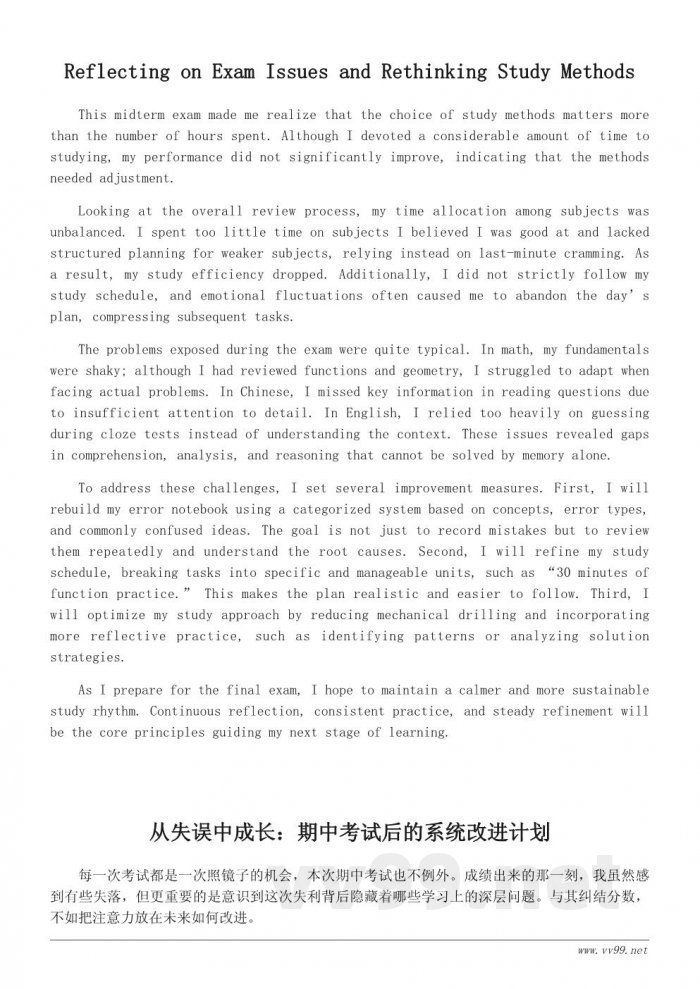
Reflecting on Exam Issues and Rethinking Study Methods
This midterm exam made me realize that the choice of study methods matters more than the number of hours spent. Although I devoted a considerable amount of time to studying, my performance did not significantly improve, indicating that the methods needed adjustment.
Looking at the overall review process, my time allocation among subjects was unbalanced. I spent too little time on subjects I believed I was good at and lacked structured planning for weaker subjects, relying instead on last-minute cramming. As a result, my study efficiency dropped. Additionally, I did not strictly follow my study schedule, and emotional fluctuations often caused me to abandon the day’s plan, compressing subsequent tasks.
The problems exposed during the exam were quite typical. In math, my fundamentals were shaky; although I had reviewed functions and geometry, I struggled to adapt when facing actual problems. In Chinese, I missed key information in reading questions due to insufficient attention to detail. In English, I relied too heavily on guessing during cloze tests instead of understanding the context. These issues revealed gaps in comprehension, analysis, and reasoning that cannot be solved by memory alone.
To address these challenges, I set several improvement measures. First, I will rebuild my error notebook using a categorized system based on concepts, error types, and commonly confused ideas. The goal is not just to record mistakes but to review them repeatedly and understand the root causes. Second, I will refine my study schedule, breaking tasks into specific and manageable units, such as “30 minutes of function practice.” This makes the plan realistic and easier to follow. Third, I will optimize my study approach by reducing mechanical drilling and incorporating more reflective practice, such as identifying patterns or analyzing solution strategies.
As I prepare for the final exam, I hope to maintain a calmer and more sustainable study rhythm. Continuous reflection, consistent practice, and steady refinement will be the core principles guiding my next stage of learning.
小提示:上面此文档内容仅展示完整文档里的部分内容, 若需要下载完整文档请 点击免费下载完整文档 。