文章内容
文章内容
从错误里醒来:期中考试后的五点成长体悟
期中考试结束后的那几天,我反复翻看自己的试卷,总觉得每一个圈出来的错误都像一面镜子,把我平时学习中的疏忽照得一清二楚。原以为只是几道错题,真正静下来分析时才发现,它们背后藏着更深层的习惯问题。总结这次经历,我从五个方面看到了自己的不足,也在反思中学到了一些真正能带来改变的东西。
第一个失误来自理解偏差。语文阅读里有一道题,只因为我匆匆读过题干,就自以为抓住了重点,结果完全答偏。那一刻我意识到,所谓的粗心很多时候不是看得不够,是脑子跑得太快。今后我开始在做题前强迫自己停一秒,把题干真正“读进去”,这不仅让我答题更稳,也提升了课堂听讲时的专注度。
第二个典型失误是计算错误。数学试卷里一道本可以轻松拿分的题,因为我把一个负号看成正号,最终影响了整道题的结果。我以前总以为计算题靠的是熟练,但这次让我明白,熟练不是快,而是稳。于是我在之后的练习里开始给自己设定检测点,比如每完成一小步就检查一次符号、格式和单位,看似耗时,却大大减少了错误率。
第三类问题是知识点遗忘。历史试卷中一个课本上再清楚不过的年份,我居然写错了。这个错误让我意识到,我的复习并不系统,只是机械地过一遍课本,却没有把知识进行分类整合。后来我尝试自己构建思维框架,把每章内容拆成小主题,再用表格或简短记录把它们串起来,这样复习时感觉不再是堆叠,而是清晰的结构。
第四,是时间分配不当。英语作文明明平时练过很多次,但考试时因为前面阅读理解花了太久,导致写作时心里发慌,写出来的质量大打折扣。这让我意识到,时间管理本身也是一种能力,需要在平常练习中就培养。现在我做套卷时会像正式考试一样计时,让自己适应节奏,而不是等到考场上才仓促调整。
最后,是心态的问题。成绩出来后,我一度把这些错误看成能力不足,可冷静下来再想,其实错误本身就是学习的一部分。每个错误都像一个标记,提醒我下一次要更认真、更细致。与其逃避,不如正面面对。接受自己的不完美,反而让成长更踏实。
整体回顾这次期中考试,我从错误里看到了自己的不足,也从反思中找到了前进的方向。成长不是一下子变强,而是一步一步把缺口补起来。错误不是绊脚石,而是让人停下来思考的资源。带着这样的心态继续前进,我相信下一次的自己,一定会更好。
Awakening from Errors: Five Growth Insights After the Midterm Exam
In the days following the midterm exam, I kept reviewing my test paper and felt as if every circled mistake was a mirror reflecting the negligence hidden in my usual study habits. What seemed like a few simple errors eventually revealed deeper issues when I began to analyze them carefully. From this experience, I gained five key insights that helped reshape my approach to learning.
The first mistake came from misinterpretation. In the Chinese reading section, I answered one question completely off track simply because I skimmed the prompt and assumed I understood the main point. I realized that carelessness often comes not from failing to see clearly, but from thinking too fast. From then on, I forced myself to pause briefly before answering, truly absorbing the question. This not only stabilized my test performance but also improved my focus in class.
The second common mistake was calculation errors. A math problem that should have been easy turned into a loss of points because I misread a negative sign as a positive one. I used to believe that calculation depended only on speed, but now I understand that true proficiency means being steady. I started setting small checkpoints during practice—reviewing symbols and units after each step. It seemed time-consuming at first, but it greatly reduced my error rate.
The third issue was forgetting key knowledge. In the history exam, I wrote the wrong date for an event that was clearly stated in the textbook. This made me realize that my review process was not systematic. I was simply rereading the text mechanically instead of organizing the knowledge. Now, I create my own frameworks by breaking chapters into small themes and connecting them using tables or short notes. This makes review more structured and far less overwhelming.
The fourth problem was poor time management. Although I had practiced English writing many times, I still panicked during the exam because I spent too much time on the reading section. This taught me that time management is a skill that needs to be trained during regular practice, not on the spot during an exam. I now time myself when completing mock tests to adapt to the rhythm of real exams.
The final insight was about mindset. I used to view these mistakes as proof of inadequacy. But after calming down, I realized that mistakes are simply part of learning. Each one is like a marker that reminds me to improve. Instead of resisting them, I’ve chosen to face them directly. Accepting imperfection makes growth more genuine.
Looking back, I learned not only from the exam but from the process of reflection itself. Growth doesn’t come instantly; it comes from repairing one weakness at a time. Mistakes are not obstacles but valuable resources. With this mindset, I believe I’ll do better next time.
错误作为阶梯:期中考试后的五项思维调整
这次期中考试让我第一次意识到,错误并不是简单的扣分,而是暴露问题的一种方式。过去我总习惯把分数当作唯一的评价标准,但当我真正沉下心去整理错题、回顾整个考试过程时,我发现分数背后隐藏着许多思维方式和习惯上的漏洞。总结下来,有五个关键的思维调整带给我非常大的帮助。
第一个调整是对题目的尊重。在物理卷里,有一道选择题我明明懂原理,却答错了。原因是我只看了前半句题干,没有意识到后半句改变了条件。这个失误让我意识到,理解偏差往往来自过度依赖经验,而不是基于当下的信息。当我把这种意识应用到其他科目时,我发现自己变得更加冷静,也更愿意在动笔前停下来确认问题本身。
第二个调整是把“计算”当作一种严谨的训练。数学的几道小题看似简单,但我在草稿纸上写得太随意,导致重复计算、甚至看不懂自己的步骤。后来我开始把草稿当作正式答题的一部分,尽量写得清晰、有序。这样的训练让我在后续的练习中避免了许多过去的低级错误,也让我理解了为什么老师一直强调“过程规范化”。
第三个调整是建立知识之间的联系。化学试卷里出现的一个知识点我曾经背过,但因为平时只记结论、不记原理,导致题目稍微变形我就不知所措。这让我理解到碎片化学习的局限。于是我开始尝试给知识点归类,比如把性质、实验方法、应用放在同一张思维导图里,让自己不是靠记忆硬撑,而是靠理解建构。
第四个调整是对复习方式的反思。以前我的复习大多依赖“多刷题”,但这次考试让我明白,没有针对性的复习很难真正提升水平。于是我根据错题总结自己的弱项,比如某类语法、某个专题、某种常见陷阱,然后设计更符合自己的复习计划。这种复习虽然不一定更轻松,但效率明显提高了。
第五个调整,也是最重要的,是面对成绩的心态。过去我总觉得成绩好就代表努力有效,成绩不好就是失败。但这次我反而从失误里意识到成长的空间。原来错误不是否定,而是提醒。如果我们把错误当成路上的石头,它确实会绊倒我们;但如果把它当成阶梯,它也能帮我们向上走得更稳。
期中考试结束后我最大的变化,是不再害怕看到自己的问题。因为越早发现,越早改进。成长不是瞬间的飞跃,而是无数次微小的调整累积起来的成果。这五项思维上的改变,让我在接下来的学习中更加自信,也更加踏实。
Mistakes as Steps: Five Mental Adjustments After the Midterm Exam
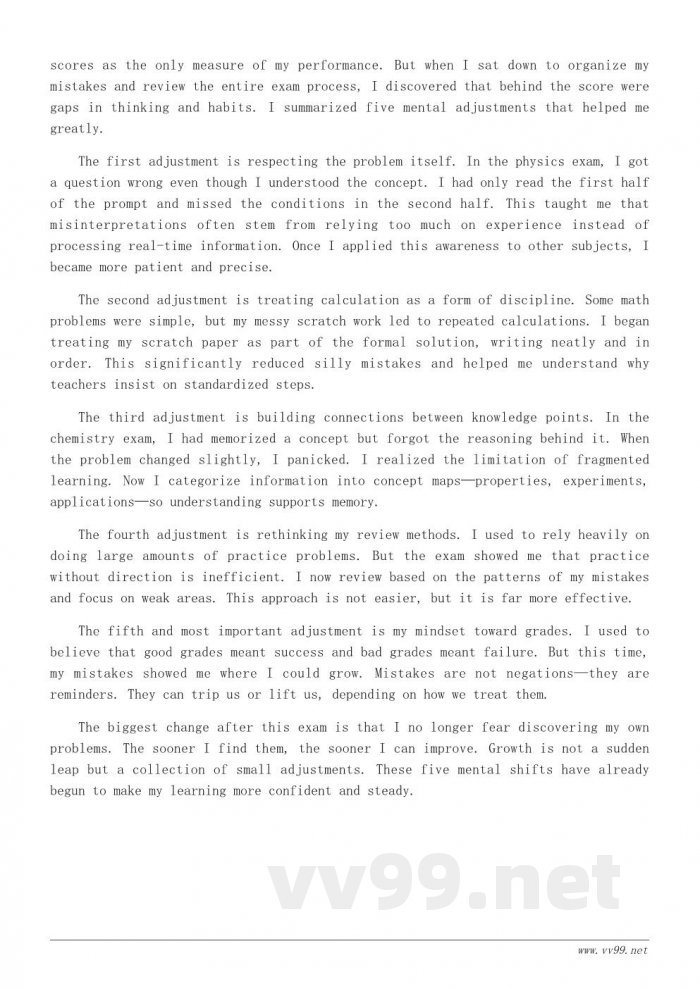
The midterm exam made me realize for the first time that mistakes are not just lost points—they are signals pointing to deeper issues. In the past, I used to treat scores as the only measure of my performance. But when I sat down to organize my mistakes and review the entire exam process, I discovered that behind the score were gaps in thinking and habits. I summarized five mental adjustments that helped me greatly.
The first adjustment is respecting the problem itself. In the physics exam, I got a question wrong even though I understood the concept. I had only read the first half of the prompt and missed the conditions in the second half. This taught me that misinterpretations often stem from relying too much on experience instead of processing real-time information. Once I applied this awareness to other subjects, I became more patient and precise.
The second adjustment is treating calculation as a form of discipline. Some math problems were simple, but my messy scratch work led to repeated calculations. I began treating my scratch paper as part of the formal solution, writing neatly and in order. This significantly reduced silly mistakes and helped me understand why teachers insist on standardized steps.
The third adjustment is building connections between knowledge points. In the chemistry exam, I had memorized a concept but forgot the reasoning behind it. When the problem changed slightly, I panicked. I realized the limitation of fragmented learning. Now I categorize information into concept maps—properties, experiments, applications—so understanding supports memory.
The fourth adjustment is rethinking my review methods. I used to rely heavily on doing large amounts of practice problems. But the exam showed me that practice without direction is inefficient. I now review based on the patterns of my mistakes and focus on weak areas. This approach is not easier, but it is far more effective.
The fifth and most important adjustment is my mindset toward grades. I used to believe that good grades meant success and bad grades meant failure. But this time, my mistakes showed me where I could grow. Mistakes are not negations—they are reminders. They can trip us or lift us, depending on how we treat them.
The biggest change after this exam is that I no longer fear discovering my own problems. The sooner I find them, the sooner I can improve. Growth is not a sudden leap but a collection of small adjustments. These five mental shifts have already begun to make my learning more confident and steady.
小提示:上面此文档内容仅展示完整文档里的部分内容, 若需要下载完整文档请 点击免费下载完整文档 。