文章内容
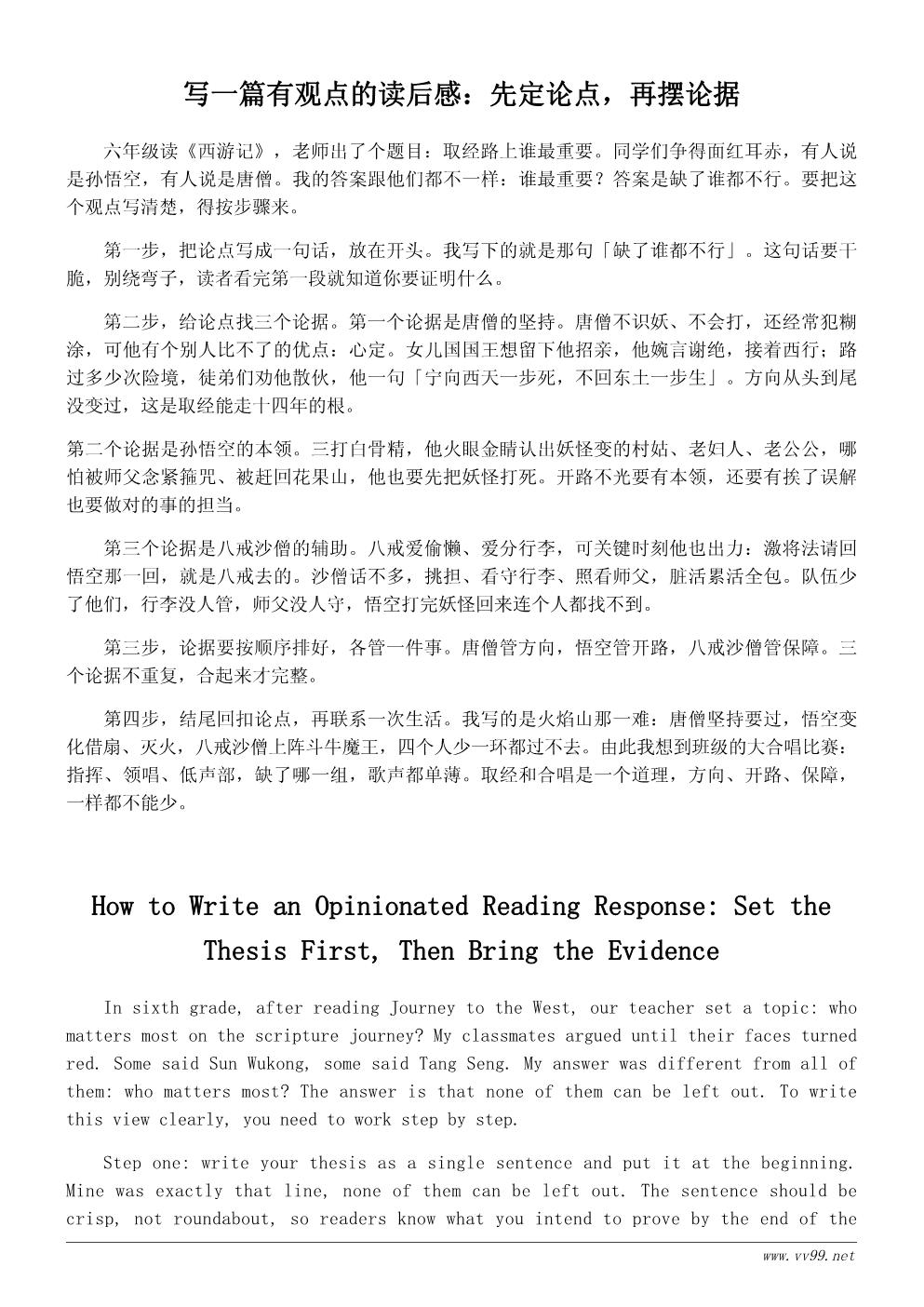
写一篇有观点的读后感:先定论点,再摆论据
六年级读《西游记》,老师出了个题目:取经路上谁最重要。同学们争得面红耳赤,有人说是孙悟空,有人说是唐僧。我的答案跟他们都不一样:谁最重要?答案是缺了谁都不行。要把这个观点写清楚,得按步骤来。
第一步,把论点写成一句话,放在开头。我写下的就是那句「缺了谁都不行」。这句话要干脆,别绕弯子,读者看完第一段就知道你要证明什么。
第二步,给论点找三个论据。第一个论据是唐僧的坚持。唐僧不识妖、不会打,还经常犯糊涂,可他有个别人比不了的优点:心定。女儿国国王想留下他招亲,他婉言谢绝,接着西行;路过多少次险境,徒弟们劝他散伙,他一句「宁向西天一步死,不回东土一步生」。方向从头到尾没变过,这是取经能走十四年的根。
第二个论据是孙悟空的本领。三打白骨精,他火眼金睛认出妖怪变的村姑、老妇人、老公公,哪怕被师父念紧箍咒、被赶回花果山,他也要先把妖怪打死。开路不光要有本领,还要有挨了误解也要做对的事的担当。
第三个论据是八戒沙僧的辅助。八戒爱偷懒、爱分行李,可关键时刻他也出力:激将法请回悟空那一回,就是八戒去的。沙僧话不多,挑担、看守行李、照看师父,脏活累活全包。队伍少了他们,行李没人管,师父没人守,悟空打完妖怪回来连个人都找不到。
第三步,论据要按顺序排好,各管一件事。唐僧管方向,悟空管开路,八戒沙僧管保障。三个论据不重复,合起来才完整。
第四步,结尾回扣论点,再联系一次生活。我写的是火焰山那一难:唐僧坚持要过,悟空变化借扇、灭火,八戒沙僧上阵斗牛魔王,四个人少一环都过不去。由此我想到班级的大合唱比赛:指挥、领唱、低声部,缺了哪一组,歌声都单薄。取经和合唱是一个道理,方向、开路、保障,一样都不能少。
How to Write an Opinionated Reading Response: Set the Thesis First, Then Bring the Evidence
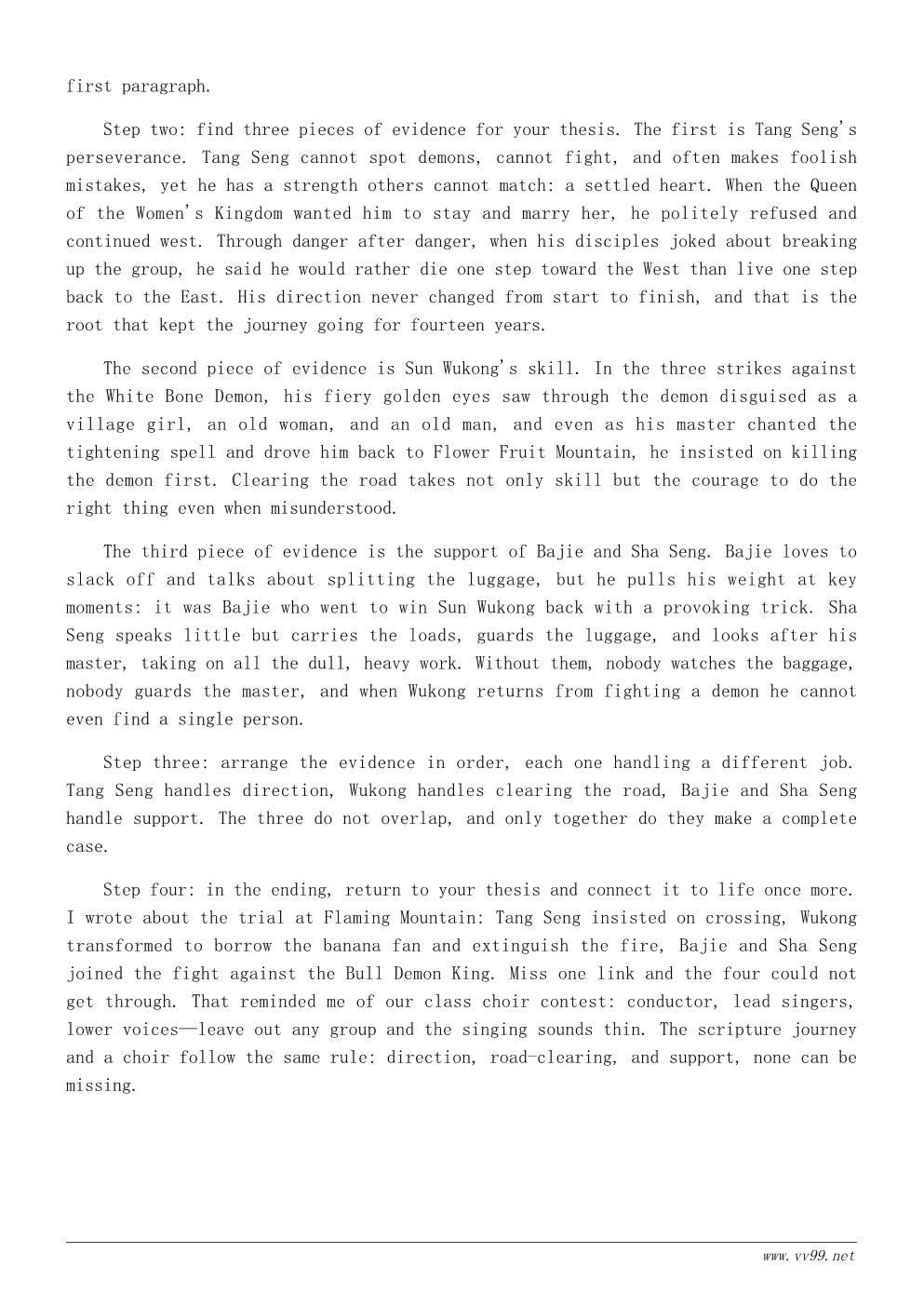
In sixth grade, after reading Journey to the West, our teacher set a topic: who matters most on the scripture journey? My classmates argued until their faces turned red. Some said Sun Wukong, some said Tang Seng. My answer was different from all of them: who matters most? The answer is that none of them can be left out. To write this view clearly, you need to work step by step.
Step one: write your thesis as a single sentence and put it at the beginning. Mine was exactly that line, none of them can be left out. The sentence should be crisp, not roundabout, so readers know what you intend to prove by the end of the first paragraph.
Step two: find three pieces of evidence for your thesis. The first is Tang Seng's perseverance. Tang Seng cannot spot demons, cannot fight, and often makes foolish mistakes, yet he has a strength others cannot match: a settled heart. When the Queen of the Women's Kingdom wanted him to stay and marry her, he politely refused and continued west. Through danger after danger, when his disciples joked about breaking up the group, he said he would rather die one step toward the West than live one step back to the East. His direction never changed from start to finish, and that is the root that kept the journey going for fourteen years.
The second piece of evidence is Sun Wukong's skill. In the three strikes against the White Bone Demon, his fiery golden eyes saw through the demon disguised as a village girl, an old woman, and an old man, and even as his master chanted the tightening spell and drove him back to Flower Fruit Mountain, he insisted on killing the demon first. Clearing the road takes not only skill but the courage to do the right thing even when misunderstood.
The third piece of evidence is the support of Bajie and Sha Seng. Bajie loves to slack off and talks about splitting the luggage, but he pulls his weight at key moments: it was Bajie who went to win Sun Wukong back with a provoking trick. Sha Seng speaks little but carries the loads, guards the luggage, and looks after his master, taking on all the dull, heavy work. Without them, nobody watches the baggage, nobody guards the master, and when Wukong returns from fighting a demon he cannot even find a single person.
Step three: arrange the evidence in order, each one handling a different job. Tang Seng handles direction, Wukong handles clearing the road, Bajie and Sha Seng handle support. The three do not overlap, and only together do they make a complete case.
Step four: in the ending, return to your thesis and connect it to life once more. I wrote about the trial at Flaming Mountain: Tang Seng insisted on crossing, Wukong transformed to borrow the banana fan and extinguish the fire, Bajie and Sha Seng joined the fight against the Bull Demon King. Miss one link and the four could not get through. That reminded me of our class choir contest: conductor, lead singers, lower voices—leave out any group and the singing sounds thin. The scripture journey and a choir follow the same rule: direction, road-clearing, and support, none can be missing.
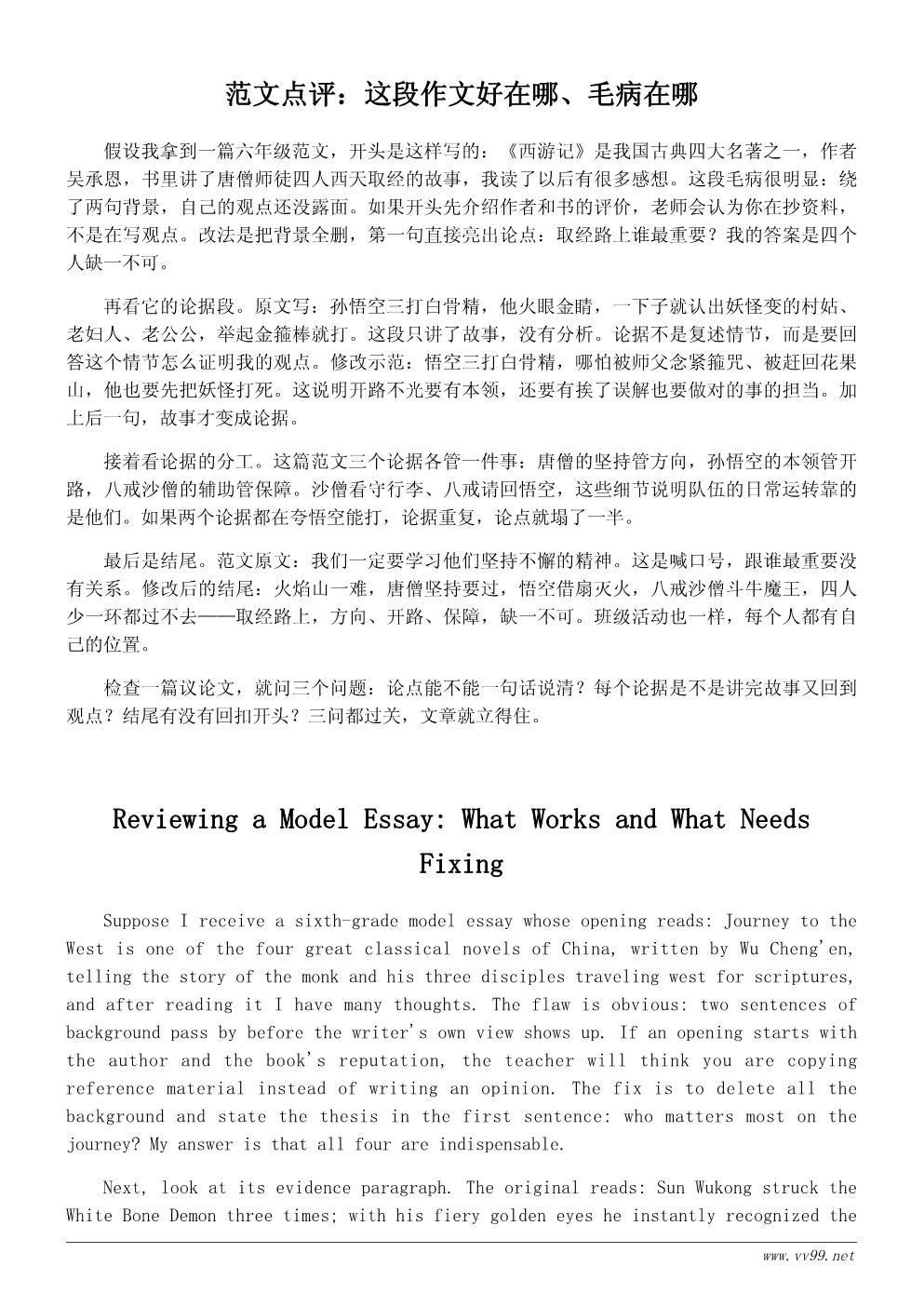
范文点评:这段作文好在哪、毛病在哪
假设我拿到一篇六年级范文,开头是这样写的:《西游记》是我国古典四大名著之一,作者吴承恩,书里讲了唐僧师徒四人西天取经的故事,我读了以后有很多感想。这段毛病很明显:绕了两句背景,自己的观点还没露面。如果开头先介绍作者和书的评价,老师会认为你在抄资料,不是在写观点。改法是把背景全删,第一句直接亮出论点:取经路上谁最重要?我的答案是四个人缺一不可。
再看它的论据段。原文写:孙悟空三打白骨精,他火眼金睛,一下子就认出妖怪变的村姑、老妇人、老公公,举起金箍棒就打。这段只讲了故事,没有分析。论据不是复述情节,而是要回答这个情节怎么证明我的观点。修改示范:悟空三打白骨精,哪怕被师父念紧箍咒、被赶回花果山,他也要先把妖怪打死。这说明开路不光要有本领,还要有挨了误解也要做对的事的担当。加上后一句,故事才变成论据。
接着看论据的分工。这篇范文三个论据各管一件事:唐僧的坚持管方向,孙悟空的本领管开路,八戒沙僧的辅助管保障。沙僧看守行李、八戒请回悟空,这些细节说明队伍的日常运转靠的是他们。如果两个论据都在夸悟空能打,论据重复,论点就塌了一半。
最后是结尾。范文原文:我们一定要学习他们坚持不懈的精神。这是喊口号,跟谁最重要没有关系。修改后的结尾:火焰山一难,唐僧坚持要过,悟空借扇灭火,八戒沙僧斗牛魔王,四人少一环都过不去——取经路上,方向、开路、保障,缺一不可。班级活动也一样,每个人都有自己的位置。
检查一篇议论文,就问三个问题:论点能不能一句话说清?每个论据是不是讲完故事又回到观点?结尾有没有回扣开头?三问都过关,文章就立得住。
Reviewing a Model Essay: What Works and What Needs Fixing
Suppose I receive a sixth-grade model essay whose opening reads: Journey to the West is one of the four great classical novels of China, written by Wu Cheng'en, telling the story of the monk and his three disciples traveling west for scriptures, and after reading it I have many thoughts. The flaw is obvious: two sentences of background pass by before the writer's own view shows up. If an opening starts with the author and the book's reputation, the teacher will think you are copying reference material instead of writing an opinion. The fix is to delete all the background and state the thesis in the first sentence: who matters most on the journey? My answer is that all four are indispensable.
Next, look at its evidence paragraph. The original reads: Sun Wukong struck the White Bone Demon three times; with his fiery golden eyes he instantly recognized the demon disguised as a village girl, an old woman, and an old man, and raised his golden cudgel to strike. This paragraph only retells the story; it analyzes nothing. Evidence is not plot summary—it must answer how this episode proves my point. A revised version: Wukong struck the White Bone Demon three times, and even as his master chanted the tightening headband spell and drove him back to Flower Fruit Mountain, he insisted on killing the demon first. This shows that clearing the road takes not only skill but the courage to do the right thing even when misunderstood. With that second sentence, the story becomes evidence.
Then check how the evidence divides its labor. This model essay gives each of its three points a separate job: Tang Seng's perseverance covers direction, Sun Wukong's skill covers road-clearing, Bajie and Sha Seng's support covers logistics. Sha Seng guarding the luggage and Bajie winning Wukong back show that the team's daily routine runs on them. If two points both praise Wukong's fighting, the evidence repeats itself and half the thesis collapses.
Finally, the ending. The original reads: we must learn their spirit of perseverance. That is a slogan, unrelated to who matters most. A revised ending: at Flaming Mountain, Tang Seng insisted on crossing, Wukong borrowed the fan and quenched the fire, Bajie and Sha Seng fought the Bull Demon King—miss one link and the four could not pass. On the scripture journey, direction, road-clearing, and support are all indispensable; class activities are the same, with a place for everyone.
To check an argumentative essay, ask three questions: Can the thesis be stated in one sentence? Does each piece of evidence return to the point after telling the story? Does the ending echo the opening? Pass all three, and the essay stands.
小提示:上面此文档内容仅展示完整文档里的部分内容, 若需要下载完整文档请 点击免费下载完整文档 。