文章内容
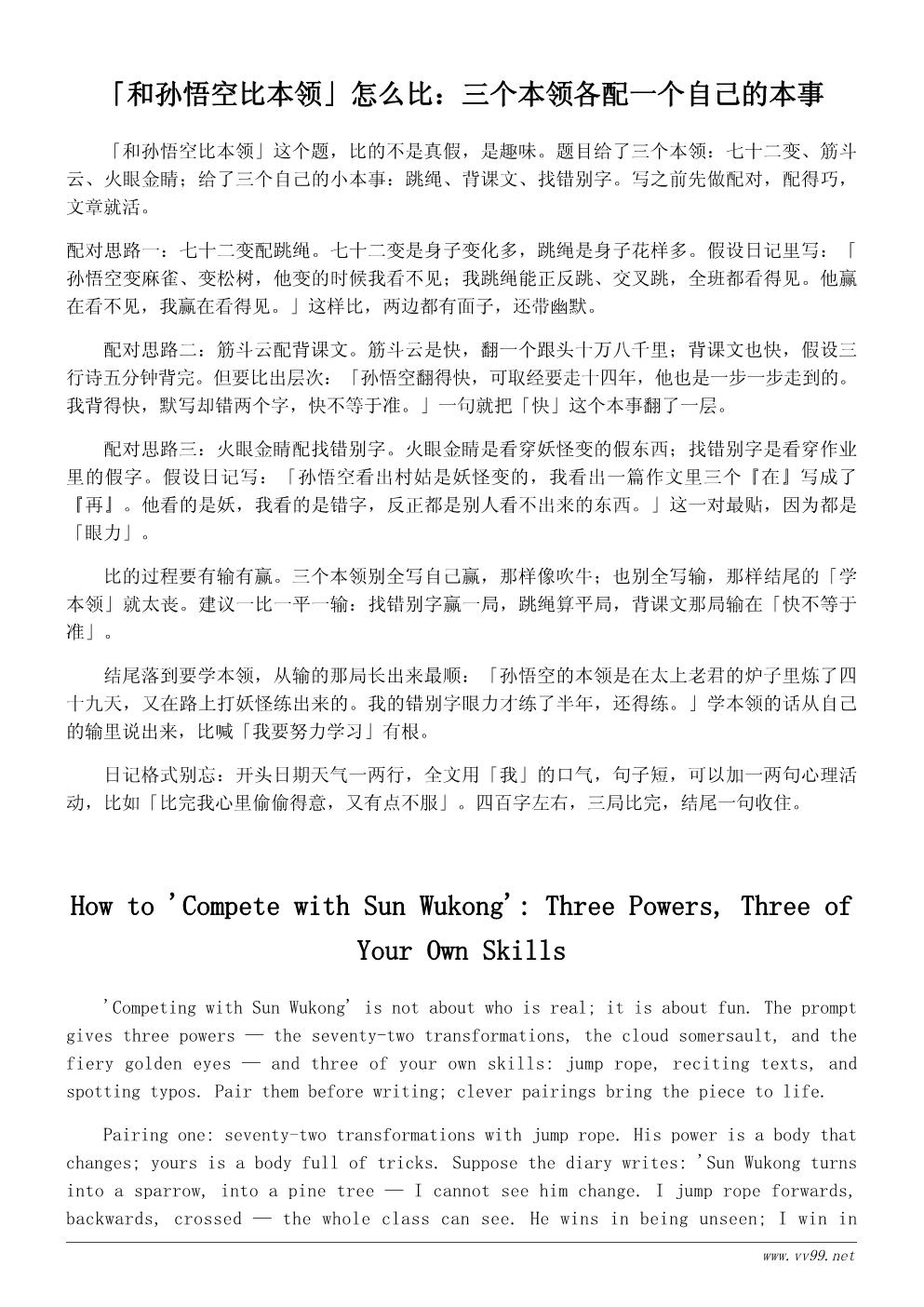
「和孙悟空比本领」怎么比:三个本领各配一个自己的本事
「和孙悟空比本领」这个题,比的不是真假,是趣味。题目给了三个本领:七十二变、筋斗云、火眼金睛;给了三个自己的小本事:跳绳、背课文、找错别字。写之前先做配对,配得巧,文章就活。
配对思路一:七十二变配跳绳。七十二变是身子变化多,跳绳是身子花样多。假设日记里写:「孙悟空变麻雀、变松树,他变的时候我看不见;我跳绳能正反跳、交叉跳,全班都看得见。他赢在看不见,我赢在看得见。」这样比,两边都有面子,还带幽默。
配对思路二:筋斗云配背课文。筋斗云是快,翻一个跟头十万八千里;背课文也快,假设三行诗五分钟背完。但要比出层次:「孙悟空翻得快,可取经要走十四年,他也是一步一步走到的。我背得快,默写却错两个字,快不等于准。」一句就把「快」这个本事翻了一层。
配对思路三:火眼金睛配找错别字。火眼金睛是看穿妖怪变的假东西;找错别字是看穿作业里的假字。假设日记写:「孙悟空看出村姑是妖怪变的,我看出一篇作文里三个『在』写成了『再』。他看的是妖,我看的是错字,反正都是别人看不出来的东西。」这一对最贴,因为都是「眼力」。
比的过程要有输有赢。三个本领别全写自己赢,那样像吹牛;也别全写输,那样结尾的「学本领」就太丧。建议一比一平一输:找错别字赢一局,跳绳算平局,背课文那局输在「快不等于准」。
结尾落到要学本领,从输的那局长出来最顺:「孙悟空的本领是在太上老君的炉子里炼了四十九天,又在路上打妖怪练出来的。我的错别字眼力才练了半年,还得练。」学本领的话从自己的输里说出来,比喊「我要努力学习」有根。
日记格式别忘:开头日期天气一两行,全文用「我」的口气,句子短,可以加一两句心理活动,比如「比完我心里偷偷得意,又有点不服」。四百字左右,三局比完,结尾一句收住。
How to 'Compete with Sun Wukong': Three Powers, Three of Your Own Skills
'Competing with Sun Wukong' is not about who is real; it is about fun. The prompt gives three powers — the seventy-two transformations, the cloud somersault, and the fiery golden eyes — and three of your own skills: jump rope, reciting texts, and spotting typos. Pair them before writing; clever pairings bring the piece to life.
Pairing one: seventy-two transformations with jump rope. His power is a body that changes; yours is a body full of tricks. Suppose the diary writes: 'Sun Wukong turns into a sparrow, into a pine tree — I cannot see him change. I jump rope forwards, backwards, crossed — the whole class can see. He wins in being unseen; I win in being seen.' This comparison lets both sides keep face and adds humor.
Pairing two: the cloud somersault with reciting. The somersault is speed — one flip covers 108,000 li; reciting is fast too, suppose three lines of poetry memorized in five minutes. But add a layer: 'Wukong flips fast, yet the scripture journey took fourteen years on foot. I recite fast, but dictation still loses two characters — fast is not accurate.' One sentence turns the skill of speed inside out.
Pairing three: the fiery golden eyes with spotting typos. His eyes see through a demon disguised as a village girl; your eyes see through fake characters in homework. Suppose the diary writes: 'He saw the village girl was a demon; I found three 'zai' characters written wrong in one composition. He watches for demons, I watch for typos — either way, things others cannot see.' This pair fits best because both are eyesight.
The contest needs wins and losses. Do not win all three — that is bragging; do not lose all three — then the closing 'learn skills' sounds gloomy. Suggest one win, one draw, one loss: typos win, jump rope a draw, reciting lost on 'fast is not accurate'.
The ending must land on learning skills, and it grows most naturally from the lost round: 'Sun Wukong's powers were refined forty-nine days in Laozi's furnace and drilled on the road fighting demons. My typo eye has trained only half a year; it needs more.' Learning-to-learn words spoken out of your own loss have roots, unlike shouting 'I will study hard'.
Do not forget diary format: date and weather in one or two lines, the whole piece in the voice of 'I', short sentences, one or two lines of inner thought such as 'after the contest I secretly gloated, yet still felt unconvinced'. Around four hundred characters: three rounds done, one sentence to close.
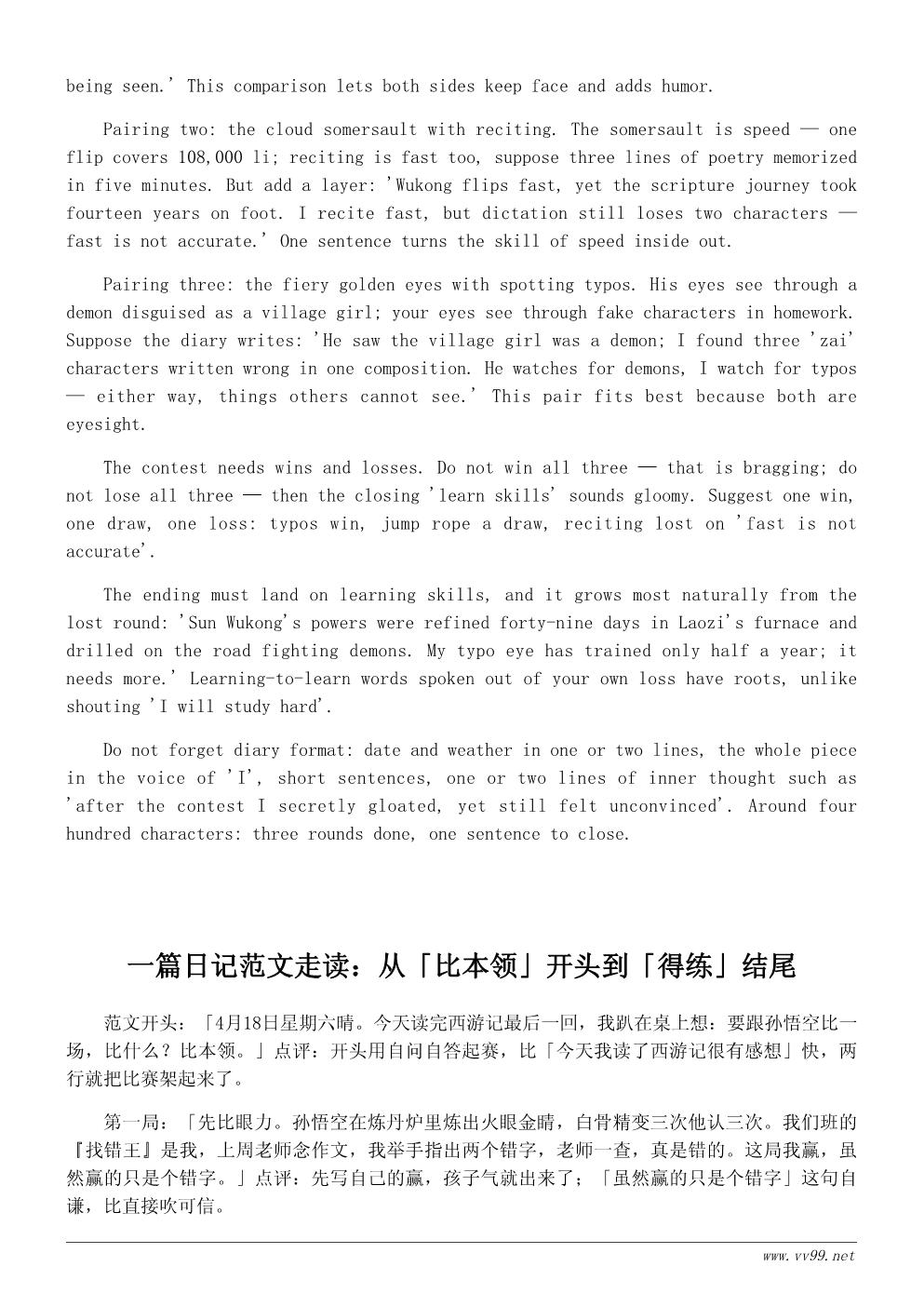
一篇日记范文走读:从「比本领」开头到「得练」结尾
范文开头:「4月18日星期六晴。今天读完西游记最后一回,我趴在桌上想:要跟孙悟空比一场,比什么?比本领。」点评:开头用自问自答起赛,比「今天我读了西游记很有感想」快,两行就把比赛架起来了。
第一局:「先比眼力。孙悟空在炼丹炉里炼出火眼金睛,白骨精变三次他认三次。我们班的『找错王』是我,上周老师念作文,我举手指出两个错字,老师一查,真是错的。这局我赢,虽然赢的只是个错字。」点评:先写自己的赢,孩子气就出来了;「虽然赢的只是个错字」这句自谦,比直接吹可信。
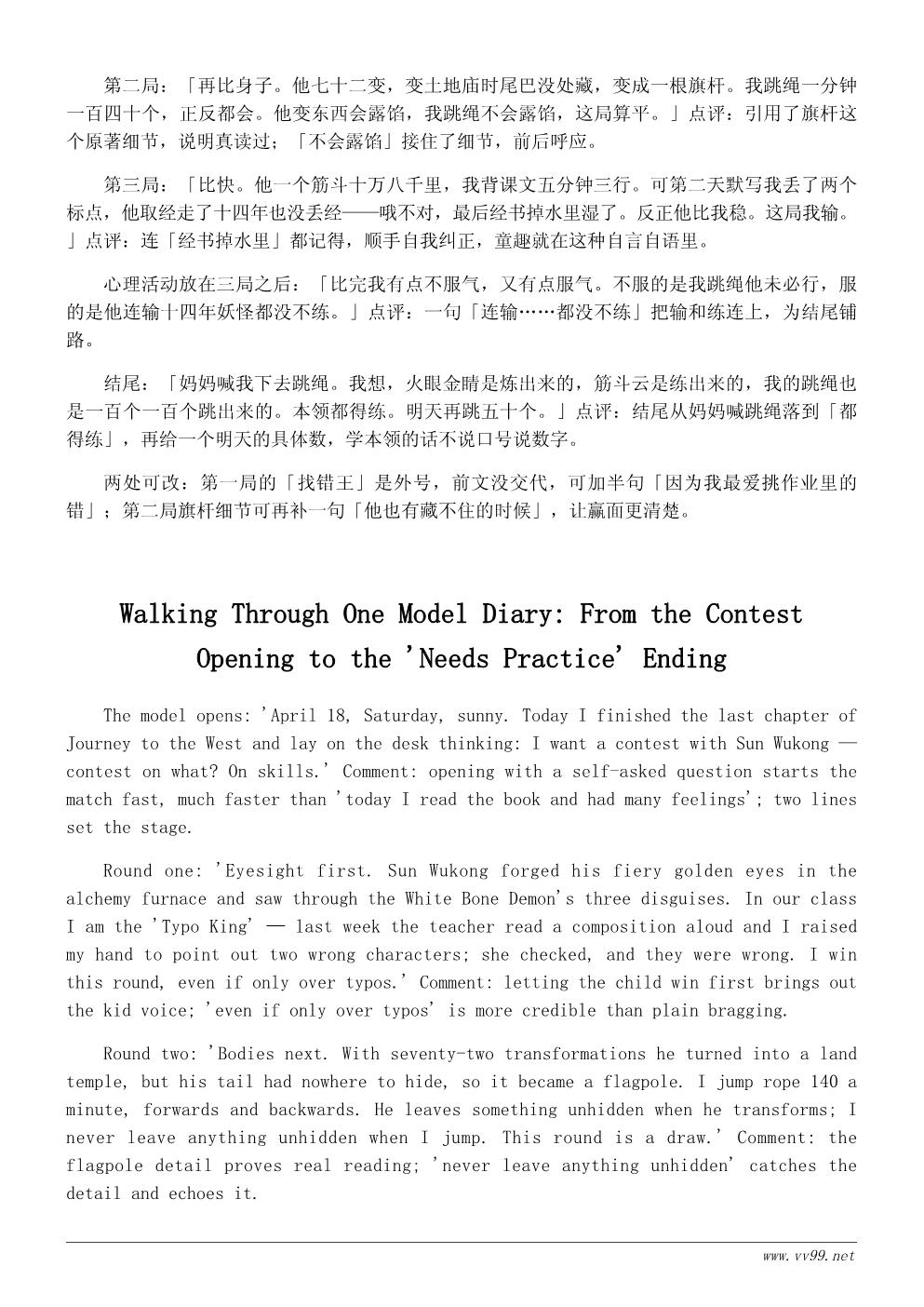
第二局:「再比身子。他七十二变,变土地庙时尾巴没处藏,变成一根旗杆。我跳绳一分钟一百四十个,正反都会。他变东西会露馅,我跳绳不会露馅,这局算平。」点评:引用了旗杆这个原著细节,说明真读过;「不会露馅」接住了细节,前后呼应。
第三局:「比快。他一个筋斗十万八千里,我背课文五分钟三行。可第二天默写我丢了两个标点,他取经走了十四年也没丢经——哦不对,最后经书掉水里湿了。反正他比我稳。这局我输。」点评:连「经书掉水里」都记得,顺手自我纠正,童趣就在这种自言自语里。
心理活动放在三局之后:「比完我有点不服气,又有点服气。不服的是我跳绳他未必行,服的是他连输十四年妖怪都没不练。」点评:一句「连输……都没不练」把输和练连上,为结尾铺路。
结尾:「妈妈喊我下去跳绳。我想,火眼金睛是炼出来的,筋斗云是练出来的,我的跳绳也是一百个一百个跳出来的。本领都得练。明天再跳五十个。」点评:结尾从妈妈喊跳绳落到「都得练」,再给一个明天的具体数,学本领的话不说口号说数字。
两处可改:第一局的「找错王」是外号,前文没交代,可加半句「因为我最爱挑作业里的错」;第二局旗杆细节可再补一句「他也有藏不住的时候」,让赢面更清楚。
Walking Through One Model Diary: From the Contest Opening to the 'Needs Practice' Ending
The model opens: 'April 18, Saturday, sunny. Today I finished the last chapter of Journey to the West and lay on the desk thinking: I want a contest with Sun Wukong — contest on what? On skills.' Comment: opening with a self-asked question starts the match fast, much faster than 'today I read the book and had many feelings'; two lines set the stage.
Round one: 'Eyesight first. Sun Wukong forged his fiery golden eyes in the alchemy furnace and saw through the White Bone Demon's three disguises. In our class I am the 'Typo King' — last week the teacher read a composition aloud and I raised my hand to point out two wrong characters; she checked, and they were wrong. I win this round, even if only over typos.' Comment: letting the child win first brings out the kid voice; 'even if only over typos' is more credible than plain bragging.
Round two: 'Bodies next. With seventy-two transformations he turned into a land temple, but his tail had nowhere to hide, so it became a flagpole. I jump rope 140 a minute, forwards and backwards. He leaves something unhidden when he transforms; I never leave anything unhidden when I jump. This round is a draw.' Comment: the flagpole detail proves real reading; 'never leave anything unhidden' catches the detail and echoes it.
Round three: 'Speed. One somersault covers 108,000 li; I memorize three lines in five minutes. But next day's dictation lost two punctuation marks, and he walked fourteen years without losing the scriptures — oh wait, the scriptures did fall in the river and got wet. Anyway he is steadier than me. I lose this round.' Comment: even remembering the drowned scriptures, with a self-correction on the fly — the childlike charm lives in this kind of muttering.
The inner thought comes after the three rounds: 'After the contest I feel unconvinced and yet convinced. Unconvinced because he might not manage my jump rope; convinced because he kept training even after losing to demons for fourteen years.' Comment: 'kept training even after losing' links loss to practice and paves the ending.
The ending: 'Mom calls me downstairs to jump rope. I think: the fiery eyes were forged, the somersault was trained, and my jump rope came from a hundred jumps at a time. Every skill needs practice. Tomorrow, fifty more.' Comment: from mom's call to jump rope it lands on 'all need practice', then gives a concrete number for tomorrow — learning skills by numbers, not slogans.
Two places to improve: the nickname 'Typo King' in round one appears without setup — half a line like 'because I love picking errors in homework' would help; the flagpole detail in round two could add 'he too has things he cannot hide', making the draw clearer.
小提示:上面此文档内容仅展示完整文档里的部分内容, 若需要下载完整文档请 点击免费下载完整文档 。