文章内容
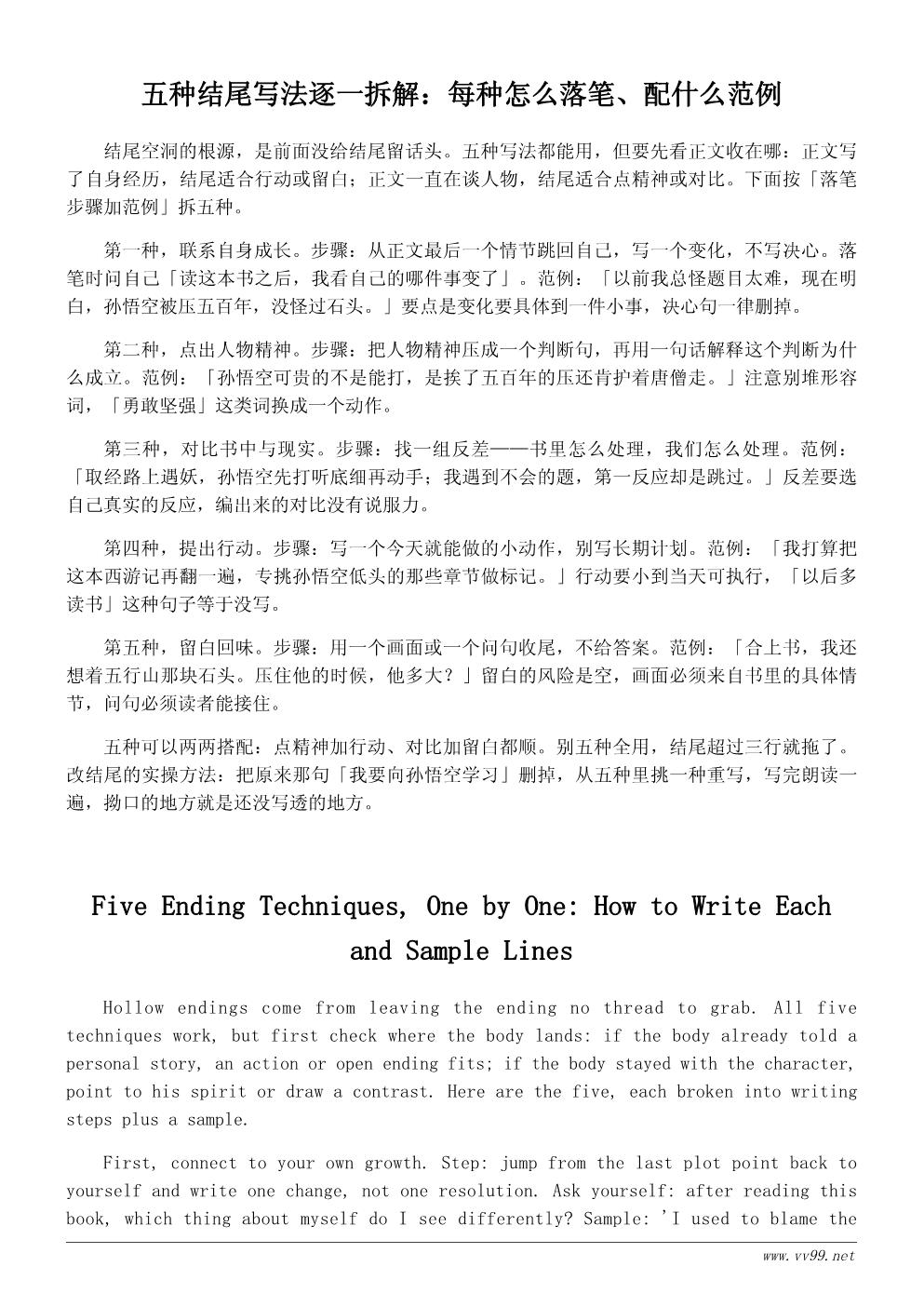
五种结尾写法逐一拆解:每种怎么落笔、配什么范例
结尾空洞的根源,是前面没给结尾留话头。五种写法都能用,但要先看正文收在哪:正文写了自身经历,结尾适合行动或留白;正文一直在谈人物,结尾适合点精神或对比。下面按「落笔步骤加范例」拆五种。
第一种,联系自身成长。步骤:从正文最后一个情节跳回自己,写一个变化,不写决心。落笔时问自己「读这本书之后,我看自己的哪件事变了」。范例:「以前我总怪题目太难,现在明白,孙悟空被压五百年,没怪过石头。」要点是变化要具体到一件小事,决心句一律删掉。
第二种,点出人物精神。步骤:把人物精神压成一个判断句,再用一句话解释这个判断为什么成立。范例:「孙悟空可贵的不是能打,是挨了五百年的压还肯护着唐僧走。」注意别堆形容词,「勇敢坚强」这类词换成一个动作。
第三种,对比书中与现实。步骤:找一组反差——书里怎么处理,我们怎么处理。范例:「取经路上遇妖,孙悟空先打听底细再动手;我遇到不会的题,第一反应却是跳过。」反差要选自己真实的反应,编出来的对比没有说服力。
第四种,提出行动。步骤:写一个今天就能做的小动作,别写长期计划。范例:「我打算把这本西游记再翻一遍,专挑孙悟空低头的那些章节做标记。」行动要小到当天可执行,「以后多读书」这种句子等于没写。
第五种,留白回味。步骤:用一个画面或一个问句收尾,不给答案。范例:「合上书,我还想着五行山那块石头。压住他的时候,他多大?」留白的风险是空,画面必须来自书里的具体情节,问句必须读者能接住。
五种可以两两搭配:点精神加行动、对比加留白都顺。别五种全用,结尾超过三行就拖了。改结尾的实操方法:把原来那句「我要向孙悟空学习」删掉,从五种里挑一种重写,写完朗读一遍,拗口的地方就是还没写透的地方。
Five Ending Techniques, One by One: How to Write Each and Sample Lines
Hollow endings come from leaving the ending no thread to grab. All five techniques work, but first check where the body lands: if the body already told a personal story, an action or open ending fits; if the body stayed with the character, point to his spirit or draw a contrast. Here are the five, each broken into writing steps plus a sample.
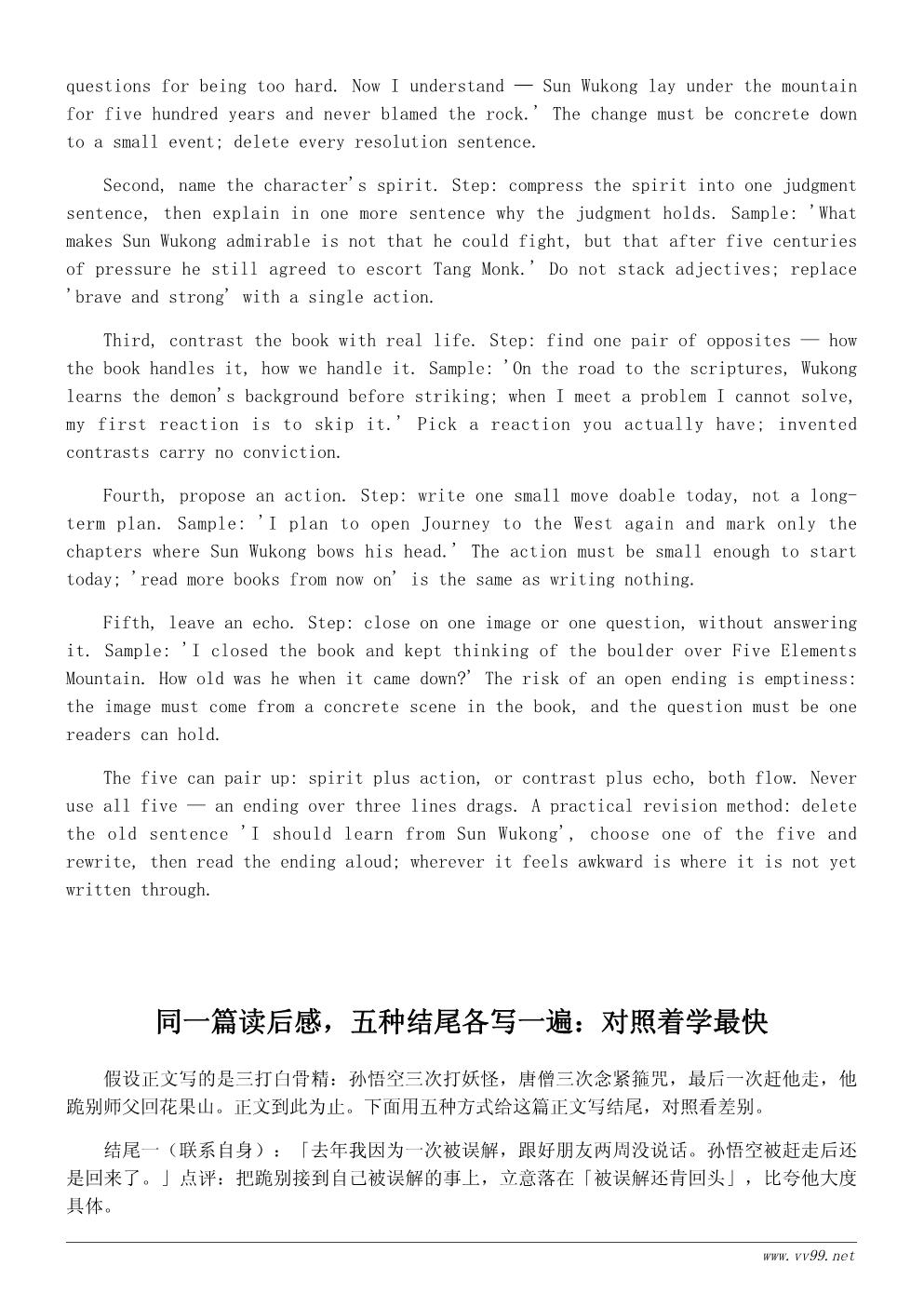
First, connect to your own growth. Step: jump from the last plot point back to yourself and write one change, not one resolution. Ask yourself: after reading this book, which thing about myself do I see differently? Sample: 'I used to blame the questions for being too hard. Now I understand — Sun Wukong lay under the mountain for five hundred years and never blamed the rock.' The change must be concrete down to a small event; delete every resolution sentence.
Second, name the character's spirit. Step: compress the spirit into one judgment sentence, then explain in one more sentence why the judgment holds. Sample: 'What makes Sun Wukong admirable is not that he could fight, but that after five centuries of pressure he still agreed to escort Tang Monk.' Do not stack adjectives; replace 'brave and strong' with a single action.
Third, contrast the book with real life. Step: find one pair of opposites — how the book handles it, how we handle it. Sample: 'On the road to the scriptures, Wukong learns the demon's background before striking; when I meet a problem I cannot solve, my first reaction is to skip it.' Pick a reaction you actually have; invented contrasts carry no conviction.
Fourth, propose an action. Step: write one small move doable today, not a long-term plan. Sample: 'I plan to open Journey to the West again and mark only the chapters where Sun Wukong bows his head.' The action must be small enough to start today; 'read more books from now on' is the same as writing nothing.
Fifth, leave an echo. Step: close on one image or one question, without answering it. Sample: 'I closed the book and kept thinking of the boulder over Five Elements Mountain. How old was he when it came down?' The risk of an open ending is emptiness: the image must come from a concrete scene in the book, and the question must be one readers can hold.
The five can pair up: spirit plus action, or contrast plus echo, both flow. Never use all five — an ending over three lines drags. A practical revision method: delete the old sentence 'I should learn from Sun Wukong', choose one of the five and rewrite, then read the ending aloud; wherever it feels awkward is where it is not yet written through.
同一篇读后感,五种结尾各写一遍:对照着学最快
假设正文写的是三打白骨精:孙悟空三次打妖怪,唐僧三次念紧箍咒,最后一次赶他走,他跪别师父回花果山。正文到此为止。下面用五种方式给这篇正文写结尾,对照看差别。
结尾一(联系自身):「去年我因为一次被误解,跟好朋友两周没说话。孙悟空被赶走后还是回来了。」点评:把跪别接到自己被误解的事上,立意落在「被误解还肯回头」,比夸他大度具体。
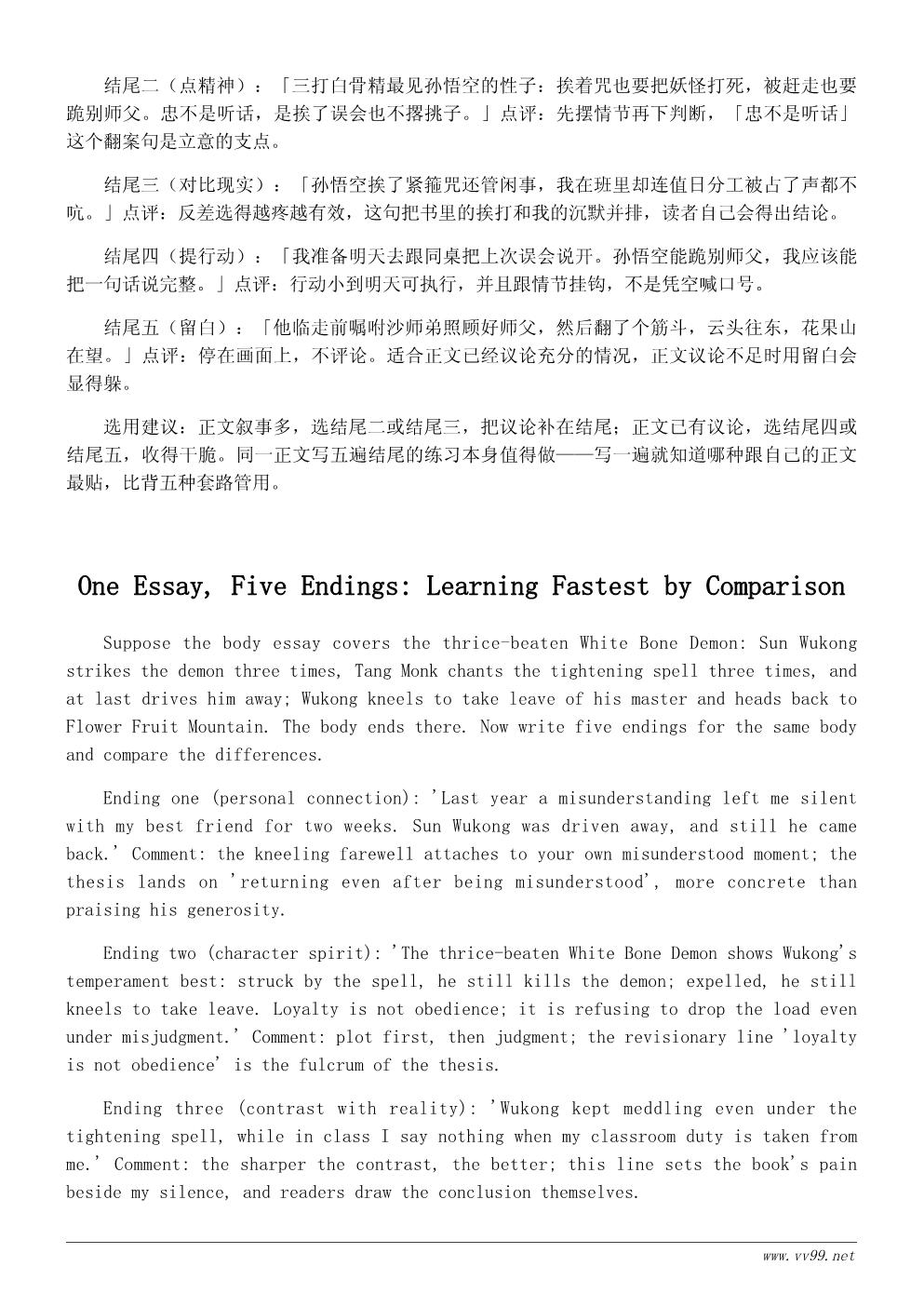
结尾二(点精神):「三打白骨精最见孙悟空的性子:挨着咒也要把妖怪打死,被赶走也要跪别师父。忠不是听话,是挨了误会也不撂挑子。」点评:先摆情节再下判断,「忠不是听话」这个翻案句是立意的支点。
结尾三(对比现实):「孙悟空挨了紧箍咒还管闲事,我在班里却连值日分工被占了声都不吭。」点评:反差选得越疼越有效,这句把书里的挨打和我的沉默并排,读者自己会得出结论。
结尾四(提行动):「我准备明天去跟同桌把上次误会说开。孙悟空能跪别师父,我应该能把一句话说完整。」点评:行动小到明天可执行,并且跟情节挂钩,不是凭空喊口号。
结尾五(留白):「他临走前嘱咐沙师弟照顾好师父,然后翻了个筋斗,云头往东,花果山在望。」点评:停在画面上,不评论。适合正文已经议论充分的情况,正文议论不足时用留白会显得躲。
选用建议:正文叙事多,选结尾二或结尾三,把议论补在结尾;正文已有议论,选结尾四或结尾五,收得干脆。同一正文写五遍结尾的练习本身值得做——写一遍就知道哪种跟自己的正文最贴,比背五种套路管用。
One Essay, Five Endings: Learning Fastest by Comparison
Suppose the body essay covers the thrice-beaten White Bone Demon: Sun Wukong strikes the demon three times, Tang Monk chants the tightening spell three times, and at last drives him away; Wukong kneels to take leave of his master and heads back to Flower Fruit Mountain. The body ends there. Now write five endings for the same body and compare the differences.
Ending one (personal connection): 'Last year a misunderstanding left me silent with my best friend for two weeks. Sun Wukong was driven away, and still he came back.' Comment: the kneeling farewell attaches to your own misunderstood moment; the thesis lands on 'returning even after being misunderstood', more concrete than praising his generosity.
Ending two (character spirit): 'The thrice-beaten White Bone Demon shows Wukong's temperament best: struck by the spell, he still kills the demon; expelled, he still kneels to take leave. Loyalty is not obedience; it is refusing to drop the load even under misjudgment.' Comment: plot first, then judgment; the revisionary line 'loyalty is not obedience' is the fulcrum of the thesis.
Ending three (contrast with reality): 'Wukong kept meddling even under the tightening spell, while in class I say nothing when my classroom duty is taken from me.' Comment: the sharper the contrast, the better; this line sets the book's pain beside my silence, and readers draw the conclusion themselves.
Ending four (action): 'Tomorrow I will go clear up the last misunderstanding with my deskmate. If Sun Wukong could kneel to his master, I can at least finish one sentence.' Comment: the action is small enough for tomorrow and hooked to the plot, not a slogan out of thin air.
Ending five (open echo): 'Before leaving he charged Sha Monk with looking after the master, then flipped his cloud eastward, Flower Fruit Mountain in sight.' Comment: it stops on the image without commentary. It suits a body already rich in reflection; using it when the body is thin looks like evasion.
Selection advice: if the body is mostly narration, choose endings two or three to add the argument at the end; if the body already argues, choose endings four or five to close cleanly. The exercise of writing five endings for one body is worth doing — one pass tells you which ending fits your own essay best, which beats memorizing formulas.
小提示:上面此文档内容仅展示完整文档里的部分内容, 若需要下载完整文档请 点击免费下载完整文档 。