文章内容
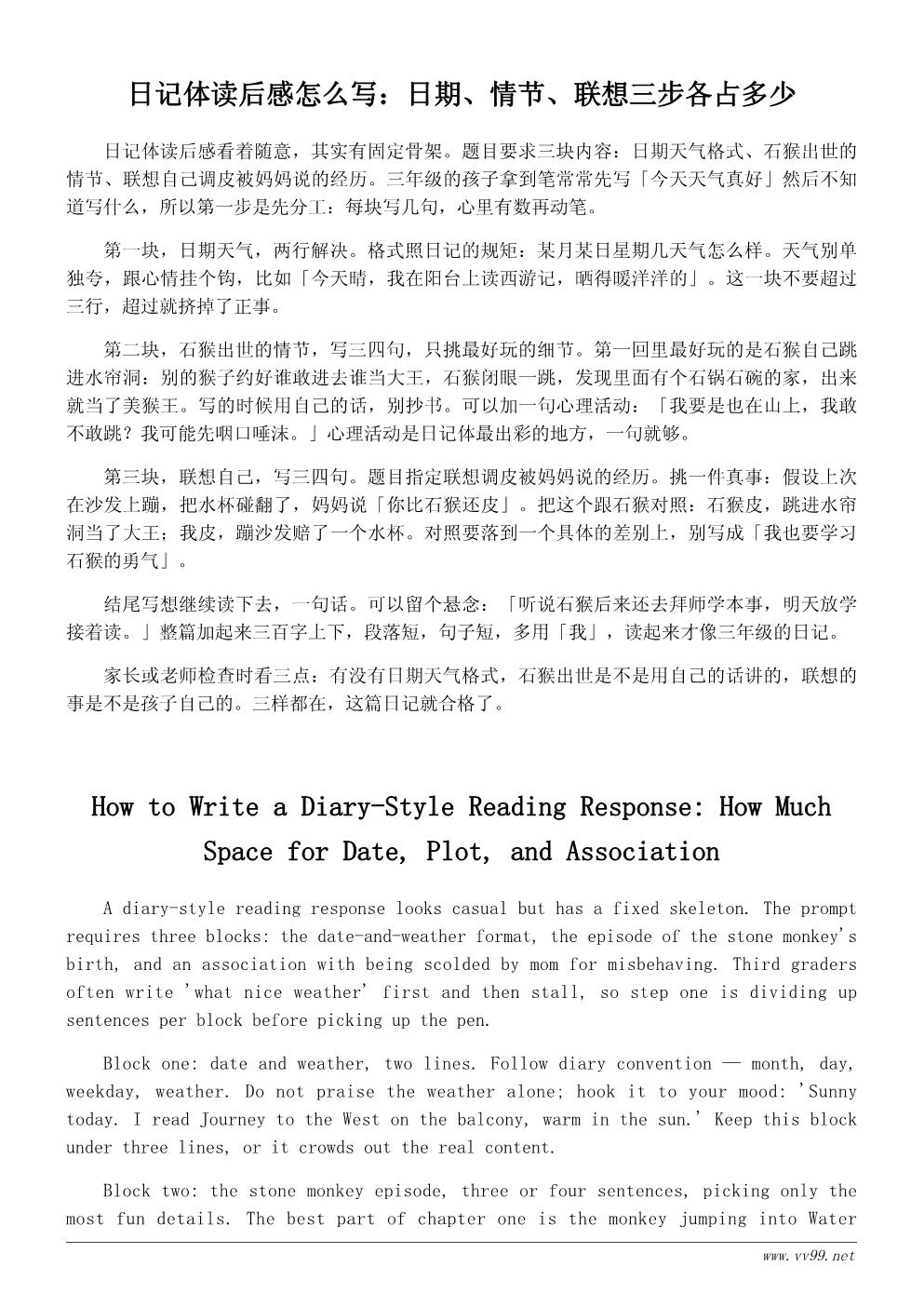
日记体读后感怎么写:日期、情节、联想三步各占多少
日记体读后感看着随意,其实有固定骨架。题目要求三块内容:日期天气格式、石猴出世的情节、联想自己调皮被妈妈说的经历。三年级的孩子拿到笔常常先写「今天天气真好」然后不知道写什么,所以第一步是先分工:每块写几句,心里有数再动笔。
第一块,日期天气,两行解决。格式照日记的规矩:某月某日星期几天气怎么样。天气别单独夸,跟心情挂个钩,比如「今天晴,我在阳台上读西游记,晒得暖洋洋的」。这一块不要超过三行,超过就挤掉了正事。
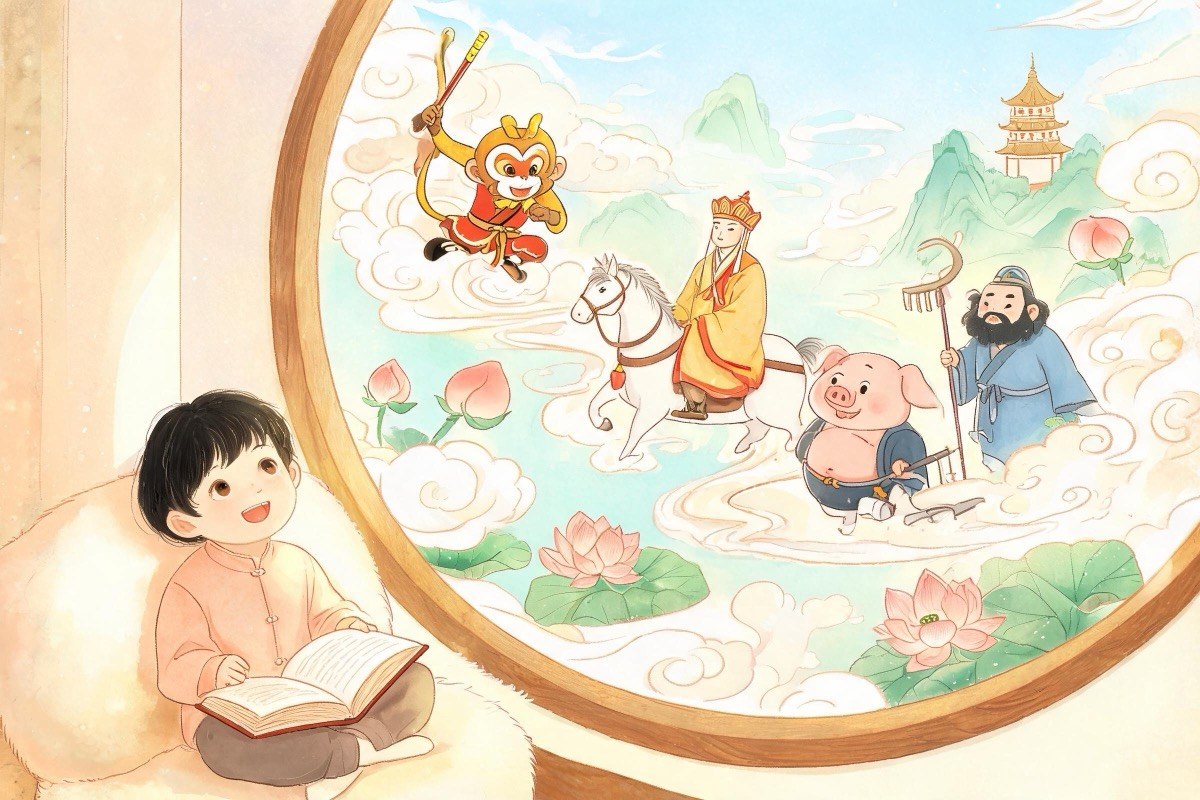
第二块,石猴出世的情节,写三四句,只挑最好玩的细节。第一回里最好玩的是石猴自己跳进水帘洞:别的猴子约好谁敢进去谁当大王,石猴闭眼一跳,发现里面有个石锅石碗的家,出来就当了美猴王。写的时候用自己的话,别抄书。可以加一句心理活动:「我要是也在山上,我敢不敢跳?我可能先咽口唾沫。」心理活动是日记体最出彩的地方,一句就够。
第三块,联想自己,写三四句。题目指定联想调皮被妈妈说的经历。挑一件真事:假设上次在沙发上蹦,把水杯碰翻了,妈妈说「你比石猴还皮」。把这个跟石猴对照:石猴皮,跳进水帘洞当了大王;我皮,蹦沙发赔了一个水杯。对照要落到一个具体的差别上,别写成「我也要学习石猴的勇气」。
结尾写想继续读下去,一句话。可以留个悬念:「听说石猴后来还去拜师学本事,明天放学接着读。」整篇加起来三百字上下,段落短,句子短,多用「我」,读起来才像三年级的日记。
家长或老师检查时看三点:有没有日期天气格式,石猴出世是不是用自己的话讲的,联想的事是不是孩子自己的。三样都在,这篇日记就合格了。
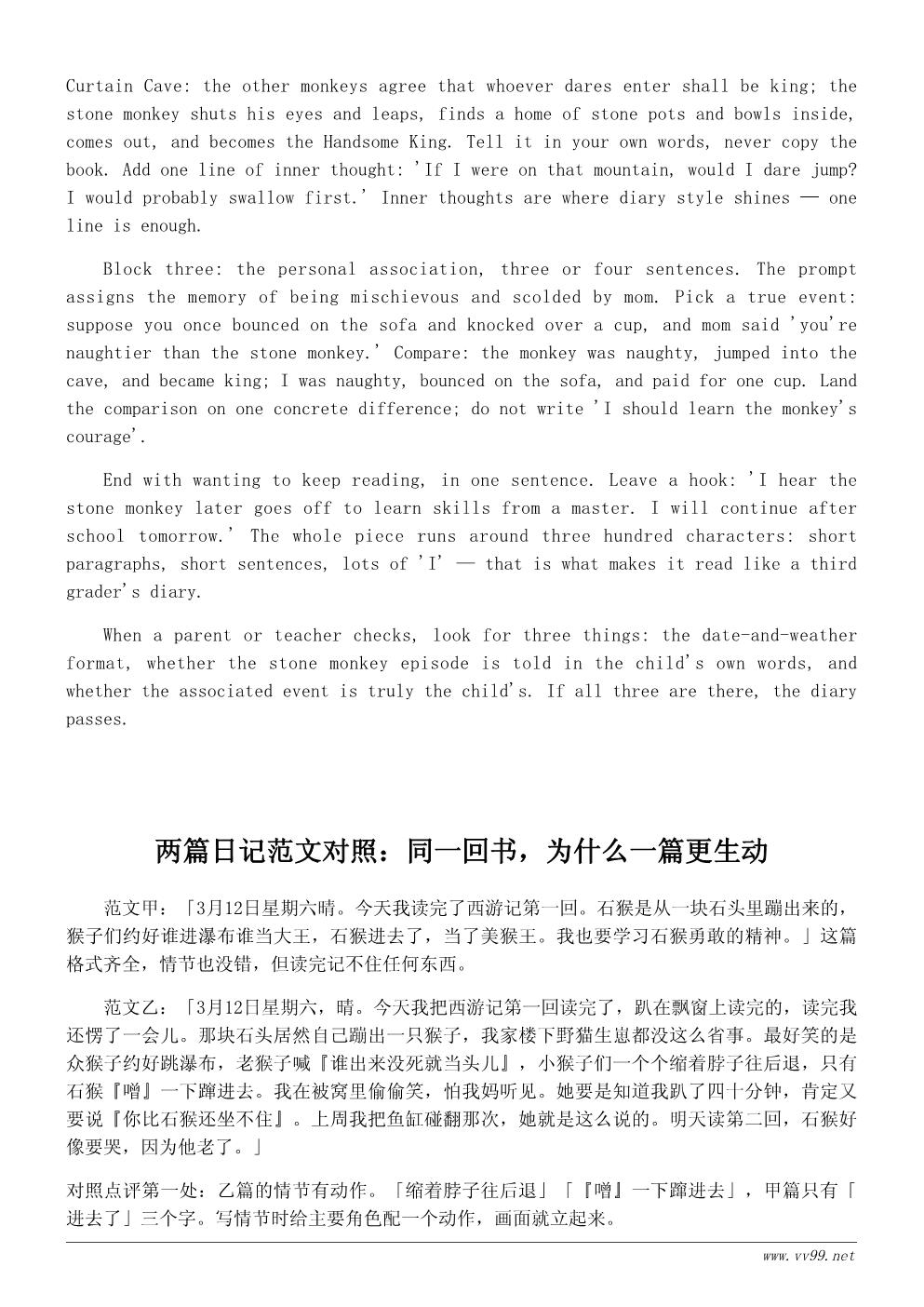
How to Write a Diary-Style Reading Response: How Much Space for Date, Plot, and Association
A diary-style reading response looks casual but has a fixed skeleton. The prompt requires three blocks: the date-and-weather format, the episode of the stone monkey's birth, and an association with being scolded by mom for misbehaving. Third graders often write 'what nice weather' first and then stall, so step one is dividing up sentences per block before picking up the pen.
Block one: date and weather, two lines. Follow diary convention — month, day, weekday, weather. Do not praise the weather alone; hook it to your mood: 'Sunny today. I read Journey to the West on the balcony, warm in the sun.' Keep this block under three lines, or it crowds out the real content.
Block two: the stone monkey episode, three or four sentences, picking only the most fun details. The best part of chapter one is the monkey jumping into Water Curtain Cave: the other monkeys agree that whoever dares enter shall be king; the stone monkey shuts his eyes and leaps, finds a home of stone pots and bowls inside, comes out, and becomes the Handsome King. Tell it in your own words, never copy the book. Add one line of inner thought: 'If I were on that mountain, would I dare jump? I would probably swallow first.' Inner thoughts are where diary style shines — one line is enough.
Block three: the personal association, three or four sentences. The prompt assigns the memory of being mischievous and scolded by mom. Pick a true event: suppose you once bounced on the sofa and knocked over a cup, and mom said 'you're naughtier than the stone monkey.' Compare: the monkey was naughty, jumped into the cave, and became king; I was naughty, bounced on the sofa, and paid for one cup. Land the comparison on one concrete difference; do not write 'I should learn the monkey's courage'.
End with wanting to keep reading, in one sentence. Leave a hook: 'I hear the stone monkey later goes off to learn skills from a master. I will continue after school tomorrow.' The whole piece runs around three hundred characters: short paragraphs, short sentences, lots of 'I' — that is what makes it read like a third grader's diary.
When a parent or teacher checks, look for three things: the date-and-weather format, whether the stone monkey episode is told in the child's own words, and whether the associated event is truly the child's. If all three are there, the diary passes.
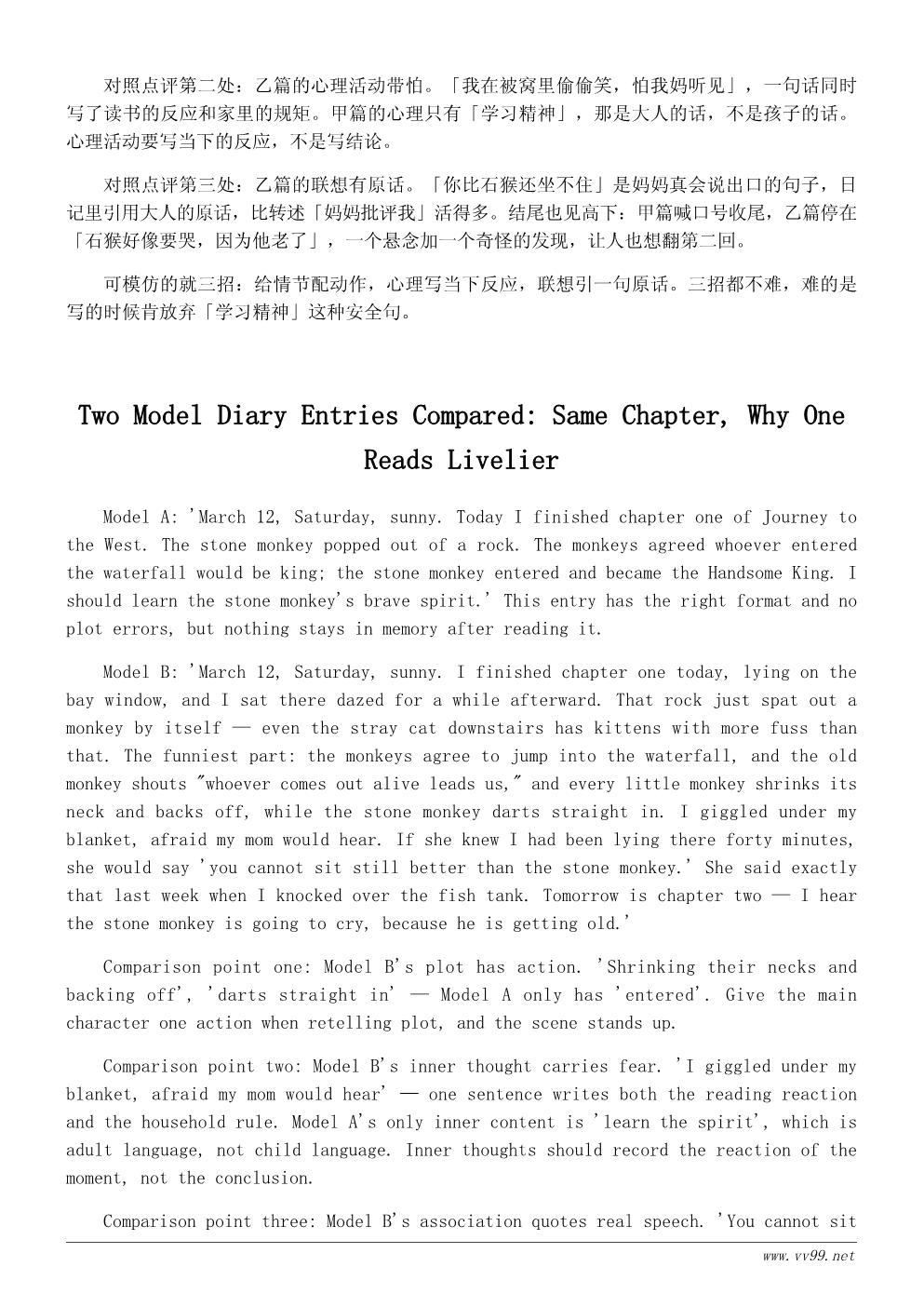
两篇日记范文对照:同一回书,为什么一篇更生动
范文甲:「3月12日星期六晴。今天我读完了西游记第一回。石猴是从一块石头里蹦出来的,猴子们约好谁进瀑布谁当大王,石猴进去了,当了美猴王。我也要学习石猴勇敢的精神。」这篇格式齐全,情节也没错,但读完记不住任何东西。
范文乙:「3月12日星期六,晴。今天我把西游记第一回读完了,趴在飘窗上读完的,读完我还愣了一会儿。那块石头居然自己蹦出一只猴子,我家楼下野猫生崽都没这么省事。最好笑的是众猴子约好跳瀑布,老猴子喊『谁出来没死就当头儿』,小猴子们一个个缩着脖子往后退,只有石猴『噌』一下蹿进去。我在被窝里偷偷笑,怕我妈听见。她要是知道我趴了四十分钟,肯定又要说『你比石猴还坐不住』。上周我把鱼缸碰翻那次,她就是这么说的。明天读第二回,石猴好像要哭,因为他老了。」
对照点评第一处:乙篇的情节有动作。「缩着脖子往后退」「『噌』一下蹿进去」,甲篇只有「进去了」三个字。写情节时给主要角色配一个动作,画面就立起来。
对照点评第二处:乙篇的心理活动带怕。「我在被窝里偷偷笑,怕我妈听见」,一句话同时写了读书的反应和家里的规矩。甲篇的心理只有「学习精神」,那是大人的话,不是孩子的话。心理活动要写当下的反应,不是写结论。
对照点评第三处:乙篇的联想有原话。「你比石猴还坐不住」是妈妈真会说出口的句子,日记里引用大人的原话,比转述「妈妈批评我」活得多。结尾也见高下:甲篇喊口号收尾,乙篇停在「石猴好像要哭,因为他老了」,一个悬念加一个奇怪的发现,让人也想翻第二回。
可模仿的就三招:给情节配动作,心理写当下反应,联想引一句原话。三招都不难,难的是写的时候肯放弃「学习精神」这种安全句。
Two Model Diary Entries Compared: Same Chapter, Why One Reads Livelier
Model A: 'March 12, Saturday, sunny. Today I finished chapter one of Journey to the West. The stone monkey popped out of a rock. The monkeys agreed whoever entered the waterfall would be king; the stone monkey entered and became the Handsome King. I should learn the stone monkey's brave spirit.' This entry has the right format and no plot errors, but nothing stays in memory after reading it.
Model B: 'March 12, Saturday, sunny. I finished chapter one today, lying on the bay window, and I sat there dazed for a while afterward. That rock just spat out a monkey by itself — even the stray cat downstairs has kittens with more fuss than that. The funniest part: the monkeys agree to jump into the waterfall, and the old monkey shouts "whoever comes out alive leads us," and every little monkey shrinks its neck and backs off, while the stone monkey darts straight in. I giggled under my blanket, afraid my mom would hear. If she knew I had been lying there forty minutes, she would say 'you cannot sit still better than the stone monkey.' She said exactly that last week when I knocked over the fish tank. Tomorrow is chapter two — I hear the stone monkey is going to cry, because he is getting old.'
Comparison point one: Model B's plot has action. 'Shrinking their necks and backing off', 'darts straight in' — Model A only has 'entered'. Give the main character one action when retelling plot, and the scene stands up.
Comparison point two: Model B's inner thought carries fear. 'I giggled under my blanket, afraid my mom would hear' — one sentence writes both the reading reaction and the household rule. Model A's only inner content is 'learn the spirit', which is adult language, not child language. Inner thoughts should record the reaction of the moment, not the conclusion.
Comparison point three: Model B's association quotes real speech. 'You cannot sit still better than the stone monkey' is a line a mother would actually say; quoting an adult's exact words in a diary beats reporting 'mom criticized me'. The endings differ too: Model A closes with a slogan; Model B stops at 'the stone monkey is going to cry, because he is getting old' — one hook plus one odd discovery, and the reader wants chapter two as well.
Three imitable moves: give plot an action, write inner thoughts as present reactions, quote one line of real speech in the association. None are hard; the hard part is being willing to give up safe sentences like 'learn the spirit'.
小提示:上面此文档内容仅展示完整文档里的部分内容, 若需要下载完整文档请 点击免费下载完整文档 。