文章内容
我在花坛边蹲了一个钟头
科学老师布置了一项观察作业,要求写一种小动物。同桌在花坛边绕了半圈,回来说蚂蚁又小又多,两句话就把作业打发了。我不服气,第二天放学,搬了块砖,在花坛那道裂缝边上坐下来,打算跟蚂蚁耗到底。
头十分钟,什么新鲜事也没有,还是那些蚂蚁,还是那条线。我差点也起身走掉。我忍住了,把眼睛再压低一点,近到能看清一只蚂蚁的六条腿轮流往前倒。
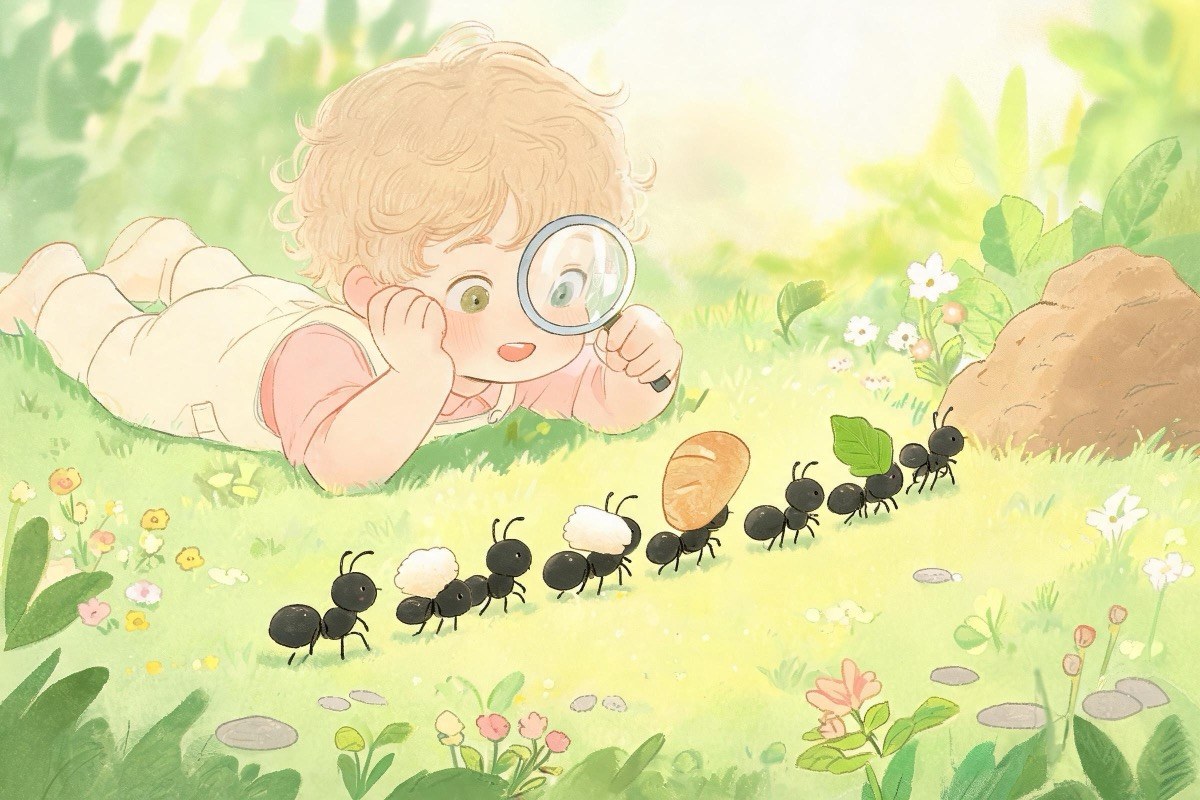
看清动作是在第二十分钟。一只蚂蚁发现了一粒米饭,它先用触角敲了敲,再试着从前面抬,抬不动,又转到侧面推,米饭转了个方向。它回身走了几步,又回头,再走,最后干脆钻进米饭底下,用背把米饭顶起来,一步一步往后退着走。
路线是后来才看明白的。蚂蚁不是乱走,它们全沿着地砖之间那条最深的缝,缝就是路。走到墙根,队伍分了岔:搬食物的往左,回洞的往右,还有一小撮贴着墙往上爬,去够一只死掉的飞虫。三条线各有各的走法,谁也不挤谁。
一个钟头快到的时候,我数出这条队伍至少经过四次碰触角:碰一下,前面的蚂蚁就停下等一等;再碰一下,后面的就补上来。我不懂这是什么意思,只把它们记在心里。
回家路上,问题一个接一个冒出来:米饭那么重,它怎么知道回去叫人?缝是谁挖的,还是天生就该走?碰触角是在说话吗,说的什么?我越想越多,比同桌那两句话多出一百个问号。
第二天交作业,我写了满满两页,写米饭怎么被顶起来,写墙根的三条线,写我答不上来的那些问题。老师在我的本子边上写:这才是观察。我把那块砖又搬回花坛边,作业交了,可我的观察没有完,那些问题还等着我接着蹲下去,一个一个问明白。
I Squatted by the Flower Bed for a Whole Hour
Our science teacher assigned an observation task: write about a small animal. My deskmate circled the flower bed once, came back saying ants are tiny and numerous, and finished the assignment in two sentences. I was not convinced. The next day after school I carried a brick over, sat down beside the crack at the flower bed, and decided to see it through with the ants.
For the first ten minutes nothing new happened — the same ants, the same line. I nearly got up and left too. I held on, and lowered my eyes until I could see six legs of one ant tipping forward one after another.
The movements only came clear around the twentieth minute. An ant found a grain of rice. It tapped the rice with its antennae, tried lifting from the front, failed, switched to the side and pushed, and the rice turned a quarter circle. The ant walked a few steps away, turned back, walked again, then finally crawled under the grain and hoisted it on its back, walking backward step by step.
The routes made sense only later. The ants were not wandering; every one of them followed the deepest crack between the paving stones, and the crack was the road. At the foot of the wall the column forked: food-carriers turned left, nest-returners turned right, and a small cluster climbed the wall itself to reach a dead fly. Three lines, each with its own traffic, none crowding another.
Near the end of my hour, I counted at least four antenna-taps along the line: one tap and the ant ahead paused to wait; a second tap and the ant behind moved up. I did not know what it meant. I simply kept it in mind.
On the way home, questions came one after another: the rice was so heavy — how did the ant know to go fetch help? Who dug the crack, or is it simply born to be a road? Are they talking when they touch antennae, and what do they say? The questions multiplied, a hundred question marks more than my deskmate's two sentences.
When we handed in the homework the next day, mine filled two pages: how the rice was hoisted, the three lines at the wall, and all the questions I could not answer. My teacher wrote in the margin: now this is observation. I carried the brick back to the flower bed afterward. The assignment was turned in, but my observation was not over — those questions were still waiting for me to squat back down and work them out one by one.
裂缝里的五天
自然笔记的第一页,老师要求连续观察一种东西,写满五天。我在练习本上写下的开头很丢人:墙缝里有蚂蚁,很小,很多,黑色。写完这十二个字,我盯着本子,觉得对不住老师。
第二天我逼自己多看一会儿。这一回我看的是触角。两只蚂蚁迎面碰上,触角碰一下就走,可有一对碰了很久,绕着对方转了半圈才分开。我还看见一只蚂蚁搬着一片比它大两倍的菜叶,走得很稳,下坡的时候先把菜叶放下来,自己滑下去,再回头把菜叶拖下来。
第三天,我在它们的路线上放了一颗小石子。蚂蚁走到石子跟前,没有爬,也没有推,整条队伍往左边让开,绕过石子,再合回原来的线。我在笔记里写:它们好像早就知道路可以弯。
第四天出了大事。那条走了几天的线不见了,我急得把地砖缝挨个看过去,最后在离原线半米远的另一条缝里找到了队伍。它们改道了,原因我猜是有人往那条缝里倒了半瓶汽水,缝边还黏着。新线上蚂蚁走得比原来快,谁也不绕弯。
第五天,我没再蹲在原地,把前四天的笔记摊在膝盖上重看了一遍,然后在本子最后一页写下攒下的疑问:触角碰很久的那一对,是不是在吵嘴?搬菜叶的蚂蚁为什么先下坡再拖菜叶?改道是谁决定的,没有谁下令,它们怎么都知道新线?写完我数了数,五个问题,一个也答不上来。
交笔记那天,老师把最后一页翻给我看,说问题比记录金贵,能提问的眼睛才算真的看过。同桌的本子上五天都写着蚂蚁很小很多,我的本子上五天没有一句重样。墙缝还是那道墙缝,蚂蚁还是那些蚂蚁,五天里我换了一双眼睛。
Five Days Inside the Crack
For the first page of our nature notebook, the teacher asked us to observe one thing for five days straight. My opening line was embarrassing: ants in the wall crack — small, many, black. After those twelve characters I stared at the notebook, feeling I had let the teacher down.
On day two I forced myself to look longer. This time I watched the antennae. When two ants met head-on, they tapped antennae and parted, but one pair touched for a long while and circled half around each other before splitting up. I also saw an ant carrying a vegetable leaf twice its size, walking steadily; at the slope it set the leaf down, slid down itself, then turned back and dragged the leaf after it.
On day three I placed a small pebble in their route. When the ants reached it, they neither climbed nor pushed. The whole column stepped to the left, flowed around the pebble, and closed back into the original line. I wrote in my notebook: they seem to have known all along that a road may bend.
On day four something big happened. The line they had walked for days was gone. In a panic I checked the cracks between the paving stones one by one, and finally found the column half a meter away in another crack. They had changed routes. I guessed the cause was someone pouring half a bottle of soda into the old crack; its edge was still sticky. On the new line the ants walked faster than before, and nobody wandered.
On day five I did not squat in place. I spread the previous four days of notes across my knees, reread them, then wrote on the last page every question I had saved up: were that pair who touched antennae for so long quarreling? Why did the leaf-carrier slide down first and drag the leaf after? Who decided to change the route — with no one giving orders, how did they all know the new line? I counted five questions and could answer not one.
The day we handed in the notebooks, the teacher turned to my last page and said: questions are more precious than records; only eyes that can ask have truly seen. My deskmate's notebook said the same thing five days running — ants are small and many. Mine had no repeated sentence across five days. The crack was still the same crack, the ants still the same ants, but in five days I had swapped in a new pair of eyes.
小提示:上面此文档内容仅展示完整文档里的部分内容, 若需要下载完整文档请 点击免费下载完整文档 。