文章内容
护腕与三米
女儿七岁生日的前一天,我带她去了一趟车行,又去了一趟体育用品店。体育用品店的老板推荐一整套护具,护腕、护肘、护膝,全要,说孩子摔起来不含糊。我挑了护腕和护膝,护肘没要。头盔是女儿自己抱住的,粉色的,不肯放。老板说头盔不能买大,大了晃,真摔的时候护不住,他帮我们把旋钮拧到两根手指刚好塞不进去。
学车就在我们小区的广场上。车是表哥家孩子淘汰下来的,辅助轮拆了,车座压到最低,女儿坐上去,脚尖刚好点着地。她先没哭,只问了一句,会倒吗。我说会倒,倒就是学。
我全程弯腰扶着后座架。扶了半个下午,腰就直不起来了。广场上有个遛鸟的老头看了一会儿,说,你这样扶,等于你在骑。他教我手别碰车,去抓孩子后领,轻轻抓着,人往哪边歪,往另一边带一带就行。我换了法子,女儿说,这个好,我感觉得到你,你又没管我。
女儿的进步是按米数的。头一个下午,两米。再一个下午,五米。我站在广场那头喊,再来三米,她就蹬出三米停下来,我隔着整个广场喊好。散步的人都回头看我。
她问我,你怎么一直不松手。我说,松过好几回了,你不知道哪回松的。她想了想,说,那你再松一回。
学会那个下午,她绕着广场骑了一圈,风把裙角吹起来。她停在我跟前,一直说,我会了我会了。我说,我看见了。我的手还往前伸着,虚虚地抓着一个后领的形状。
护腕后来收起来了,上面一道磕痕都没有。护膝磨穿了一小块,就是摔在广场砖上的那一下。女儿现在上五年级,自己骑车上学,粉色头盔还挂在门后的钩子上,每次出门自己戴上,自己把旋钮拧两下。
大人总说要夸孩子,要会说话。我不太会说,那个下午用到的话,拢共就是好和再来三米。可女儿都记得。有一回写作文,她写她的第一辆车,写的全是那三米。
The Wrist Guard and Three Meters
The day before the seventh birthday of my daughter, I took her first to a bicycle shop and then to a sporting-goods store. The shopkeeper recommended a full set of protectors — wrists, elbows, knees, all of them — saying children fall hard. I chose the wrist guards and the knee pads and skipped the elbow ones. The helmet my daughter hugged to herself and refused to put back: pink. The shopkeeper said a helmet must not be bought large, because a loose one wobbles and protects nothing in a real fall, and he turned the dial for us until two fingers just failed to fit in.
We learned on the plaza of our residential compound. The bicycle was one handed down from a child of my cousin, training wheels removed, seat pushed to its lowest, so that my daughter sat with her toes just touching the ground. She did not cry at first; she only asked one question: will it fall? I said: it will fall, and falling is the learning.
I bent over holding the rear rack the whole time, and by late afternoon my back could not straighten. An old man walking his caged bird watched for a while and said: holding like that means you are the one riding. He taught me to keep my hands off the bicycle and instead lightly grip the collar at the back of her neck — if she leaned one way, just guide her gently the other way. I switched methods, and my daughter said: this is better, I can feel you, but you are not controlling me.
Her progress was measured in meters. The first afternoon: two meters. The next afternoon: five. I stood at the far end of the plaza and shouted, three more meters, and she pedaled out three meters and stopped, and I shouted good from across the whole plaza. People out for a walk turned to look at me.
She asked me why I never let go. I said: I have let go many times, you just do not know which times. She thought about it and said: then let go one more time.
On the afternoon she finally rode, she made one lap of the plaza, the wind lifting the hem of her skirt. She stopped in front of me and kept saying: I can do it, I can do it. I said: I saw. My hand was still stretched forward, faintly gripping the shape of a collar.
The wrist guards were put away afterward, without a single scuff on them. One knee pad had worn through a small patch — that was the fall on the paving bricks of the plaza. My daughter is now in fifth grade and cycles to school by herself; the pink helmet still hangs on the hook behind the door, and every time she goes out she puts it on herself and twists the dial twice.
Adults always say one should praise children, should know what to say. I am not good at talking. The words I used that afternoon amounted to little more than good and three more meters. But my daughter remembers them all. Once, writing a composition about her first bicycle, what she wrote about was entirely those three meters.
四个指头搭在坐垫上
儿子八岁那年秋天,学校通知要考骑车,不会骑的利用体育课补。我们家没有会骑车的男人——这话是我婆婆说的,她说的时候很平静,好像这是家里一件光荣的事。于是那个周末,陪儿子学车的事落到了我头上。
装备是提前一周备的。我在网上下单,把能搜到的护具都买了:头盔、护腕、护肘、护膝,还有一副露指手套。到货那天摆了一床,儿子试戴,从头到脚,自己管自己叫机器人。头盔我挑得最仔细,要正儿八经有认证标志的,尺码按量出来的头围买,两根手指塞不进带子才算合格。
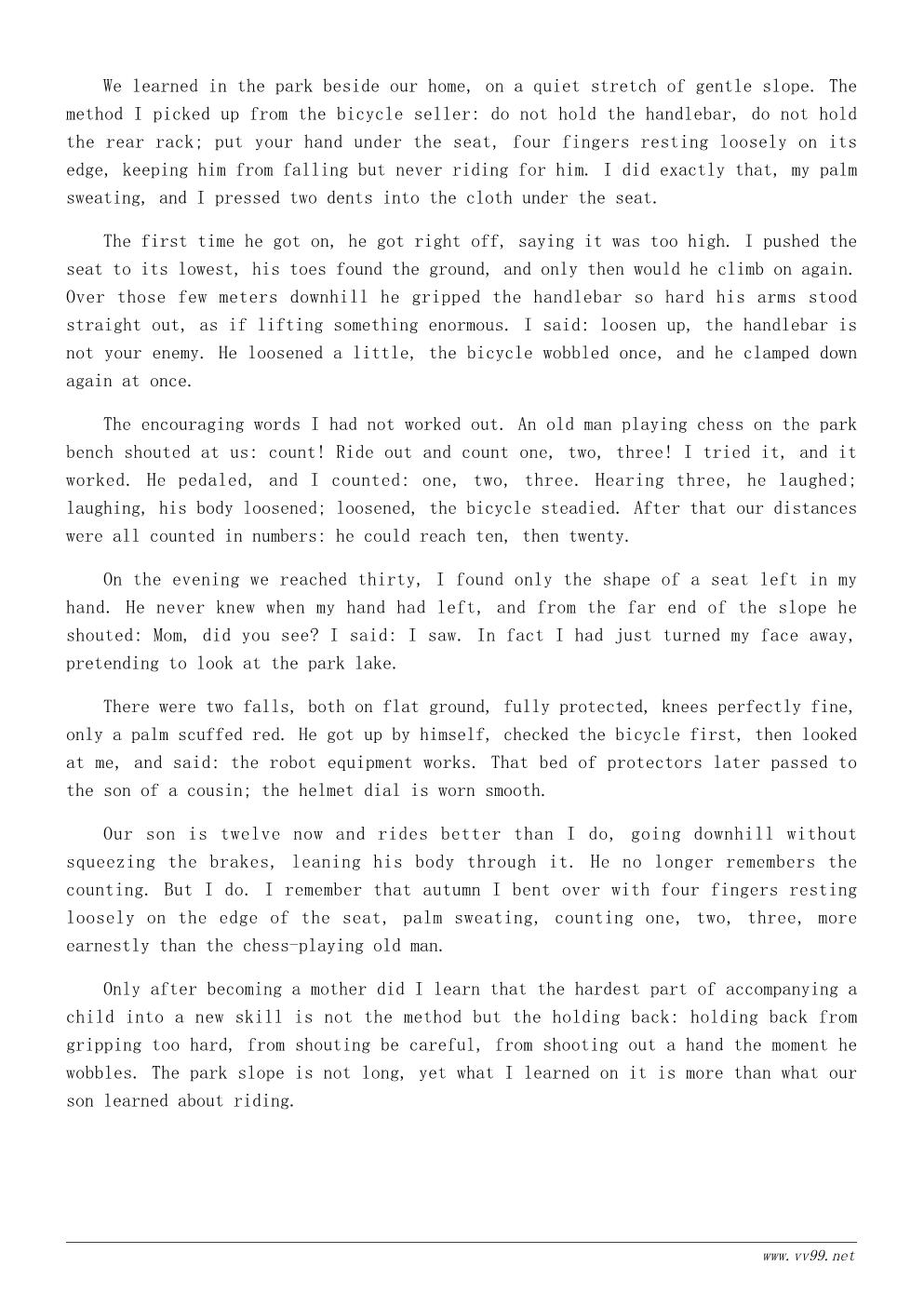
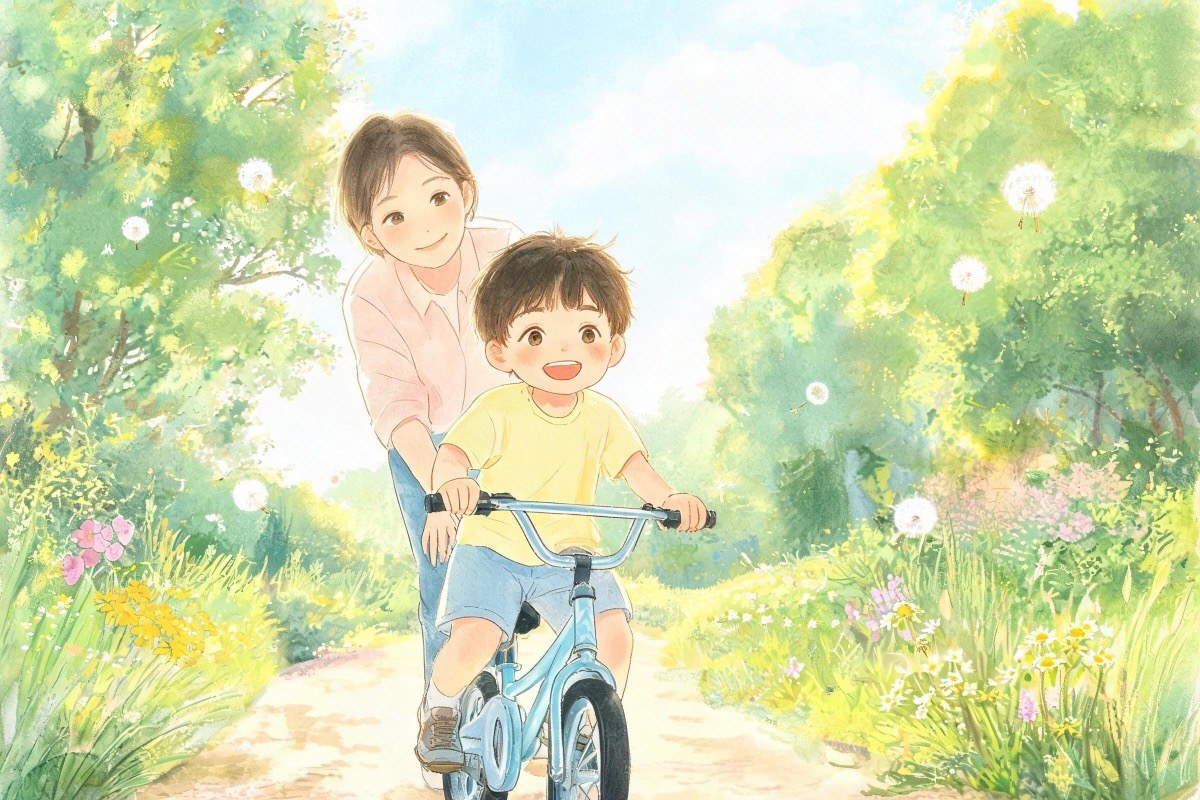
学车在家旁边的公园,找了一段没人的缓坡。方法是我从卖车那儿听来的:不扶车把,不扶后座架,手伸到坐垫底下,四个指头虚搭着坐垫边,只帮他不倒,不替他骑。我照着做,手心全是汗,坐垫底下那块布被我攥出两个印子。
儿子头一回坐上去就下来了,说高。我把车座压到最低,他脚尖着地,才肯再上去。下坡那几米,他两只手把车把攥得死紧,胳膊绷得直直的,像举着什么了不得的东西。我说松一点,车把不是敌人。他松了一点,车就晃了一下,又赶紧攥紧。
鼓励的话我原本想不好。公园长椅上坐着个下棋的大爷,冲我们喊,数数!骑出去就数一二三!我试了,管用。儿子蹬出去,我跟着数,一、二、三,他听见数到三就笑,笑了身子就松,身子松了车就稳。后来我们的里程全用数数算:能数到十了,能数到二十了。
数到三十的那个傍晚,我发现我手里只剩一个坐垫的形状。他不知道我什么时候撒的手,在坡那头冲我喊,妈你看见了吗。我说看见了。其实我那时候正把脸别过去,假装看公园的湖。
摔过两回,都在平地上,护具全乎,膝盖一点事没有,就是手掌蹭红了一块。他自己爬起来,先看车,再看我,说,机器人装备好使。那床护具后来传给了表妹的儿子,头盔的旋钮都磨花了。
如今儿子十二岁,骑车比我骑得好,下坡不捏闸,靠身子压着走。他早不记得数数的事了。可我记得。我记得那个秋天我弯着腰,四个指头虚搭在坐垫边上,手心出汗,一、二、三,数得比下棋的大爷还认真。
当妈以后我才知道,陪孩子学一样东西,最难的不是方法,是忍住。忍住不扶死,忍住不喊小心,忍住在他晃的时候不伸手。公园那段缓坡不长,我在上头学会的东西,比儿子学会骑车还多。
Four Fingers Resting on the Seat
The autumn my son turned eight, the school announced a bicycle test; those who could not ride would make it up during PE class. There is no man in our family who can ride a bicycle — my mother-in-law said this, and she said it calmly, as if it were a proud fact about the household. So that weekend, the job of teaching our son fell to me.
The gear was ready a week ahead. I ordered online and bought every protector I could find: helmet, wrist guards, elbow pads, knee pads, and fingerless gloves. When the parcels arrived they covered a whole bed. Our son tried them on head to toe and started calling himself a robot. I chose the helmet most carefully: a proper certification mark, the size matched to the head circumference we measured, and the strap passing only when two fingers could not slip underneath.
We learned in the park beside our home, on a quiet stretch of gentle slope. The method I picked up from the bicycle seller: do not hold the handlebar, do not hold the rear rack; put your hand under the seat, four fingers resting loosely on its edge, keeping him from falling but never riding for him. I did exactly that, my palm sweating, and I pressed two dents into the cloth under the seat.
The first time he got on, he got right off, saying it was too high. I pushed the seat to its lowest, his toes found the ground, and only then would he climb on again. Over those few meters downhill he gripped the handlebar so hard his arms stood straight out, as if lifting something enormous. I said: loosen up, the handlebar is not your enemy. He loosened a little, the bicycle wobbled once, and he clamped down again at once.
The encouraging words I had not worked out. An old man playing chess on the park bench shouted at us: count! Ride out and count one, two, three! I tried it, and it worked. He pedaled, and I counted: one, two, three. Hearing three, he laughed; laughing, his body loosened; loosened, the bicycle steadied. After that our distances were all counted in numbers: he could reach ten, then twenty.
On the evening we reached thirty, I found only the shape of a seat left in my hand. He never knew when my hand had left, and from the far end of the slope he shouted: Mom, did you see? I said: I saw. In fact I had just turned my face away, pretending to look at the park lake.
There were two falls, both on flat ground, fully protected, knees perfectly fine, only a palm scuffed red. He got up by himself, checked the bicycle first, then looked at me, and said: the robot equipment works. That bed of protectors later passed to the son of a cousin; the helmet dial is worn smooth.
Our son is twelve now and rides better than I do, going downhill without squeezing the brakes, leaning his body through it. He no longer remembers the counting. But I do. I remember that autumn I bent over with four fingers resting loosely on the edge of the seat, palm sweating, counting one, two, three, more earnestly than the chess-playing old man.
Only after becoming a mother did I learn that the hardest part of accompanying a child into a new skill is not the method but the holding back: holding back from gripping too hard, from shouting be careful, from shooting out a hand the moment he wobbles. The park slope is not long, yet what I learned on it is more than what our son learned about riding.
小提示:上面此文档内容仅展示完整文档里的部分内容, 若需要下载完整文档请 点击免费下载完整文档 。