文章内容
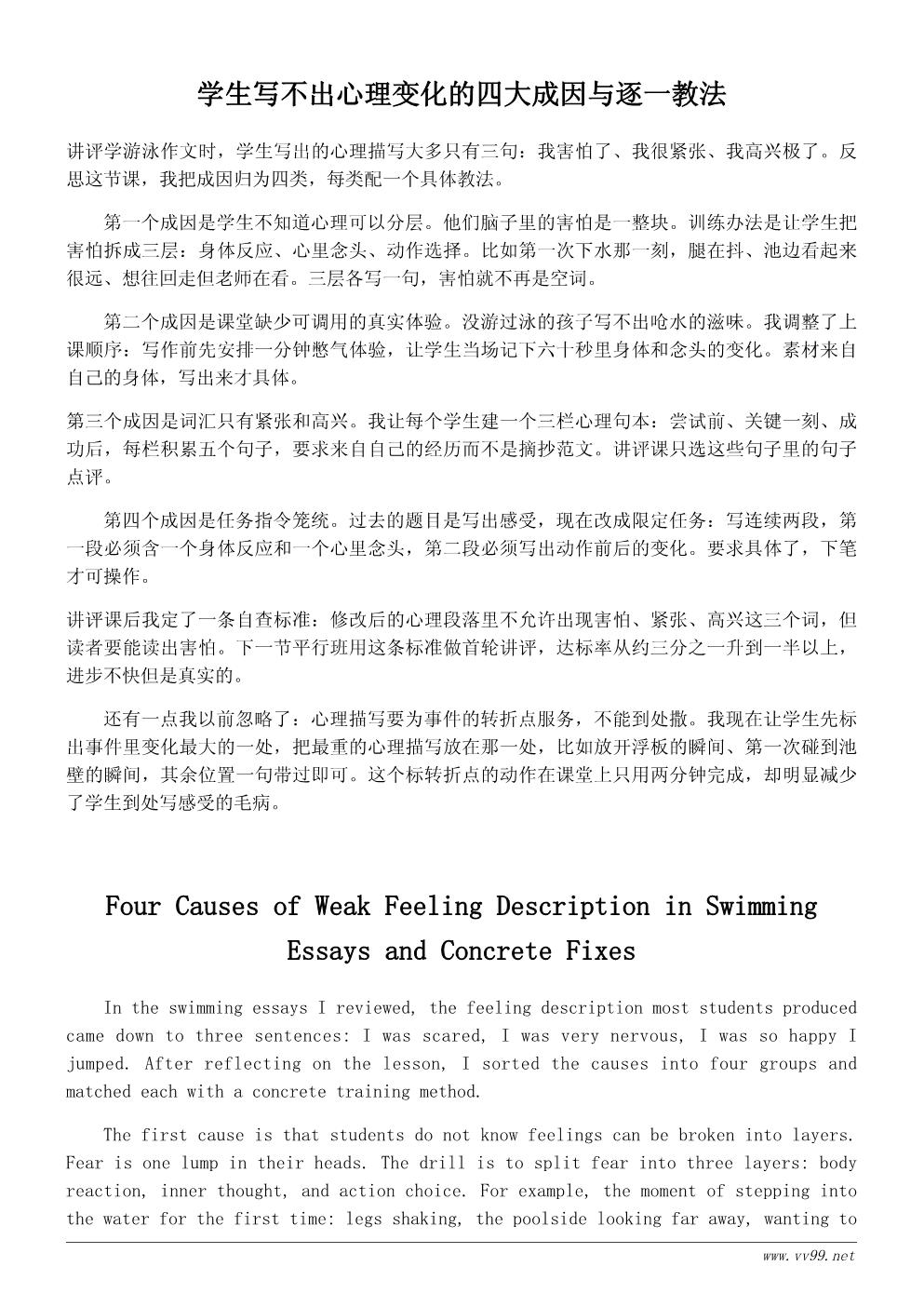
学生写不出心理变化的四大成因与逐一教法
讲评学游泳作文时,学生写出的心理描写大多只有三句:我害怕了、我很紧张、我高兴极了。反思这节课,我把成因归为四类,每类配一个具体教法。
第一个成因是学生不知道心理可以分层。他们脑子里的害怕是一整块。训练办法是让学生把害怕拆成三层:身体反应、心里念头、动作选择。比如第一次下水那一刻,腿在抖、池边看起来很远、想往回走但老师在看。三层各写一句,害怕就不再是空词。
第二个成因是课堂缺少可调用的真实体验。没游过泳的孩子写不出呛水的滋味。我调整了上课顺序:写作前先安排一分钟憋气体验,让学生当场记下六十秒里身体和念头的变化。素材来自自己的身体,写出来才具体。
第三个成因是词汇只有紧张和高兴。我让每个学生建一个三栏心理句本:尝试前、关键一刻、成功后,每栏积累五个句子,要求来自自己的经历而不是摘抄范文。讲评课只选这些句子里的句子点评。
第四个成因是任务指令笼统。过去的题目是写出感受,现在改成限定任务:写连续两段,第一段必须含一个身体反应和一个心里念头,第二段必须写出动作前后的变化。要求具体了,下笔才可操作。
讲评课后我定了一条自查标准:修改后的心理段落里不允许出现害怕、紧张、高兴这三个词,但读者要能读出害怕。下一节平行班用这条标准做首轮讲评,达标率从约三分之一升到一半以上,进步不快但是真实的。
还有一点我以前忽略了:心理描写要为事件的转折点服务,不能到处撒。我现在让学生先标出事件里变化最大的一处,把最重的心理描写放在那一处,比如放开浮板的瞬间、第一次碰到池壁的瞬间,其余位置一句带过即可。这个标转折点的动作在课堂上只用两分钟完成,却明显减少了学生到处写感受的毛病。
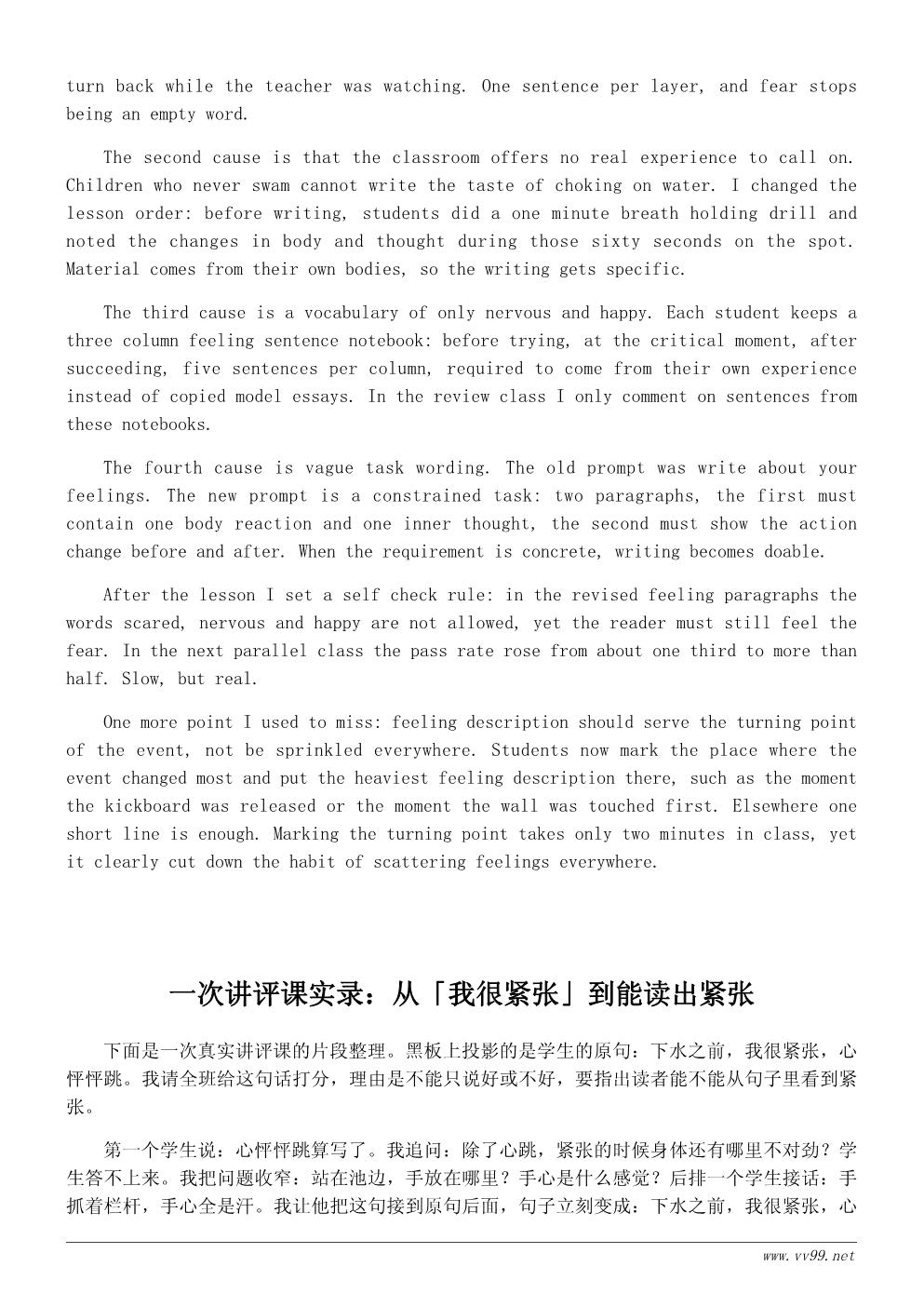
Four Causes of Weak Feeling Description in Swimming Essays and Concrete Fixes
In the swimming essays I reviewed, the feeling description most students produced came down to three sentences: I was scared, I was very nervous, I was so happy I jumped. After reflecting on the lesson, I sorted the causes into four groups and matched each with a concrete training method.
The first cause is that students do not know feelings can be broken into layers. Fear is one lump in their heads. The drill is to split fear into three layers: body reaction, inner thought, and action choice. For example, the moment of stepping into the water for the first time: legs shaking, the poolside looking far away, wanting to turn back while the teacher was watching. One sentence per layer, and fear stops being an empty word.
The second cause is that the classroom offers no real experience to call on. Children who never swam cannot write the taste of choking on water. I changed the lesson order: before writing, students did a one minute breath holding drill and noted the changes in body and thought during those sixty seconds on the spot. Material comes from their own bodies, so the writing gets specific.
The third cause is a vocabulary of only nervous and happy. Each student keeps a three column feeling sentence notebook: before trying, at the critical moment, after succeeding, five sentences per column, required to come from their own experience instead of copied model essays. In the review class I only comment on sentences from these notebooks.
The fourth cause is vague task wording. The old prompt was write about your feelings. The new prompt is a constrained task: two paragraphs, the first must contain one body reaction and one inner thought, the second must show the action change before and after. When the requirement is concrete, writing becomes doable.
After the lesson I set a self check rule: in the revised feeling paragraphs the words scared, nervous and happy are not allowed, yet the reader must still feel the fear. In the next parallel class the pass rate rose from about one third to more than half. Slow, but real.
One more point I used to miss: feeling description should serve the turning point of the event, not be sprinkled everywhere. Students now mark the place where the event changed most and put the heaviest feeling description there, such as the moment the kickboard was released or the moment the wall was touched first. Elsewhere one short line is enough. Marking the turning point takes only two minutes in class, yet it clearly cut down the habit of scattering feelings everywhere.
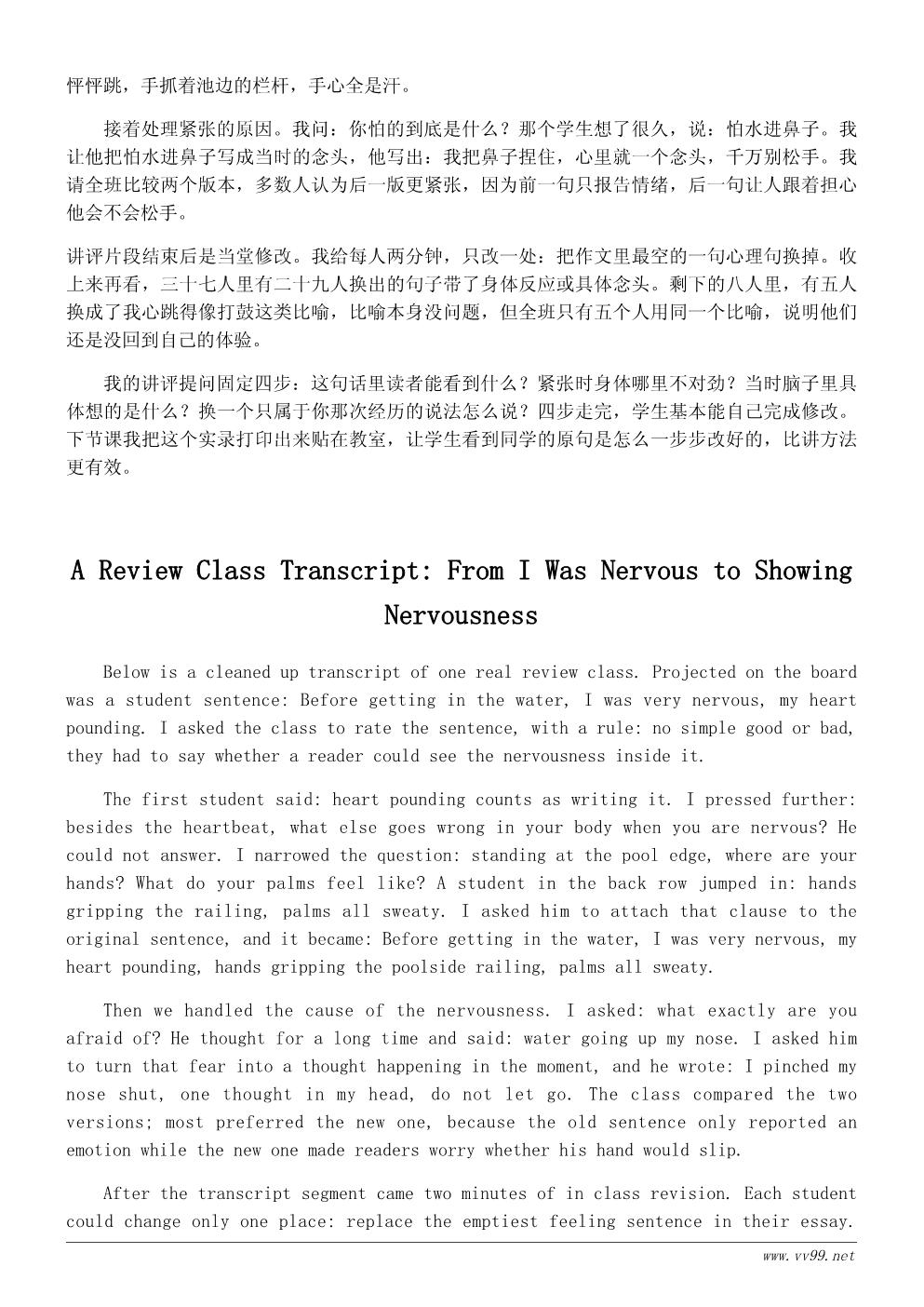
一次讲评课实录:从「我很紧张」到能读出紧张
下面是一次真实讲评课的片段整理。黑板上投影的是学生的原句:下水之前,我很紧张,心怦怦跳。我请全班给这句话打分,理由是不能只说好或不好,要指出读者能不能从句子里看到紧张。
第一个学生说:心怦怦跳算写了。我追问:除了心跳,紧张的时候身体还有哪里不对劲?学生答不上来。我把问题收窄:站在池边,手放在哪里?手心是什么感觉?后排一个学生接话:手抓着栏杆,手心全是汗。我让他把这句接到原句后面,句子立刻变成:下水之前,我很紧张,心怦怦跳,手抓着池边的栏杆,手心全是汗。
接着处理紧张的原因。我问:你怕的到底是什么?那个学生想了很久,说:怕水进鼻子。我让他把怕水进鼻子写成当时的念头,他写出:我把鼻子捏住,心里就一个念头,千万别松手。我请全班比较两个版本,多数人认为后一版更紧张,因为前一句只报告情绪,后一句让人跟着担心他会不会松手。
讲评片段结束后是当堂修改。我给每人两分钟,只改一处:把作文里最空的一句心理句换掉。收上来再看,三十七人里有二十九人换出的句子带了身体反应或具体念头。剩下的八人里,有五人换成了我心跳得像打鼓这类比喻,比喻本身没问题,但全班只有五个人用同一个比喻,说明他们还是没回到自己的体验。
我的讲评提问固定四步:这句话里读者能看到什么?紧张时身体哪里不对劲?当时脑子里具体想的是什么?换一个只属于你那次经历的说法怎么说?四步走完,学生基本能自己完成修改。下节课我把这个实录打印出来贴在教室,让学生看到同学的原句是怎么一步步改好的,比讲方法更有效。
A Review Class Transcript: From I Was Nervous to Showing Nervousness
Below is a cleaned up transcript of one real review class. Projected on the board was a student sentence: Before getting in the water, I was very nervous, my heart pounding. I asked the class to rate the sentence, with a rule: no simple good or bad, they had to say whether a reader could see the nervousness inside it.
The first student said: heart pounding counts as writing it. I pressed further: besides the heartbeat, what else goes wrong in your body when you are nervous? He could not answer. I narrowed the question: standing at the pool edge, where are your hands? What do your palms feel like? A student in the back row jumped in: hands gripping the railing, palms all sweaty. I asked him to attach that clause to the original sentence, and it became: Before getting in the water, I was very nervous, my heart pounding, hands gripping the poolside railing, palms all sweaty.
Then we handled the cause of the nervousness. I asked: what exactly are you afraid of? He thought for a long time and said: water going up my nose. I asked him to turn that fear into a thought happening in the moment, and he wrote: I pinched my nose shut, one thought in my head, do not let go. The class compared the two versions; most preferred the new one, because the old sentence only reported an emotion while the new one made readers worry whether his hand would slip.
After the transcript segment came two minutes of in class revision. Each student could change only one place: replace the emptiest feeling sentence in their essay. When I collected the papers, twenty nine of thirty seven had produced a sentence with a body reaction or a concrete thought. Of the remaining eight, five had swapped in similes like my heart beat like a drum. Similes are fine, but five students in one class reaching for the same simile showed they still had not returned to their own experience.
My review questions follow a fixed four steps: what can a reader see in this sentence? Where in the body does nervousness show? What exactly was in your head at that moment? How would you say it using only your own experience from that day? After the four steps most students can revise on their own. Next class I will print this transcript and post it in the room, because seeing a classmate sentence improve step by step works better than lecturing about method.
小提示:上面此文档内容仅展示完整文档里的部分内容, 若需要下载完整文档请 点击免费下载完整文档 。