文章内容
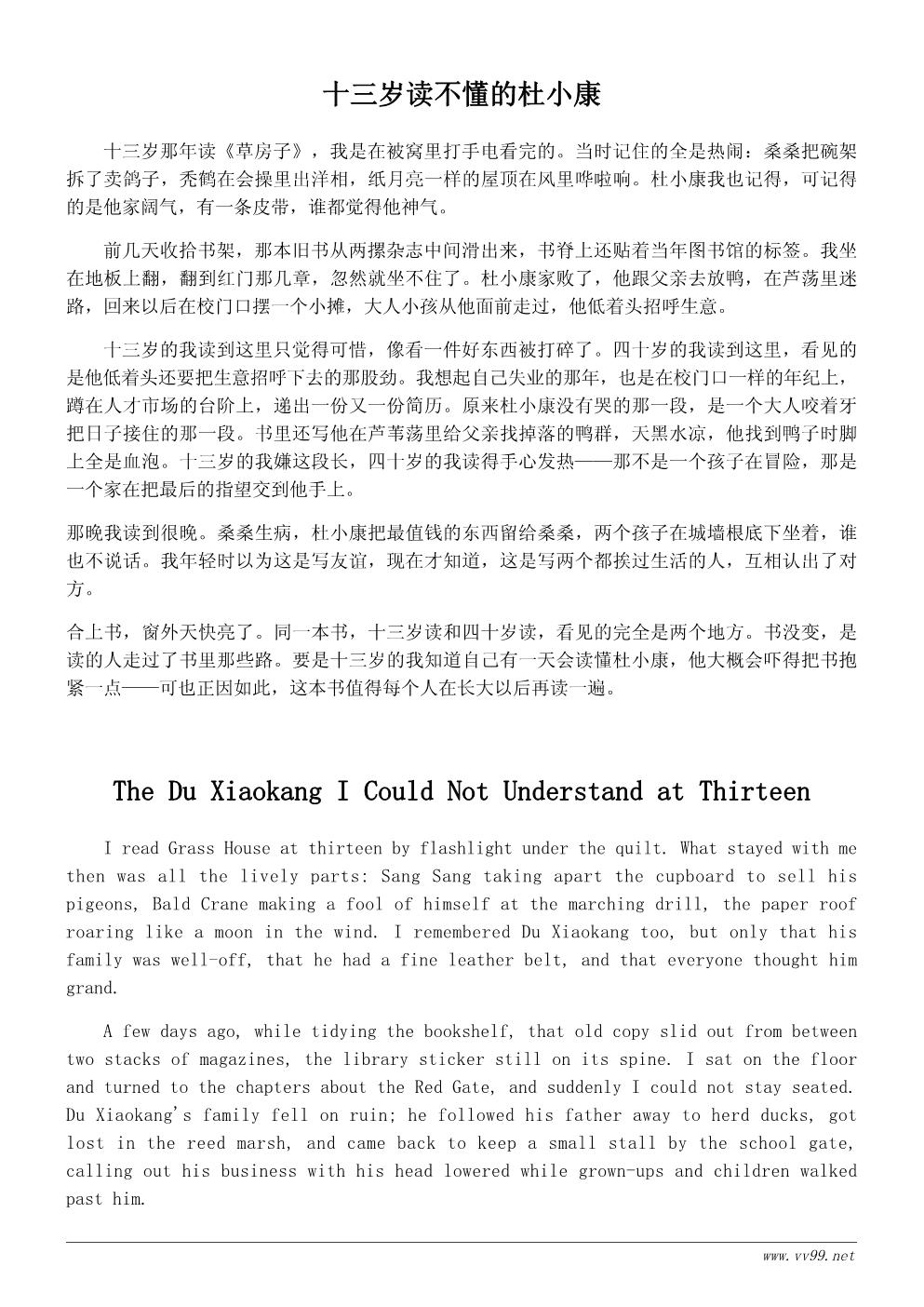
十三岁读不懂的杜小康
十三岁那年读《草房子》,我是在被窝里打手电看完的。当时记住的全是热闹:桑桑把碗架拆了卖鸽子,秃鹤在会操里出洋相,纸月亮一样的屋顶在风里哗啦响。杜小康我也记得,可记得的是他家阔气,有一条皮带,谁都觉得他神气。
前几天收拾书架,那本旧书从两摞杂志中间滑出来,书脊上还贴着当年图书馆的标签。我坐在地板上翻,翻到红门那几章,忽然就坐不住了。杜小康家败了,他跟父亲去放鸭,在芦荡里迷路,回来以后在校门口摆一个小摊,大人小孩从他面前走过,他低着头招呼生意。
十三岁的我读到这里只觉得可惜,像看一件好东西被打碎了。四十岁的我读到这里,看见的是他低着头还要把生意招呼下去的那股劲。我想起自己失业的那年,也是在校门口一样的年纪上,蹲在人才市场的台阶上,递出一份又一份简历。原来杜小康没有哭的那一段,是一个大人咬着牙把日子接住的那一段。书里还写他在芦苇荡里给父亲找掉落的鸭群,天黑水凉,他找到鸭子时脚上全是血泡。十三岁的我嫌这段长,四十岁的我读得手心发热——那不是一个孩子在冒险,那是一个家在把最后的指望交到他手上。
那晚我读到很晚。桑桑生病,杜小康把最值钱的东西留给桑桑,两个孩子在城墙根底下坐着,谁也不说话。我年轻时以为这是写友谊,现在才知道,这是写两个都挨过生活的人,互相认出了对方。
合上书,窗外天快亮了。同一本书,十三岁读和四十岁读,看见的完全是两个地方。书没变,是读的人走过了书里那些路。要是十三岁的我知道自己有一天会读懂杜小康,他大概会吓得把书抱紧一点——可也正因如此,这本书值得每个人在长大以后再读一遍。
The Du Xiaokang I Could Not Understand at Thirteen
I read Grass House at thirteen by flashlight under the quilt. What stayed with me then was all the lively parts: Sang Sang taking apart the cupboard to sell his pigeons, Bald Crane making a fool of himself at the marching drill, the paper roof roaring like a moon in the wind. I remembered Du Xiaokang too, but only that his family was well-off, that he had a fine leather belt, and that everyone thought him grand.
A few days ago, while tidying the bookshelf, that old copy slid out from between two stacks of magazines, the library sticker still on its spine. I sat on the floor and turned to the chapters about the Red Gate, and suddenly I could not stay seated. Du Xiaokang's family fell on ruin; he followed his father away to herd ducks, got lost in the reed marsh, and came back to keep a small stall by the school gate, calling out his business with his head lowered while grown-ups and children walked past him.
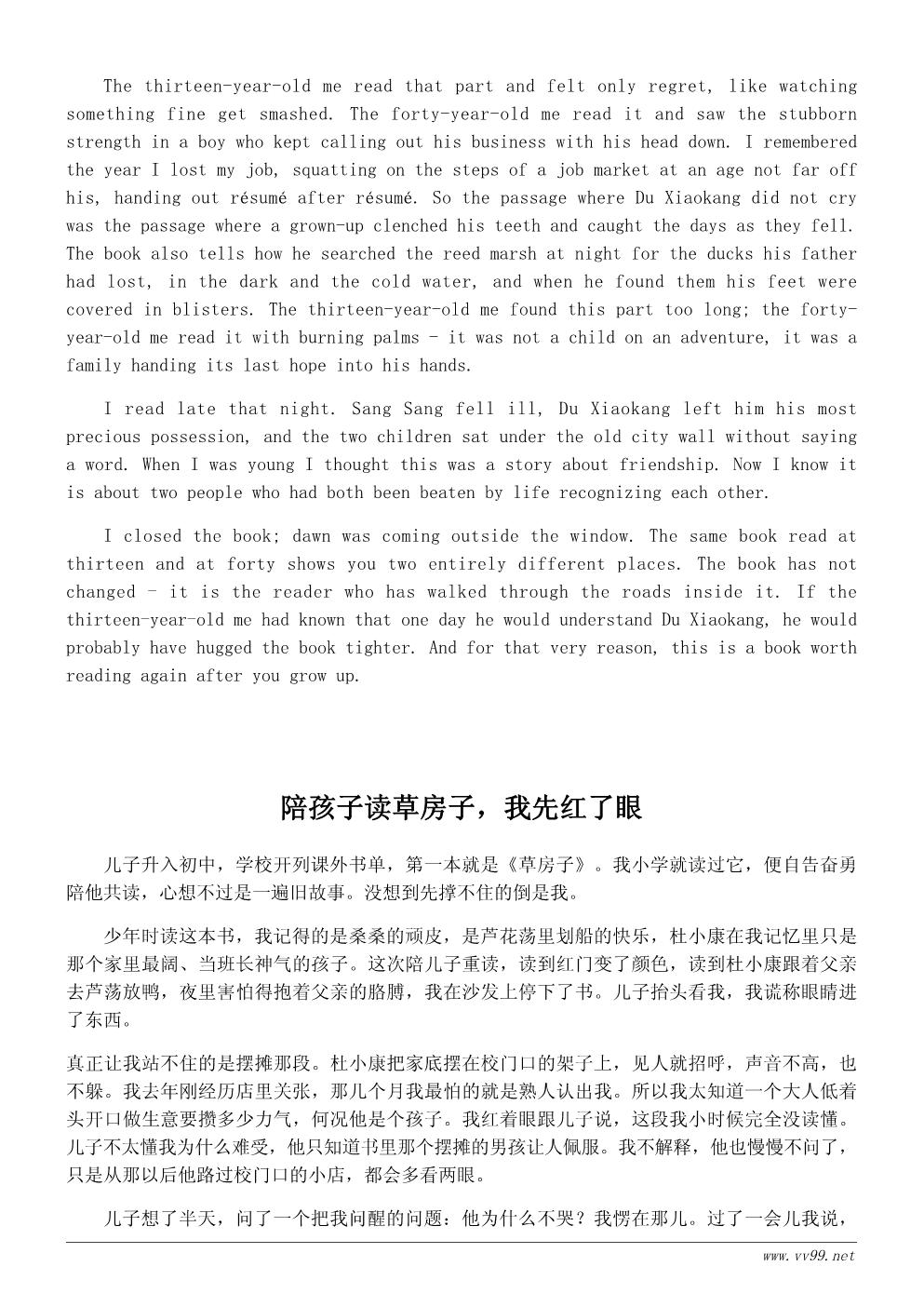
The thirteen-year-old me read that part and felt only regret, like watching something fine get smashed. The forty-year-old me read it and saw the stubborn strength in a boy who kept calling out his business with his head down. I remembered the year I lost my job, squatting on the steps of a job market at an age not far off his, handing out résumé after résumé. So the passage where Du Xiaokang did not cry was the passage where a grown-up clenched his teeth and caught the days as they fell. The book also tells how he searched the reed marsh at night for the ducks his father had lost, in the dark and the cold water, and when he found them his feet were covered in blisters. The thirteen-year-old me found this part too long; the forty-year-old me read it with burning palms - it was not a child on an adventure, it was a family handing its last hope into his hands.
I read late that night. Sang Sang fell ill, Du Xiaokang left him his most precious possession, and the two children sat under the old city wall without saying a word. When I was young I thought this was a story about friendship. Now I know it is about two people who had both been beaten by life recognizing each other.
I closed the book; dawn was coming outside the window. The same book read at thirteen and at forty shows you two entirely different places. The book has not changed - it is the reader who has walked through the roads inside it. If the thirteen-year-old me had known that one day he would understand Du Xiaokang, he would probably have hugged the book tighter. And for that very reason, this is a book worth reading again after you grow up.
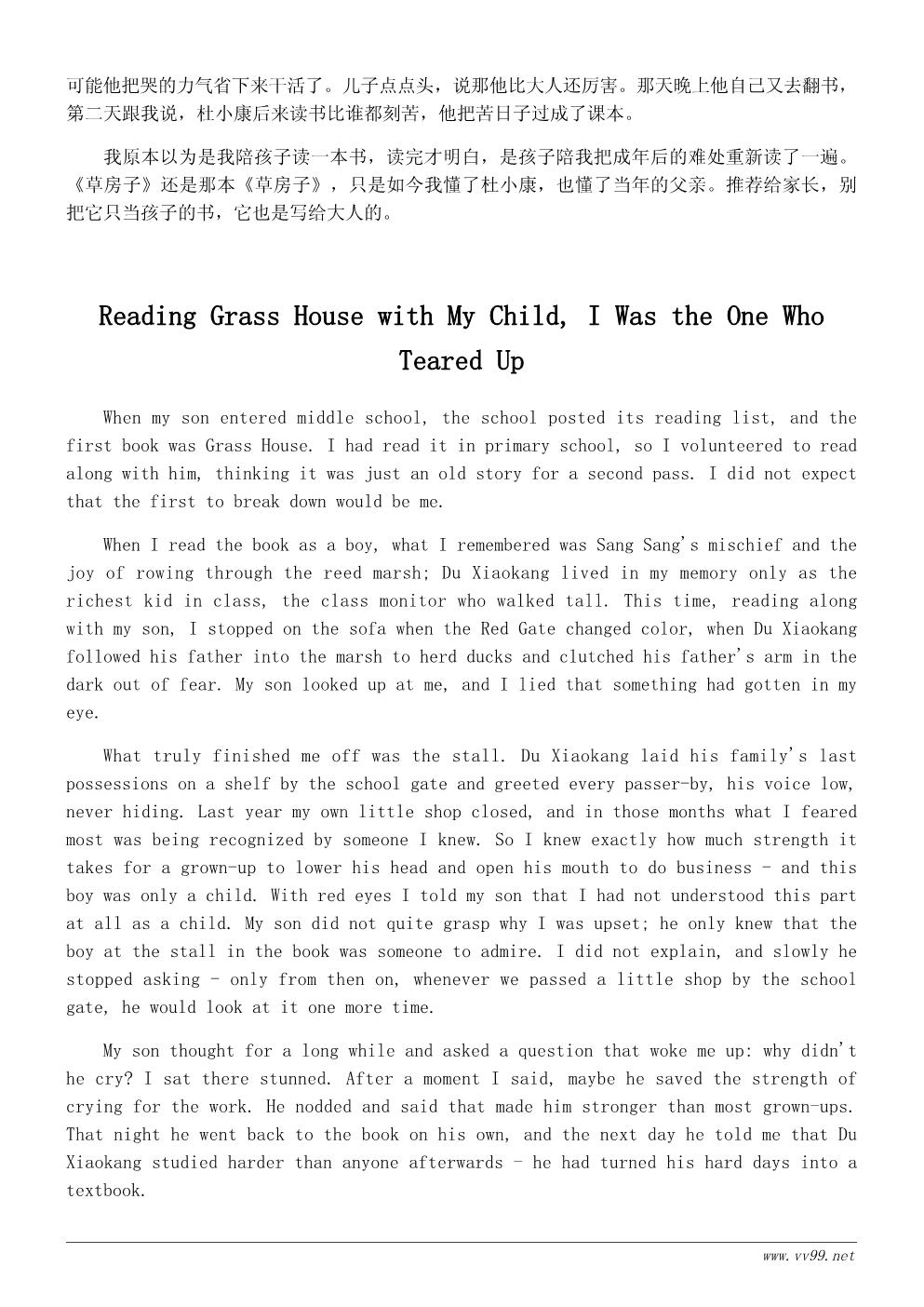
陪孩子读草房子,我先红了眼
儿子升入初中,学校开列课外书单,第一本就是《草房子》。我小学就读过它,便自告奋勇陪他共读,心想不过是一遍旧故事。没想到先撑不住的倒是我。
少年时读这本书,我记得的是桑桑的顽皮,是芦花荡里划船的快乐,杜小康在我记忆里只是那个家里最阔、当班长神气的孩子。这次陪儿子重读,读到红门变了颜色,读到杜小康跟着父亲去芦荡放鸭,夜里害怕得抱着父亲的胳膊,我在沙发上停下了书。儿子抬头看我,我谎称眼睛进了东西。
真正让我站不住的是摆摊那段。杜小康把家底摆在校门口的架子上,见人就招呼,声音不高,也不躲。我去年刚经历店里关张,那几个月我最怕的就是熟人认出我。所以我太知道一个大人低着头开口做生意要攒多少力气,何况他是个孩子。我红着眼跟儿子说,这段我小时候完全没读懂。儿子不太懂我为什么难受,他只知道书里那个摆摊的男孩让人佩服。我不解释,他也慢慢不问了,只是从那以后他路过校门口的小店,都会多看两眼。
儿子想了半天,问了一个把我问醒的问题:他为什么不哭?我愣在那儿。过了一会儿我说,可能他把哭的力气省下来干活了。儿子点点头,说那他比大人还厉害。那天晚上他自己又去翻书,第二天跟我说,杜小康后来读书比谁都刻苦,他把苦日子过成了课本。
我原本以为是我陪孩子读一本书,读完才明白,是孩子陪我把成年后的难处重新读了一遍。《草房子》还是那本《草房子》,只是如今我懂了杜小康,也懂了当年的父亲。推荐给家长,别把它只当孩子的书,它也是写给大人的。
Reading Grass House with My Child, I Was the One Who Teared Up
When my son entered middle school, the school posted its reading list, and the first book was Grass House. I had read it in primary school, so I volunteered to read along with him, thinking it was just an old story for a second pass. I did not expect that the first to break down would be me.
When I read the book as a boy, what I remembered was Sang Sang's mischief and the joy of rowing through the reed marsh; Du Xiaokang lived in my memory only as the richest kid in class, the class monitor who walked tall. This time, reading along with my son, I stopped on the sofa when the Red Gate changed color, when Du Xiaokang followed his father into the marsh to herd ducks and clutched his father's arm in the dark out of fear. My son looked up at me, and I lied that something had gotten in my eye.
What truly finished me off was the stall. Du Xiaokang laid his family's last possessions on a shelf by the school gate and greeted every passer-by, his voice low, never hiding. Last year my own little shop closed, and in those months what I feared most was being recognized by someone I knew. So I knew exactly how much strength it takes for a grown-up to lower his head and open his mouth to do business - and this boy was only a child. With red eyes I told my son that I had not understood this part at all as a child. My son did not quite grasp why I was upset; he only knew that the boy at the stall in the book was someone to admire. I did not explain, and slowly he stopped asking - only from then on, whenever we passed a little shop by the school gate, he would look at it one more time.
My son thought for a long while and asked a question that woke me up: why didn't he cry? I sat there stunned. After a moment I said, maybe he saved the strength of crying for the work. He nodded and said that made him stronger than most grown-ups. That night he went back to the book on his own, and the next day he told me that Du Xiaokang studied harder than anyone afterwards - he had turned his hard days into a textbook.
I thought I was keeping my child company through a book. Only when we finished did I understand that he had kept me company through the hard parts of being an adult. Grass House is still the same Grass House; it is just that now I understand Du Xiaokang, and I understand my own father back then. To other parents I recommend it not as a children's book alone - it is written for grown-ups too.
小提示:上面此文档内容仅展示完整文档里的部分内容, 若需要下载完整文档请 点击免费下载完整文档 。