文章内容
第一次做饭日记怎么写好:别漏了这三个场景
四年级的孩子常被布置写第一次做饭的日记,可他们写出来的往往是:我先淘米,再把米下锅,最后煮熟了,很好吃。通篇像一份流水线说明书,干巴巴的。原因很简单:孩子记录了步骤,却没有记录场景。一篇好日记来自三个具体的场景,每一个场景都能装下细节和感情。
第一个场景是淘米。别让孩子写洗好米了四个字就过关,要让他回忆:水是怎么从清变浑的?米粒滑不滑,抓不抓得住?有没有几粒撒在了地上?撒了之后他做了什么,是蹲下去一粒一粒捡,还是不好意思地假装没看见?米粒撒一地的那一刻,往往是全文最真实的时刻,写出来比十句我很紧张都有用。
第二个场景是守锅。煮粥需要耐心,而耐心天然带有戏剧性。火大了锅会溢,孩子慌忙去拧小火,手忙脚乱差点烫到手,这些都是素材。还可以让孩子写声音:水开后的咕嘟声,锅盖被顶得轻轻放气的噗噗声。五感一参与,文字自然就活了。
第三个场景是端碗。这是全文的灵魂。奶奶生病喝粥时是什么样子?眼睛眯起来了吗?先吹了几口吗?她说了什么?这碗粥怎么比我煮的还甜,一句对话,顶得上孩子自己写一整段我很骄傲。孩子的感情要借别人的语言和表情来呈现,不要自己直接喊出来。
家长在指导时,不要急着让孩子动笔。先让他真做一次饭,然后趁热聊三个问题:整个过程里最狼狈的一刻是什么?最担心发生什么?最想端给谁吃?这三个问题的答案,就是日记的骨架。按发生了什么、当时什么感受、对方说了什么的顺序写下来,四百字的日记自然会写得又丰满又动人。秘诀从来不是天赋,而是让孩子先经历场景,再落笔。
再提醒一点:日记是第一人称,要用孩子自己的口吻。孩子嘴里说出来的话,比如米粒像小鱼一样逃跑,比模仿大人的书面语好得多。家长检查时只改错别字和标点,不要替孩子改写句子。孩子的语言一旦被大人的语言替换,这篇日记就死了。
How to Write a Great First-Time Cooking Diary: Three Scenes You Cannot Miss
Sooner or later, most fourth graders are assigned a diary entry about their first time cooking something. What they usually hand in reads like an assembly line manual: first I washed the rice, then I put the pot on the stove, then it was done, and it tasted delicious. The writing is flat and forgettable, and the reason is simple: the child recorded the steps but never recorded the scenes. A memorable diary is built from three concrete scenes, and each scene is a place where details and feelings can live.
The first scene is washing the rice. Do not let your child write the four words rice is washed and then move on. Ask them to remember exactly what happened. How did the water change from clear to cloudy? Were the grains slippery and hard to hold in your palm? Did some grains jump out of the bowl and scatter across the floor? What did you do next, did you crouch down and pick them up one by one, or did you feel embarrassed and pretend you did not see them? The moment when rice ends up all over the kitchen floor is often the most honest moment in the whole diary, and writing it honestly is worth far more than ten sentences claiming that you were very nervous.
The second scene is watching the pot. Cooking porridge demands patience, and patience naturally creates dramatic tension. If the flame is too high, the pot boils over, the child rushes to turn the knob down, and maybe nearly burns a finger in the process. All of this is usable material. Encourage the child to write about sounds as well: the gurgling that starts after the water comes to a boil, the soft puffing noise when the lid lifts itself up and falls back down. When the five senses are involved, the writing comes alive on its own, without any fancy vocabulary.
The third scene is serving the bowl. This is the soul of the entire piece. What does grandma look like as she drinks the porridge? Does she narrow her eyes? Does she blow on the spoon a few times before the first sip? What does she say? A single line of dialogue, such as this porridge tastes sweeter than the one I make myself, is worth an entire paragraph of the child declaring that they felt very proud. A child's feelings should be revealed through another person's words and expressions, not shouted out directly by the writer.
When parents guide this kind of writing, resist the urge to push the child straight to the desk. Let the child cook once for real, and then talk about three questions while the memory is still hot. What was the most embarrassing moment of the whole process? What were you most afraid would happen? Who did you most want to serve the food to? The answers to these three questions form the skeleton of the diary. Write them down in the order of what happened, how it felt, and what the other person said, and a four hundred word diary entry will naturally become rich, specific and moving. The secret is never talent. The secret is letting the child live through the scenes first and write about them second.
It also helps to show children the difference between weak and strong sentences side by side. A weak sentence says the porridge was very good. A strong sentence says the porridge was so thick that the spoon could stand straight up in the middle of the bowl. A weak sentence says grandma was happy. A strong sentence says grandma pretended not to care but took a second bowl anyway. When a child sees these pairs with their own eyes, they start hearing the weak version inside their own drafts, and that self-editing ear is the most valuable habit an elementary school writer can build.
One final note. Diaries are written in the first person and should sound like a child talking. A child's own phrasing, such as the rice grains were like little fish, beats any imitation of adult written language. When parents proofread, they should fix punctuation and spelling only, and never rewrite the child's sentences for them. The moment a child's voice is replaced by an adult's voice, the diary dies, no matter how correct the grammar becomes.
一篇400字范文点评:一碗粥是怎么打动人的
范文题目叫《我给奶奶煮了一碗粥》,是一位四年级女生写的,全文四百字出头,老师用红笔圈出了三处好句子。我们一段一段拆开看,看它好在哪里。
日记开头写:奶奶感冒了,妈妈去医院拿药,厨房里静悄悄的,我决定给奶奶煮粥。点评:两句话交代了时间、人物、起因,没有一个多余的字。很多孩子写作文,铺垫三段还没进入正题,范文证明日记的开头应该像下锅一样干脆。
第二段最精彩:淘米的时候,米粒滑溜溜的,一把撒在了地上。我蹲下去捡,捡着捡着觉得又尴尬又好笑,这些米粒像小鱼一样,一碰就跑了。点评:撒米是一次真实的意外,孩子没有把它藏起来,反而写进了文章,还加了一个新鲜的比喻。真实的细节,比十个编造的完美瞬间都值钱,读者永远分得清真话和假话。
第三段写守锅:我守在灶台前面,怕它溢出来。水一咕嘟,我就把火拧小,锅盖总是噗地鼓起来,我就把它按下去,十分钟里我像个站岗的士兵。点评:站岗的比喻把耐心这种看不见的品质变成了看得见的画面,拧、按、守一连串动词用得扎实,读者像也站在那间厨房里。
结尾是奶奶喝粥:奶奶喝了一口,眼睛眯起来,说这粥怎么这么甜。我说我没放糖,可能是奶奶生病了。点评:全文的情感高点完全靠对话完成,小作者没有写我很感动,读者却已经感动了。这就是记叙文最高的手法:呈现,而不是宣告。
这篇范文告诉我们:好日记不需要大事。米粒撒地、守锅十分钟、奶奶一句话,三个场景就撑起了四百个字。孩子写的时候,先帮他找到自己的米粒、自己的守锅、自己的一句话。如果这三样都找不到,别急着动笔,先一起下厨做一次,素材自然就来了。
A Model Diary Annotated: How One Bowl of Porridge Moves the Reader
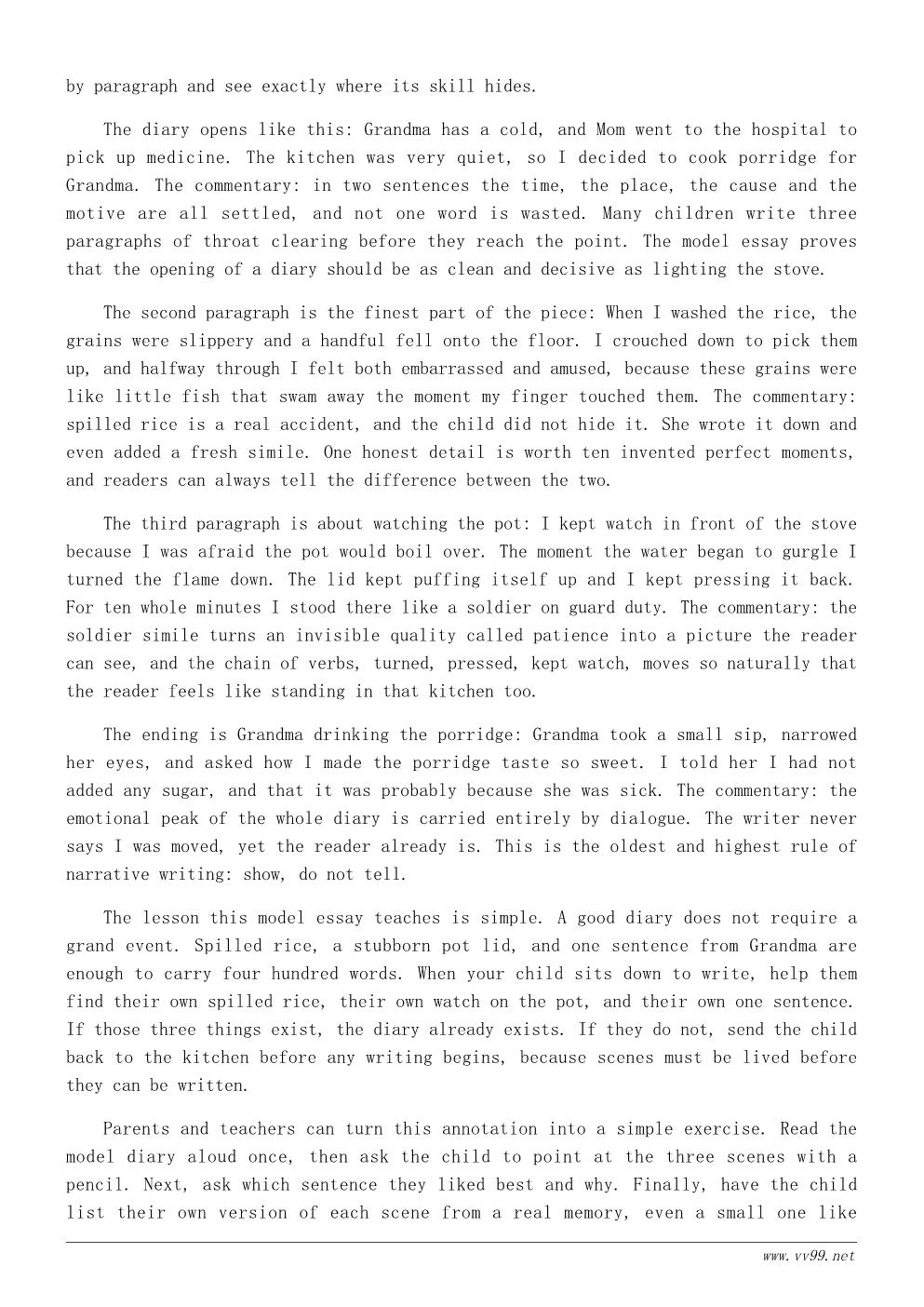
The model essay is titled I Cooked a Bowl of Porridge for Grandma, written by a fourth grade girl. It runs just over four hundred words in Chinese, and the teacher circled three sentences in red as excellent examples. Let us take it apart paragraph by paragraph and see exactly where its skill hides.
The diary opens like this: Grandma has a cold, and Mom went to the hospital to pick up medicine. The kitchen was very quiet, so I decided to cook porridge for Grandma. The commentary: in two sentences the time, the place, the cause and the motive are all settled, and not one word is wasted. Many children write three paragraphs of throat clearing before they reach the point. The model essay proves that the opening of a diary should be as clean and decisive as lighting the stove.
The second paragraph is the finest part of the piece: When I washed the rice, the grains were slippery and a handful fell onto the floor. I crouched down to pick them up, and halfway through I felt both embarrassed and amused, because these grains were like little fish that swam away the moment my finger touched them. The commentary: spilled rice is a real accident, and the child did not hide it. She wrote it down and even added a fresh simile. One honest detail is worth ten invented perfect moments, and readers can always tell the difference between the two.
The third paragraph is about watching the pot: I kept watch in front of the stove because I was afraid the pot would boil over. The moment the water began to gurgle I turned the flame down. The lid kept puffing itself up and I kept pressing it back. For ten whole minutes I stood there like a soldier on guard duty. The commentary: the soldier simile turns an invisible quality called patience into a picture the reader can see, and the chain of verbs, turned, pressed, kept watch, moves so naturally that the reader feels like standing in that kitchen too.
The ending is Grandma drinking the porridge: Grandma took a small sip, narrowed her eyes, and asked how I made the porridge taste so sweet. I told her I had not added any sugar, and that it was probably because she was sick. The commentary: the emotional peak of the whole diary is carried entirely by dialogue. The writer never says I was moved, yet the reader already is. This is the oldest and highest rule of narrative writing: show, do not tell.
The lesson this model essay teaches is simple. A good diary does not require a grand event. Spilled rice, a stubborn pot lid, and one sentence from Grandma are enough to carry four hundred words. When your child sits down to write, help them find their own spilled rice, their own watch on the pot, and their own one sentence. If those three things exist, the diary already exists. If they do not, send the child back to the kitchen before any writing begins, because scenes must be lived before they can be written.
Parents and teachers can turn this annotation into a simple exercise. Read the model diary aloud once, then ask the child to point at the three scenes with a pencil. Next, ask which sentence they liked best and why. Finally, have the child list their own version of each scene from a real memory, even a small one like burning toast or dropping an egg. Once the child sees that the model was built from ordinary events, the fear of writing disappears, and the next draft usually arrives with its own spilled rice and its own grandmother sentence already waiting inside it.
小提示:上面此文档内容仅展示完整文档里的部分内容, 若需要下载完整文档请 点击免费下载完整文档 。