文章内容
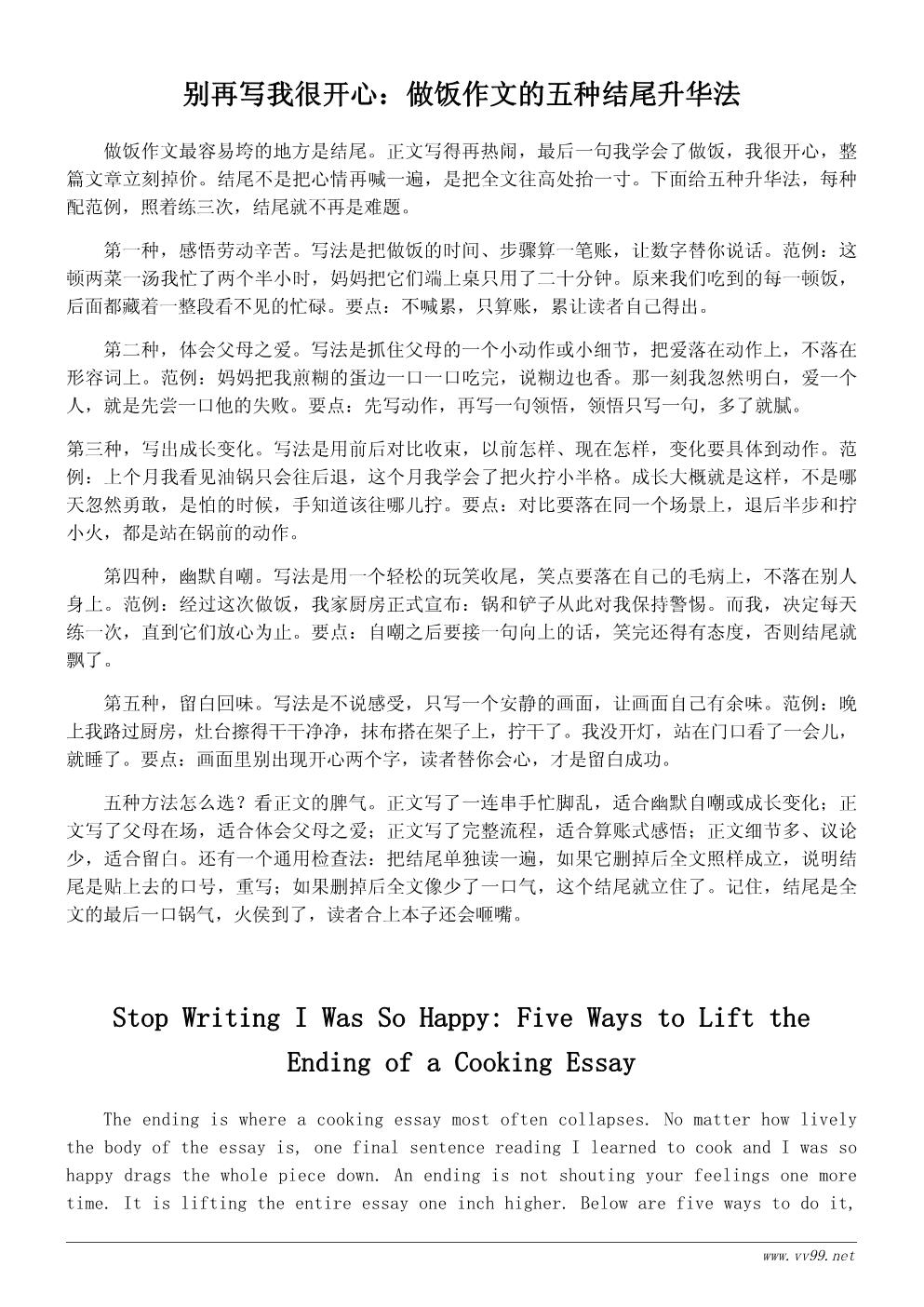
别再写我很开心:做饭作文的五种结尾升华法
做饭作文最容易垮的地方是结尾。正文写得再热闹,最后一句我学会了做饭,我很开心,整篇文章立刻掉价。结尾不是把心情再喊一遍,是把全文往高处抬一寸。下面给五种升华法,每种配范例,照着练三次,结尾就不再是难题。
第一种,感悟劳动辛苦。写法是把做饭的时间、步骤算一笔账,让数字替你说话。范例:这顿两菜一汤我忙了两个半小时,妈妈把它们端上桌只用了二十分钟。原来我们吃到的每一顿饭,后面都藏着一整段看不见的忙碌。要点:不喊累,只算账,累让读者自己得出。
第二种,体会父母之爱。写法是抓住父母的一个小动作或小细节,把爱落在动作上,不落在形容词上。范例:妈妈把我煎糊的蛋边一口一口吃完,说糊边也香。那一刻我忽然明白,爱一个人,就是先尝一口他的失败。要点:先写动作,再写一句领悟,领悟只写一句,多了就腻。
第三种,写出成长变化。写法是用前后对比收束,以前怎样、现在怎样,变化要具体到动作。范例:上个月我看见油锅只会往后退,这个月我学会了把火拧小半格。成长大概就是这样,不是哪天忽然勇敢,是怕的时候,手知道该往哪儿拧。要点:对比要落在同一个场景上,退后半步和拧小火,都是站在锅前的动作。
第四种,幽默自嘲。写法是用一个轻松的玩笑收尾,笑点要落在自己的毛病上,不落在别人身上。范例:经过这次做饭,我家厨房正式宣布:锅和铲子从此对我保持警惕。而我,决定每天练一次,直到它们放心为止。要点:自嘲之后要接一句向上的话,笑完还得有态度,否则结尾就飘了。
第五种,留白回味。写法是不说感受,只写一个安静的画面,让画面自己有余味。范例:晚上我路过厨房,灶台擦得干干净净,抹布搭在架子上,拧干了。我没开灯,站在门口看了一会儿,就睡了。要点:画面里别出现开心两个字,读者替你会心,才是留白成功。
五种方法怎么选?看正文的脾气。正文写了一连串手忙脚乱,适合幽默自嘲或成长变化;正文写了父母在场,适合体会父母之爱;正文写了完整流程,适合算账式感悟;正文细节多、议论少,适合留白。还有一个通用检查法:把结尾单独读一遍,如果它删掉后全文照样成立,说明结尾是贴上去的口号,重写;如果删掉后全文像少了一口气,这个结尾就立住了。记住,结尾是全文的最后一口锅气,火侯到了,读者合上本子还会咂嘴。
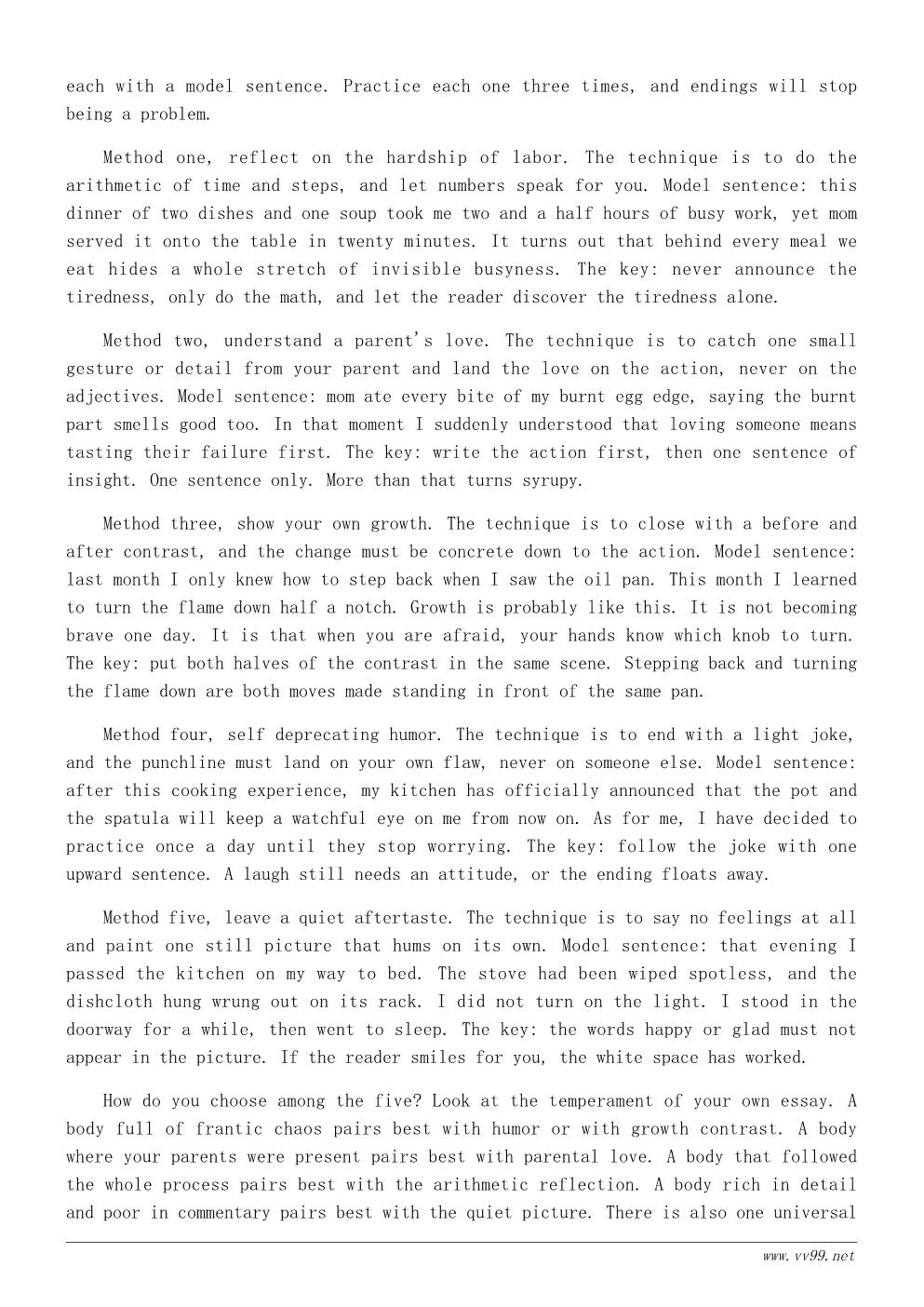
Stop Writing I Was So Happy: Five Ways to Lift the Ending of a Cooking Essay
The ending is where a cooking essay most often collapses. No matter how lively the body of the essay is, one final sentence reading I learned to cook and I was so happy drags the whole piece down. An ending is not shouting your feelings one more time. It is lifting the entire essay one inch higher. Below are five ways to do it, each with a model sentence. Practice each one three times, and endings will stop being a problem.
Method one, reflect on the hardship of labor. The technique is to do the arithmetic of time and steps, and let numbers speak for you. Model sentence: this dinner of two dishes and one soup took me two and a half hours of busy work, yet mom served it onto the table in twenty minutes. It turns out that behind every meal we eat hides a whole stretch of invisible busyness. The key: never announce the tiredness, only do the math, and let the reader discover the tiredness alone.
Method two, understand a parent's love. The technique is to catch one small gesture or detail from your parent and land the love on the action, never on the adjectives. Model sentence: mom ate every bite of my burnt egg edge, saying the burnt part smells good too. In that moment I suddenly understood that loving someone means tasting their failure first. The key: write the action first, then one sentence of insight. One sentence only. More than that turns syrupy.
Method three, show your own growth. The technique is to close with a before and after contrast, and the change must be concrete down to the action. Model sentence: last month I only knew how to step back when I saw the oil pan. This month I learned to turn the flame down half a notch. Growth is probably like this. It is not becoming brave one day. It is that when you are afraid, your hands know which knob to turn. The key: put both halves of the contrast in the same scene. Stepping back and turning the flame down are both moves made standing in front of the same pan.
Method four, self deprecating humor. The technique is to end with a light joke, and the punchline must land on your own flaw, never on someone else. Model sentence: after this cooking experience, my kitchen has officially announced that the pot and the spatula will keep a watchful eye on me from now on. As for me, I have decided to practice once a day until they stop worrying. The key: follow the joke with one upward sentence. A laugh still needs an attitude, or the ending floats away.
Method five, leave a quiet aftertaste. The technique is to say no feelings at all and paint one still picture that hums on its own. Model sentence: that evening I passed the kitchen on my way to bed. The stove had been wiped spotless, and the dishcloth hung wrung out on its rack. I did not turn on the light. I stood in the doorway for a while, then went to sleep. The key: the words happy or glad must not appear in the picture. If the reader smiles for you, the white space has worked.
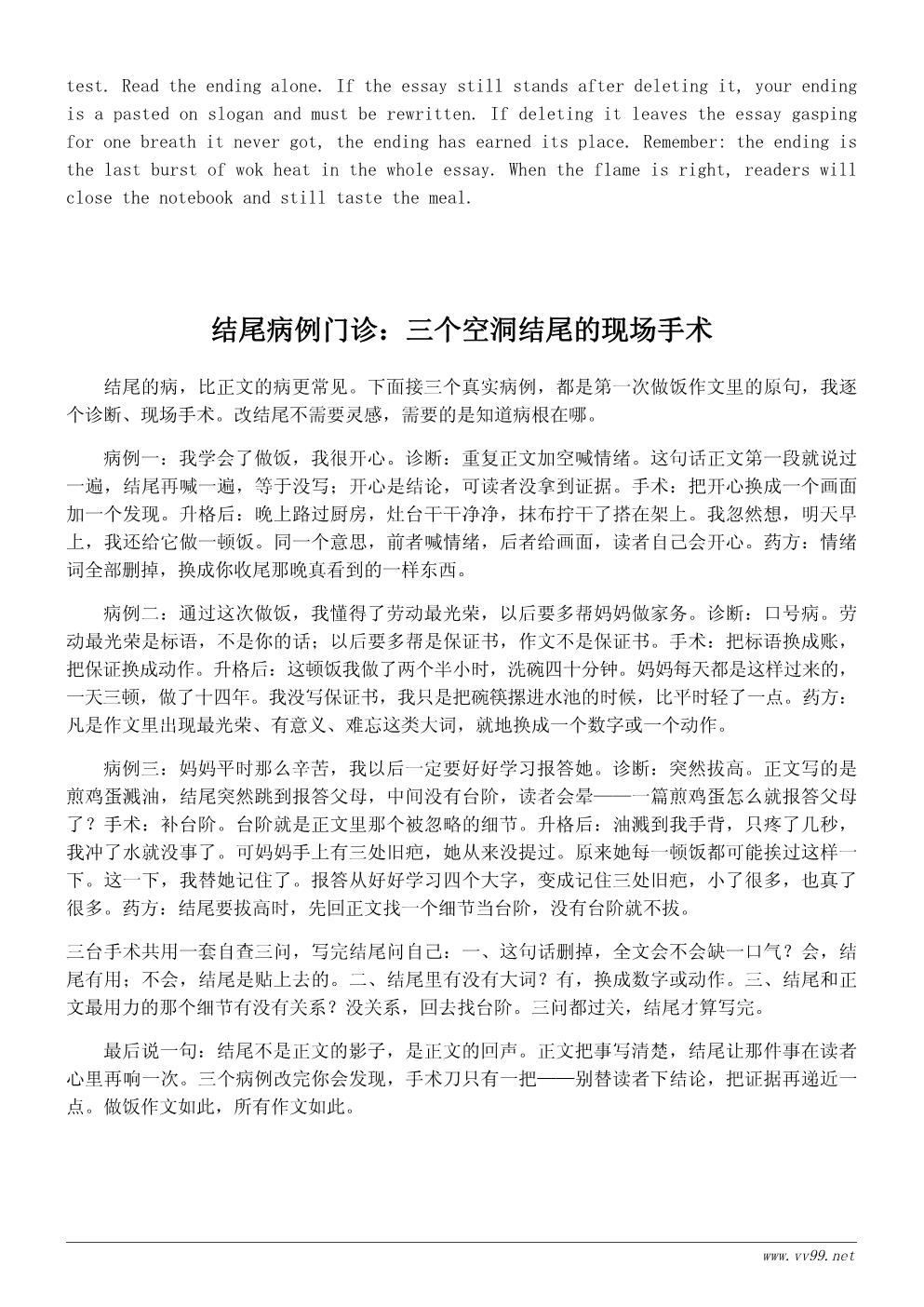
How do you choose among the five? Look at the temperament of your own essay. A body full of frantic chaos pairs best with humor or with growth contrast. A body where your parents were present pairs best with parental love. A body that followed the whole process pairs best with the arithmetic reflection. A body rich in detail and poor in commentary pairs best with the quiet picture. There is also one universal test. Read the ending alone. If the essay still stands after deleting it, your ending is a pasted on slogan and must be rewritten. If deleting it leaves the essay gasping for one breath it never got, the ending has earned its place. Remember: the ending is the last burst of wok heat in the whole essay. When the flame is right, readers will close the notebook and still taste the meal.
结尾病例门诊:三个空洞结尾的现场手术
结尾的病,比正文的病更常见。下面接三个真实病例,都是第一次做饭作文里的原句,我逐个诊断、现场手术。改结尾不需要灵感,需要的是知道病根在哪。
病例一:我学会了做饭,我很开心。诊断:重复正文加空喊情绪。这句话正文第一段就说过一遍,结尾再喊一遍,等于没写;开心是结论,可读者没拿到证据。手术:把开心换成一个画面加一个发现。升格后:晚上路过厨房,灶台干干净净,抹布拧干了搭在架上。我忽然想,明天早上,我还给它做一顿饭。同一个意思,前者喊情绪,后者给画面,读者自己会开心。药方:情绪词全部删掉,换成你收尾那晚真看到的一样东西。
病例二:通过这次做饭,我懂得了劳动最光荣,以后要多帮妈妈做家务。诊断:口号病。劳动最光荣是标语,不是你的话;以后要多帮是保证书,作文不是保证书。手术:把标语换成账,把保证换成动作。升格后:这顿饭我做了两个半小时,洗碗四十分钟。妈妈每天都是这样过来的,一天三顿,做了十四年。我没写保证书,我只是把碗筷摞进水池的时候,比平时轻了一点。药方:凡是作文里出现最光荣、有意义、难忘这类大词,就地换成一个数字或一个动作。
病例三:妈妈平时那么辛苦,我以后一定要好好学习报答她。诊断:突然拔高。正文写的是煎鸡蛋溅油,结尾突然跳到报答父母,中间没有台阶,读者会晕——一篇煎鸡蛋怎么就报答父母了?手术:补台阶。台阶就是正文里那个被忽略的细节。升格后:油溅到我手背,只疼了几秒,我冲了水就没事了。可妈妈手上有三处旧疤,她从来没提过。原来她每一顿饭都可能挨过这样一下。这一下,我替她记住了。报答从好好学习四个大字,变成记住三处旧疤,小了很多,也真了很多。药方:结尾要拔高时,先回正文找一个细节当台阶,没有台阶就不拔。
三台手术共用一套自查三问,写完结尾问自己:一、这句话删掉,全文会不会缺一口气?会,结尾有用;不会,结尾是贴上去的。二、结尾里有没有大词?有,换成数字或动作。三、结尾和正文最用力的那个细节有没有关系?没关系,回去找台阶。三问都过关,结尾才算写完。
最后说一句:结尾不是正文的影子,是正文的回声。正文把事写清楚,结尾让那件事在读者心里再响一次。三个病例改完你会发现,手术刀只有一把——别替读者下结论,把证据再递近一点。做饭作文如此,所有作文如此。
The Ending Clinic: Live Surgery on Three Hollow Essay Endings
Hollow endings are more common than hollow bodies. Below are three real cases, all original sentences from first time cooking essays. I will diagnose each one and perform live surgery. Fixing an ending does not require inspiration. It requires knowing where the disease sits.
Case one: I learned to cook and I was very happy. Diagnosis: repetition plus empty cheering. The essay already said this in its first paragraph, so the ending repeats what is already known, and happy is a verdict the reader never received evidence for. Surgery: replace the feeling with one picture plus one discovery. Upgraded version: that evening I passed the kitchen on my way to bed. The stove was spotless, and the dishcloth hung wrung out on its rack. I suddenly thought, tomorrow morning I will cook for it again. Same meaning, but the first version shouts a feeling while the second hands over a picture, and the reader becomes happy on their own. Prescription: delete every emotion word and replace it with one real thing you saw on the night you finished.
Case two: through this cooking experience I understood that labor is the most glorious thing, and from now on I will help mom with housework more. Diagnosis: slogan disease. Labor is glorious is a banner, not your voice. From now on I will help more is a pledge letter, and an essay is not a pledge letter. Surgery: trade the banner for arithmetic and the pledge for one action. Upgraded version: this meal took me two and a half hours to cook and forty minutes of dishwashing. This is how mom lives every single day, three meals a day, for fourteen years. I wrote no pledge letter. I simply stacked the bowls into the sink a little more gently than usual. Prescription: whenever a grand word like glorious, meaningful, or unforgettable appears in your essay, replace it on the spot with one number or one action.
Case three: mom works so hard every day, so I must study hard in the future to repay her. Diagnosis: sudden elevation. The body of the essay is about oil splashing while frying an egg, yet the ending jumps straight to repaying your parents with no staircase in between, and readers get dizzy. How did an essay about fried eggs suddenly reach repaying parents? Surgery: build the staircase, and the staircase is a detail the body already had but ignored. Upgraded version: the oil splash stung my hand for only a few seconds. I rinsed it under water and it was fine. But mom's hands carry three old scars, and she has never once mentioned them. It turns out every meal she cooked might have hidden a moment like mine. This one, I will remember for her. Repaying changed from the four big words study hard into remembering three old scars. It became much smaller, and much more real. Prescription: whenever an ending tries to rise, first find one detail in your own body text to serve as the staircase. No staircase, no elevation.
All three surgeries share one self-check of three questions. Ask them after writing any ending. One, if I delete this sentence, will the essay gasp for a missing breath? If yes, the ending works. If no, it is pasted on. Two, does the ending contain any grand words? If yes, trade them for numbers or actions. Three, is the ending connected to the hardest working detail in your body text? If not, go back and find the staircase. Only when all three questions pass has the ending truly been written.
One final word. An ending is not the shadow of the body. It is its echo. The body makes the event clear; the ending makes that event ring once more inside the reader. After these three operations you will notice there is only one scalpel in the whole clinic. Do not hand the reader a conclusion. Hand the evidence one inch closer. This is true for cooking essays, and it is true for every essay there is.
小提示:上面此文档内容仅展示完整文档里的部分内容, 若需要下载完整文档请 点击免费下载完整文档 。