文章内容
范文:读《第一次做饭》有感,厨房里的感恩课
最近读了几篇写第一次做饭的文章,其中一篇的主人公给我留下的印象最深。文章里的男孩第一次独自做午饭,打开冰箱半天选不定菜,炒青菜时火开太大,油点子蹦到手背上,他往后跳了半步,又舍不得那锅菜,硬着头皮翻炒。饭是做好了,灶台上却一片狼藉,他洗了四十分钟的碗才收拾干净。读到这里我笑了,笑完又觉得脸上发烫,因为我想起了自己。
我在家从来不进厨房。不是不能进,是从来没有那个念头。饭点到了,桌上自然有饭;杯子空了,自然有人添。我以为日子本来就是这样运转的,像电灯一按就亮,像水一拧就来。文章里那个手忙脚乱的男孩,像一面镜子,照出了我这些年的理所当然:我吃的每一顿饭,背后都有一个人,在油烟里站了很久。
上周末,我第一次走进厨房给妈妈打下手。任务是择菜和递东西。看起来简单,做起来全是学问:芹菜要一根一根撕掉老筋,洗菜的水不能开太大,溅出来会湿一地。妈妈一直站在灶台前,手背上有几个油点烫出的小疤,她说没事,习惯了。那一刻我心里像被什么东西轻轻碰了一下。原来习惯了三个字后面,是十几年的一日三餐。
这篇文章让我懂得,感恩不是说出来的一句话,是看懂别人替你付出的时间。一碗面十分钟,一顿晚饭四十分钟,一年三百多天,把这些时间加起来,就是父母站在厨房里的年月。我以前从不算这笔账,现在我算了。
读完文章那天晚上,我跟妈妈约好,以后每周六的早饭归我做,哪怕只是一碗面、一个煎蛋。感恩落到行动上,才叫感恩;劳动落到手上,才懂得那一碗饭有多重。这就是这篇文章给我上的最重要的一课。
Model Reading Response: After Reading My First Time Cooking, a Lesson in Gratitude Learned in the Kitchen
Recently I read several essays about cooking for the first time, and the boy in one of them left the deepest impression on me. In that essay, the boy handles lunch entirely alone for the first time. He stands in front of the refrigerator for a long time unable to choose his ingredients. When he stir fries the greens, the flame is far too high, hot oil jumps onto the back of his hand, he leaps half a step backward, then feels too sorry for the vegetables to give up and dives back in to stir. The meal is finished in the end, but the stove is a disaster area, and it takes him forty minutes of washing dishes to make the kitchen presentable again. I laughed while reading this passage, and after the laugh my face felt hot, because I thought of myself.
I never go into the kitchen at home. Not because I am not allowed, but because the idea has simply never occurred to me. When mealtime arrives, food appears on the table. When my cup is empty, someone refills it. I used to believe life simply worked this way, like a lamp that glows when the switch is pressed, like water that flows when the tap is turned. The frantic boy in the essay is a mirror, and the mirror shows all my years of taking things for granted. Behind every meal I have ever eaten stands a person who spent long minutes, long hours, breathing in cooking smoke.
Last weekend, for the first time, I walked into the kitchen to help my mother. My job was to trim the vegetables and pass things along. It looked simple, but it was full of hidden knowledge: the tough strings must be pulled off each celery stalk one by one, and the faucet must not be opened too wide, or the water splashes across the floor. My mother kept standing at the stove, and on the back of her hand I noticed several small scars left by oil splashes over the years. She said they were nothing, just a habit. In that moment something inside me was touched very gently. Behind the three words just a habit, I realized, stand more than ten years of three meals a day.
This essay taught me that gratitude is not a sentence you say. Gratitude is understanding the time someone else spent for you. A bowl of noodles takes ten minutes. A dinner takes forty. Multiply those minutes by more than three hundred days a year, and the total is the years your parents have stood in the kitchen. I had never done that arithmetic before. Now I have.
On the evening I finished reading, I made a deal with my mother. From now on, Saturday breakfast belongs to me, even if it is only a bowl of noodles or a fried egg. Gratitude becomes real only when it lands in action, and only when labor lands on your own hands do you understand how heavy one bowl of rice truly is. That is the most important lesson this essay taught me, and it is a lesson I now intend to keep practicing every Saturday morning, one small breakfast at a time.
Some readers may wonder why a simple essay about cooking could move a person so much. The answer is honest detail. The writer did not hide the burnt edges, the jumping oil, or the forty minutes at the sink. Honest details make readers examine their own lives, and that examination is where all good reading responses begin. If a book or essay makes you look at your own kitchen differently, it has already done more than most books manage in a whole school year.
读后感怎么写:三步搭出简述、联系、行动
读后感最常见的毛病,是复述原文占了四分之三,自己的话只剩一句我很感动。老师看了摇头,孩子自己也委屈:我真的有感触啊。问题出在结构。一篇合格的读后感,应该像做菜一样分三步:简述、联系、行动。
第一步,简述,占全文四分之一就够了。简述不是复述全文,是挑一个画面。比如写第一次做饭的文章,就挑主人公手忙脚乱那一幕:选菜选不定、油点蹦到手背、往后跳了半步又扑回去。两三句话,把画面立住,后面才有话可接。简述的窍门是挑带动作的画面,别挑讲道理的句子,画面才能勾出自己的故事。
第二步,联系自身,占全文一半,这是读后感的心脏。联系不是写我也做过,而是写我没做过什么、我以前怎么以为。比如读了不进厨房的故事,写自己从不进厨房:饭点到了桌上自然有饭,我以为日子本来就这样运转。这个我以前怎么以为,就是文章和自己的接口。接口接得越实,后面的感悟越不空洞。
第三步,行动,占结尾一小段。感恩主题的文章,结尾必须落到一件具体的小事上:以后每周六早饭归我做。注意要具体,帮妈妈做家务这种句子等于没写,每周六、早饭、我做的,三个限定词齐全,行动才立得住。
常见毛病列三条。一、开头大帽子:读了这篇文章,我受到了深刻的教育。删掉,直接从画面进。二、感悟喊口号:我们要感恩父母。改成心里被碰了一下的具体感觉,比如看见妈妈手背上的油疤。三、行动假大空:我以后要多体谅父母。改成一件本周就能做的小事。
最后说字数分配。四百到五百字的读后感,简述一百字,联系二百二十字,行动八十到一百字,中间用一两句感悟焊接。孩子写完自己数段落比例,一眼就能看出结构对不对。结构对了,真情实感才有地方住。
How to Write a Reading Response: Build Summary, Connection, and Action in Three Steps
The most common flaw in a reading response essay is that retelling the original article eats up three quarters of the space, leaving only one sentence of the writer's own voice: I was very moved. Teachers shake their heads at such essays, and the child feels wronged, because the feeling was real. The problem is structural. A proper reading response should be built in three steps, like cooking a meal: summarize, connect, and act.
Step one, the summary, should take up no more than a quarter of the essay. A summary is not a retelling of the whole article. It is the choice of one single scene. For an article about cooking for the first time, choose the frantic moment: the boy cannot decide what to cook, hot oil jumps onto the back of his hand, he leaps half a step backward and then dives back in. Two or three sentences are enough to set the scene, and only then does the writer have something to attach their own story to. The trick is to choose a scene built from actions rather than a sentence built from moralizing, because scenes can hook your own story while slogans cannot hook anything.
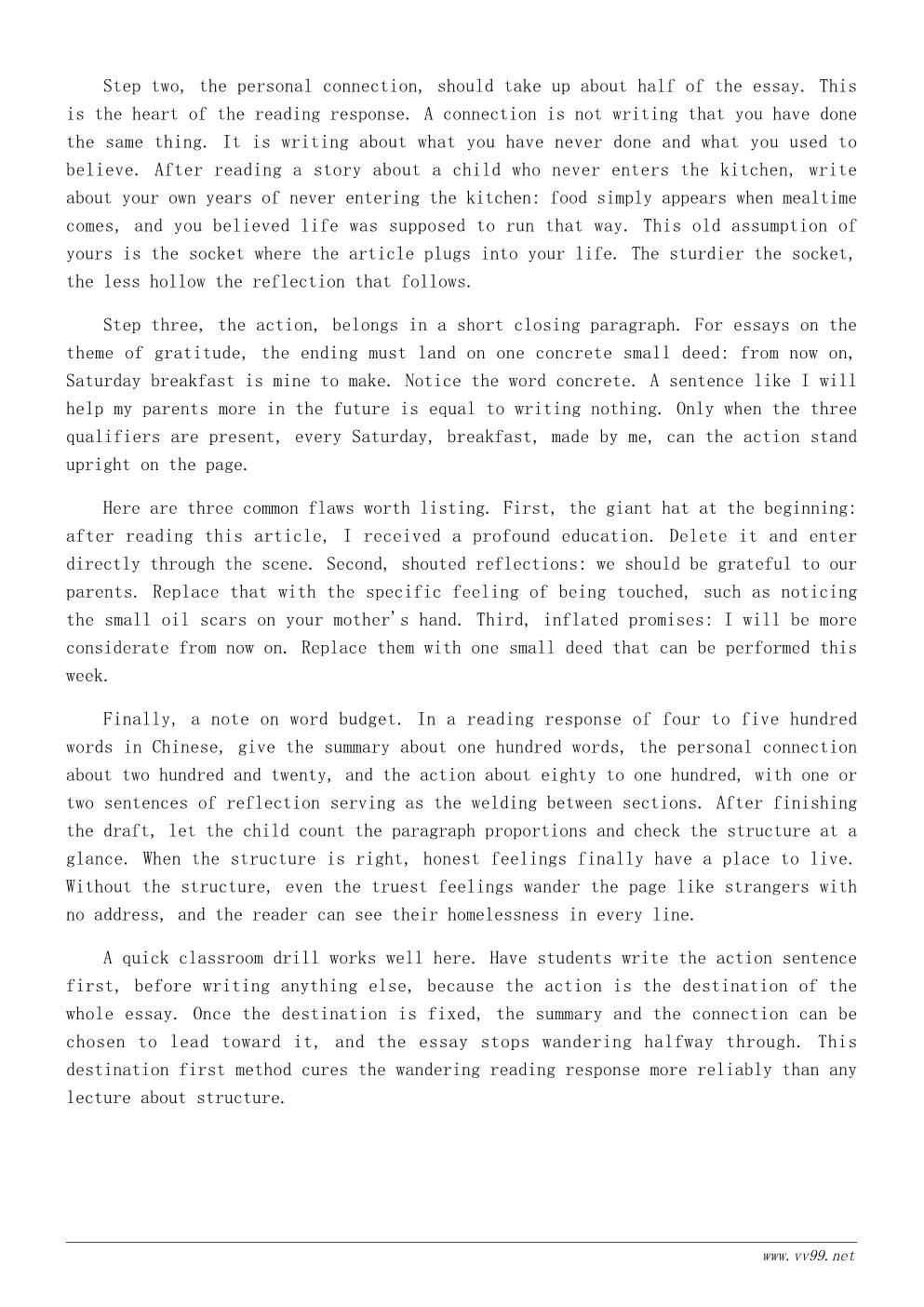
Step two, the personal connection, should take up about half of the essay. This is the heart of the reading response. A connection is not writing that you have done the same thing. It is writing about what you have never done and what you used to believe. After reading a story about a child who never enters the kitchen, write about your own years of never entering the kitchen: food simply appears when mealtime comes, and you believed life was supposed to run that way. This old assumption of yours is the socket where the article plugs into your life. The sturdier the socket, the less hollow the reflection that follows.
Step three, the action, belongs in a short closing paragraph. For essays on the theme of gratitude, the ending must land on one concrete small deed: from now on, Saturday breakfast is mine to make. Notice the word concrete. A sentence like I will help my parents more in the future is equal to writing nothing. Only when the three qualifiers are present, every Saturday, breakfast, made by me, can the action stand upright on the page.
Here are three common flaws worth listing. First, the giant hat at the beginning: after reading this article, I received a profound education. Delete it and enter directly through the scene. Second, shouted reflections: we should be grateful to our parents. Replace that with the specific feeling of being touched, such as noticing the small oil scars on your mother's hand. Third, inflated promises: I will be more considerate from now on. Replace them with one small deed that can be performed this week.
Finally, a note on word budget. In a reading response of four to five hundred words in Chinese, give the summary about one hundred words, the personal connection about two hundred and twenty, and the action about eighty to one hundred, with one or two sentences of reflection serving as the welding between sections. After finishing the draft, let the child count the paragraph proportions and check the structure at a glance. When the structure is right, honest feelings finally have a place to live. Without the structure, even the truest feelings wander the page like strangers with no address, and the reader can see their homelessness in every line.
A quick classroom drill works well here. Have students write the action sentence first, before writing anything else, because the action is the destination of the whole essay. Once the destination is fixed, the summary and the connection can be chosen to lead toward it, and the essay stops wandering halfway through. This destination first method cures the wandering reading response more reliably than any lecture about structure.
小提示:上面此文档内容仅展示完整文档里的部分内容, 若需要下载完整文档请 点击免费下载完整文档 。