文章内容
观察日记怎么写:用三次煎蛋搭出对比结构
观察日记和普通日记不一样。普通日记记今天发生了什么,观察日记记一个东西是怎么一步步变化的。煎一颗鸡蛋,就能写出一篇标准的观察日记,因为它天然带着三个阶段:第一次煎糊,第二次摸到火候,第三次成功。三个阶段往下一摆,对比结构就有了,文章不会写成流水账。
先说观察顺序。观察日记的顺序就是眼睛移动的顺序:先看锅,再看油,再看鸡蛋下锅那一瞬间,然后一直盯着边缘和中心的变化。糊掉的那次,要写黑边是怎么从一圈灰变成一圈黑的,白烟是什么时候冒起来的。顺序对了,读者就跟着你的眼睛走,不会乱。
再说变化描写。观察日记的命根子是变化两个字。写变化要用具体的刻度,不能用大概。比如油温,别写油热了,要写油面开始发抖、筷子头伸进去周围冒小泡。比如鸡蛋下锅,别写鸡蛋熟了,要写蛋白先从透明变成白色,边缘翘起硬壳一样的边,中心的蛋黄还鼓着,晃一下会轻轻颤。刻度越细,观察越像样。
三次对比怎么搭?第一次写惨败:火太大,蛋底成了黑炭,蛋黄还是生的,妈妈尝了一口皱起脸。第二次写半懂:火调小了,蛋底金黄,可蛋白还是夹生,因为盖了锅盖又忘了翻面。第三次写成功:中小火,油热下锅,蛋白凝固到八成时关火,用余温焖一分钟,边缘脆、中心嫩。三次各写一段,每段末尾加一句当时的想法,对比就立起来了。
观察日记还要写工具和数据。几点几分开的火,火苗是大是小,数了多少秒翻的面,这些数字是观察日记的骨架。孩子写的时候容易只写感受不写数据,家长提醒一句:拿手机记一下时间,或者心里数秒。有了数据,第二次和第一次的差别才说得清,耐心也就不是空话了。
最后说反思放哪里。观察日记的反思不放在结尾喊口号,放在每次失败的当口。糊了之后想明白火太大,夹生之后想明白要翻面,这些一句两句的想法,比结尾写做任何事都要耐心有力得多。结尾只需要一句:第三次煎蛋端上桌,我数了一下,从开火到关火,一共三分四十秒。数字收尾,干净,也点题。
How to Write an Observation Diary: Build a Comparison Structure With Three Fried Eggs
An observation diary is not the same as an ordinary diary. An ordinary diary records what happened today. An observation diary records how one single thing changed, step by step, while you watched. Frying an egg can produce a textbook observation diary, because the task naturally contains three stages: the first egg burns, the second egg teaches you about heat, and the third egg finally succeeds. Lay those three stages down in order and the comparison structure appears by itself, and the entry cannot possibly read like a boring list of steps.
Start with the order of observation. The order of an observation diary is simply the order in which your eyes travel. Look at the pan first, then the oil, then the exact second the egg slides in, and after that keep watching the edges and the center. When describing the burnt attempt, write how the rim changed from a pale ring to a grey ring to a black ring, and note the moment the white smoke began to rise. If the order is right, the reader walks behind your eyes the whole time and never gets lost.
Next comes the description of change. The word change is the lifeline of this genre. Describe change with concrete measuring points, never with vague words like a little or kind of. For the oil, do not write that the oil was hot. Write that the surface of the oil began to tremble, and that a few tiny bubbles gathered around the tip of a chopstick when you dipped it in. For the egg, do not write that the egg was cooked. Write that the white turned from clear to milky first, that its edges lifted into a hard lace-like crust, and that the yolk in the middle stayed round and round and trembled softly when the pan was shaken. The finer the measuring points, the more professional the observation looks.
How should the three attempts be arranged? The first attempt is a disaster: the flame was too high, the bottom of the egg became a black coin while the yolk stayed raw, and mom took one bite and made a face. The second attempt is half a victory: the flame was turned down, the bottom turned golden, but the white stayed undercooked because the lid was on and the egg was never flipped. The third attempt is the success: medium low heat, egg into hot oil, flame off when the white was eighty percent set, and one final minute of resting in the pan so the edge stayed crisp while the center stayed tender. Write one paragraph for each attempt, and end every paragraph with one sentence of what you thought at that moment. The comparison stands up on its own.
An observation diary also needs tools and numbers. What time the flame was lit, whether the flame was big or small, how many seconds you counted before flipping, these numbers are the skeleton of the genre. Children tend to write only feelings and forget data, so parents should suggest one small trick: time the egg on a phone, or count seconds silently in your head. With numbers in hand, the difference between the second attempt and the first can finally be explained, and patience stops being an empty word.
Finally, decide where the reflection goes. In an observation diary, reflection should not be shouted as a slogan at the end. It should appear at the exact moment of each failure. After the burnt egg, one sentence: the flame was the enemy. After the undercooked egg, one sentence: heat must be turned over, not only turned down. These one line thoughts are far stronger than a closing paragraph claiming that everything requires patience. The ending only needs one sentence: I served the third egg at the table and counted the time from lighting the flame to turning it off, three minutes and forty seconds in total. Ending with a number is clean, honest, and perfectly on theme.
One last classroom tip. Before the real frying, let students practice describing a slow motion clip of an egg frying in silence, writing only what they see, no adjectives about taste allowed. This drill trains the eye to catch changes in order, and when the children later fry their own eggs, the three stages will already have a place in their notebooks waiting for them.
范文点评:一颗鸡蛋的三次重生
这篇范文叫《一颗鸡蛋的三次重生》,五年级女生写的观察日记,记录她周末学煎蛋的全过程。全文四百多字,三段对比清清楚楚。我们挑几处最好的地方拆开看。
开头:科学老师让我们写观察日记,我选了煎蛋,因为鸡蛋最经不起观察,一小时就坏了。点评:一句话交代动机,还带点幽默,鸡蛋经不起观察这个说法又俏皮又准。
第一次煎蛋:我把火开到最大,油一冒烟就磕进鸡蛋。刺啦一声,边上溅起油点。我还没反应过来,蛋的边缘已经翘起一圈灰边,灰边变黑边,白烟起来了。翻面的时候,蛋底下是一块黑炭,蛋黄还亮亮地躺着,生的。点评:灰边变黑边,这是变化刻度的教科书。蛋黄还亮亮地躺着,一个躺字把生的蛋黄写活了。惨败写得越细,后面的进步越可信。
第二次:这次火小了一半。蛋底煎出金黄的壳,我盖上锅盖去看电视,回来忘了翻面,蛋白上层还是稀的。妈妈夹开半个蛋,断面上一层白一层黄。点评:看电视这个细节诚实,把不专心写了出来,也解释了夹生的原因,反思不用喊,读者自己看得见。
第三次:中小火,油里放了一小撮盐。蛋白边上鼓起小泡的时候,我数了四十秒,翻面,再数二十秒,关火,盖着锅盖焖了一分钟。蛋黄外面结了一层薄膜,一咬,流心。点评:数四十秒、二十秒、焖一分钟,三个数字把耐心写成了可以摸到的东西。一咬,流心,四个字收住全篇,干脆。
结尾:三次煎蛋,用掉五个鸡蛋,坏掉两个。我把成功的样子画在日记本上,旁边写:火候不是记性,是数出来的。点评:坏掉两个鸡蛋,诚实;火候是数出来的,这句反思又新又稳,是全文最好的一句。
这篇范文值得孩子背下来的不是句子,是方法:三个阶段、每段一个失败原因、每段一组数字或刻度。照着这个模子,煎蛋能写,煮面能写,泡豆芽也能写。观察日记的门,就是这样一扇一扇推开的。
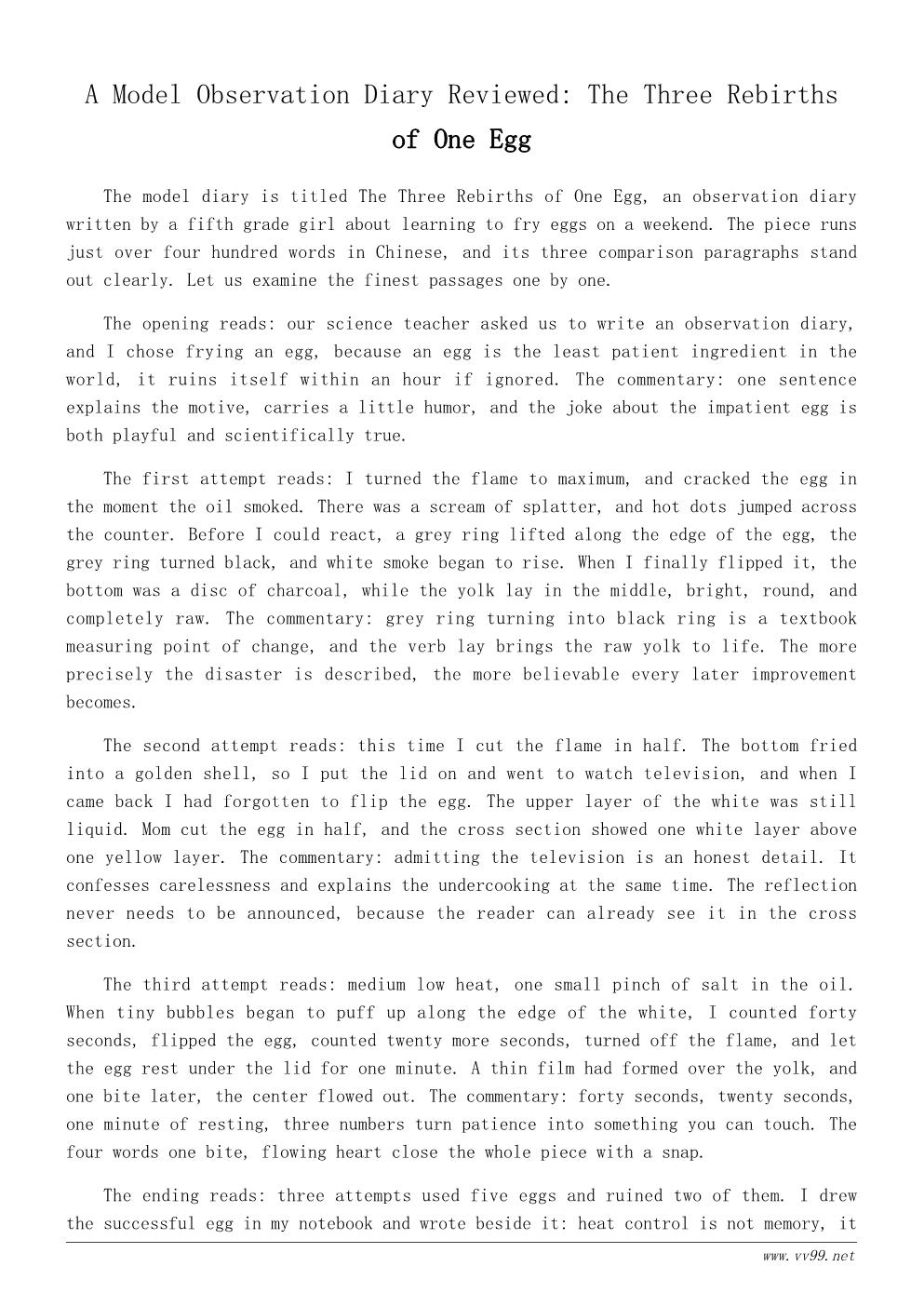
A Model Observation Diary Reviewed: The Three Rebirths of One Egg
The model diary is titled The Three Rebirths of One Egg, an observation diary written by a fifth grade girl about learning to fry eggs on a weekend. The piece runs just over four hundred words in Chinese, and its three comparison paragraphs stand out clearly. Let us examine the finest passages one by one.
The opening reads: our science teacher asked us to write an observation diary, and I chose frying an egg, because an egg is the least patient ingredient in the world, it ruins itself within an hour if ignored. The commentary: one sentence explains the motive, carries a little humor, and the joke about the impatient egg is both playful and scientifically true.
The first attempt reads: I turned the flame to maximum, and cracked the egg in the moment the oil smoked. There was a scream of splatter, and hot dots jumped across the counter. Before I could react, a grey ring lifted along the edge of the egg, the grey ring turned black, and white smoke began to rise. When I finally flipped it, the bottom was a disc of charcoal, while the yolk lay in the middle, bright, round, and completely raw. The commentary: grey ring turning into black ring is a textbook measuring point of change, and the verb lay brings the raw yolk to life. The more precisely the disaster is described, the more believable every later improvement becomes.
The second attempt reads: this time I cut the flame in half. The bottom fried into a golden shell, so I put the lid on and went to watch television, and when I came back I had forgotten to flip the egg. The upper layer of the white was still liquid. Mom cut the egg in half, and the cross section showed one white layer above one yellow layer. The commentary: admitting the television is an honest detail. It confesses carelessness and explains the undercooking at the same time. The reflection never needs to be announced, because the reader can already see it in the cross section.
The third attempt reads: medium low heat, one small pinch of salt in the oil. When tiny bubbles began to puff up along the edge of the white, I counted forty seconds, flipped the egg, counted twenty more seconds, turned off the flame, and let the egg rest under the lid for one minute. A thin film had formed over the yolk, and one bite later, the center flowed out. The commentary: forty seconds, twenty seconds, one minute of resting, three numbers turn patience into something you can touch. The four words one bite, flowing heart close the whole piece with a snap.
The ending reads: three attempts used five eggs and ruined two of them. I drew the successful egg in my notebook and wrote beside it: heat control is not memory, it is counting. The commentary: admitting two ruined eggs is honest, and the line about counting is a fresh, steady thought, the best sentence in the diary.
What children should memorize from this model is not its sentences but its method. Three stages, one cause of failure per stage, one set of numbers or measuring points per stage. With this mold in hand, a child can write about frying eggs, boiling noodles, or sprouting bean seeds. The door of the observation diary opens one kitchen at a time.
Teachers can extend this model with a simple week long project. Each student sprouts a few beans in a jar and records height in millimeters every morning for seven days, then writes one paragraph per day ending with one thought. By the end of the week, students discover that the bean jar and the frying pan share the same skeleton: stages, measurements, and small honest reflections. That discovery transfers to any subject that asks them to watch change carefully.
小提示:上面此文档内容仅展示完整文档里的部分内容, 若需要下载完整文档请 点击免费下载完整文档 。