文章内容
文章内容
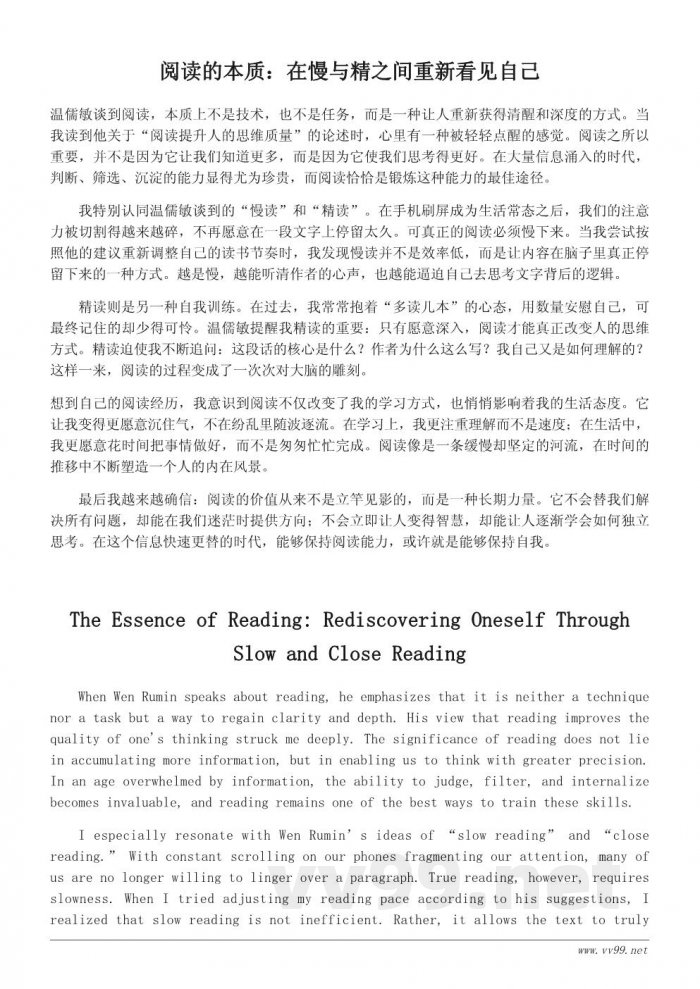
阅读的本质:在慢与精之间重新看见自己
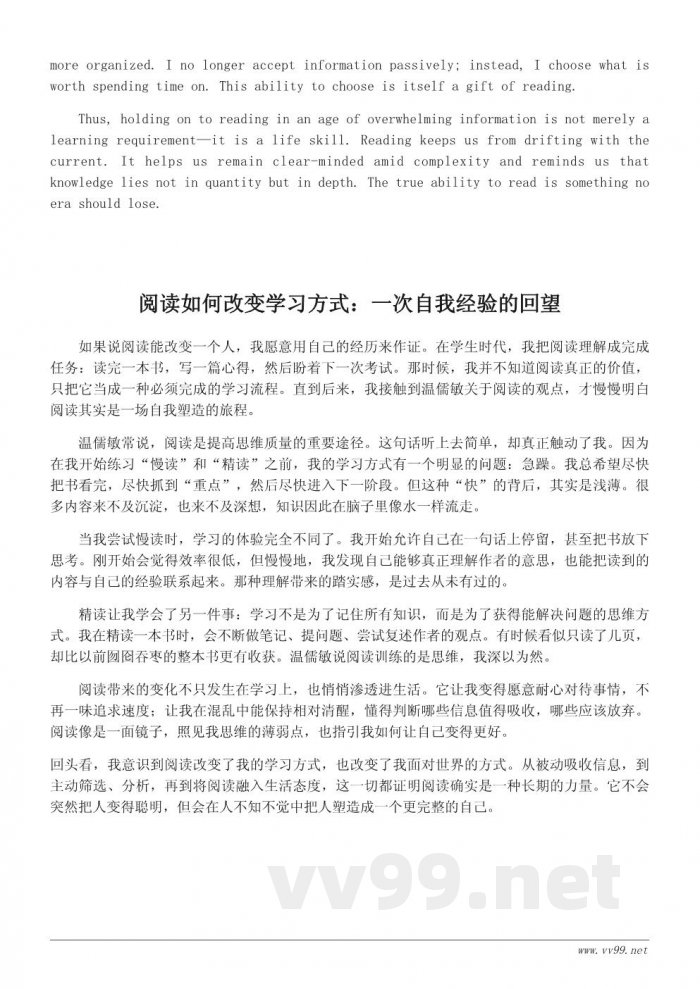
温儒敏谈到阅读,本质上不是技术,也不是任务,而是一种让人重新获得清醒和深度的方式。当我读到他关于“阅读提升人的思维质量”的论述时,心里有一种被轻轻点醒的感觉。阅读之所以重要,并不是因为它让我们知道更多,而是因为它使我们思考得更好。在大量信息涌入的时代,判断、筛选、沉淀的能力显得尤为珍贵,而阅读恰恰是锻炼这种能力的最佳途径。
我特别认同温儒敏谈到的“慢读”和“精读”。在手机刷屏成为生活常态之后,我们的注意力被切割得越来越碎,不再愿意在一段文字上停留太久。可真正的阅读必须慢下来。当我尝试按照他的建议重新调整自己的读书节奏时,我发现慢读并不是效率低,而是让内容在脑子里真正停留下来的一种方式。越是慢,越能听清作者的心声,也越能逼迫自己去思考文字背后的逻辑。
精读则是另一种自我训练。在过去,我常常抱着“多读几本”的心态,用数量安慰自己,可最终记住的却少得可怜。温儒敏提醒我精读的重要:只有愿意深入,阅读才能真正改变人的思维方式。精读迫使我不断追问:这段话的核心是什么?作者为什么这么写?我自己又是如何理解的?这样一来,阅读的过程变成了一次次对大脑的雕刻。
想到自己的阅读经历,我意识到阅读不仅改变了我的学习方式,也悄悄影响着我的生活态度。它让我变得更愿意沉住气,不在纷乱里随波逐流。在学习上,我更注重理解而不是速度;在生活中,我更愿意花时间把事情做好,而不是匆匆忙忙完成。阅读像是一条缓慢却坚定的河流,在时间的推移中不断塑造一个人的内在风景。
最后我越来越确信:阅读的价值从来不是立竿见影的,而是一种长期力量。它不会替我们解决所有问题,却能在我们迷茫时提供方向;不会立即让人变得智慧,却能让人逐渐学会如何独立思考。在这个信息快速更替的时代,能够保持阅读能力,或许就是能够保持自我。
The Essence of Reading: Rediscovering Oneself Through Slow and Close Reading
When Wen Rumin speaks about reading, he emphasizes that it is neither a technique nor a task but a way to regain clarity and depth. His view that reading improves the quality of one's thinking struck me deeply. The significance of reading does not lie in accumulating more information, but in enabling us to think with greater precision. In an age overwhelmed by information, the ability to judge, filter, and internalize becomes invaluable, and reading remains one of the best ways to train these skills.
I especially resonate with Wen Rumin’s ideas of “slow reading” and “close reading.” With constant scrolling on our phones fragmenting our attention, many of us are no longer willing to linger over a paragraph. True reading, however, requires slowness. When I tried adjusting my reading pace according to his suggestions, I realized that slow reading is not inefficient. Rather, it allows the text to truly settle in the mind. The slower I read, the clearer the author's voice becomes, prompting deeper reflection on the ideas behind the words.
Close reading is another form of self-discipline. I used to comfort myself with the belief that reading more books meant better learning, yet I retained very little. Wen Rumin reminds us that only through close engagement can reading genuinely reshape our thinking. Close reading pushes me to ask: What is the essence of this passage? Why does the author express it this way? How do I interpret it? Through these questions, reading becomes an exercise in mental craftsmanship.
Reflecting on my own reading experiences, I realize that reading has not only transformed my learning habits but has also influenced my attitude toward life. It has taught me to be patient and not be swept away by chaos. I now care more about understanding than speed in my studies, and I prefer doing things attentively rather than rushing through them. Reading is like a slow, steadfast river that shapes the landscape of one’s inner world over time.
Ultimately, I have come to believe that the value of reading is never immediate. It is a long-term force. It will not solve every problem, but it offers direction when we are lost. It may not instantly make us wise, but it teaches us how to think independently. In an age of rapid information turnover, preserving the ability to read deeply may be the key to preserving our sense of self.
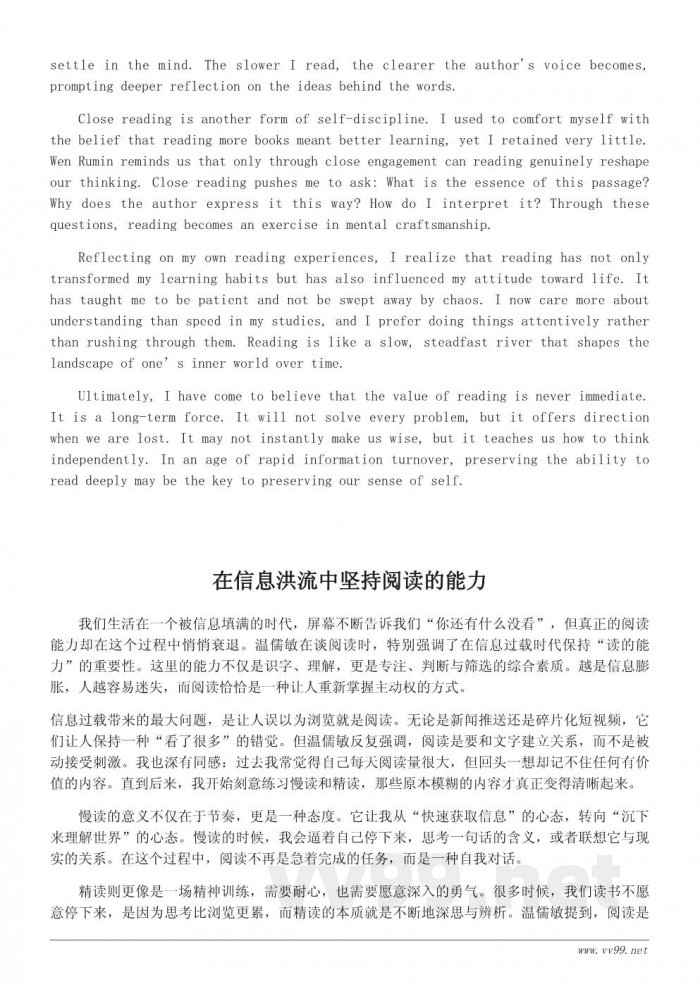
在信息洪流中坚持阅读的能力
我们生活在一个被信息填满的时代,屏幕不断告诉我们“你还有什么没看”,但真正的阅读能力却在这个过程中悄悄衰退。温儒敏在谈阅读时,特别强调了在信息过载时代保持“读的能力”的重要性。这里的能力不仅是识字、理解,更是专注、判断与筛选的综合素质。越是信息膨胀,人越容易迷失,而阅读恰恰是一种让人重新掌握主动权的方式。
信息过载带来的最大问题,是让人误以为浏览就是阅读。无论是新闻推送还是碎片化短视频,它们让人保持一种“看了很多”的错觉。但温儒敏反复强调,阅读是要和文字建立关系,而不是被动接受刺激。我也深有同感:过去我常觉得自己每天阅读量很大,但回头一想却记不住任何有价值的内容。直到后来,我开始刻意练习慢读和精读,那些原本模糊的内容才真正变得清晰起来。
慢读的意义不仅在于节奏,更是一种态度。它让我从“快速获取信息”的心态,转向“沉下来理解世界”的心态。慢读的时候,我会逼着自己停下来,思考一句话的含义,或者联想它与现实的关系。在这个过程中,阅读不再是急着完成的任务,而是一种自我对话。
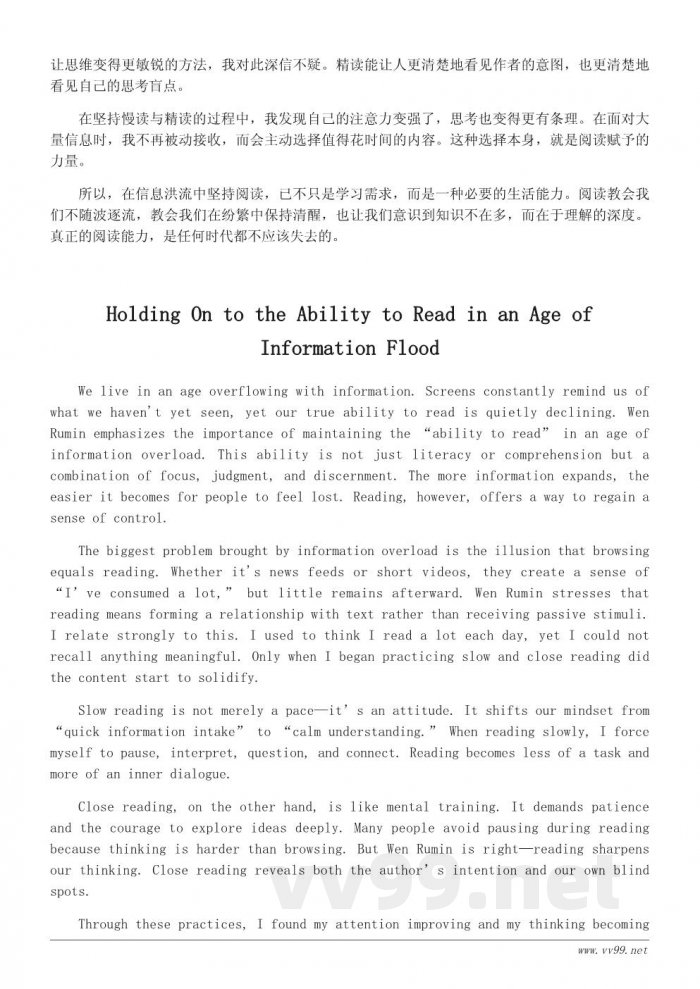
精读则更像是一场精神训练,需要耐心,也需要愿意深入的勇气。很多时候,我们读书不愿意停下来,是因为思考比浏览更累,而精读的本质就是不断地深思与辨析。温儒敏提到,阅读是让思维变得更敏锐的方法,我对此深信不疑。精读能让人更清楚地看见作者的意图,也更清楚地看见自己的思考盲点。
在坚持慢读与精读的过程中,我发现自己的注意力变强了,思考也变得更有条理。在面对大量信息时,我不再被动接收,而会主动选择值得花时间的内容。这种选择本身,就是阅读赋予的力量。
所以,在信息洪流中坚持阅读,已不只是学习需求,而是一种必要的生活能力。阅读教会我们不随波逐流,教会我们在纷繁中保持清醒,也让我们意识到知识不在多,而在于理解的深度。真正的阅读能力,是任何时代都不应该失去的。
Holding On to the Ability to Read in an Age of Information Flood
We live in an age overflowing with information. Screens constantly remind us of what we haven't yet seen, yet our true ability to read is quietly declining. Wen Rumin emphasizes the importance of maintaining the “ability to read” in an age of information overload. This ability is not just literacy or comprehension but a combination of focus, judgment, and discernment. The more information expands, the easier it becomes for people to feel lost. Reading, however, offers a way to regain a sense of control.
The biggest problem brought by information overload is the illusion that browsing equals reading. Whether it's news feeds or short videos, they create a sense of “I’ve consumed a lot,” but little remains afterward. Wen Rumin stresses that reading means forming a relationship with text rather than receiving passive stimuli. I relate strongly to this. I used to think I read a lot each day, yet I could not recall anything meaningful. Only when I began practicing slow and close reading did the content start to solidify.
Slow reading is not merely a pace—it’s an attitude. It shifts our mindset from “quick information intake” to “calm understanding.” When reading slowly, I force myself to pause, interpret, question, and connect. Reading becomes less of a task and more of an inner dialogue.
Close reading, on the other hand, is like mental training. It demands patience and the courage to explore ideas deeply. Many people avoid pausing during reading because thinking is harder than browsing. But Wen Rumin is right—reading sharpens our thinking. Close reading reveals both the author’s intention and our own blind spots.
Through these practices, I found my attention improving and my thinking becoming more organized. I no longer accept information passively; instead, I choose what is worth spending time on. This ability to choose is itself a gift of reading.
Thus, holding on to reading in an age of overwhelming information is not merely a learning requirement—it is a life skill. Reading keeps us from drifting with the current. It helps us remain clear-minded amid complexity and reminds us that knowledge lies not in quantity but in depth. The true ability to read is something no era should lose.
小提示:上面此文档内容仅展示完整文档里的部分内容, 若需要下载完整文档请 点击免费下载完整文档 。