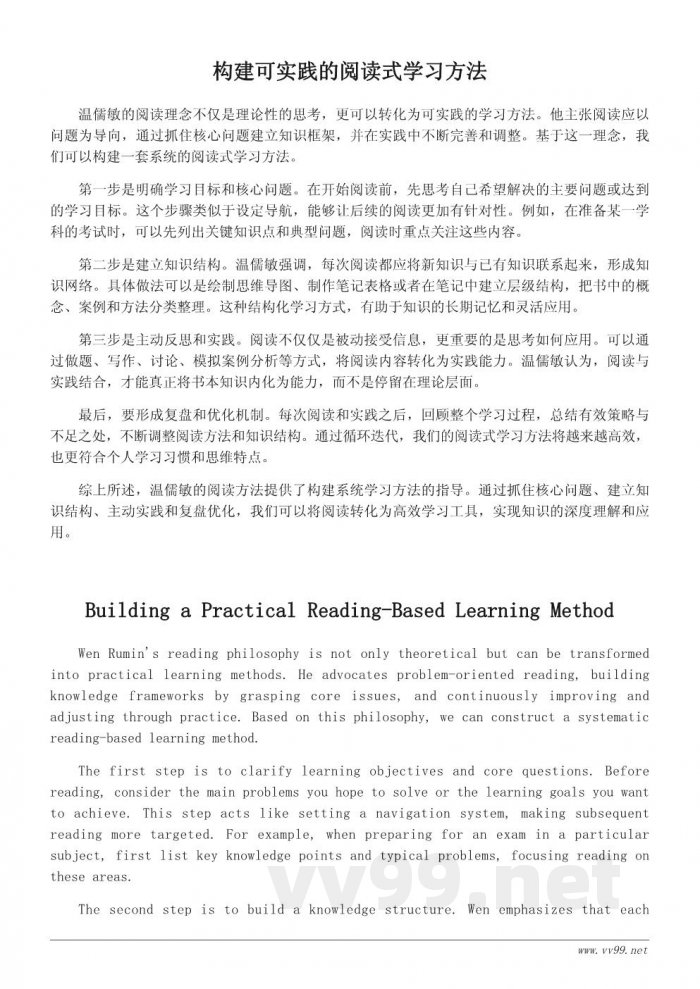
文章内容
文章内容
抓住核心问题:温儒敏阅读方法的启示
温儒敏教授在阅读方法上的核心理念之一是抓住核心问题。他认为,阅读不仅仅是获取信息,更是为了理解问题本质,形成知识框架。读书时,如果只是停留在表面信息的积累,而忽略问题的本质,学习效果往往有限。温儒敏强调,阅读的关键在于辨认出每篇文章或每本书的核心论点,然后围绕这些核心问题展开思考和笔记。
在实际学习中,我们可以先快速浏览书籍或文章,提炼出作者想要解决的主要问题。例如在学习历史时,不仅要记住事件的时间和地点,更要理解这些事件背后的因果关系和社会逻辑。通过这种方法,我们的阅读不再是机械的记忆,而是主动的理解和思考。
温儒敏还提出,通过阅读建立知识结构同样重要。这意味着每次阅读都不是孤立的,而是把新知识和已有知识联系起来。比如在学习哲学时,可以将不同哲学家的观点整理成一个知识网络,标注相互之间的联系和差异。这种方法能够帮助我们在面对复杂问题时迅速找到相关的理论支撑,从而提升分析能力和判断力。
结合具体策略,我们可以在阅读时使用提问法:先提出几个核心问题,再带着问题去寻找答案,并将答案与自己的理解相结合。此外,做读书笔记时可以采用结构化方式,将知识分门别类,形成逻辑清晰的知识体系。这不仅提升了理解力,也锻炼了归纳和分析能力。
总结来看,温儒敏的阅读方法强调抓住核心问题、建立知识结构、主动思考。这一方法不仅适用于学术研究,也适合日常学习。通过实践这些策略,我们可以将阅读变为一种高效的学习工具,使知识真正内化为自己的能力。
Grasping Core Issues: Insights from Wen Rumins Reading Methods
One of Professor Wen Rumin's core ideas in reading is to grasp the core issues. He believes that reading is not just about acquiring information but understanding the essence of problems and forming a knowledge framework. If reading only stays on the surface level of information accumulation while ignoring the core issues, learning outcomes are often limited. Wen emphasizes that the key to reading is identifying the main arguments of each article or book and then thinking and taking notes around these core issues.
In practical learning, we can first skim through books or articles to extract the main problems the author wants to address. For example, when studying history, it is not enough to remember the time and place of events; one must also understand the causes and social logic behind them. Through this approach, reading becomes active understanding and reflection rather than mechanical memorization.
Wen also suggests that building a knowledge structure through reading is equally important. This means each reading session is not isolated but connects new knowledge with existing knowledge. For instance, when studying philosophy, one can organize different philosophers' viewpoints into a knowledge network, noting their interconnections and differences. This method helps quickly find relevant theoretical support when facing complex problems, thereby enhancing analytical and judgment skills.
As for practical strategies, we can use a questioning approach while reading: first raise a few core questions, then seek answers while reading, and combine the answers with personal understanding. Additionally, taking structured notes and categorizing knowledge logically can form a clear knowledge system. This not only enhances comprehension but also trains inductive and analytical skills.
In summary, Wen Rumin's reading method emphasizes grasping core issues, building knowledge structures, and active thinking. This method is not only applicable to academic research but also to everyday learning. By practicing these strategies, we can turn reading into an effective learning tool and internalize knowledge as a personal capability.
通过阅读提升理解力与分析力的实践策略
温儒敏在阅读方法中强调,阅读不仅是信息获取,更是训练理解力和分析力的重要途径。他指出,阅读时要关注内容的逻辑结构,理解作者如何从问题出发展开论述。通过这种方式,我们不仅掌握知识,还能提高思考的深度和广度。
在日常学习中,可以通过几个步骤实践温儒敏的阅读理念。首先,选择有深度的阅读材料,避免碎片化信息的泛滥。比如学术文章、经典书籍、研究报告等,它们通常结构清晰、论点明确,更利于训练分析能力。其次,在阅读过程中,保持批判性思维,对作者观点进行质疑和比较,而不是被动接受。这种方法能够强化理解力,使大脑主动处理信息。
第三,注重知识的归纳和整理。温儒敏建议在阅读时建立自己的知识网络,将每个观点、案例或方法与已有知识联系起来。这种归纳整理不仅帮助记忆,也能发现新问题,从而提高解决复杂问题的能力。例如,在学习经济学时,可以将不同理论模型按照适用条件、假设前提整理在一张图表上,形成直观的知识结构。
第四,将阅读与实践结合。单纯阅读可能会停留在理论层面,而通过实际案例分析、问题讨论、写作总结等方式,可以让理解力和分析力真正内化。温儒敏认为,阅读后的思考和实践是巩固知识的重要环节,能够将书本上的抽象知识转化为可操作的能力。
总体来看,通过抓住逻辑结构、批判性思考、知识归纳和实践应用,我们可以把温儒敏的阅读理念转化为提升理解力与分析力的具体策略。这种方法不仅适用于学术学习,也对职业能力提升和终身学习有重要意义。
Practical Strategies to Enhance Comprehension and Analytical Skills through Reading
Wen Rumin emphasizes in his reading methodology that reading is not just about information acquisition but also an important way to train comprehension and analytical skills. He points out that while reading, attention should be paid to the logical structure of the content and how the author develops arguments from core problems. In this way, we not only master knowledge but also enhance the depth and breadth of thinking.
In daily learning, Wen Rumin's reading philosophy can be practiced through several steps. First, choose in-depth reading materials, avoiding the flood of fragmented information. For example, academic articles, classic books, and research reports usually have clear structures and well-defined arguments, which are more conducive to training analytical skills. Second, maintain critical thinking during reading, questioning and comparing the author's viewpoints instead of passively accepting them. This method strengthens comprehension by actively processing information.
Third, focus on summarizing and organizing knowledge. Wen suggests building a personal knowledge network while reading, connecting each point, case, or method with existing knowledge. This summary not only aids memory but also helps discover new problems, thereby improving the ability to solve complex issues. For instance, in studying economics, different theoretical models can be organized in a chart according to applicable conditions and assumptions, forming an intuitive knowledge structure.
Fourth, combine reading with practice. Pure reading may remain theoretical, but analyzing real cases, engaging in discussions, and writing summaries allow comprehension and analytical skills to internalize. Wen believes that reflection and practice after reading are crucial for consolidating knowledge and transforming abstract concepts into actionable skills.
Overall, by grasping logical structures, thinking critically, summarizing knowledge, and applying it in practice, we can turn Wen Rumin's reading philosophy into concrete strategies to enhance comprehension and analytical skills. This method is valuable not only for academic learning but also for professional development and lifelong learning.
小提示:上面此文档内容仅展示完整文档里的部分内容, 若需要下载完整文档请 点击免费下载完整文档 。