文章内容
文章内容
让书香在家中流动:打造可阅读空间的实践记录
在家庭生活节奏不断加快的当下,想让阅读真正成为一种习惯并不是件容易的事。我和家人也经历过一段“买书容易读书难”的时期,直到我们决定从打造一个舒适、自然、可进入的阅读空间开始,慢慢在家里营造起一种让人愿意停下来阅读的氛围。
我们最初做的事情非常简单,就是在客厅的一角腾出一个不大的空间,放上一张小书桌和一盏暖光落地灯。书架没有选择太高的那种,而是刻意挑了矮一些的,让孩子能够轻松拿到。书的选择也不再按照大人的喜好摆放,而是按主题、兴趣、季节等进行分类。孩子喜欢的图画书放在最显眼的位置,而我和伴侣的书则根据我们近期阅读的方向摆在一起,方便随手翻阅。
为了让这个空间真正“活起来”,我们把每天晚饭后的二十分钟定为家庭阅读时间。不要求读多少,也不要求读什么,只要大家各自拿一本书坐下来,就算完成。在这个过程中我们发现,阅读时间越是被设计得轻松自在,彼此越容易坚持。尤其是当孩子看到大人也在读书时,他在行为上就更容易模仿,而不是把阅读视为一种“任务”。
家庭读书会是我们后来逐渐形成的一种方式。起初只是随口分享:“你今天看了什么?”后来慢慢演变成每周一次的小分享会。孩子会讲自己最喜欢的故事情节,我和伴侣则会谈谈最近哪些观点触动了我们。有时还会根据一本书延伸出一些小活动,比如做一幅与故事相关的画,或者尝试完成书里提到的小实验。家庭读书会不仅让阅读变得有趣,也成为加深彼此理解的重要桥梁。
当然,在打造阅读环境的过程中,我们也遇到年龄差带来的需求差异。孩子需要色彩鲜明的书封和容易拿取的书架,也更喜欢坐在小地毯上阅读;而我们大人则更注重光线舒适和椅子的角度。后来我们把阅读角做到“分层次设计”:地面铺上孩子喜欢的软垫区域,而稍高一点的位置则放置大人的阅读椅。这样的布置让每个人都能找到属于自己的阅读方式,而空间仍然保持统一的氛围。
经过一段时间的实践,我逐渐意识到,家庭阅读空间的核心不是“装得多好看”,而是能不能让阅读成为一种随手即得的体验。书放得够近、光线让人舒服、氛围不刻意,反而最能让人沉浸进去。尤其是孩子的阅读习惯,其实不是靠强迫得来的,而是在耳濡目染中自然生长。
总结这段实践过程,我认为最重要的启示有三点:第一,阅读空间不需要华丽,但一定要易进入;第二,固定的阅读时间能帮助家庭形成阅读节奏;第三,通过分享与讨论,阅读更能成为家庭情感连接的一部分。希望这些经验能为正在尝试推动家庭阅读的家庭提供一些思路,也期待更多的家庭能在书香中找到属于自己的温柔时刻。
Let Reading Flow at Home: A Practical Record of Creating a Readable Space
As everyday life becomes increasingly fast-paced, cultivating a genuine reading habit at home is far from easy. Our family also went through a period when buying books was much easier than reading them. Everything started to change when we decided to create a comfortable, accessible reading corner at home, slowly nurturing an atmosphere where reading felt natural rather than forced.
The first step was simple: we cleared a small corner of the living room, added a compact desk, and placed a warm floor lamp beside it. We chose a low bookshelf so that our child could easily reach the books. Instead of arranging books by adult preferences, we sorted them by themes and interests. Picture books went on the most visible shelf, while my partner's and my books were placed according to our recent reading goals.
To make the space truly come alive, we designated twenty minutes after dinner as family reading time. There were no rules about what or how much to read—just that everyone sits down with a book. Over time, we found that the more relaxed the routine, the easier it was to maintain. When our child saw us reading quietly, he naturally followed, seeing reading as a normal part of life instead of a task.
Our family book club grew gradually from casual conversations like “What did you read today?” to weekly sharing sessions. Our child would talk about his favorite scenes from picture books, while the adults shared ideas that had recently inspired us. Sometimes we extended the reading with small activities, like drawing a scene from a story or trying a simple experiment mentioned in the book. These sessions made reading enjoyable and deepened our understanding of one another.
Of course, age differences meant different needs. Our child preferred colorful book covers and soft floor mats, while we adults cared more about lighting and comfortable seating. Eventually, we created a layered reading area: soft mats on the floor for the child, and a reading chair slightly elevated for the adults. Everyone found their own place, yet the space still felt cohesive.
Through this process, I realized that the essence of a reading space is not how beautiful it looks, but how easy it is to enter. Books within reach, comfortable lighting, and a natural atmosphere encourage immersion. A child’s reading habit grows not from pressure but from quiet influence.
Looking back, three insights stand out: first, a reading space doesn’t need to be fancy, but it must be accessible; second, a fixed reading time helps form a family reading rhythm; third, sharing and discussion turn reading into a meaningful bonding experience. I hope these experiences inspire other families to build their own reading habits and find warm, peaceful moments in the presence of books.
小小书角的大作用:家庭阅读氛围的营造与坚持
在我们家,阅读这件事真正稳定下来,是从一个不起眼的小书角开始的。我原本以为阅读氛围靠的是大量藏书、精致装饰或者严格的计划,但实践下来才发现,最有效的,是让每个家庭成员都能轻松地参与其中,而不必感到压力。
书角的位置是我们反复考虑过的——不能太偏僻,否则大家不会主动靠近;也不能太嘈杂,否则坐不住。最后我们选择了客厅靠窗的一小块区域。光线自然、位置显眼,坐下也安静。那里放了一块小地毯、一排矮书架、一个懒人沙发,再加上一盏柔和的壁灯。整个布置没有任何复杂设计,但却意外成为家人愿意停下脚步的地方。
布置好书角之后,为了让它真正“用起来”,我们给自己制定了一个简单的规则:每天至少有一个时段,家里的电视必须关闭,而书角保持开放。孩子最先习惯了这种变化,他开始会自己走过去挑书,有时候只是随便翻几页,但那种主动性让我们很惊喜。而随着孩子的动作,我们大人也自然被带动起来,渐渐养成靠着书角休息、阅读的习惯。
在推动家庭阅读过程中,阅读需求的差异曾让我们有些困扰。孩子喜欢看图多字少的书,而我偏向人文社科,伴侣则倾向实用类书籍。有一次我们甚至因为买书优先级产生争执。后来我们意识到,阅读不必统一方向,而是要让每个人都找到自己的乐趣。所以书架上分了三个区域:孩子区、家庭区和大人区,每个区域都根据使用者的习惯摆放。这样一来,不同的需求互不干扰,却又在空间里自然融合。
家庭读书会是我们试验后觉得最有凝聚力的活动。最开始我们设想太复杂,想做读后感、想做讨论题,结果几次下来大家都觉得压力大。后来我们把形式尽量简化,每周一次,每人分享三分钟即可。孩子可以讲一个故事情节,大人可以说一个触动自己的观点。有时候我们还会一起选一本“共读书”,比如绘本、科普书或者短篇小说,读完后简单聊聊感受。形式越是轻松,我们反而越坚持得久。
在这个过程中,我们也慢慢理解了一件事:阅读不会自然发生,它需要被看见、被鼓励、被陪伴。尤其对孩子来说,阅读不是被安排的任务,而是在日常生活中看到的“家里的样子”。如果大人愿意读,孩子自然会跟着读。
回头来看,小书角带来的变化远超我们的想象。它不只是放书的地方,而是让家庭节奏慢下来、让彼此靠近的空间。阅读不再是一件被强调的事情,而是家人共同生活的方式之一。
这段经历让我明白三个关键点:第一,阅读空间越简单越好,重点在于让人随时进入;第二,家庭读书会的形式一定要轻松可持续;第三,尊重每个家庭成员的阅读兴趣,才能让阅读真正扎根。希望这些经验能为想开始家庭阅读的人提供一些参考,让更多的家庭都能在书角灯光下找到属于自己的安静与温暖。
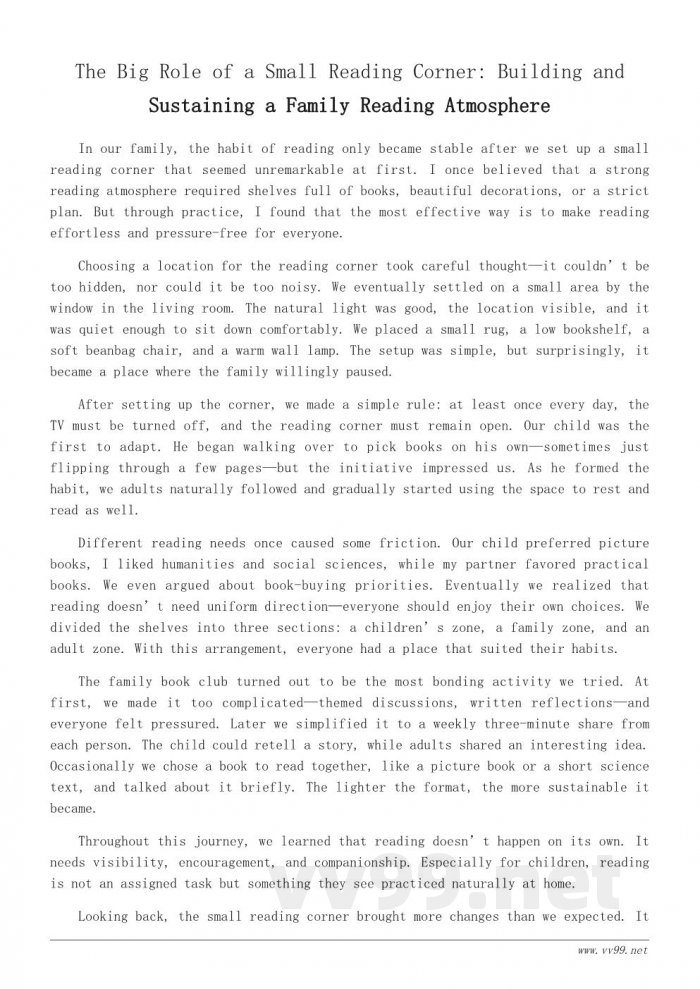
The Big Role of a Small Reading Corner: Building and Sustaining a Family Reading Atmosphere
In our family, the habit of reading only became stable after we set up a small reading corner that seemed unremarkable at first. I once believed that a strong reading atmosphere required shelves full of books, beautiful decorations, or a strict plan. But through practice, I found that the most effective way is to make reading effortless and pressure-free for everyone.
Choosing a location for the reading corner took careful thought—it couldn’t be too hidden, nor could it be too noisy. We eventually settled on a small area by the window in the living room. The natural light was good, the location visible, and it was quiet enough to sit down comfortably. We placed a small rug, a low bookshelf, a soft beanbag chair, and a warm wall lamp. The setup was simple, but surprisingly, it became a place where the family willingly paused.
After setting up the corner, we made a simple rule: at least once every day, the TV must be turned off, and the reading corner must remain open. Our child was the first to adapt. He began walking over to pick books on his own—sometimes just flipping through a few pages—but the initiative impressed us. As he formed the habit, we adults naturally followed and gradually started using the space to rest and read as well.
Different reading needs once caused some friction. Our child preferred picture books, I liked humanities and social sciences, while my partner favored practical books. We even argued about book-buying priorities. Eventually we realized that reading doesn’t need uniform direction—everyone should enjoy their own choices. We divided the shelves into three sections: a children’s zone, a family zone, and an adult zone. With this arrangement, everyone had a place that suited their habits.
The family book club turned out to be the most bonding activity we tried. At first, we made it too complicated—themed discussions, written reflections—and everyone felt pressured. Later we simplified it to a weekly three-minute share from each person. The child could retell a story, while adults shared an interesting idea. Occasionally we chose a book to read together, like a picture book or a short science text, and talked about it briefly. The lighter the format, the more sustainable it became.
Throughout this journey, we learned that reading doesn’t happen on its own. It needs visibility, encouragement, and companionship. Especially for children, reading is not an assigned task but something they see practiced naturally at home.
Looking back, the small reading corner brought more changes than we expected. It became a place where the family slowed down and connected. Reading is no longer something we deliberately emphasize but part of our shared life.
From this experience, I gained three insights: first, the simpler the reading space, the easier it is to use; second, the family book club must remain light and sustainable; third, respecting each person’s reading interests allows habits to take root. I hope these experiences help families who are beginning their reading journey and bring more warm, quiet moments into their homes.
小提示:上面此文档内容仅展示完整文档里的部分内容, 若需要下载完整文档请 点击免费下载完整文档 。