文章内容
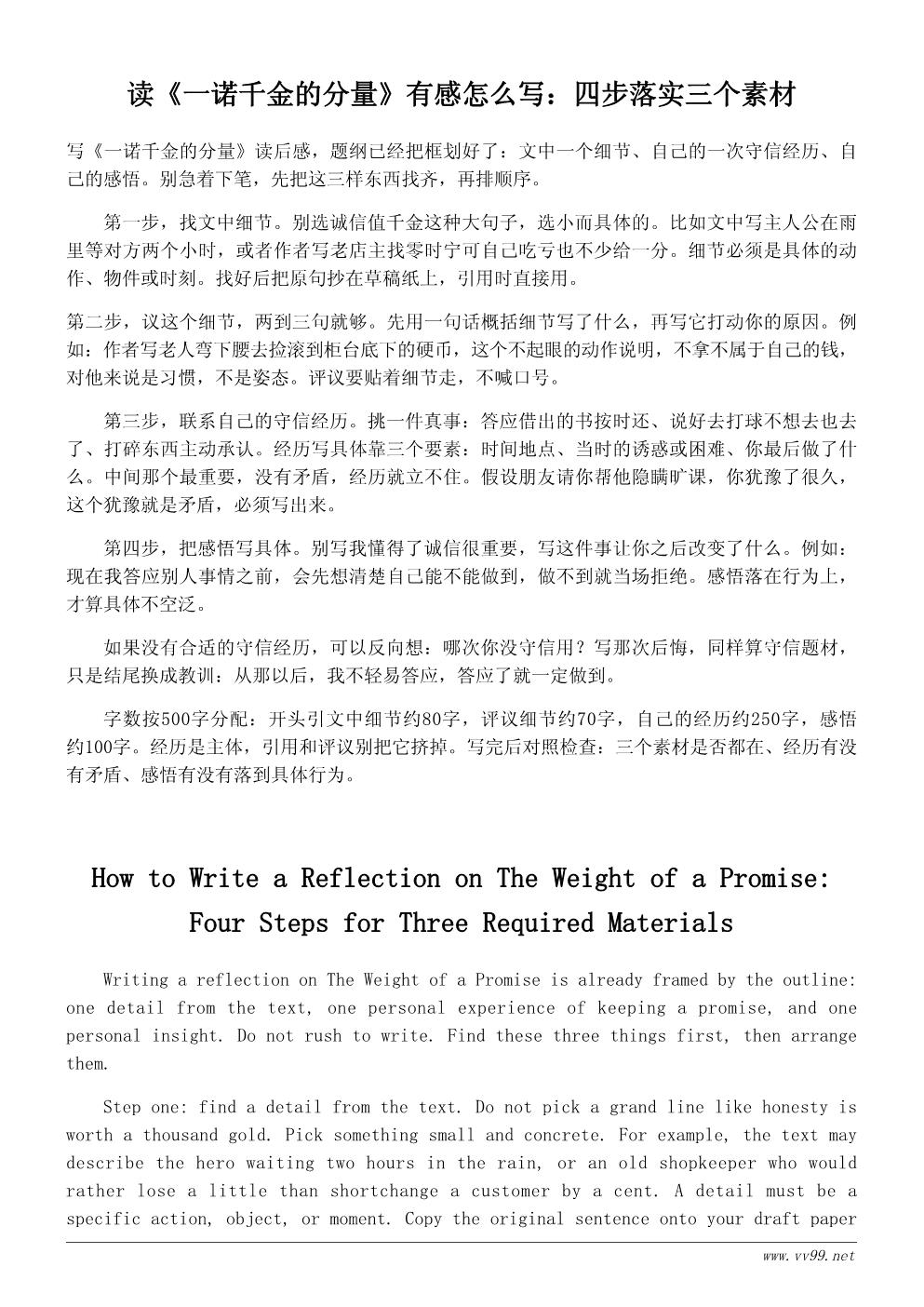
读《一诺千金的分量》有感怎么写:四步落实三个素材
写《一诺千金的分量》读后感,题纲已经把框划好了:文中一个细节、自己的一次守信经历、自己的感悟。别急着下笔,先把这三样东西找齐,再排顺序。
第一步,找文中细节。别选诚信值千金这种大句子,选小而具体的。比如文中写主人公在雨里等对方两个小时,或者作者写老店主找零时宁可自己吃亏也不少给一分。细节必须是具体的动作、物件或时刻。找好后把原句抄在草稿纸上,引用时直接用。
第二步,议这个细节,两到三句就够。先用一句话概括细节写了什么,再写它打动你的原因。例如:作者写老人弯下腰去捡滚到柜台底下的硬币,这个不起眼的动作说明,不拿不属于自己的钱,对他来说是习惯,不是姿态。评议要贴着细节走,不喊口号。
第三步,联系自己的守信经历。挑一件真事:答应借出的书按时还、说好去打球不想去也去了、打碎东西主动承认。经历写具体靠三个要素:时间地点、当时的诱惑或困难、你最后做了什么。中间那个最重要,没有矛盾,经历就立不住。假设朋友请你帮他隐瞒旷课,你犹豫了很久,这个犹豫就是矛盾,必须写出来。
第四步,把感悟写具体。别写我懂得了诚信很重要,写这件事让你之后改变了什么。例如:现在我答应别人事情之前,会先想清楚自己能不能做到,做不到就当场拒绝。感悟落在行为上,才算具体不空泛。
如果没有合适的守信经历,可以反向想:哪次你没守信用?写那次后悔,同样算守信题材,只是结尾换成教训:从那以后,我不轻易答应,答应了就一定做到。
字数按500字分配:开头引文中细节约80字,评议细节约70字,自己的经历约250字,感悟约100字。经历是主体,引用和评议别把它挤掉。写完后对照检查:三个素材是否都在、经历有没有矛盾、感悟有没有落到具体行为。
How to Write a Reflection on The Weight of a Promise: Four Steps for Three Required Materials
Writing a reflection on The Weight of a Promise is already framed by the outline: one detail from the text, one personal experience of keeping a promise, and one personal insight. Do not rush to write. Find these three things first, then arrange them.
Step one: find a detail from the text. Do not pick a grand line like honesty is worth a thousand gold. Pick something small and concrete. For example, the text may describe the hero waiting two hours in the rain, or an old shopkeeper who would rather lose a little than shortchange a customer by a cent. A detail must be a specific action, object, or moment. Copy the original sentence onto your draft paper for later quoting.
Step two: comment on the detail in two or three sentences. Summarize what the detail shows in one sentence, then explain why it moved you. For instance: the author writes that the old man bent down to pick up a coin that rolled under the counter. This small gesture shows that not taking what is not his is a habit for him, not a stance. Keep the comment attached to the detail; do not shout slogans.
Step three: connect a personal experience of keeping a promise. Choose something real: returning a borrowed book on time, showing up for a basketball game you almost skipped, admitting you broke something. Make it concrete with three elements: when and where, the temptation or difficulty at the time, and what you finally did. The middle element matters most. Without conflict, the experience collapses. Suppose a friend asked you to hide his skipping class and you hesitated for a long time. That hesitation is the conflict, and it must be written.
Step four: make the insight concrete. Do not write I have learned that honesty matters. Write what you changed afterwards. For example: now before agreeing to anything, I first check whether I can actually do it, and if not, I refuse on the spot. An insight counts as concrete only when it lands on behavior.
If you have no suitable experience, think in reverse: when did you once break a promise? Write that regret. It still fits the topic; only the ending turns into a lesson: since then, I do not make promises lightly, and once I do, I keep them.
Budget the 500 words like this: about 80 words quoting the text detail, 70 words commenting on it, 250 words on your own experience, and 100 words for the insight. The experience is the main body; do not let quotation and comment squeeze it out. After writing, check: are all three materials present, does the experience contain conflict, and does the insight land on a concrete action.
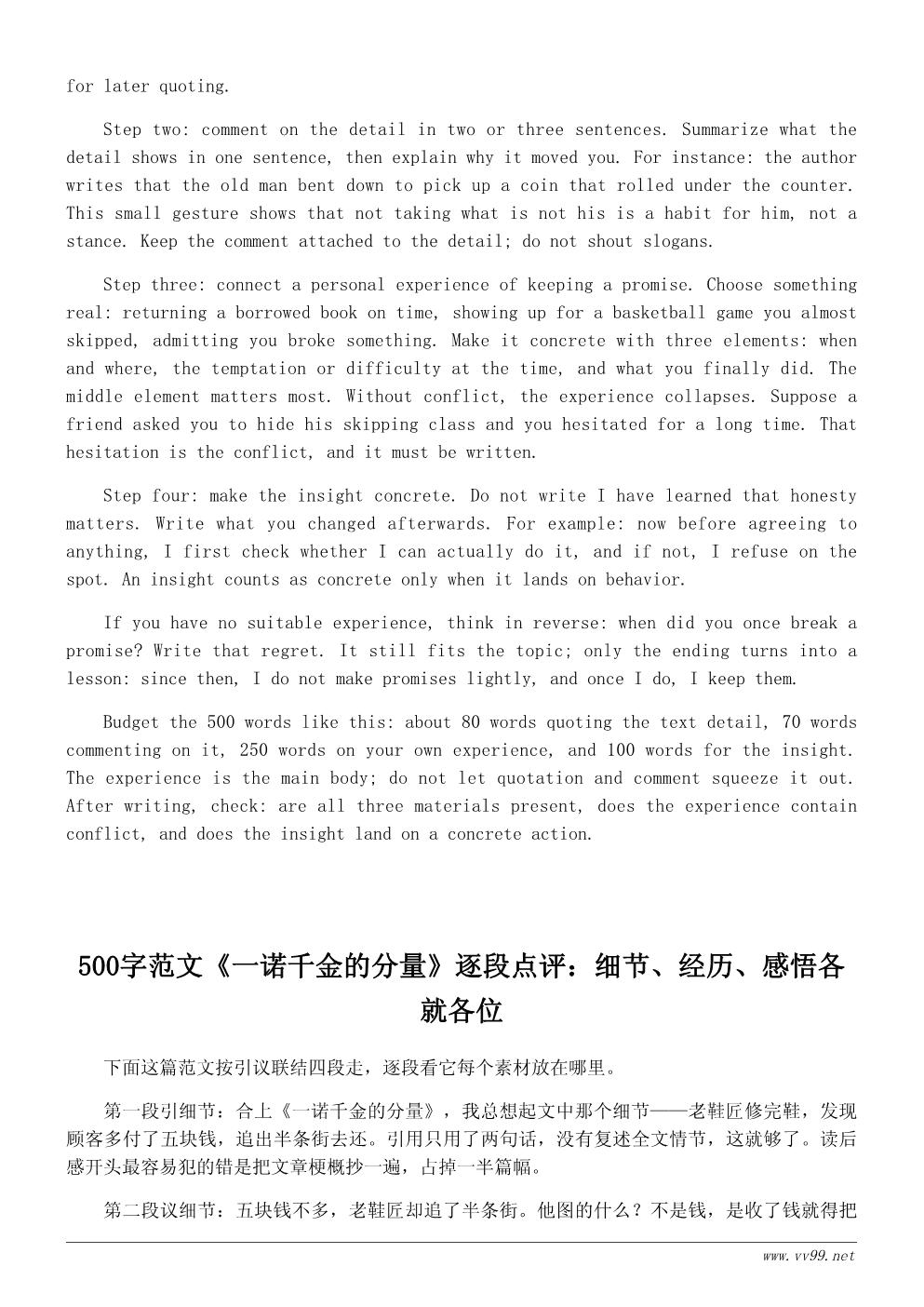
500字范文《一诺千金的分量》逐段点评:细节、经历、感悟各就各位
下面这篇范文按引议联结四段走,逐段看它每个素材放在哪里。
第一段引细节:合上《一诺千金的分量》,我总想起文中那个细节——老鞋匠修完鞋,发现顾客多付了五块钱,追出半条街去还。引用只用了两句话,没有复述全文情节,这就够了。读后感开头最容易犯的错是把文章梗概抄一遍,占掉一半篇幅。
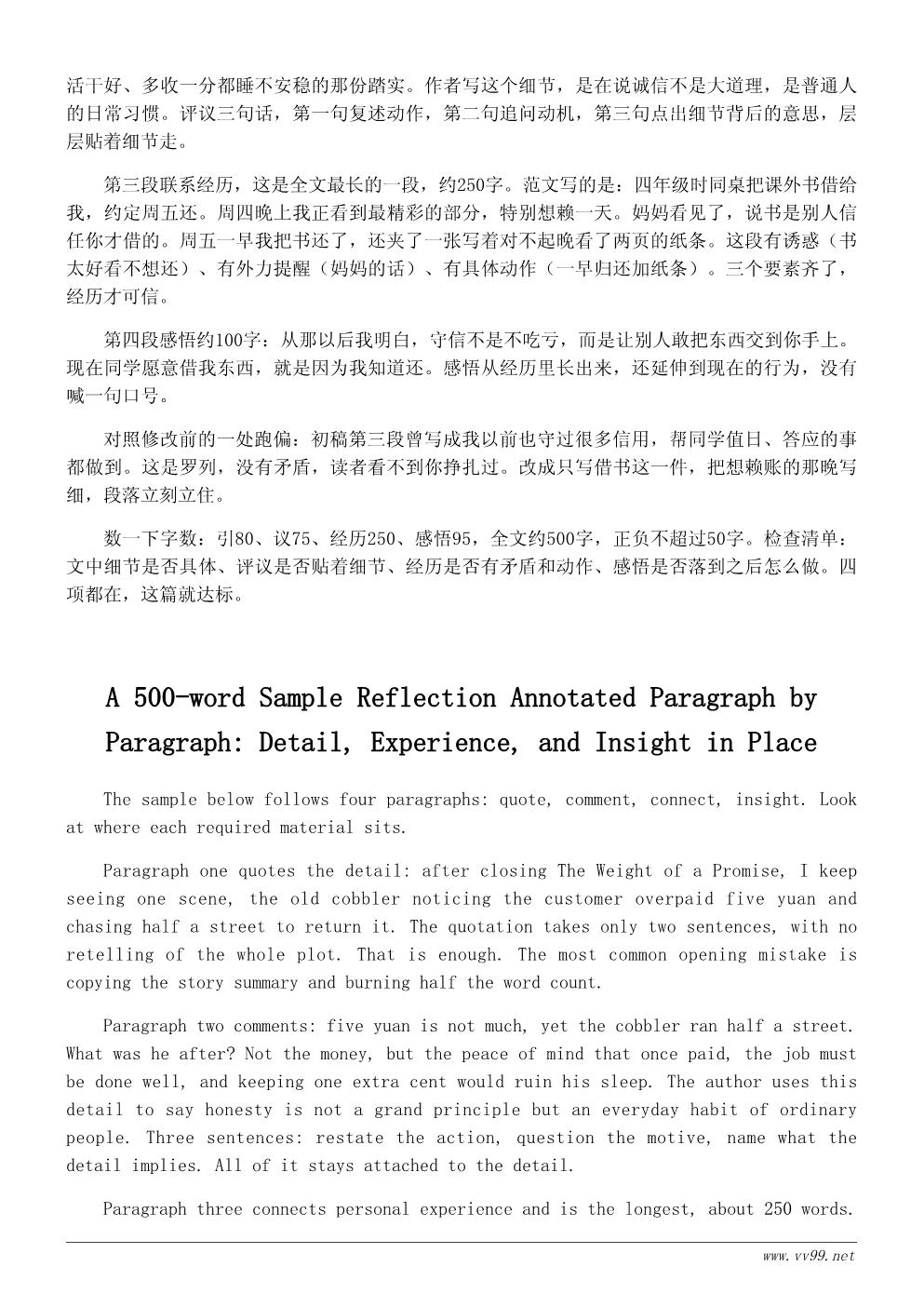
第二段议细节:五块钱不多,老鞋匠却追了半条街。他图的什么?不是钱,是收了钱就得把活干好、多收一分都睡不安稳的那份踏实。作者写这个细节,是在说诚信不是大道理,是普通人的日常习惯。评议三句话,第一句复述动作,第二句追问动机,第三句点出细节背后的意思,层层贴着细节走。
第三段联系经历,这是全文最长的一段,约250字。范文写的是:四年级时同桌把课外书借给我,约定周五还。周四晚上我正看到最精彩的部分,特别想赖一天。妈妈看见了,说书是别人信任你才借的。周五一早我把书还了,还夹了一张写着对不起晚看了两页的纸条。这段有诱惑(书太好看不想还)、有外力提醒(妈妈的话)、有具体动作(一早归还加纸条)。三个要素齐了,经历才可信。
第四段感悟约100字:从那以后我明白,守信不是不吃亏,而是让别人敢把东西交到你手上。现在同学愿意借我东西,就是因为我知道还。感悟从经历里长出来,还延伸到现在的行为,没有喊一句口号。
对照修改前的一处跑偏:初稿第三段曾写成我以前也守过很多信用,帮同学值日、答应的事都做到。这是罗列,没有矛盾,读者看不到你挣扎过。改成只写借书这一件,把想赖账的那晚写细,段落立刻立住。
数一下字数:引80、议75、经历250、感悟95,全文约500字,正负不超过50字。检查清单:文中细节是否具体、评议是否贴着细节、经历是否有矛盾和动作、感悟是否落到之后怎么做。四项都在,这篇就达标。
A 500-word Sample Reflection Annotated Paragraph by Paragraph: Detail, Experience, and Insight in Place
The sample below follows four paragraphs: quote, comment, connect, insight. Look at where each required material sits.
Paragraph one quotes the detail: after closing The Weight of a Promise, I keep seeing one scene, the old cobbler noticing the customer overpaid five yuan and chasing half a street to return it. The quotation takes only two sentences, with no retelling of the whole plot. That is enough. The most common opening mistake is copying the story summary and burning half the word count.
Paragraph two comments: five yuan is not much, yet the cobbler ran half a street. What was he after? Not the money, but the peace of mind that once paid, the job must be done well, and keeping one extra cent would ruin his sleep. The author uses this detail to say honesty is not a grand principle but an everyday habit of ordinary people. Three sentences: restate the action, question the motive, name what the detail implies. All of it stays attached to the detail.
Paragraph three connects personal experience and is the longest, about 250 words. In the sample: in fourth grade a deskmate lent me a storybook, to be returned on Friday. Thursday night I was at the best part and badly wanted to keep it one more day. My mother said the book was lent because someone trusted me. Friday morning I returned it with a note apologizing for reading two pages late. The paragraph has temptation (the book was too good to give back), an outside nudge (mother's words), and a concrete action (returning early plus a note). With all three, the experience becomes believable.
Paragraph four, the insight, is about 95 words: since then I understand that keeping a promise is not about losing out; it is about making others dare to hand things to you. Now classmates still lend me things because they know I return them. The insight grows out of the experience and extends to present behavior, without a single slogan.
One fixed deviation for comparison: the first draft listed many good deeds, helping with class duty, always doing what I promised. Listing has no conflict, so readers never see you struggle. Rewriting it around the single book incident, with the Thursday night temptation described in detail, made the paragraph stand at once.
Word budget: quote 80, comment 75, experience 250, insight 95, total around 500, within 50 either way. Checklist: is the text detail concrete, does the comment hug the detail, does the experience contain conflict and action, does the insight land on what you do now. Four yes answers and the piece passes.
小提示:上面此文档内容仅展示完整文档里的部分内容, 若需要下载完整文档请 点击免费下载完整文档 。