文章内容
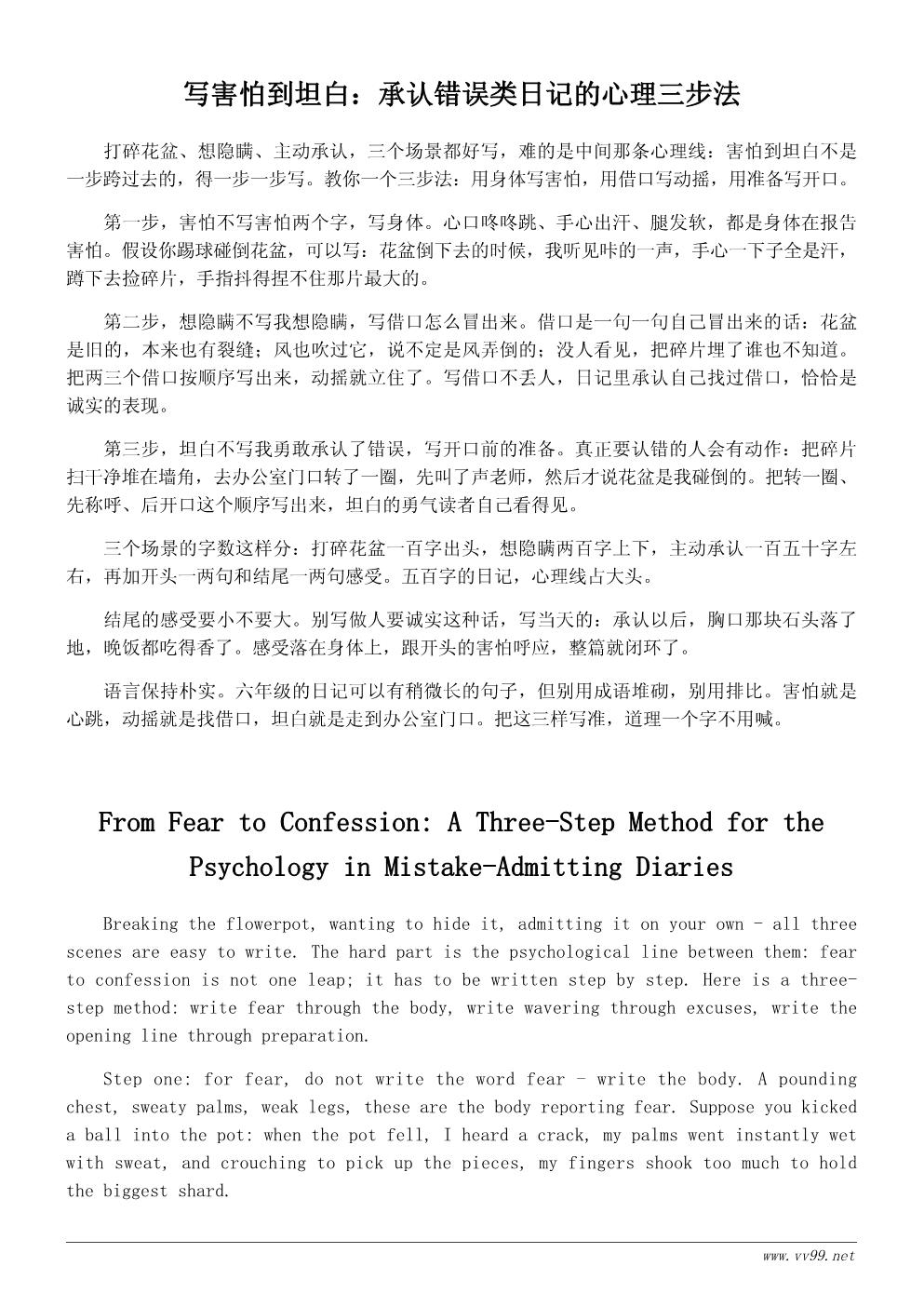
写害怕到坦白:承认错误类日记的心理三步法
打碎花盆、想隐瞒、主动承认,三个场景都好写,难的是中间那条心理线:害怕到坦白不是一步跨过去的,得一步一步写。教你一个三步法:用身体写害怕,用借口写动摇,用准备写开口。
第一步,害怕不写害怕两个字,写身体。心口咚咚跳、手心出汗、腿发软,都是身体在报告害怕。假设你踢球碰倒花盆,可以写:花盆倒下去的时候,我听见咔的一声,手心一下子全是汗,蹲下去捡碎片,手指抖得捏不住那片最大的。
第二步,想隐瞒不写我想隐瞒,写借口怎么冒出来。借口是一句一句自己冒出来的话:花盆是旧的,本来也有裂缝;风也吹过它,说不定是风弄倒的;没人看见,把碎片埋了谁也不知道。把两三个借口按顺序写出来,动摇就立住了。写借口不丢人,日记里承认自己找过借口,恰恰是诚实的表现。
第三步,坦白不写我勇敢承认了错误,写开口前的准备。真正要认错的人会有动作:把碎片扫干净堆在墙角,去办公室门口转了一圈,先叫了声老师,然后才说花盆是我碰倒的。把转一圈、先称呼、后开口这个顺序写出来,坦白的勇气读者自己看得见。
三个场景的字数这样分:打碎花盆一百字出头,想隐瞒两百字上下,主动承认一百五十字左右,再加开头一两句和结尾一两句感受。五百字的日记,心理线占大头。
结尾的感受要小不要大。别写做人要诚实这种话,写当天的:承认以后,胸口那块石头落了地,晚饭都吃得香了。感受落在身体上,跟开头的害怕呼应,整篇就闭环了。
语言保持朴实。六年级的日记可以有稍微长的句子,但别用成语堆砌,别用排比。害怕就是心跳,动摇就是找借口,坦白就是走到办公室门口。把这三样写准,道理一个字不用喊。
From Fear to Confession: A Three-Step Method for the Psychology in Mistake-Admitting Diaries
Breaking the flowerpot, wanting to hide it, admitting it on your own - all three scenes are easy to write. The hard part is the psychological line between them: fear to confession is not one leap; it has to be written step by step. Here is a three-step method: write fear through the body, write wavering through excuses, write the opening line through preparation.
Step one: for fear, do not write the word fear - write the body. A pounding chest, sweaty palms, weak legs, these are the body reporting fear. Suppose you kicked a ball into the pot: when the pot fell, I heard a crack, my palms went instantly wet with sweat, and crouching to pick up the pieces, my fingers shook too much to hold the biggest shard.
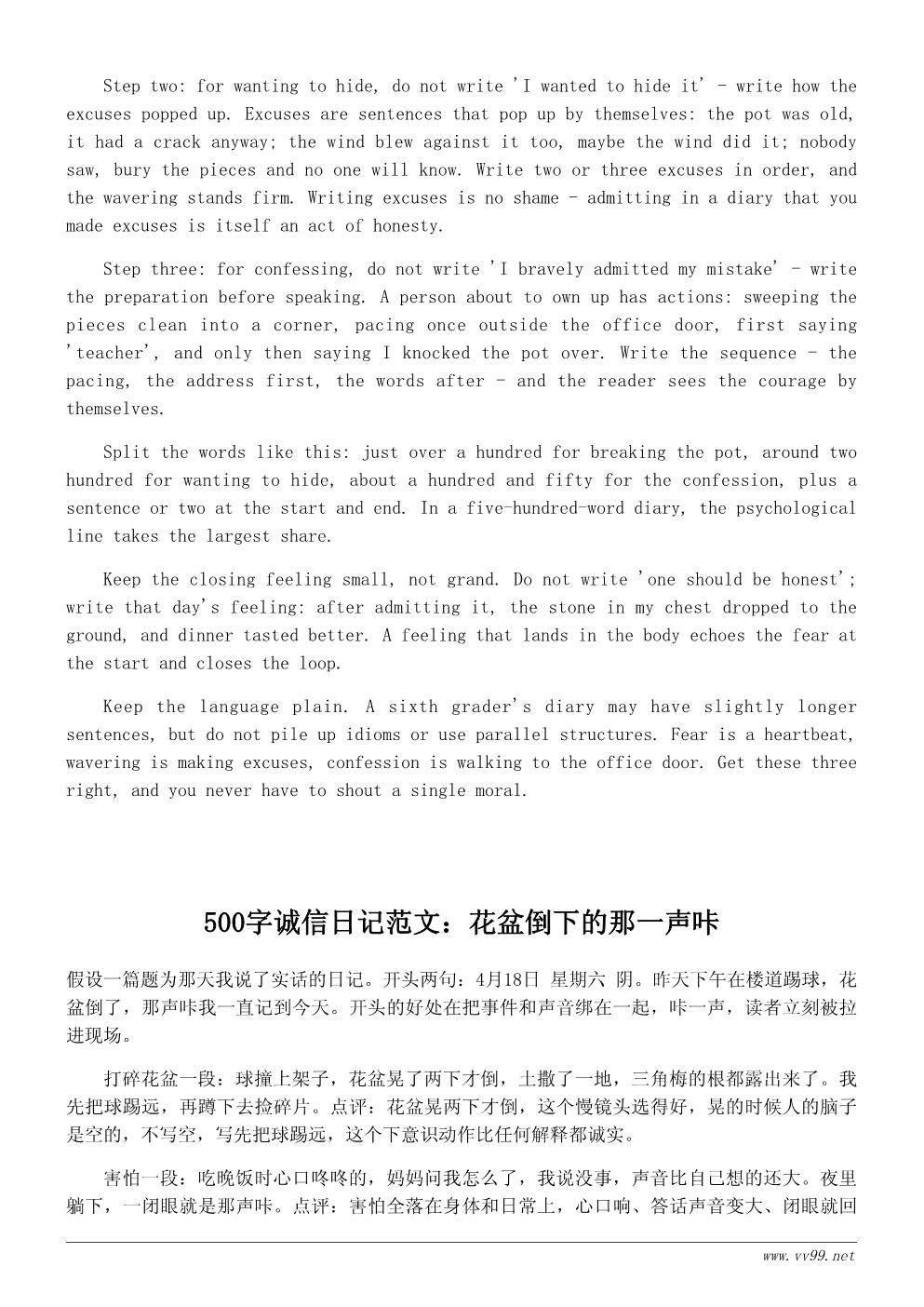
Step two: for wanting to hide, do not write 'I wanted to hide it' - write how the excuses popped up. Excuses are sentences that pop up by themselves: the pot was old, it had a crack anyway; the wind blew against it too, maybe the wind did it; nobody saw, bury the pieces and no one will know. Write two or three excuses in order, and the wavering stands firm. Writing excuses is no shame - admitting in a diary that you made excuses is itself an act of honesty.
Step three: for confessing, do not write 'I bravely admitted my mistake' - write the preparation before speaking. A person about to own up has actions: sweeping the pieces clean into a corner, pacing once outside the office door, first saying 'teacher', and only then saying I knocked the pot over. Write the sequence - the pacing, the address first, the words after - and the reader sees the courage by themselves.
Split the words like this: just over a hundred for breaking the pot, around two hundred for wanting to hide, about a hundred and fifty for the confession, plus a sentence or two at the start and end. In a five-hundred-word diary, the psychological line takes the largest share.
Keep the closing feeling small, not grand. Do not write 'one should be honest'; write that day's feeling: after admitting it, the stone in my chest dropped to the ground, and dinner tasted better. A feeling that lands in the body echoes the fear at the start and closes the loop.
Keep the language plain. A sixth grader's diary may have slightly longer sentences, but do not pile up idioms or use parallel structures. Fear is a heartbeat, wavering is making excuses, confession is walking to the office door. Get these three right, and you never have to shout a single moral.
500字诚信日记范文:花盆倒下的那一声咔
假设一篇题为那天我说了实话的日记。开头两句:4月18日 星期六 阴。昨天下午在楼道踢球,花盆倒了,那声咔我一直记到今天。开头的好处在把事件和声音绑在一起,咔一声,读者立刻被拉进现场。
打碎花盆一段:球撞上架子,花盆晃了两下才倒,土撒了一地,三角梅的根都露出来了。我先把球踢远,再蹲下去捡碎片。点评:花盆晃两下才倒,这个慢镜头选得好,晃的时候人的脑子是空的,不写空,写先把球踢远,这个下意识动作比任何解释都诚实。
害怕一段:吃晚饭时心口咚咚的,妈妈问我怎么了,我说没事,声音比自己想的还大。夜里躺下,一闭眼就是那声咔。点评:害怕全落在身体和日常上,心口响、答话声音变大、闭眼就回想,三个反应没有一个词写害怕,读者全懂。
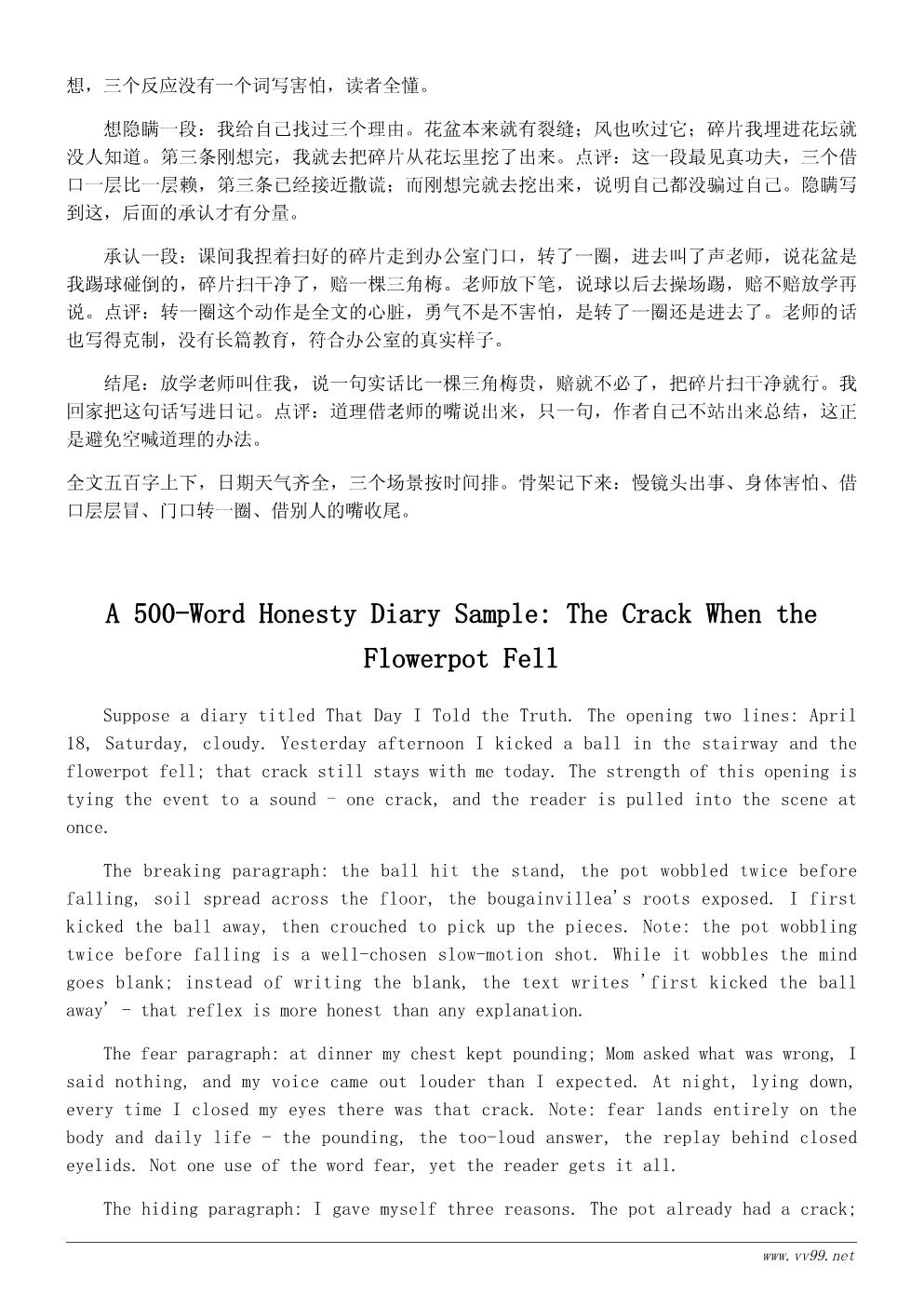
想隐瞒一段:我给自己找过三个理由。花盆本来就有裂缝;风也吹过它;碎片我埋进花坛就没人知道。第三条刚想完,我就去把碎片从花坛里挖了出来。点评:这一段最见真功夫,三个借口一层比一层赖,第三条已经接近撒谎;而刚想完就去挖出来,说明自己都没骗过自己。隐瞒写到这,后面的承认才有分量。
承认一段:课间我捏着扫好的碎片走到办公室门口,转了一圈,进去叫了声老师,说花盆是我踢球碰倒的,碎片扫干净了,赔一棵三角梅。老师放下笔,说球以后去操场踢,赔不赔放学再说。点评:转一圈这个动作是全文的心脏,勇气不是不害怕,是转了一圈还是进去了。老师的话也写得克制,没有长篇教育,符合办公室的真实样子。
结尾:放学老师叫住我,说一句实话比一棵三角梅贵,赔就不必了,把碎片扫干净就行。我回家把这句话写进日记。点评:道理借老师的嘴说出来,只一句,作者自己不站出来总结,这正是避免空喊道理的办法。
全文五百字上下,日期天气齐全,三个场景按时间排。骨架记下来:慢镜头出事、身体害怕、借口层层冒、门口转一圈、借别人的嘴收尾。
A 500-Word Honesty Diary Sample: The Crack When the Flowerpot Fell
Suppose a diary titled That Day I Told the Truth. The opening two lines: April 18, Saturday, cloudy. Yesterday afternoon I kicked a ball in the stairway and the flowerpot fell; that crack still stays with me today. The strength of this opening is tying the event to a sound - one crack, and the reader is pulled into the scene at once.
The breaking paragraph: the ball hit the stand, the pot wobbled twice before falling, soil spread across the floor, the bougainvillea's roots exposed. I first kicked the ball away, then crouched to pick up the pieces. Note: the pot wobbling twice before falling is a well-chosen slow-motion shot. While it wobbles the mind goes blank; instead of writing the blank, the text writes 'first kicked the ball away' - that reflex is more honest than any explanation.
The fear paragraph: at dinner my chest kept pounding; Mom asked what was wrong, I said nothing, and my voice came out louder than I expected. At night, lying down, every time I closed my eyes there was that crack. Note: fear lands entirely on the body and daily life - the pounding, the too-loud answer, the replay behind closed eyelids. Not one use of the word fear, yet the reader gets it all.
The hiding paragraph: I gave myself three reasons. The pot already had a crack; the wind had blown against it too; if I buried the pieces in the flower bed nobody would know. The moment the third one finished forming, I went and dug the pieces back out of the bed. Note: this paragraph shows real craft. The three excuses escalate, the third one close to lying; and digging the pieces right back out proves the child never fooled himself. Only when hiding is written this well does the later confession carry weight.
The confession paragraph: at break I carried the swept pieces to the office door, paced once around, went in, said 'teacher', and said I knocked the pot over with the ball, the pieces were swept clean, and I would pay for a new bougainvillea. The teacher put down the pen and said: ball goes to the playground from now on, payment we will talk about after school. Note: the pacing is the heart of the whole piece - courage is not being unafraid, it is pacing once and still walking in. The teacher's words stay restrained, no long lecture, true to how offices actually sound.
The ending: after school the teacher called me back and said one honest sentence is worth more than a bougainvillea, no payment needed, just sweep the pieces clean. I went home and wrote that sentence into the diary. Note: the moral comes out of someone else's mouth, just one line, while the author refuses to step forward and summarize - that is exactly how to avoid shouting empty principles.
The text runs around five hundred words, date and weather complete, three scenes in time order. Remember the skeleton: slow-motion accident, bodily fear, excuses stacking up, one lap at the door, and someone else's words as the close.
小提示:上面此文档内容仅展示完整文档里的部分内容, 若需要下载完整文档请 点击免费下载完整文档 。