文章内容
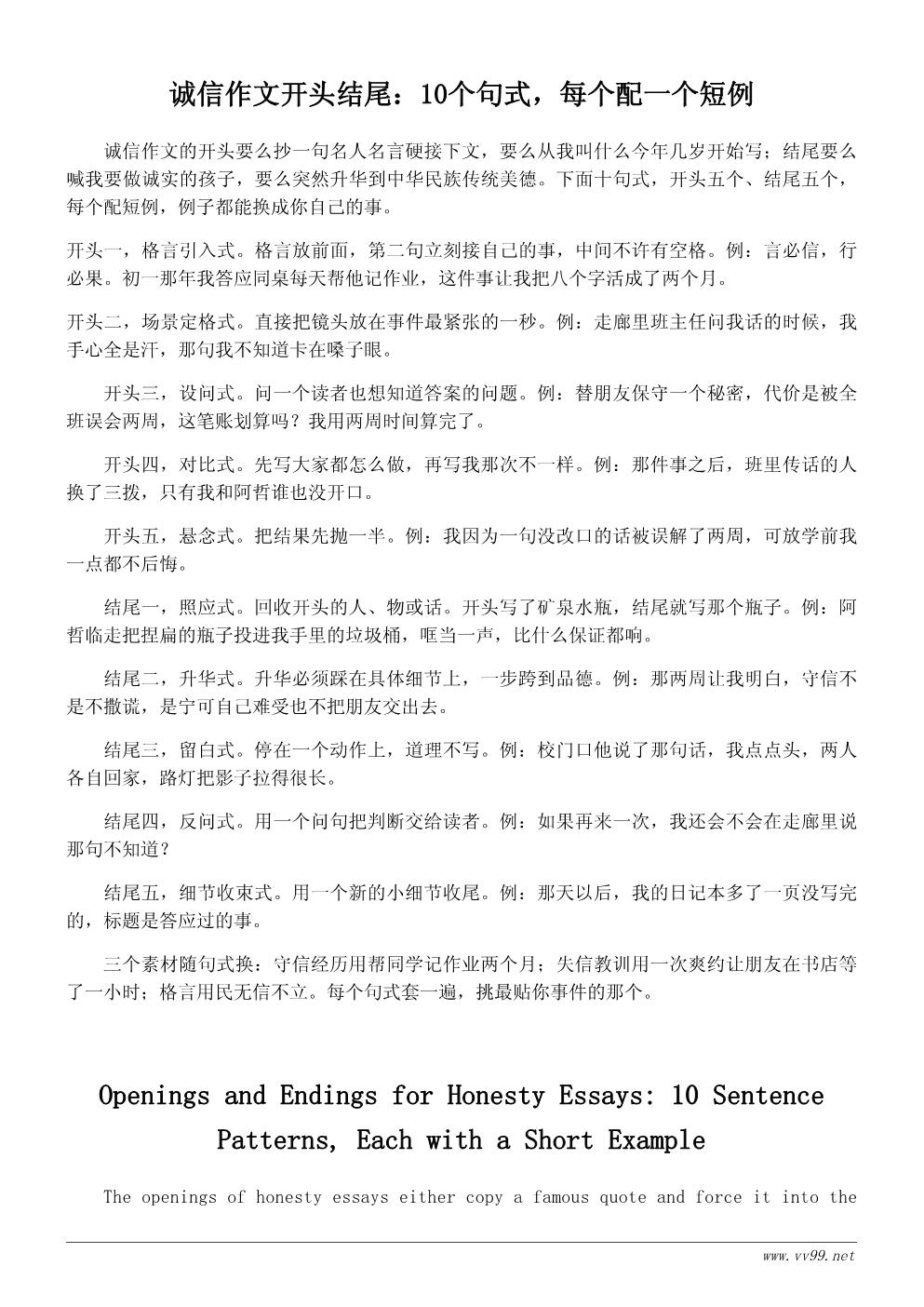
诚信作文开头结尾:10个句式,每个配一个短例
诚信作文的开头要么抄一句名人名言硬接下文,要么从我叫什么今年几岁开始写;结尾要么喊我要做诚实的孩子,要么突然升华到中华民族传统美德。下面十句式,开头五个、结尾五个,每个配短例,例子都能换成你自己的事。
开头一,格言引入式。格言放前面,第二句立刻接自己的事,中间不许有空格。例:言必信,行必果。初一那年我答应同桌每天帮他记作业,这件事让我把八个字活成了两个月。
开头二,场景定格式。直接把镜头放在事件最紧张的一秒。例:走廊里班主任问我话的时候,我手心全是汗,那句我不知道卡在嗓子眼。
开头三,设问式。问一个读者也想知道答案的问题。例:替朋友保守一个秘密,代价是被全班误会两周,这笔账划算吗?我用两周时间算完了。
开头四,对比式。先写大家都怎么做,再写我那次不一样。例:那件事之后,班里传话的人换了三拨,只有我和阿哲谁也没开口。
开头五,悬念式。把结果先抛一半。例:我因为一句没改口的话被误解了两周,可放学前我一点都不后悔。
结尾一,照应式。回收开头的人、物或话。开头写了矿泉水瓶,结尾就写那个瓶子。例:阿哲临走把捏扁的瓶子投进我手里的垃圾桶,哐当一声,比什么保证都响。
结尾二,升华式。升华必须踩在具体细节上,一步跨到品德。例:那两周让我明白,守信不是不撒谎,是宁可自己难受也不把朋友交出去。
结尾三,留白式。停在一个动作上,道理不写。例:校门口他说了那句话,我点点头,两人各自回家,路灯把影子拉得很长。
结尾四,反问式。用一个问句把判断交给读者。例:如果再来一次,我还会不会在走廊里说那句不知道?
结尾五,细节收束式。用一个新的小细节收尾。例:那天以后,我的日记本多了一页没写完的,标题是答应过的事。
三个素材随句式换:守信经历用帮同学记作业两个月;失信教训用一次爽约让朋友在书店等了一小时;格言用民无信不立。每个句式套一遍,挑最贴你事件的那个。
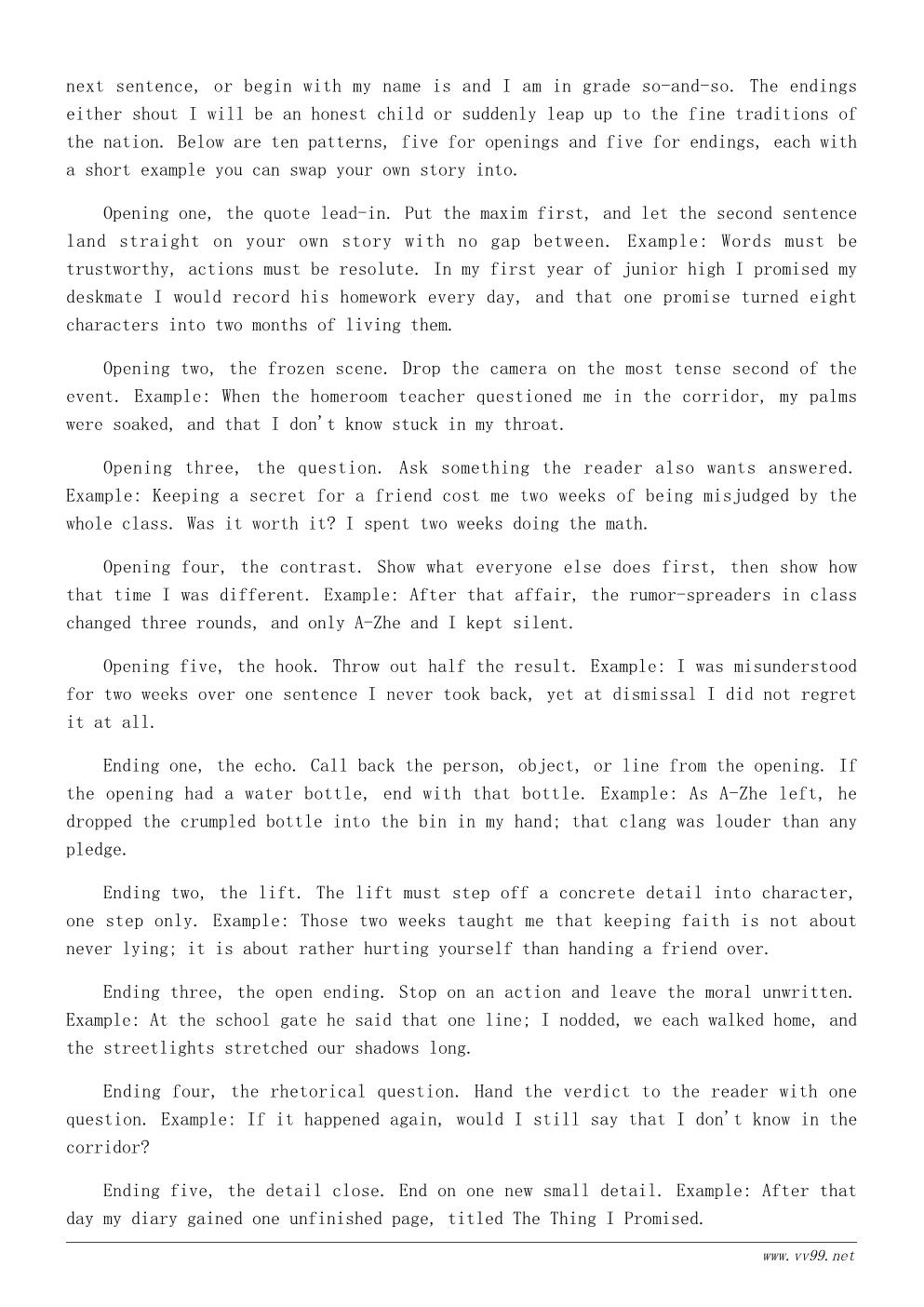
Openings and Endings for Honesty Essays: 10 Sentence Patterns, Each with a Short Example
The openings of honesty essays either copy a famous quote and force it into the next sentence, or begin with my name is and I am in grade so-and-so. The endings either shout I will be an honest child or suddenly leap up to the fine traditions of the nation. Below are ten patterns, five for openings and five for endings, each with a short example you can swap your own story into.
Opening one, the quote lead-in. Put the maxim first, and let the second sentence land straight on your own story with no gap between. Example: Words must be trustworthy, actions must be resolute. In my first year of junior high I promised my deskmate I would record his homework every day, and that one promise turned eight characters into two months of living them.
Opening two, the frozen scene. Drop the camera on the most tense second of the event. Example: When the homeroom teacher questioned me in the corridor, my palms were soaked, and that I don't know stuck in my throat.
Opening three, the question. Ask something the reader also wants answered. Example: Keeping a secret for a friend cost me two weeks of being misjudged by the whole class. Was it worth it? I spent two weeks doing the math.
Opening four, the contrast. Show what everyone else does first, then show how that time I was different. Example: After that affair, the rumor-spreaders in class changed three rounds, and only A-Zhe and I kept silent.
Opening five, the hook. Throw out half the result. Example: I was misunderstood for two weeks over one sentence I never took back, yet at dismissal I did not regret it at all.
Ending one, the echo. Call back the person, object, or line from the opening. If the opening had a water bottle, end with that bottle. Example: As A-Zhe left, he dropped the crumpled bottle into the bin in my hand; that clang was louder than any pledge.
Ending two, the lift. The lift must step off a concrete detail into character, one step only. Example: Those two weeks taught me that keeping faith is not about never lying; it is about rather hurting yourself than handing a friend over.
Ending three, the open ending. Stop on an action and leave the moral unwritten. Example: At the school gate he said that one line; I nodded, we each walked home, and the streetlights stretched our shadows long.
Ending four, the rhetorical question. Hand the verdict to the reader with one question. Example: If it happened again, would I still say that I don't know in the corridor?
Ending five, the detail close. End on one new small detail. Example: After that day my diary gained one unfinished page, titled The Thing I Promised.
Three materials rotate through the patterns: a kept-promise story about recording a classmate's homework for two months; a broken-promise lesson about standing a friend up for an hour at a bookstore; the maxim a people without trust cannot stand. Run every pattern once, then keep the one closest to your event.
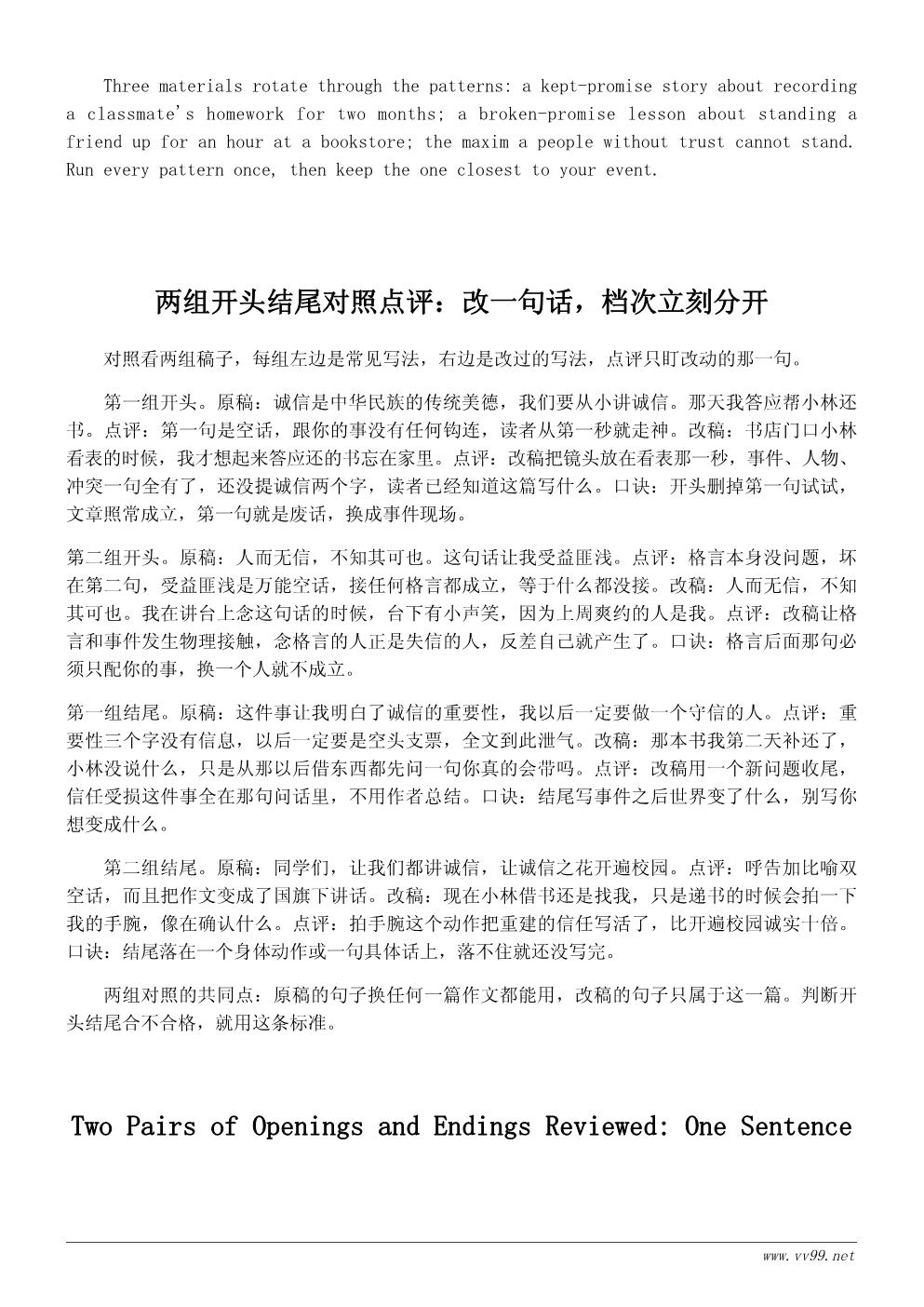
两组开头结尾对照点评:改一句话,档次立刻分开
对照看两组稿子,每组左边是常见写法,右边是改过的写法,点评只盯改动的那一句。
第一组开头。原稿:诚信是中华民族的传统美德,我们要从小讲诚信。那天我答应帮小林还书。点评:第一句是空话,跟你的事没有任何钩连,读者从第一秒就走神。改稿:书店门口小林看表的时候,我才想起来答应还的书忘在家里。点评:改稿把镜头放在看表那一秒,事件、人物、冲突一句全有了,还没提诚信两个字,读者已经知道这篇写什么。口诀:开头删掉第一句试试,文章照常成立,第一句就是废话,换成事件现场。
第二组开头。原稿:人而无信,不知其可也。这句话让我受益匪浅。点评:格言本身没问题,坏在第二句,受益匪浅是万能空话,接任何格言都成立,等于什么都没接。改稿:人而无信,不知其可也。我在讲台上念这句话的时候,台下有小声笑,因为上周爽约的人是我。点评:改稿让格言和事件发生物理接触,念格言的人正是失信的人,反差自己就产生了。口诀:格言后面那句必须只配你的事,换一个人就不成立。
第一组结尾。原稿:这件事让我明白了诚信的重要性,我以后一定要做一个守信的人。点评:重要性三个字没有信息,以后一定要是空头支票,全文到此泄气。改稿:那本书我第二天补还了,小林没说什么,只是从那以后借东西都先问一句你真的会带吗。点评:改稿用一个新问题收尾,信任受损这件事全在那句问话里,不用作者总结。口诀:结尾写事件之后世界变了什么,别写你想变成什么。
第二组结尾。原稿:同学们,让我们都讲诚信,让诚信之花开遍校园。点评:呼告加比喻双空话,而且把作文变成了国旗下讲话。改稿:现在小林借书还是找我,只是递书的时候会拍一下我的手腕,像在确认什么。点评:拍手腕这个动作把重建的信任写活了,比开遍校园诚实十倍。口诀:结尾落在一个身体动作或一句具体话上,落不住就还没写完。
两组对照的共同点:原稿的句子换任何一篇作文都能用,改稿的句子只属于这一篇。判断开头结尾合不合格,就用这条标准。
Two Pairs of Openings and Endings Reviewed: One Sentence Changed, a World of Difference
Compare two pairs of drafts. On the left is the common version; on the right is the revised one. The review looks only at the sentence that changed.
Pair one, opening. Original: Honesty is a fine tradition of the Chinese nation, and we should be honest from a young age. That day I promised to help Xiao Lin return a book. Review: the first sentence is empty talk with no hook to your story; readers check out from second one. Revised: At the bookstore door, watching Xiao Lin check his watch, I remembered that the book I promised to return was forgotten at home. Review: the revision puts the camera on the glance at the watch; event, character, and conflict all arrive in one sentence, and although the word honesty never appears, the reader already knows what this essay is about. Rule of thumb: try deleting your first sentence. If the essay still works, the first sentence was filler; replace it with the scene itself.
Pair two, opening. Original: A person without trust cannot stand; this saying benefited me greatly. Review: the maxim itself is fine; the flaw is the second sentence. Benefited me greatly is universal empty talk that fits any maxim, which means it connects to nothing. Revised: A person without trust cannot stand. When I read that line aloud at the podium, some snickering came from the seats, because the person who broke a promise last week was me. Review: the revision makes the maxim and the event touch physically; the one reading the maxim is the one who broke faith, and the contrast generates itself. Rule of thumb: the sentence after a maxim must fit only your story; if it would still work for someone else, rewrite it.
Pair one, ending. Original: This matter taught me the importance of honesty, and from now on I will surely be a trustworthy person. Review: the importance of honesty carries no information, and from now on I will is a bounced check; the whole essay deflates here. Revised: I returned the book the next day. Xiao Lin said nothing, but from then on, whenever he borrowed something he first asked one question: will you really bring it? Review: the revision ends on a new question; all the damage to trust lives inside that question, with no summary needed from the author. Rule of thumb: in the ending, write what changed in the world after the event, not what you promise to become.
Pair two, ending. Original: Classmates, let us all be honest and let the flower of honesty bloom across campus. Review: an appeal plus a metaphor, doubly empty, and it turns the essay into a flag-raising speech. Revised: Xiao Lin still borrows books from me, but now when he hands one over he taps my wrist once, as if confirming something. Review: the tap on the wrist brings rebuilt trust to life, ten times more honest than blooming across campus. Rule of thumb: land the ending on one physical gesture or one concrete line of speech; if you cannot land it, you are not finished writing.
What the two pairs share: every original sentence could be pasted into any essay, while every revised sentence belongs only to this one. Use that as your test for whether an opening or ending passes.
小提示:上面此文档内容仅展示完整文档里的部分内容, 若需要下载完整文档请 点击免费下载完整文档 。