文章内容
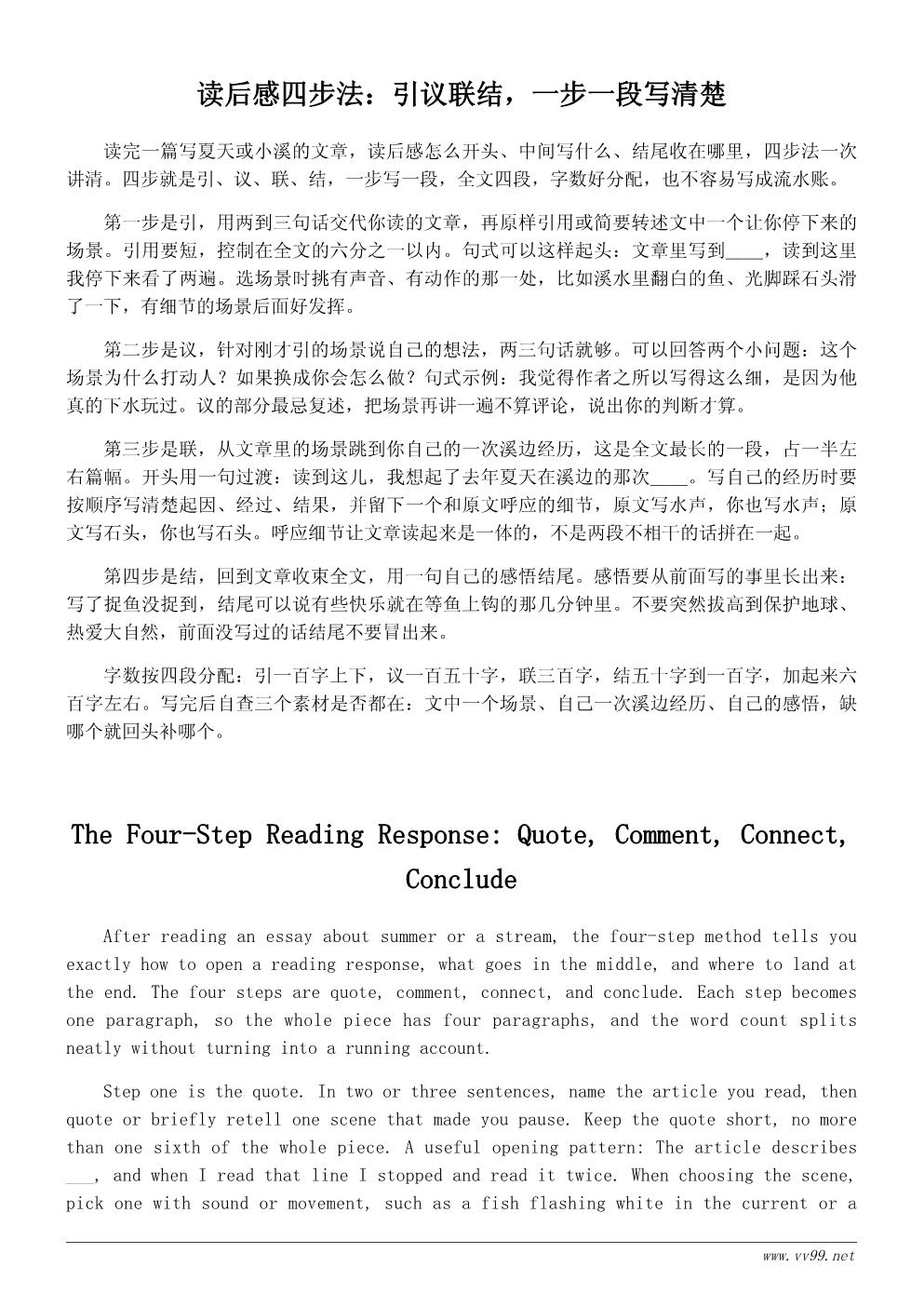
读后感四步法:引议联结,一步一段写清楚
读完一篇写夏天或小溪的文章,读后感怎么开头、中间写什么、结尾收在哪里,四步法一次讲清。四步就是引、议、联、结,一步写一段,全文四段,字数好分配,也不容易写成流水账。
第一步是引,用两到三句话交代你读的文章,再原样引用或简要转述文中一个让你停下来的场景。引用要短,控制在全文的六分之一以内。句式可以这样起头:文章里写到__,读到这里我停下来看了两遍。选场景时挑有声音、有动作的那一处,比如溪水里翻白的鱼、光脚踩石头滑了一下,有细节的场景后面好发挥。
第二步是议,针对刚才引的场景说自己的想法,两三句话就够。可以回答两个小问题:这个场景为什么打动人?如果换成你会怎么做?句式示例:我觉得作者之所以写得这么细,是因为他真的下水玩过。议的部分最忌复述,把场景再讲一遍不算评论,说出你的判断才算。
第三步是联,从文章里的场景跳到你自己的一次溪边经历,这是全文最长的一段,占一半左右篇幅。开头用一句过渡:读到这儿,我想起了去年夏天在溪边的那次__。写自己的经历时要按顺序写清楚起因、经过、结果,并留下一个和原文呼应的细节,原文写水声,你也写水声;原文写石头,你也写石头。呼应细节让文章读起来是一体的,不是两段不相干的话拼在一起。
第四步是结,回到文章收束全文,用一句自己的感悟结尾。感悟要从前面写的事里长出来:写了捉鱼没捉到,结尾可以说有些快乐就在等鱼上钩的那几分钟里。不要突然拔高到保护地球、热爱大自然,前面没写过的话结尾不要冒出来。
字数按四段分配:引一百字上下,议一百五十字,联三百字,结五十字到一百字,加起来六百字左右。写完后自查三个素材是否都在:文中一个场景、自己一次溪边经历、自己的感悟,缺哪个就回头补哪个。
The Four-Step Reading Response: Quote, Comment, Connect, Conclude
After reading an essay about summer or a stream, the four-step method tells you exactly how to open a reading response, what goes in the middle, and where to land at the end. The four steps are quote, comment, connect, and conclude. Each step becomes one paragraph, so the whole piece has four paragraphs, and the word count splits neatly without turning into a running account.
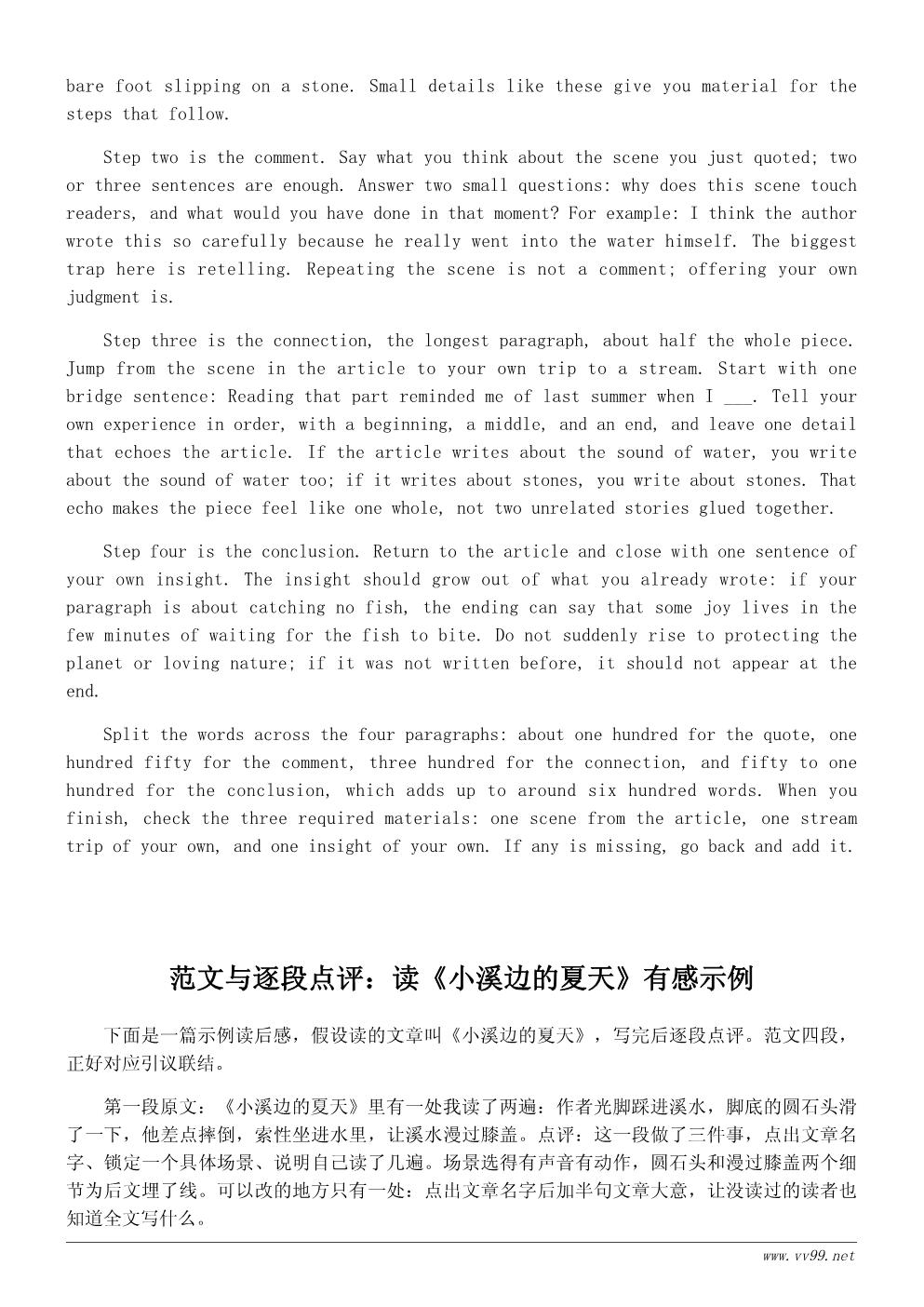
Step one is the quote. In two or three sentences, name the article you read, then quote or briefly retell one scene that made you pause. Keep the quote short, no more than one sixth of the whole piece. A useful opening pattern: The article describes ___, and when I read that line I stopped and read it twice. When choosing the scene, pick one with sound or movement, such as a fish flashing white in the current or a bare foot slipping on a stone. Small details like these give you material for the steps that follow.
Step two is the comment. Say what you think about the scene you just quoted; two or three sentences are enough. Answer two small questions: why does this scene touch readers, and what would you have done in that moment? For example: I think the author wrote this so carefully because he really went into the water himself. The biggest trap here is retelling. Repeating the scene is not a comment; offering your own judgment is.
Step three is the connection, the longest paragraph, about half the whole piece. Jump from the scene in the article to your own trip to a stream. Start with one bridge sentence: Reading that part reminded me of last summer when I ___. Tell your own experience in order, with a beginning, a middle, and an end, and leave one detail that echoes the article. If the article writes about the sound of water, you write about the sound of water too; if it writes about stones, you write about stones. That echo makes the piece feel like one whole, not two unrelated stories glued together.
Step four is the conclusion. Return to the article and close with one sentence of your own insight. The insight should grow out of what you already wrote: if your paragraph is about catching no fish, the ending can say that some joy lives in the few minutes of waiting for the fish to bite. Do not suddenly rise to protecting the planet or loving nature; if it was not written before, it should not appear at the end.
Split the words across the four paragraphs: about one hundred for the quote, one hundred fifty for the comment, three hundred for the connection, and fifty to one hundred for the conclusion, which adds up to around six hundred words. When you finish, check the three required materials: one scene from the article, one stream trip of your own, and one insight of your own. If any is missing, go back and add it.
范文与逐段点评:读《小溪边的夏天》有感示例
下面是一篇示例读后感,假设读的文章叫《小溪边的夏天》,写完后逐段点评。范文四段,正好对应引议联结。
第一段原文:《小溪边的夏天》里有一处我读了两遍:作者光脚踩进溪水,脚底的圆石头滑了一下,他差点摔倒,索性坐进水里,让溪水漫过膝盖。点评:这一段做了三件事,点出文章名字、锁定一个具体场景、说明自己读了几遍。场景选得有声音有动作,圆石头和漫过膝盖两个细节为后文埋了线。可以改的地方只有一处:点出文章名字后加半句文章大意,让没读过的读者也知道全文写什么。
第二段原文:作者敢坐进水里,是因为他不怕别人看见自己狼狈。我们写作文常常只写溪边真美,却不敢写自己滑倒、鞋掉进水里的样子,所以读起来像明信片,不像真事。点评:这一段是议,它没有复述场景,而是给出了判断:文章好在敢写狼狈。判断还顺手连到了写作文这件事上,议论有了延伸。注意它只说了一个观点,没有同时铺开三个,一段一个观点,议得透。
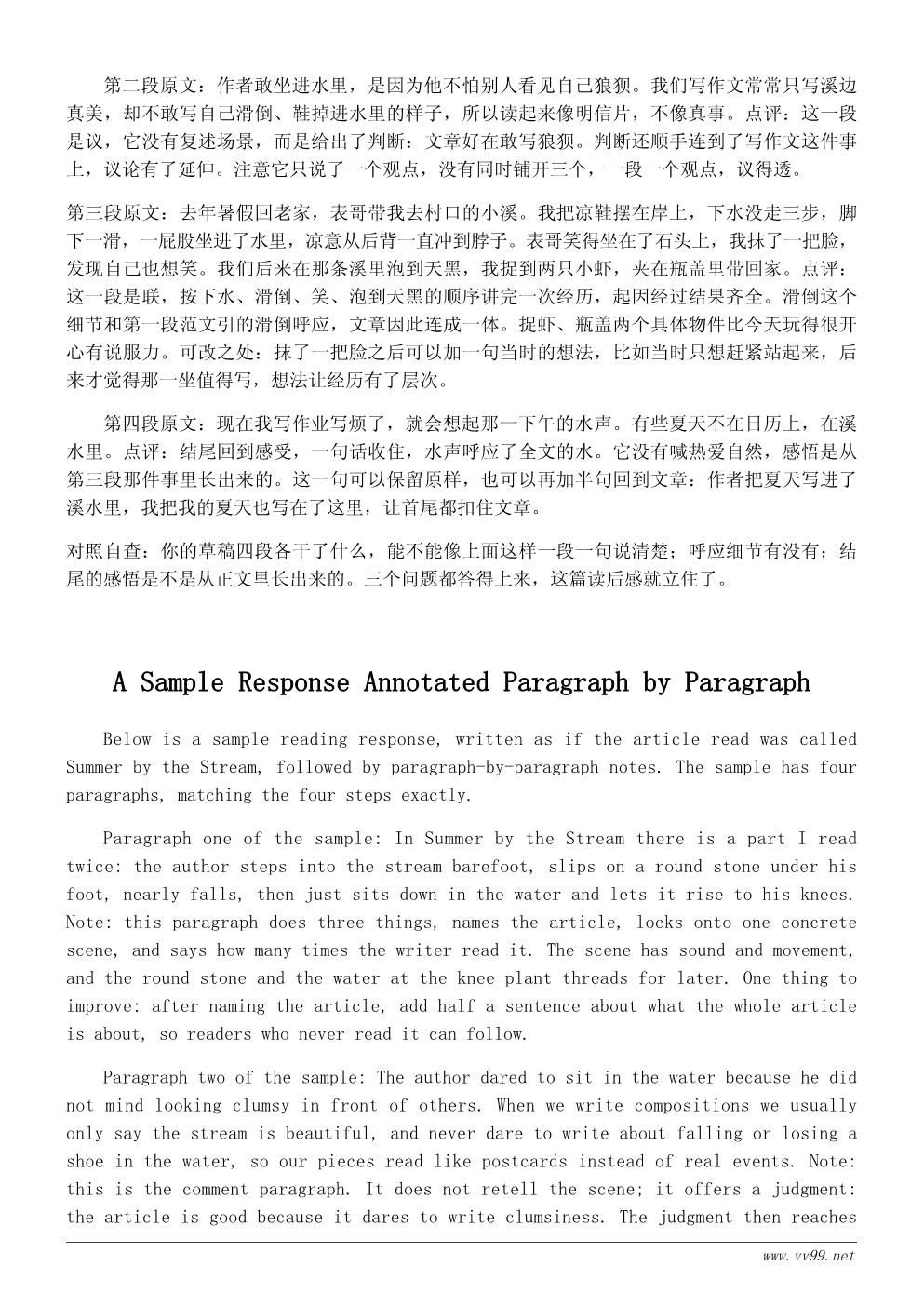
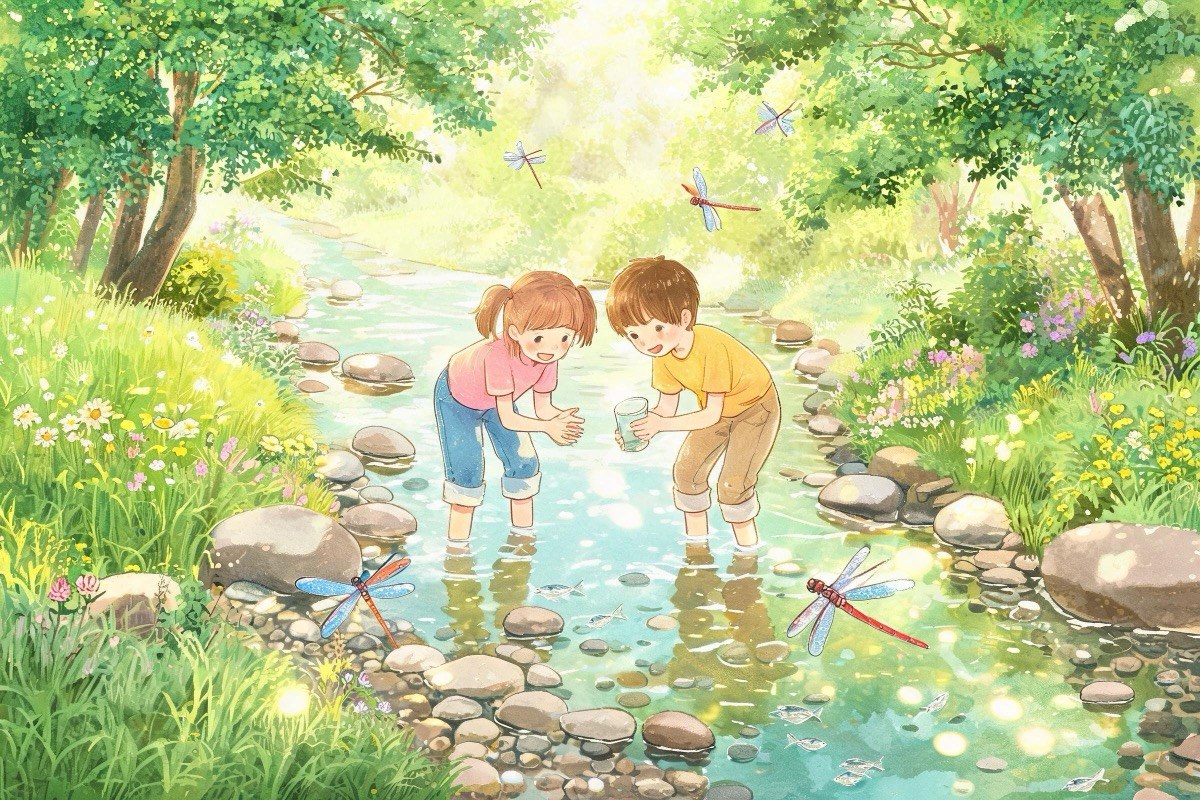
第三段原文:去年暑假回老家,表哥带我去村口的小溪。我把凉鞋摆在岸上,下水没走三步,脚下一滑,一屁股坐进了水里,凉意从后背一直冲到脖子。表哥笑得坐在了石头上,我抹了一把脸,发现自己也想笑。我们后来在那条溪里泡到天黑,我捉到两只小虾,夹在瓶盖里带回家。点评:这一段是联,按下水、滑倒、笑、泡到天黑的顺序讲完一次经历,起因经过结果齐全。滑倒这个细节和第一段范文引的滑倒呼应,文章因此连成一体。捉虾、瓶盖两个具体物件比今天玩得很开心有说服力。可改之处:抹了一把脸之后可以加一句当时的想法,比如当时只想赶紧站起来,后来才觉得那一坐值得写,想法让经历有了层次。
第四段原文:现在我写作业写烦了,就会想起那一下午的水声。有些夏天不在日历上,在溪水里。点评:结尾回到感受,一句话收住,水声呼应了全文的水。它没有喊热爱自然,感悟是从第三段那件事里长出来的。这一句可以保留原样,也可以再加半句回到文章:作者把夏天写进了溪水里,我把我的夏天也写在了这里,让首尾都扣住文章。
对照自查:你的草稿四段各干了什么,能不能像上面这样一段一句说清楚;呼应细节有没有;结尾的感悟是不是从正文里长出来的。三个问题都答得上来,这篇读后感就立住了。
A Sample Response Annotated Paragraph by Paragraph
Below is a sample reading response, written as if the article read was called Summer by the Stream, followed by paragraph-by-paragraph notes. The sample has four paragraphs, matching the four steps exactly.
Paragraph one of the sample: In Summer by the Stream there is a part I read twice: the author steps into the stream barefoot, slips on a round stone under his foot, nearly falls, then just sits down in the water and lets it rise to his knees. Note: this paragraph does three things, names the article, locks onto one concrete scene, and says how many times the writer read it. The scene has sound and movement, and the round stone and the water at the knee plant threads for later. One thing to improve: after naming the article, add half a sentence about what the whole article is about, so readers who never read it can follow.
Paragraph two of the sample: The author dared to sit in the water because he did not mind looking clumsy in front of others. When we write compositions we usually only say the stream is beautiful, and never dare to write about falling or losing a shoe in the water, so our pieces read like postcards instead of real events. Note: this is the comment paragraph. It does not retell the scene; it offers a judgment: the article is good because it dares to write clumsiness. The judgment then reaches over into composition writing, which gives the comment some range. Notice it holds to one single point instead of spreading three at once; one point per paragraph, argued through.
Paragraph three of the sample: Last summer I went back to my grandparents village, and my cousin took me to the stream at the village edge. I left my sandals on the bank, and three steps into the water my foot slid and I landed hard in the stream, cold rushing from my back up to my neck. My cousin laughed so hard he sat down on a stone, and I wiped my face and realized I wanted to laugh too. We soaked in that stream until dark, and I caught two small shrimp and carried them home in a bottle cap. Note: this is the connection paragraph. It follows the order of getting in, slipping, laughing, and staying until dark, so the event has a beginning, a middle, and an end. The slip echoes the slip quoted in paragraph one, which ties the piece together. The shrimp and the bottle cap beat any sentence that says we had a great time. One improvement: after wiping the face, add one line of thought, such as I only wanted to stand up fast then, and only later understood that the fall was worth writing about; the thought adds a layer to the event.
Paragraph four of the sample: Now whenever homework bores me, I hear that afternoon of water sounds again. Some summers are not on the calendar; they are in the stream. Note: the ending returns to feeling and closes in one sentence, and the water sound ties back to the water running through the piece. It does not shout about loving nature; the insight grew out of paragraph three. This sentence can stay as it is, or add half a sentence returning to the article: the author put his summer into the stream, and I have put mine here too, so both ends hold the article.
Use the notes to check your own draft: can you say, one line per paragraph, what each of your four paragraphs does; is there an echoing detail; does your closing insight grow out of your own body text. If you can answer all three questions, your response stands.
小提示:上面此文档内容仅展示完整文档里的部分内容, 若需要下载完整文档请 点击免费下载完整文档 。