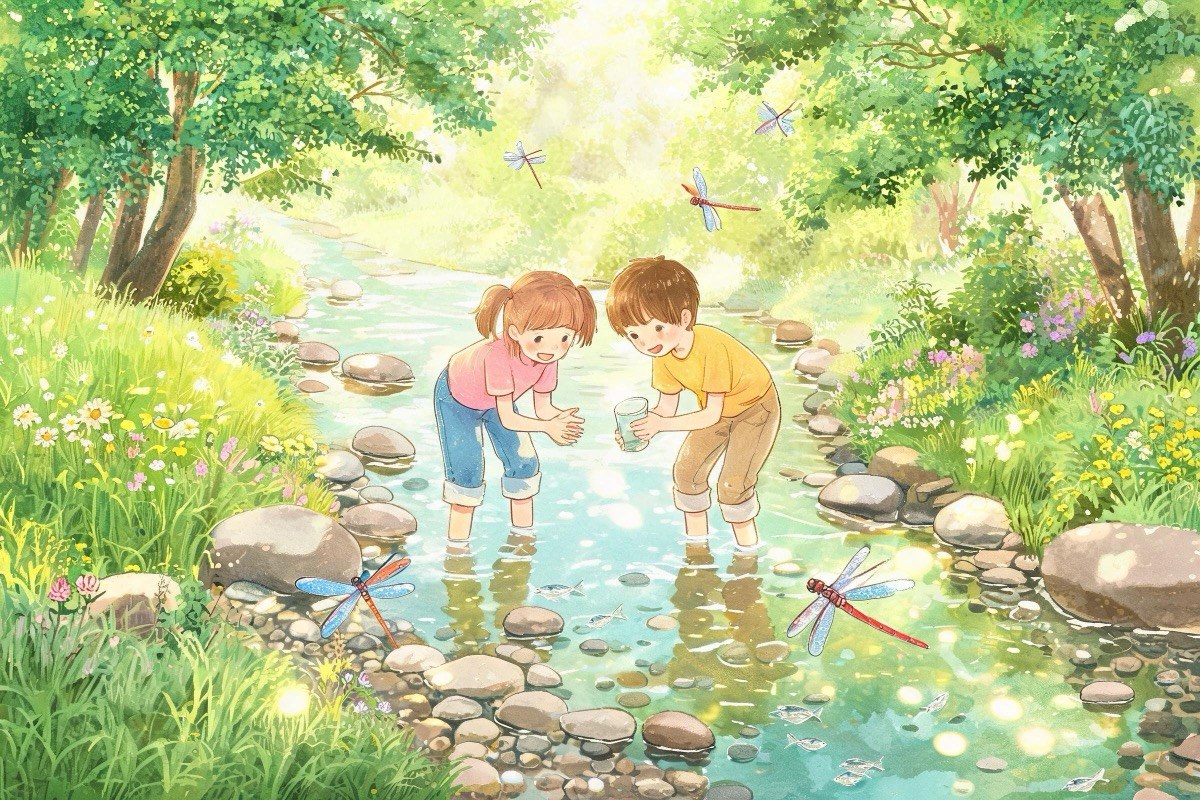
文章内容
写溪水的词语分四类记:水、光、声、人,每类配运用例句
第一类写水。清澈见底、清亮、冰凉、浅浅、汩汩、湍急、浑浊。记的时候别孤立地记清澈见底这四个字,要连着它的主语记:溪水清澈见底,水底的鹅卵石一颗一颗数得清。运用示范:那条溪不深,水清澈见底,脚踩下去,石头滑溜溜的,脚趾头都能看见。注意示范里清澈见底后面马上接了一个看得见的证据,鹅卵石和脚趾头,好词才立得住。
第二类写光。波光粼粼、亮晶晶、晃眼、碎金、橘红、倒影。波光粼粼最常配夕阳下的溪面。运用示范:夕阳掉进水里,溪面波光粼粼,像谁撒了一把碎玻璃。这个示范把波光粼粼换成了碎玻璃的比喻,意思一样,但更像小孩说的话。摘抄本上可以两个都记:原词加自己的比喻,考试时比喻比成语新鲜。
第三类写声。叮咚、哗啦啦、汩汩、蝉鸣、扑通、叽叽喳喳。溪边的声音要分远近:近的叮咚是溪水,远的蝉鸣是树上。运用示范:叮咚声最近,蝉鸣隔着一层,扑通一声是我们跳下去了。一句话排了三个声音,远近高低各不同,比单独写溪水叮咚有层次。
第四类写人。欢声笑语、撒开脚丫、光着脊梁、湿淋淋、气喘吁吁、意犹未尽。欢声笑语是总结词,最容易滥用,要用就得给它装上具体内容。运用示范:溪那边传来欢声笑语,是我们几个人在打水仗,水花溅得比人高。示范里欢声笑语后面紧跟谁在笑、为什么笑,总结词立刻变成现场。
四类词语在作文里的位置也不同:写水的词放开头和写景段,写光的词放傍晚场景,写声的词放过渡和开头,写人的词放事件段结尾。每篇作文每类用两三个就够,四类十二个词塞进一篇就是堆砌。摘抄本按这四类分栏,比按字母顺序背好用十倍,因为作文本来就是按水光声人组织的。
Stream Vocabulary in Four Groups: Water, Light, Sound, People, Each with an Example
Group one describes water: crystal clear, glassy, icy cold, shallow, gurgling, rushing, muddy. Never memorize crystal clear alone; memorize it with its subject: the stream is crystal clear, every pebble on the bottom countable. Usage example: the creek was not deep, the water crystal clear; step in and the stones are slick, your toes visible through the water. Notice the example supplies visible proof right after the good phrase - pebbles, toes - that is what makes a fine phrase stand up.
Group two describes light: glittering, sparkling, dazzling, scattered gold, orange, reflection. Glittering pairs best with the sunset stream. Usage example: the sunset fell into the water, the surface glittering like someone scattering broken glass. The example trades the idiom for a child-sized simile; keep both in the notebook, idiom plus your own simile, because in an exam a fresh simile beats a stock idiom.
Group three describes sound: plip, splash, gurgle, cicada song, plop, chirping. Sort stream sounds by distance: near is the water, far is the cicadas. Usage example: the plip was nearest, the cicadas one layer away, then a plop as we jumped in. One sentence arranges three sounds at different distances and heights - richer than stream plus plip alone.
Group four describes people: laughter everywhere, running barefoot, bare backs, dripping wet, out of breath, reluctant to leave. Laughter everywhere is a summary phrase and the most abused; if used, bolt concrete content onto it. Usage example: laughter came from beyond the bend - the four of us in a water fight, splashes higher than our heads. The example answers who laughs and why, turning a summary word back into a scene.
The four groups live in different places in an essay: water words in the opening and scenery paragraphs, light words in evening scenes, sound words in transitions and openings, people words at the ends of event paragraphs. Two or three per group per essay is enough; twelve idioms in one piece is piling. Divide the notebook into these four columns - ten times more useful than alphabetical order, because essays are already built from water, light, sound, and people.
好句摘抄十句与仿写示范:句子怎么化进作文
第一句:溪水清澈见底,连水底最细小的沙粒都睡得安稳。仿写方法换主语加换动词:河水清得能数清阿婆洗的青菜有几根黄叶。原句写沙粒睡觉,仿句写数青菜,都靠具体东西撑住清这个字。
第二句:阳光落在溪面上,碎成一把一把的金子。仿写:午后的太阳照进水洼,亮得不敢睁眼,蹲下摸一把,水是烫的。原句是看,仿句加了摸,好句仿写最忌只换名词不换感官。
第三句:溪面波光粼粼,像一匹抖动的银绸子。仿写:傍晚的溪面一闪一闪,像有人在水底下晃手电筒。银绸子是大人见过的东西,手电筒是小孩见过的东西,仿写要换成自己真见过的喻体。
第四句:蝉在树上把夏天叫得好长好长。仿写:蝉鸣一阵接一阵,吵得午睡都睡不着,翻个身,蝉还在吵。把蝉鸣从景变成事,它就有了作用,把午睡段也带出来了。
第五句:夕阳把我们的影子拉得比溪还长。仿写:太阳落山前,五个影子排成一排,从这岸够到那岸。原句一个影子,仿句五个影子排队,够这个动词是小孩玩过的把戏。
第六句:欢声笑语顺着水漂过来,比溪水还凉快。仿写:对岸的笑声飘过来,我们抬头看一眼,继续打水仗。原句把笑声比凉快,仿句不比喻了,用抬头看一眼这个动作写笑声的存在,两种路数都要会。
第七句:石头被水摸了一百年,摸得圆圆润润。仿写:那块大石头被我们坐滑了,坐得比溪里的石头还亮。水摸石头是拟人,人坐石头是事实,仿写时拟人和事实可以互换。
第八句:草席铺在樟树下,蝉声把午后缝得严严实实。仿写:树荫底下一躺,蝉声、水声、心跳声挤在一起,人就沉下去了。缝这个动词好,仿句换成挤,动词自己得换一个,不能照搬。
第九句:我们湿淋淋地回家,影子先我们一步进了村。仿写:裤脚滴着水一路走,水点在地上画虚线,画到家门口。影子先进村是诗,水点画虚线是小孩看得见的东西。
第十句:多年以后我才明白,那条溪一直在流,流进我够不着的地方。仿写:去年路过,溪还在,我在溪边站了十秒,上班要迟到了。原句抒情,仿句用十秒和迟到把怀念压进日程里,高年级可以用,中年级建议停在第九句那种画面句。
Ten Collected Sentences with Imitation Models: How to Work Them into an Essay
Sentence 1: the stream is so clear that even the finest grains of sand sleep peacefully on the bottom. Imitation, swap subject and verb: the river was clear enough to count which of grandmother greens had yellow leaves. The original lets sand sleeping prove clarity; the imitation lets counting greens do it - both stand on concrete things.
Sentence 2: sunlight lands on the water and shatters into handfuls of gold. Imitation: afternoon sun in a puddle, too bright to stare; scoop a handful and the water is hot. The original is sight; the imitation adds touch. When imitating, never swap nouns only - swap the sense too.
Sentence 3: the stream glittered like a shaking bolt of silver silk. Imitation: at dusk the water flickered, like someone waving a flashlight under it. Silk is what adults have seen; flashlights are what kids have seen. Use the tenor you have actually met.
Sentence 4: cicadas on the tree dragged the summer out long, long. Imitation: cicada after cicada, too noisy to nap; I turn over, still noisy. The sound becomes an event with a job, and it carries the nap scene with it.
Sentence 5: the setting sun stretched our shadows longer than the stream. Imitation: before sunset five shadows lined up, reaching from this bank to that one. One shadow becomes five filing; the verb reaching is a kid game.
Sentence 6: laughter drifted down the water, cooler than the stream. Imitation: laughter from the far bank floated over; we looked up once, then went on fighting with water. The original compares laughter to cool; the imitation just uses one look up to prove laughter exists. Learn both roads.
Sentence 7: the water has stroked the stones for a hundred years, round and smooth. Imitation: the big stone went slick from our sitting, shinier than the stones in the stream. Water stroking is personification; people sitting is fact - the two can trade places in imitation.
Sentence 8: the mat spread under the camphor tree, cicadas sewing the afternoon tight. Imitation: lie down in the shade, cicada sound, water sound, heartbeat crowding together, and the body sinks. Sew is a fine verb; the imitation must pick its own verb - crowd - never copy.
Sentence 9: we walked home dripping, our shadows entering the village a step ahead of us. Imitation: trouser hems dripping all the way, water dots drawing a dashed line on the ground, ending at our door. A shadow entering first is poetry; dots drawing dashes is what a child actually sees.
Sentence 10: only years later did I understand the stream kept flowing, into a place I could no longer reach. Imitation: passing by last year, the stream was still there; I stood ten seconds, late for work. The original lingers; the imitation presses nostalgia into a schedule. Upper grades may use it; middle grades should stop at image sentences like number nine.
小提示:上面此文档内容仅展示完整文档里的部分内容, 若需要下载完整文档请 点击免费下载完整文档 。